
Chapter 2:
Benefitting Canadians: A Canada for all
A rapidly changing world is leaving Canadian families and businesses under a cloud of uncertainty. In response, Canada's new government is focused on what we can control: building a stronger economy to make life more affordable for Canadians.
Skilled workers will be at the centre of this agenda. They have been the cornerstone of the Canadian economy, leading the way in building homes, roads, and bridges throughout our history, and we will once again need their support to build Canada's economic strength. That is why the government is taking action to strengthen and accelerate Canada's skilled trades training and apprenticeship system, mobilise talent earlier, support apprentices through training and in completing their programs, and ensure Canada has the workers it needs to build a secure and sovereign future.
Canadians are also feeling the pressures of everyday expenses right now. That's why the government is protecting the essential social programs that give Canadians a fair chance to get ahead—child care, dental care, and pharmacare.
The Spring Economic Update 2026 outlines our government's plan to bring down costs for Canadians and help them get ahead. We are supercharging the housing sector and strengthening competition—empowering Canadians with greater certainty, security, and prosperity, now and into the future.
New initiatives include:
- Launching Team Canada Strong to recruit, train, and hire 80,000 to 100,000 new Red Seal skilled trades workers by 2030-31, providing paid pathways for young Canadians into building housing, major infrastructure, and defence projects at speed and scale.
- Standing up the Financial Crimes Agency as a best-in-class Agency that will employ a "follow-the-money" approach to investigate serious and complex financial crimes, recover illicit proceeds, and hold criminals to account.
- Investments in the programs and services that ensure Canadians feel safe, supported, and able to fully participate in community life.
- Providing $755 million to expand access to sport, creating opportunities for Canadians to build meaningful relationships within their communities and make full use of existing and new infrastructure, and support Canada's world-class athletes.
- Providing nearly $1 billion to repair and maintain small craft harbours, essential infrastructure for coastal communities and commercial fishing.
- Making it easier to access the Disability Tax Credit by streamlining the application process for individuals with certain long-lasting medical conditions.
- Nearly $4.3 billion to empower healthy, thriving Indigenous communities.
We are providing a boost to Canadians who most need one, while creating a bridge to longer-term prosperity. As a result of recent actions the government has taken:
-
More than 12 million Canadians will receive hundreds of dollars more in their bank accounts through the new Canada Groceries and Essentials Benefit.
-
Canadians' bills at the gas station are expected to be reduced across Canada thanks to the temporary suspension of the federal fuel excise tax on gasoline and diesel, allowing them to save 10 cents per litre on regular gasoline and 4 cents on diesel.
-
Families with two children are saving $800 per year on groceries with the permanent National School Food Program.
-
22 million Canadians are getting a middle-class tax cut, and two-income families are keeping up to $840 per year in their pockets.
-
Canadians travelling on the Confederation Bridge now pay only $20 in tolls, down from $50, and those travelling by ferries in Atlantic Canada are paying 50 per cent less in fares.
2.1 Supporting Workers and Young People
Canadian workers, men and women alike, are building Canada strong, from major infrastructure projects to new housing across the country. The government is committed to supporting a flourishing labour market for all.
Young people, in particular, are facing real challenges as they try to build their career and get ahead. Many are balancing everyday costs with big life goals, like post-secondary education or saving for a first home. At the same time, finding that first good job is not always easy: youth unemployment sat at 13.8 per cent in March 2026, and many recent graduates are still struggling to get a foothold in the job market.
This is why the government is strengthening the Canada Student Financial Assistance Program, to make post-secondary education more accessible and help ease financial pressure on students and recent graduates.
The government is also expanding access to hands-on experience and on-the-job training so young people can build the skills they need to confidently enter the labour market. Budget 2025 announced that the government would support 175,000 young people in 2026-27 through employment and work-integrated learning opportunities delivered by Canada Summer Jobs, the horizontal Youth Employment and Skills Strategy, and the Student Work Placement Program.
Looking ahead, meeting Canada's housing, infrastructure, and defence needs will require a new generation of skilled trades workers. Team Canada Strong sets out an end‑to‑end approach to recruit, train, and hire 80,000 to 100,000 new Red Seal skilled trades workers by 2030-31, creating clear, paid pathways for young Canadians into good jobs while strengthening Canada's future workforce.
Team Canada Strong
Skilled workers have always been the cornerstone of the Canadian economy. Throughout our history, they have led the way in building homes, roads and bridges.
Build Canada Strong will deliver housing, major projects and defence readiness, built at speed and scale, right across the country. But lumber, steel and capital do not build projects on their own. Skilled workers do. Canada needs them now more than ever.
The Challenge
We need to move quickly to recruit and train the workers we need: retirements and economic growth mean that Canada will need more than 1.4 million additional trades workers by 2033, and the scale of investments in housing and infrastructure projects will add to this demand. The need is urgent, but long training processes and financial pressures on apprentices contribute to low rates of completion. In 2024, more than 100,000 new apprentices registered, but only about 34,000 completed their apprenticeship. If nothing changes, Canada will face a persistent gap of more than 20,000 skilled trades workers per year.
Too few young Canadians are entering the trades—missing out on well-paid jobs and long-term financial security. If we want them to benefit from the good jobs that the Build Canada agenda will deliver, we need a new approach.
Our goal is clear: create Team Canada Strong, which will give young Canadians a direct, paid pathway into the work of building Canada. We will take a multi-channel approach to recruit, train, and hire 80,000 to 100,000 new Red Seal trades workers aligned to Canada's housing, infrastructure, resource development, and defence needs by 2030-31.
Skilled workers are indispensable to the historic, nation-building investments we are making to secure Canada's future. We are making big investments in projects. We need to match that with big investments in the young workers who will get those projects done on time and set Canada up for success.
Our plan for a career in skilled trades

Step 1: Join the Team Canada Strong Program
- Start up to 4-month job placement to gain experience.

Step 2 : Register as an apprentice and begin on-the-job training with either an employer or a union training centre
- Small and medium enterprises receive $10K wage incentive.

Step 3: Complete your technical training at a college and through your employer or a union training centre
- Receive a $400 weekly Apprenticeship Grant.
- Receive income supports if caught between training and work.

Step 4: Get certified
- Once certified in a Red Seal trade, receive $5K Completion Bonus.

Step 5: Start career as a Red Seal tradesperson
- Contribute to the Build Canada agenda.
There will be new pathways to skilled trades through the Canadian Armed Forces
Hands-on training through Cadets and Junior Canadian Rangers
Fully funded trades training for young Canadians joining the Canadian Armed Forces Primary Reserve
One process: faster and simpler (50% reduction in total time)
We are taking a new approach
Many Canadians know first-hand the value of a career in the skilled trades. But getting their certification can be slow and challenging. Seats in popular programs can be in short supply. Employers do not always want to take a chance on a first-year apprentice. Navigating all the government programs and financial supports takes time and can be discouraging, and many apprentices find it hard to make ends meet while on training—especially when the cost of living has gone up.
Our plan for Team Canada Strong delivers:
-
End-to-end support: We will support young people every step of the way in recruitment, training and hiring. From their first interest in the skilled trades through apprenticeship and Red Seal certification, we will be alongside with the supports they need. Their success is Canada's success.
-
Faster results: The path to Red Seal certification will be faster and easier to navigate. We want young people to be ready for jobs as soon as possible—our goal is to see the path to certification cut by 50 per cent.
-
Scale: We will not get results from a patchwork of small-scale efforts. Canada needs a new level of ambition for apprentices. That is why we are ready to invest up to $6 billion over five years in Team Canada Strong.
-
A multi-channel approach: The training workers need can't be found all in one place. We will work closely with provinces and territories, Indigenous partners, employers, unions, and the Canadian Armed Forces to achieve rapid-scale, high-quality training and strong completion rates for apprenticeships.
Our plan will eliminate bottlenecks throughout a worker's journey:
Recruit
We need more Canadians who are ready to sign up for the work of building Canada, and we want them to take that first step as early as possible.
- The Spring Economic Update 2026 proposes to provide $2 billion over five years, starting in 2026-27, and $262 million ongoing, to increase the number of young people who are ready to take up the challenge of a good career in the skilled trades. Team Canada Strong will provide a simple and seamless way to learn about and enter into the trades and link up with employers.
Young people will start with paid, job ready placements that lead directly into registered apprenticeships—earning income, gaining experience, and contributing immediately to major housing, infrastructure, and defence projects. Small- and medium-sized businesses will also be supported when they hire new apprentices, saving them time and effort in the apprenticeship matching process.
- Team Canada Strong Program, providing youth aged 15-30 with paid, entry-level, trades-related work experience that leads into apprenticeship.
- Build Canada Apprenticeship Service, helping employers to hire, train, and retain apprentices by providing wage subsidies of up to $10,000 for their first-year salary, matching apprentices to job opportunities, and offering hands on navigation and support.
Train
We need training systems that are ready for a growing workforce, and that are set up to get that workforce job-ready as soon as possible.
- The Spring Economic Update 2026 proposes to provide up to $331 million over five years, starting in 2026-27, and $18 million ongoing to boost and modernise apprenticeship training for a faster journey to the Red Seal. We would expand and accelerate union-led and employer led training pathways.
- We also intend to work with provinces and territories to strengthen workforce and training systems.
This approach recognizes that no single pathway can deliver the required scale fast enough on its own.
To achieve this, we will invest in the following:
- Red Seal Program modernisation, reducing certification delays and improving national consistency, including by introducing online exams, digital logbooks, and secure credentials, and by creating a single national registered apprenticeship number.
- Union Training and Innovation Program (UTIP) expansion, enabling union-run training centres to upgrade facilities, expand capacity, and invest in modern equipment.
Hire
We want young Canadians to share the benefits of building Canada by qualifying for their first Red Seal job.
- The Spring Economic Update 2026 proposes to provide $3.4 billion over five years, starting in 2026-27, and $468 million ongoing to address the challenges that can stop apprentices from completing their training and moving into permanent jobs. We will also call on employers (particularly those who get major federal investments) to do their part in recruiting and retaining trades workers.
- Remove financial barriers during training—Apprenticeship Training Grant: Providing apprentices with a weekly income top up of $400 per week while they are attending mandatory in class technical training for a total payment of up to $16,000 per apprentice, paid in addition to Employment Insurance.
- Reward completion and accelerate certification—Apprenticeship completion bonuses and continuation support: To increase apprenticeship completion rates by providing a one-time $5,000 bonus to apprentices obtaining certification in a Red Seal trade, and providing income supports for those between training and work.
Creating New Pathways to Skilled Trades through the Canadian Armed Forces
Just as we Build Canada, we have to be ready to defend it. The Canadian Armed Forces (CAF) also needs a skilled workforce to stand by its side in this important mission.
- The Spring Economic Update 2026 proposes to provide $250 million over five years, starting in 2026-27, and $45 million ongoing, to expand Canada's skilled trades training capacity through the CAF.
We will deliver end-to-end support for young Cadets and Junior Canadian Rangers interested in learning about trades through training to certification. We will accelerate the pace of training by piloting a new CAF pathway, a dedicated channel for Canadians to complete their apprenticeship while contributing directly to CAF operations and readiness.
- Earlier exposure to trades through enhanced Cadets and Junior Canadian Rangers programs: We will expand hands-on training through the Cadets and Junior Canadian Rangers programs, including enhanced summer experiences and clearer connections to Reserve-based trades pathways. Partnerships with Helmets to Hardhats, colleges, and universities will help participants transition directly into apprenticeships, strengthening early talent pipelines into the skilled trades.
- Reserve Trades Experience Pilot Program: We will pilot a new CAF pathway to attract Canadians into the Primary Reserve, offering fully funded trades training alongside paid, part-time experience on critical infrastructure and resilience projects. Participants will commit to a period of Reserve service in exchange for subsidized education, strengthening both Canada's skilled workforce and defence capacity.
Extending Employment Insurance Support for Seasonal Workers
Many sectors in Canada—agriculture, fishing industry, forestry, and tourism—rely heavily on seasonal workers due to weather, natural cycles, and fluctuating demand. Employment Insurance provides temporary income support to these workers during off-season periods when their seasonal work is unavailable, helping them maintain financial stability and remain in their communities. This support also benefits employers and regional economies by ensuring that experienced workers return each season, which helps industries operate efficiently and supports economic activity in many rural and coastal regions across Canada.
To address gaps in Employment Insurance support between seasons in specific regions, temporary rules were introduced in 2018 to provide up to five additional weeks of Employment Insurance regular benefits—for a maximum of 45 weeks—to eligible seasonal workers in 13 economic regions. This support is set to expire in October 2026.
- The Spring Economic Update 2026 announces the government's intention to extend this support for seasonal workers in the 13 targeted regions until October 2028. The cost of this measure is estimated at $356.2 million over five years, starting in 2026-27.
Reducing Student Loan Debt for Young Canadians
The financial stress that young Canadians face can delay major milestones such as buying a home, starting a business, or building long-term savings. By reducing excessive financial barriers, we empower young Canadians to fully participate in the labour market, pursue innovation and entrepreneurship, and contribute to Canada's long-term economic growth.
As of December 31, 2025, the government has expanded the Canada Student Loan Forgiveness Program beyond doctors and nurses to a range of health and social services professionals who work in rural and remote communities. This allows eligible professionals to have their federal student loan forgiven, reducing debt levels for young Canadians.
Federal student loans have also been interest-free since April 1, 2023, saving an average student loan borrower $350 in 2026. Students are also not required to make any payments towards their principal debt until six months after graduation. In addition, borrowers who experience financial difficulties can benefit from the Repayment Assistance Plan to pause repayment until they earn at least $40,000 per year.
Increasing Student Grants and Loans
The federal government supports approximately 730,000 post-secondary students per year, on average, with about $7 billion in up-front grants and interest-free loans—enabling young Canadians to pursue post-secondary education, regardless of their background.
Even with the government's significant support through student aid, many students are still in need of additional financial assistance.
As announced on March 23, 2026, the government will maintain for one additional year the increase in full-time Canada Student Grants from $3,000 to $4,200 per year, and interest-free Canada Student Loans from $210 to $300 per week. Increased students grants and loans will be available for the 2026-2027 school year, at an estimated total cost of $1.1 billion over five years, starting in 2026-27.
Grants for part-time students, students with disabilities, and students with dependants will also be increased proportionately. Québec, the Northwest Territories, and Nunavut, which do not participate in the federal program, can receive funding to provide their own comparable support.
| Maximum Amount in 2014 |
Maximum Amount in 2019 |
Maximum Amount in 2026 |
|
|---|---|---|---|
| Canada Student Loans (per week) |
$210 | $210 | $300 |
| Canada Student Grants | |||
| Full-Time Students | $2,000 | $3,000 | $4,200 |
| Part-Time Students | $1,200 | $1,800 | $2,520 |
| Students With Dependants (Full-Time) | $1,600 (per dependant) |
$1,600 (per dependant) |
$2,240 (per dependant) |
| Students With Dependants (Part-Time) | $1,920 | $1,920 | $2,688 |
| Students With Disabilities | $2,000 | $2,000 | $2,800 |
Enhancing the Labour Mobility Deduction for Tradespeople
The government recognises that skilled trades workers are essential to build the future of Canada and that some workers in the construction trades incur high expenses to travel for temporary jobs.
- The Spring Economic Update 2026 proposes to increase the annual limit on expenses that can be deducted under the Labour Mobility Deduction for Tradespeople from $4,000 to $10,000, indexed annually to inflation, and to modify the minimum distance threshold for relocations from 150 kilometres to 120 kilometres, effective for the 2026 and subsequent taxation years.
Supporting Workers and Businesses by Reducing Canada Pension Plan Contributions
The Canada Pension Plan (CPP) is a cornerstone of Canada's retirement income system, providing stable and predictable pension income to millions of Canadians. The federal government and provincial partners are joint stewards of the CPP, with decisions guided by regular actuarial reviews to ensure the long-term sustainability of the plan.
The 32nd Actuarial Report on the CPP, tabled in Parliament on December 8, 2025, showed that the minimum contribution rate in the base CPP—the lowest rate required to financially sustain the plan over the next 75 years—is at least 69 basis points below the legislated rate.
Many hard-working Canadians continue to face affordability pressures as the cost of essential goods, housing, and everyday expenses remains high. In light of these challenges, Canada's Ministers of Finance unanimously agreed earlier this month to reduce the contribution rate for the CPP as part of the 2025-2027 Triennial Review, so that more money remains in the pockets of Canadians while preserving the long-term sustainability of the plan.
- The Spring Economic Update 2026 announces the government's intention to introduce legislative amendments to the Canada Pension Plan that would implement a reduction in the contribution rate in the base CPP from 9.9 per cent to 9.5 per cent, effective January 1, 2027.
This change would maintain a prudent financial buffer to protect the CPP against future economic and demographic risks, while providing meaningful contribution relief. A 40-basis point reduction in the CPP contribution would translate into annual savings of about $133 for an employee earning $70,000 a year, with equivalent savings for their employer.
Across roughly 16 million contributors, this measure would reduce total contributions by more than $3 billion per year, allowing them to keep more of their pay while preserving the long-term sustainability of the CPP and supporting intergenerational fairness. Importantly, this can be achieved without deteriorating governments' fiscal positions as the CPP is financed entirely through its own source of revenues and assets and liabilities do not enter federal or provincial balance sheets.
2.2 Bringing Down the Costs of Groceries and Essentials
For too many Canadians, the cost of groceries and everyday essentials has been too high for too long. The pandemic caused inflation to spike worldwide, pushing up the costs of groceries and essentials. Global supply chain shocks caused by tariffs, weather events from a changing climate, and geopolitical disruptions have caused food prices to rise faster than overall inflation.
One of the best things about Canada is that we look after each other. We believe that our economy is strongest when it serves everyone.
That is why we took action to make groceries and other essentials more affordable in the near term, and in parallel, promote food security and support innovation in the agricultural and food sector.
Making Essentials More Affordable Through the Canada Groceries and Essentials Benefit
To support those most affected by the rising price of food, in January 2026, the federal government announced the new Canada Groceries and Essentials Benefit (CGEB) to help more than 12 million Canadians afford day-to-day essentials.
The CGEB builds on the existing Goods and Services Tax (GST) Credit and will provide $11.7 billion in additional support over six years through:
-
A one-time top-up payment to be issued June 5th—equal to a 50 per cent increase in the annual 2025-26 value of the GST Credit. This delivers $3.1 billion in assistance to individuals and families who currently get the GST Credit.
-
An increase in the value of the GST Credit by 25 per cent for five years starting in July 2026. This increase delivers $8.6 billion in additional support over five years, starting in 2026-27, including to 500,000 new individuals and families.
Combined, this means that a family of four will receive up to $1,890 this year, and about $1,400 a year for the next four years; and a single person will receive up to $950 this year, and about $700 a year for the next four years.
The benefit will be paid quarterly and is in addition to existing benefits, such as the Canada Child Benefit, the Canada Disability Benefit, and the Guaranteed Income Supplement.
Alongside the benefit, the government also announced a series of other measures to help bring down costs for Canadians, including:
-
Setting aside $500 million from the Strategic Response Fund to help businesses address the costs of supply chain disruptions;
-
Creating a $150 million Food Security Fund under the existing Regional Tariff Response Initiative for small- and medium-sized enterprises;
-
Introducing immediate expensing for greenhouse buildings ($41 million over six years) to support increased domestic supply and investment in food production;
-
Providing $20 million to the Local Food Infrastructure Fund to support food banks and other national, regional, and local organisations to deliver more nutritious food to families in need; and
-
Developing a National Food Security Strategy that strengthens domestic food production and improves access to affordable, nutritious food, including measures to encourage unit price labelling and support the work of the Competition Bureau.
Food Security in the North
Many Northerners and Indigenous people living in isolated communities feel food insecurity and affordability challenges. In February 2026, the government made investments in the Northern Isolated Community Initiatives (NICI) Fund and the Nutrition North Canada Retail Subsidy to support food security and affordability in the North:
- An additional $6.3 million in 2026-27 ensures the NICI Fund keeps supporting local and Indigenous food production systems, including innovative northern food businesses, contributing to food security in the North.
- A $30 million top-up in 2026-27 to the Nutrition North Canada Retail Subsidy helps make nutritious food and essential items more affordable in 124 isolated northern communities by subsidising the cost of shipping.
The government remains committed to working with Inuit and Northern Indigenous partners on reforms to Nutrition North Canada that will allow the program to better meet the high cost of living and affordability challenges faced by many Inuit and northern communities.
Increasing Food Security
The rising cost of food is a major concern for Canadians, and it places significant strain on households. This is why the government committed to developing a National Food Security Strategy. The Strategy will make it easier for Canadians to access affordable and nutritious food and build Canada's resilience and capacity to meet domestic needs. More information on the Strategy will be provided in the coming months.
- The Spring Economic Update 2026:
- Announces the government's intention to amend the Canadian Food Inspection Agency Act and the Pest Control Products Act to include consideration of food security and cost of food;
- Proposes to provide $24 million over four years, starting in 2027-28, and $9 million per year ongoing, to enable Health Canada to expand economic analysis capacity and to optimise the review processes for pest control products. Costs will be fully recovered through annual fees.
Scaling Innovation in the Canadian Agriculture and Food Sector
Bringing down food costs also means seizing the many opportunities for growth and investment that Canada's agriculture and food sector offer. To strengthen the sector's capacity for innovation, in May 2025, Farm Credit Canada (FCC) committed to investing $2 billion by 2030 to advance agri-tech innovation in Canada's agriculture and food industry.
In addition, in February 2026, FCC announced it secured investment pledges from more than 20 investment organisations, including RBC and Northleaf Capital Partners, to deploy up to $5 billion in capital to support Canadian agriculture and food innovation by 2030.
With these two combined planned investments, this represents up to $7 billion in new capital by 2030 to grow and support the Canadian agriculture and food sector.
Temporarily Suspending the Federal Fuel Excise Tax
Global conflict and ongoing supply disruptions in the Middle East are causing fuel prices to rise around the world, including Canada. To help Canadians cope with rising fuel prices, the Government of Canada announced a temporary suspension of the federal fuel excise tax on gasoline, diesel, and aviation fuels.
The federal tax rates would be set to zero cents per litre, effective April 20, 2026 until and including Labour Day, September 7, 2026. This measure is expected to reduce Canadians' bills at the gas station by 10 cents per litre on regular gasoline and 4 cents on diesel. It is expected to reduce costs for truckers and other businesses, while helping families save on their transportation costs and as they explore Canada this summer.
The measure is estimated to provide relief of over $2.4 billion in 2026-27. On September 8, 2026, the federal fuel excise tax rates would return to 10 cents per litre on gasoline and unleaded aviation gasoline, and 4 cents per litre for diesel fuel and aviation fuel.
2.3 Making it Easier to Afford a Home
Central to Canada's new government's mission is making it easier for Canadians to afford a home. Supported by federal measures, the housing supply gap is beginning to narrow, particularly in rental markets, including in our largest cities. In Toronto, average monthly asking rents for a one-bedroom apartment have declined by $210 over the past two years. In Vancouver, monthly rents have declined by $320 over that same period.
While home buyers have also seen some relief, challenges remain. We must build more homes, faster, together. To do this, we are tackling the underlying issues that drive up building costs and slow down construction.
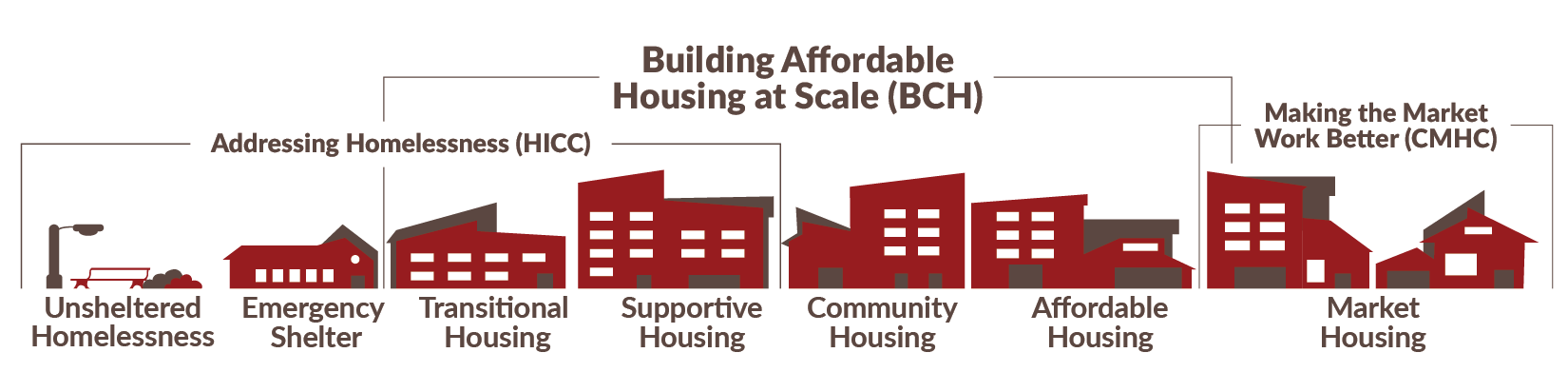
Last September, the government launched Build Canada Homes, a federal agency that builds affordable housing at scale. It helps fight homelessness by building transitional and supportive housing—working with provinces, territories, municipalities, Indigenous and marginalized communities. It builds deeply affordable and community housing for low-income households, and partners with private market developers to build affordable homes for the Canadian middle class.
Build Canada Homes transforms public-private collaboration and deploys modern methods of construction, as it catalyses the creation of an entirely new Canadian housing industry. It leverages public lands, offers flexible financial incentives, attracts private capital, facilitates large portfolio projects, and partners with modern manufacturers to build the homes Canadians need.
Working alongside a comprehensive suite of federal housing measures, estimated at over $140 billion in spending and foregone revenues over the next five years, Build Canada Homes is providing tailored support to quickly address varying housing needs across the country. These initiatives include supports through the tax system to reduce building costs and spur sector productivity, and through measures to lower financing costs and build missing middle housing, as well as broader efforts to tackle regulatory barriers and catalyse a more modern and efficient homebuilding sector. They are complemented by further federal investments in housing-enabling infrastructure.
To lower costs and unlock new housing supply, the government has eliminated the Goods and Services Tax (GST) on new homes for first-time home buyers and is working with provinces and territories to implement additional measures across the country, including reducing development charges or levies on new homes.
Enabling Homebuilding
With construction costs continuing to increase and the homebuilding sector facing productivity and workforce challenges, it is costly to build at prices Canadians can afford. Canada's new government is changing that.
Building on recent action, including $1.7 billion proposed through the Improving Housing Supply Act, the government proposes additional measures to accelerate homebuilding projects and get more of the types of homes Canadians want built, while tackling regulatory barriers and improving productivity to reduce homebuilding costs.
Innovate Homebuilding
- The Spring Economic Update 2026 proposes to provide $41.9 million over five years, starting in 2026-27, to the National Research Council, the Standards Council of Canada, and Innovation, Science and Economic Development Canada to:
- Enable a more modern and efficient regulatory environment, in collaboration with the provinces and territories, through updates to the National Model Codes and regulatory streamlining in order to reduce regulatory friction, improve affordability, provide clearer and more predictable pathways for factory‑built housing, and shorten project timelines. This includes eliminating redundant factory and site inspections, creating a performance-based approval pathway for modular and panelised systems, and improving the consistency of how National Building Code requirements are interpreted;
- Strengthen innovation capacity in the homebuilding sector by mobilising private and public research and development, supporting firms to adopt modern construction technologies and practices in homebuilding that improve productivity and reduce cost. This includes accelerating the review and approval processes of innovative and prefabricated construction products, expanding the Codes to support more flexible building options (such as engineered wood), and strengthening analysis of proposed building code and standards changes to better assess cumulative cost impacts on housing affordability; and
- Improve the responsiveness of Canada's housing markets by working with stakeholders to modernise how housing data is collected, tracked, monitored, and shared across the country.
The government is also exploring ways to modernise mortgage products in line with best practices adopted by other G7 countries to improve access to homeownership and affordable housing for all Canadians.
Facilitate Homebuilding
Building more row homes, stacked townhouses, or smaller low-rise apartments makes better use of serviced land and existing infrastructure while creating attainable housing options in established neighbourhoods. Even with recent municipal zoning reforms in Canada's major cities to add gentle density to our neighbourhoods, builders still have trouble accessing financing at rates that make these smaller projects viable.
The government is taking action to help lower financing costs to build residential properties with up to eight units.
- The Spring Economic Update 2026 announces the government's intention to:
- Amend mortgage insurance rules to permit private mortgage insurers to offer multi-unit mortgage loan insurance on five- to eight-unit residential properties to promote competition and offer lenders more choice; and
- Amend mortgage insurance rules to increase flexibilities for mortgage insurers to offer products to borrowers building new three- and four-unit housing, helping unlock financing for "missing middle" homes such as triplexes and fourplexes—an important step toward increasing housing supply and addressing Canada's housing shortage.
The government will initiate a 30-day consultation on these measures and announce further details after this consultation.
The government is also taking action to support ongoing homebuilding activity, a slowdown of which can negatively impact the delivery of new supply needed to counterbalance affordability pressures down the road.
- The Spring Economic Update 2026 proposes to accelerate over $7 billion in low-cost loans under the Apartment Construction Loan Program to speed up the construction of up to 16,500 new rental homes.
- Further, the government intends to consult on possible additional financing measures to support the continued supply of more owner-occupied homes in advance of Budget 2026.
These changes will collectively unlock financing for more homes, including "missing middle" homes—materially increasing housing supply for renters and owners across the country. This is a significant step in advancing the solutions for the housing crisis. The government looks forward to partnering with provinces and territories to advance collective solutions through cooperative federalism.
Support With Housing
Finally, while the government works to make housing more attainable for all Canadians through measures to support supply across the continuum, it will continue to ensure the most vulnerable are supported. As announced on April 1, 2026, the government has extended the Unsheltered Homelessness and Encampments Initiative by one year by providing $125 million in 2026-27 to Housing, Infrastructure and Communities Canada. The government also intends to extend flexibilities through bilateral housing agreements with the territories to ensure survivors of gender-based violence can access a safe place to live.
Extending the Home Buyers' Plan
The government recognises that many Canadians who have recently purchased their first home or who are planning to do so continue to face significant affordability challenges and could benefit from cash flow support.
- The Spring Economic Update 2026 proposes to extend the grace period during which homeowners are not required to start repaying their Home Buyers' Plan withdrawals from their Registered Retirement Savings Plan (RRSP) from two years to five years, for participants making a first withdrawal between January 1, 2026 and December 31, 2028. This extended grace period already applies to withdrawals made between 2022 and 2025.
This will provide cash flow relief of up to $4,000 (1/15 of $60,000) per individual per year for the three years over which they are not required to repay the amount into their RRSP.
Making New Homes More Affordable for First-Time Buyers
To help bring down costs for many Canadians and promote the construction of new homes, Canada's new government has eliminated the Goods and Services Tax (GST) for first-time home buyers on new homes costing up to $1 million, and reduced the GST for first-time home buyers on new homes between $1 million and $1.5 million. This measure can provide savings up to $50,000 and generally applies to first-time home buyers who meet eligibility requirements and entered into an agreement to purchase a new home on or after March 20, 2025 and before 2031.
Partnering With Provinces and Territories to Improve Housing Supply
On March 26, 2026, the government introduced Bill C-26, the Improving Housing Supply Act. It proposes to immediately provide $1.7 billion to provinces and territories to implement measures across the country to increase housing supply, such as reducing development charges or levies on new home construction and making incremental investments in provincial and territorial programming already in place to spur housing developments.
On March 30, 2026, Canada and the Province of Ontario announced a partnership that will help lower costs, reduce barriers to construction, and accelerate delivery of infrastructure as well as thousands of new homes. Housing supply to be unlocked through this agreement is made possible, in part, by the introduction of the Improving Housing Supply Act.
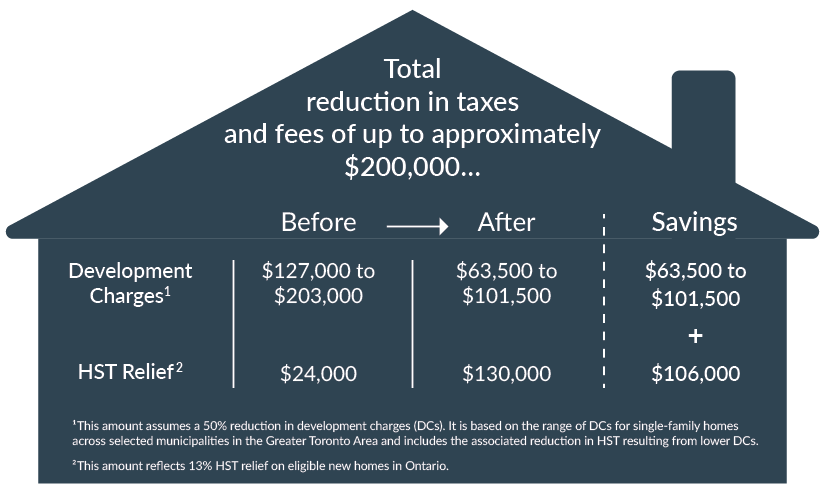
As part of the government's partnership with Ontario, the province will reduce development charges by up to 50 per cent for three years in its largest and fastest-growing cities, covering approximately 80 per cent of the province's population. With federal financial support, Ontario also announced on March 25, 2026 that it intends to provide full relief in respect of the 13 per cent Harmonized Sales Tax (HST) in Ontario on all eligible purchases of new homes valued up to $1 million, and partial relief on homes between $1 million and $1.85 million, for eligible agreements of purchase and sale entered between April 1, 2026, and March 31, 2027. This new partnership will reduce taxes and fees for a new home in Ontario by up to approximately $200,000.
Progress on the Launch of Build Canada Homes
Since its creation in September 2025, Build Canada Homes has seen strong interest. Proposals have been received from across the country, with thousands of homes proposed. Since its launch, the agency has committed to supporting thousands of new housing units through partnerships with the governments of Ottawa, Nova Scotia, New Brunswick, British Columbia, Nunavut, and Québec, and on six federal properties expected to break ground in 2026.
Through these and future projects, Build Canada Homes is prioritising the use of modern methods of construction and Canadian building materials, driving changes in how we build, and demand for Canadian products.
Build Canada Homes is also supporting the preservation of existing affordable housing stock through the Canada Rental Protection Fund, which will launch this spring. The Fund brings together public and private investment to protect Canada's affordable housing stock and is expected to support the acquisitions of thousands of homes within the next five years.
Continued Support for the Urban, Rural, and Northern Indigenous Housing Strategy
Access to safe and affordable housing is necessary for improving health and social outcomes in Indigenous and northern communities. To address the distinct challenges faced by Indigenous people living in urban, rural, and northern areas in finding affordable, adequate and suitable housing, Budget 2022 announced $300 million for an Urban, Rural, and Northern Indigenous Housing Strategy, supplemented by an additional $4 billion in Budget 2023.
- To continue to advance this work, the Spring Economic Update 2026 proposes to realign previous investments to better support Indigenous housing providers by reallocating $2.8 billion over five years, starting in 2026-27, to Build Canada Homes, Crown-Indigenous Relations and Northern Affairs Canada, Indigenous Services Canada and Housing, Infrastructure and Communities Canada. This approach will better align support for Indigenous housing within Canada's current housing landscape.
2.4 Protecting Communities
Canadians deserve to feel safe where they live, learn, work, and worship. The Spring Economic Update 2026 builds on the historic investments to law enforcement made in Budget 2025 by introducing new measures to fight fraud and adopt a 'follow the money' approach to disrupt and dismantle the international and organised criminal networks that threaten the safety and security of communities and rob Canadians of their hard-earned money.
Consumer-targeted fraud continues to grow in both scale and sophistication, with fraudsters leveraging technological advances to target Canadians. According to the Canadian Anti‑Fraud Centre, Canadians reported losing more than $704 million to fraud in 2025, bringing total reported losses since 2022 to over $2.4 billion.
With only an estimated 5-to-10 per cent of consumer-targeted fraud incidents being reported, the true impact is likely far higher. These trends highlight the urgent need to strengthen protections and safeguards to better prevent fraud and reduce its impact on Canadians, especially vulnerable groups such as seniors who are disproportionately targeted.
The exploitation of the financial system to launder illicit proceeds supports and perpetuates crimes such as fraud, theft, and extortion that take money straight out of Canadians pockets, while fuelling the drugs, gangs, and violence that threaten the safety of our communities.
Canada's new government is taking bold action to counter these threats, protect Canadians, and ensure that crime doesn't pay. This includes standing up Canada's first-ever organisation dedicated to investigating sophisticated financial crimes and recovering illicit proceeds from criminals, as well as protecting Canadians from criminal abuse of money services businesses and supporting timely financial intelligence to tackle extortion.
The new government is also developing Canada's first-ever whole-of-government National Anti-Fraud Strategy which aims to establish a robust, multi-sector approach to combatting fraud across its full lifecycle, from prevention and detection to disruption and response.
To protect Canadians against economic abuse, which robs people of independence and safety, the government is acting now by working with community and industry partners to develop a code of conduct that strengthens protections for Canadians.
Standing Up the Financial Crimes Agency
Complex financial crimes require dedicated expertise to identify, trace, and seize illicit money to disrupt and dismantle drug trafficking, extortion, fraud, and other organised criminal networks that threaten the safety of our communities and the integrity of our financial system. On April 27, 2026, the government introduced legislation to establish the Financial Crimes Agency—thereby delivering on the government's Budget 2025 commitment to stand up this new lead enforcement agency.
The Financial Crimes Agency will be an independent agency, reporting to the Minister of Finance, with police powers and civilian leadership.
Key features of the Agency include:
- A mandate to investigate serious and complex financial crimes, such as money laundering, serious fraud, and major capital market crimes, and to recover the proceeds of crime;
- The capacity to lead investigations on its own and in close cooperation with provincial, territorial, municipal, and international law enforcement partners;
- The ability to attract, develop, and retain highly specialised personnel to support intelligence-led, follow-the-money investigations, including civilian and police investigators, criminal and financial intelligence personnel, and asset recovery experts, who will be supported by dedicated and specialised prosecutors; and
- Headquarters in the National Capital Region, with authority to establish regional offices.
The government is committed to providing the Financial Crimes Agency with the resources needed to successfully deliver on its ambitious mandate.
- To stand up this new lead enforcement agency, the Spring Economic Update 2026 proposes to provide:
- $352.7 million over five years starting in 2026-27, with $57.8 million in remaining amortisation, and $82.1 million ongoing to the Financial Crimes Agency;
- $46.2 million over five years and $11.5 million ongoing to the Public Prosecution Service of Canada; and
- $19.6 million over five years and $1.5 million ongoing to the Department of Finance Canada.
- The Spring Economic Update 2026 also announces the government's intention for the Minister of Justice to explore new criminal justice reforms to support the investigation and prosecution of complex financial crimes.
We are delivering on our commitment to create a best-in-class Agency with the personnel, resources, mandate, and supportive legislative tools needed to tackle sophisticated financial crimes. This will protect Canadians by detecting and dismantling the complex illicit financing that fuels crime across Canada.
Protecting Money Services Businesses From Illicit Activity
Money services businesses (MSBs) are an important source of competition in the financial sector, providing services such as remittances, currency exchange, and digital payments, enhancing financial inclusion. However, criminals are increasingly abusing MSBs to launder money, finance terrorism, evade sanctions, and defraud Canadians of their hard-earned savings. In March 2026 alone, the Financial Transactions and Reports Analysis Centre of Canada (FINTRAC) revoked the registration of 84 MSBs.
- To support FINTRAC's efforts and protect Canadians from these crimes, the Spring Economic Update 2026 proposes to crack down on the criminal abuse of MSBs by:
- Introducing new Ministerial Directive powers to safeguard national security and the integrity of the financial system;
- Expanding FINTRAC's ability to refuse or revoke registration of MSBs;
- Preventing the re-registration of non-compliant MSBs;
- Increasing the number of criminal record checks for MSBs; and
- Enhancing FINTRAC's understanding of MSB risks by ensuring it has accurate and up-to-date information regarding the commencement of business and services provided by MSBs.
- To protect Canadians by shutting down a primary method for scammers to defraud victims and for criminals to place their cash proceeds of crime, the Spring Economic Update 2026 proposes to ban crypto ATMs.
These measures will ensure Canadians can still benefit from the services offered by MSBs, including buying virtual currencies from brick-and-mortar MSBs, while better protecting MSBs from illicit activity.
Following the Money to Fight Extortion
Accurate and timely financial intelligence is a front-line tool for law enforcement to fight rising extortion that threatens the safety of our communities and the livelihood of small business owners across Canada.
In February, the Minister of Finance and National Revenue directed FINTRAC to prioritise resources to tackle extortion. FINTRAC has:
- Launched a Countering Extortion Partnership with financial institutions, government, and law enforcement to enhance information sharing and share best practices to fight extortion;
- Assigned dedicated liaison officers to support the effective use of financial intelligence by local law enforcement in the most affected areas; and
- Provided timely, targeted, and effective strategic intelligence to help financial institutions identify the laundering of proceeds of extortion.
- The Spring Economic Update 2026 proposes to provide $17.9 million over four years, starting in 2026-27, in new funding to ensure FINTRAC has the resources it needs to prioritise the detection, deterrence, and disruption of the illicit financing that supports and perpetuates extortion and fentanyl trafficking in Canada and to advance a technology and artificial intelligence roadmap.
Update on the National Anti-Fraud Strategy
Budget 2025 announced the government's commitment to protect Canadians from fraud by developing a whole-of-government National Anti-Fraud Strategy to advance anti-fraud efforts across the financial and telecommunications sectors and digital platforms.
As a first step, the government introduced new fraud-related consumer protections in the Bank Act, with the intent of making regulations by the end of 2026 to bring these changes into force.
To develop the National Anti-Fraud Strategy, the Department of Finance Canada convened an interdepartmental working group with representatives from 11 other federal departments and agencies.
On March 30, the government launched a public consultation on the National Anti‑Fraud Strategy. The consultation seeks feedback on three initial measures which could be taken to advance the strategy: to establish a comprehensive Multi‑Sector Anti-Fraud Framework that strengthens market‑conduct requirements for banks, telecommunication providers, and digital platforms, including social media, to prevent, detect, and respond to fraud losses when they occur; to strengthen public awareness about fraud; and to support law enforcement's ability to combat fraud.
The approach proposed in this consultation builds upon successful anti-fraud initiatives in other jurisdictions and incorporates feedback received to date from key stakeholders, including the industry-led Canadian Anti-Scam Coalition.
In the next year, the government will outline additional measures to further Canada's work to combat fraud and protect Canadians.
Update on the Code of Conduct for the Prevention of Economic Abuse
Canada's financial sector plays an essential role in identifying early warning signs of economic abuse and helping victims and survivors, especially women, access safe, practical support. Since announcing the government's intention to develop a Code of Conduct for the Prevention of Economic Abuse for banks, there has been extensive engagement with stakeholders. Discussions have involved victims and survivors, including women with lived experience, frontline service providers, banks, consumer advocates, and experts in gender-based violence and seniors' financial protection.
Feedback has highlighted the need for clear bank protocols, improved staff training, stronger internal escalation pathways, and safeguards that protect client privacy and autonomy. Stakeholders also stressed the importance of consistent approaches across banks, while allowing flexibility to meet individual needs.
Guided by this input, the government is moving into formal discussions with industry partners on the Code's core elements. This next phase advances a collaborative approach that promotes financial security, independence, and safer futures for Canadians.
Investing in Community Safety
The Canada Community Security Program has been helping Canadians feel safer in their communities, including in places of worship, schools, community centres, and other institutions. Given a significant increase in police-reported hate crime in recent years, including incidents driven by Islamophobia and antisemitism and hate targeting LGBTQ+ communities, continued and enhanced support is needed to ensure communities at risk can respond to evolving security challenges.
- To help address rising hate-related crimes, the Spring Economic Update 2026 proposes to provide $75 million over five years, starting in 2026-27, to Public Safety Canada for the Canada Community Security Program. This additional funding will allow the program to continue to help eligible organisations implement physical security enhancements and foster safer, more inclusive communities.
2.5 Empowering Canadians
The world is more challenging and divided. Canadians feel this every day. But Canadians have never waited around for the world we wish to see. Canada has always been built by the people who did hard things, who showed up when it mattered most, and who took care of each other. That is still what this moment asks of us.
Strong Canadian communities are essential in our goal of building Canada and ensuring we fulfill our promise. Together, we are taking clear, decisive action to ensure communities remain safe and welcoming spaces to live, work, learn, worship, and play. This includes strengthening local journalism so Canadians can remain informed about and engaged in the communities where they live; investing in small craft harbours that sustain coastal livelihoods; advancing accessibility so persons with disabilities can fully participate in community life; renewing Canada's sport system; and providing supports to ensure that Indigenous communities are healthy and vibrant.
Investing in Sport—From Playground to Podium
Canada is a sporting nation. Whether it's Northern games, lacrosse, ice hockey, soccer, curling, basketball or para sports, communities love to come together to cheer on their friends and neighbours. Our athletes draw us together. They inspire and exhibit the qualities that set Canadians apart: Determination. Team spirit. Grit.
Sport challenges us, pushes us to do better. It forges lifelong friendships and connections. It teaches us respect and shows our kids that the sky is the limit. Our background, ability or age doesn't matter – there is a place for us in sport. Our shared experiences on the field, court or rink encourage inclusion, mutual respect, and social connections – truly building Canada strong.
Sport contributes to our health and well-being, as well as the economy. The sport system supports more than 100,000 jobs all across our country and our communities.
We are making a generational investment in sport and our athletes. To increase participation. To put more Canadians on podiums. And to bring more world‑class sporting events to Canada.
- The Spring Economic Update 2026 proposes to provide $755 million over five years, starting in 2026-27, and $118 million ongoing, to Canadian Heritage to support Canada's sport system to:
- Host and compete with the best: $50 million over five years to bring more world-class sporting events to Canada. Funding will be tied to legacy-building projects that deliver lasting benefits well beyond the events themselves. Facilities built or upgraded for major events will continue to serve communities, support grassroots participation, and strengthen local sport systems for years to come.
- Support our athletes in performing at the highest levels: $45 million over five years and $8 million ongoing to help our athletes train, compete, and perform, including support for better mental health and funding that will be linked to robust safe sport measures and frameworks. These actions will strengthen the sport system and respond to some of the findings of the Final Report of the Future of Sport in Canada Commission while the government continues to consider all of its Calls to Action.
- Get more Canadians involved in sport: $660 million over five years and $110 million ongoing for National Sport Organisations, increasing funding that has remained largely unchanged since 2005, so that they can invest in a strong and safe sport system and grow participation among children and youth nationwide. We want to see new and existing community infrastructure—like the Embleton Community Centre and Park in Brampton, Ontario that will be supported with a $64 million investment from the Building Communities Strong Fund—fully used and enjoyed by a new generation of athletes. We want National Sport Organisations to work with private sector partners who share the goal of getting more Canadians involved in sport. And we expect National Sport Organisations to make changes to their programming to invest in sport at all levels.
Building Canada Strong includes a strong sporting system. We will champion our athletes so that they can do their best and play to win—whether that's on the playground or the podium.
Repairing and Maintaining Small Craft Harbours
Small craft harbours are a crucial connection point and lifeline to small communities—providing much needed maritime links, including transportation and fishing as well as opportunities for recreation and aquaculture. These harbours are essential infrastructure and at the heart of many coastal communities, where over five million Canadians live. They also provide crucial infrastructure to multiple Indigenous communities, supporting them in exercising their Indigenous and treaty rights.
Small craft harbours are also critical to the commercial fishing industry, with billions of dollars in landings at small craft harbours every year. Small craft harbours support more than 45,000 jobs in the fish and seafood industry, as well as many thousands of additional jobs in supporting industries.
With close to 950 harbours valued at approximately $7.1 billion across the country, Canada's new government is committed to repairing and maintaining small craft harbours to protect and create flourishing coastal communities.
- The Spring Economic Update 2026 proposes to provide $957.8 million over five years, starting in 2026-27, on a cash basis, to Fisheries and Oceans Canada for the Small Craft Harbours Program. This represents an increase of more than 35 per cent per year over the 10-year average and provides needed stability in funding for repairs. This is in addition to the Department's annual program budget of approximately $90 million a year. Next steps will be announced by the Minister of Fisheries.
Empowering Indigenous Communities
Supporting Indigenous-led services and supports rooted in their unique cultures is essential to this government's commitment to advance reconciliation. It ensures critical services like education, family services, social services and community governance meet the needs of Indigenous families, communities and individuals. These services are central to fostering a strong sense of identity and belonging, and support the long‑term growth and success of Indigenous people.
- As part of this commitment, the government previously annnounced:
- $359 million over three years, starting in 2026-27, to support data collection and Indigenous governance and capacity programs, enabling First Nations to effectively deliver community-based services. This funding will ensure First Nations can sustain core functions necessary to deliver essential services and actively participate in Canada's economy, while balancing community responsibilities and keeping pace with population growth;
- $168 million over five years, starting in 2026-27, to support Urban Programming for Indigenous Peoples so that Friendship Centres across Canada can continue to provide critical supports and services to their community members; and
- $592 million over nine years, starting in 2025-26, for social support services for people living on reserve with chronic illness or disability under the Assisted Living Program so that they can maintain their independence and participate in their communities.
- To ensure First Nations, Inuit, and Métis individuals and communities have access to opportunities to grow and reach their full potential, the Spring Economic Update 2026 proposes to provide the following funding to Indigenous Services Canada:
- $601 million in 2026-27 to support high-quality, culturally relevant elementary and secondary education on reserve that meets the needs of students so that First Nations youth can participate fully in Canada's skilled workforce; and
- $700 million over six years, starting in 2025-26, to continue to support Indigenous communities to implement their own solutions to protect children and families by exercising their jurisdiction under An Act respecting First Nations, Inuit and Métis children, youth and families.
Healthy Indigenous Communities
Health is a key indicator of a prosperous economy and is a critical enabler of a person's ability to live life to the fullest. Indigenous people across Canada should have safe and equitable access to health care that responds to their unique needs. The government is committed to advancing reconciliation by supporting Indigenous communities to improve health outcomes by modernising delivery of services and ensuring people have access to the health products and services they need to thrive and actively participate in their communities.
- The government has already announced:
- $27 million over five years, starting in 2026-27, to continue working with Inuit Tapiriit Kanatami to take concrete action to eliminate tuberculosis in Inuit Nunangat by 2030.
- $630 million over two years, starting in 2026-27, to maintain trauma-informed and culturally appropriate mental wellness services for Indigenous people including continued support for crisis lines and Indigenous-led mental wellness programming that supports community-based services grounded in culture and ceremony.
- $400 million over five years, starting in 2026-27, to maintain access to high-quality primary care services including nurses, nurse practitioners, and paramedics for First Nations in rural and remote on-reserve communities.
- To ensure high-quality and culturally relevant health care that responds to the distinct needs of Indigenous individuals, families, and communities, the Spring Economic Update 2026 proposes to provide the following funding to Indigenous Services Canada:
- $794 million in 2026-27 to support the Non-Insured Health Benefits Program, which provides First Nations and Inuit with coverage for a range of health products and services such as medical travel, pharmaceuticals, and mental health counselling.
Making it Easier to Access the Disability Tax Credit
The Disability Tax Credit provides significant tax relief for persons with disabilities and their supporting family members. Eligibility for the credit serves as a key requirement for other supports including the Canada Disability Benefit, the Child Disability Benefit, and the Registered Disability Savings Plan along with the Canada Disability Savings Grant and Bond.
Each year, more Canadians are accessing the Disability Tax Credit, yet barriers in navigating the application process remain for many. The government is committed to supporting persons with disabilities and their families to access all the supports they need. Medical practitioners are required to certify an individual's impairment and its impacts on basic activities of daily living to ensure that the eligibility criteria for the credit are applied consistently and fairly, but this does add to their administrative burden.
- To improve the Disability Tax Credit application for persons with disabilities and their families, and to reduce paperwork for medical practitioners, the Spring Economic Update 2026 proposes to:
- Streamline the application process for individuals with a formal diagnosis of certain long-lasting medical conditions. These conditions, listed in the Tax Measures: Supplementary Information annex, have been identified through the Canada Revenue Agency's experience in processing applications as satisfying the disability impact criteria for the credit. This proposal would not change the disability criteria to qualify for the credit and the Canada Revenue Agency would continue to have authority to ask for additional information to verify that these criteria are met. This measure would apply for the 2026 and subsequent taxation years.
- Expand the list of medical practitioners who can certify eligibility for the Disability Tax Credit to include podiatrists (for a specific type of impairment) and broaden the types of impairment that can be certified by physiotherapists, speech-language pathologists and occupational therapists, within the scope of their training and practice. This measure would apply to Disability Tax Credit certificates issued after 2026 for the 2027 and subsequent taxation years.
- Recognise provincial or territorial public guardians and trustees as being qualified to certify for the Disability Tax Credit for adults in their care for property matters who have a valid certificate of incapacity based on a medical practitioner's assessment of their mental impairment. This measure would apply to the 2026 and subsequent taxation years.
These changes are expected to provide $345 million over six years, and $86 million per year ongoing, in tax relief under the Disability Tax Credit and via increased payments of federal benefits (such as the Canada Disability Benefit and the Child Disability Benefit), starting in 2025-26.
- Further, to ensure applications are processed in an accurate and timely manner, the Spring Economic Update 2026 proposes to provide $42.5 million over five years, starting in 2026-27, to the Canada Revenue Agency to administer these changes.
Modern Tax Rules for Charities
The Government of Canada's tax incentives for charitable giving aim to mobilise private capital for public needs, creating an attractive environment for donors while supporting affordability, social security and our communities across the country. The government recognises that the charitable sector, and non-governmental organisations, are an important driver for the Canadian economy, create well-paying jobs and supplement the social safety net.
- With advances in technology and digitisation, the government will undertake an exercise to modernise the framework for the charitable sector in 2026-27. As a first step, the government will undertake a consultation with key stakeholders and relevant agencies for them to provide feedback and align with best practices adopted by other G7 countries.
Extending the Canadian Journalism Labour Tax Credit
The government recognises the importance of journalism in our communities. Broadcast journalism in particular is a key part of our community fabric. Supporting the important work of journalists is crucial in our democratic system, ensuring accountability and a well-informed public, especially during a period of global uncertainty. Canada's new government is committed to supporting fact-based, local journalism that benefits Canadian communities.
- The Spring Economic Update 2026 announces the government's intention to seek the views of Canadians and stakeholders on extending the Canadian Journalism Labour Tax Credit to audio and audiovisual news production. Further details on the consultation process will be released on the Department of Finance Canada website.
Ensuring Canadians Can File Their Taxes in Their Communities
The Community Volunteer Income Tax Program (CVITP) Grant supports community organisations in hosting tax preparation clinics, and arranging for volunteers to prepare income tax and benefit returns for individuals with modest incomes and simple tax situations, free of charge. These community tax clinics represent a trusted community resource, ensuring Canadians can receive the benefits, credits, and refunds to which they are entitled. This work complements the government's commitment to introducing automatic federal benefits for lower-income individuals.
In 2025, the program supported over 3,500 organisations with almost 20,000 volunteers who helped file close to 1.1 million returns—delivering almost $2.6 billion in federal refunds, credits, and benefit entitlements. Approximately 17 per cent of returns filed through the CVITP in 2025 were from individuals who had not filed a tax return in previous years—helping Canadians enter the tax system and access the benefits and credits to which they may be entitled.
On February 3, 2026, the Secretary of State (Canada Revenue Agency and Financial Institutions) announced the CVITP Grant would be renewed for the next three years.
- The Spring Economic Update 2026 proposes to provide $18.7 million over three years, starting in 2026-27, to the Canada Revenue Agency to renew and expand the CVITP Grant.
Gender and Diversity Impacts Spotlight
The government is supporting Canadians by addressing cost-of-living pressures, strengthening community safety, and investing in inclusive, resilient communities. This includes supporting critical programs and services for Indigenous people, promoting sport participation, strengthening safeguards against financial fraud, supporting communities at risk of hate-motivated crimes, and making tax administration easier.
- The Canada Groceries and Essentials Benefit is targeted at low- and modest-income individuals and families, and will provide support to more than 12 million Canadians. Single individuals, single mothers, Indigenous people, and persons with disabilities will particularly benefit from extra support to help with day-to-day essentials, as they are more likely to have lower incomes. It is estimated that over three-quarters of the additional support will go to singles (with and without children), of which about one-third will go to single women without children and one-fifth to single mothers. More than half of seniors will receive additional assistance, including three-quarters of single seniors.
- Supporting the Nutrition North Canada Retail Subsidy is targeted at 124 isolated communities, the majority of which are Indigenous. The share of the population living in food insecure households in Canada's North is much higher than the national average of 22.9 per cent—reaching 62.6 per cent in Nunavut and 27.6 per cent in the Northwest Territories, while Indigenous families are around twice as likely as non-Indigenous families to face food insecurity. Groups at higher risk of facing food insecurity, such as women, children, lone-parent households, persons with disabilities, and elders, would predominantly benefit from this measure.
- The National Anti-Fraud Strategy will help protect all Canadians, especially seniors, who are more often targeted by phone scams, as well as younger people who face rising risks on digital platforms. In 2025, reported losses totaled $704 million, which is likely an underestimate as only an estimated 5 to 10 per cent of fraud is reported.
- Continuing to support the Canada Community Security Program will help ensure that communities at heightened risk of hate-motivated crime feel safe and supported, regardless of their identity, faith, or background. In 2024, there were 4,882 police-reported hate crime incidents, with 49 per cent targeting race or ethnicity and 27 per cent targeting religion. By strengthening the security of gathering spaces, including places of worship, schools, shelters, and community centres, this measure will benefit all Canadians.
- Investing in Sport—from Playground to Podium will help increase participation of underrepresented groups, directly benefitting women and girls, persons from low-income households, Indigenous people, Black and racialised people, and persons with a disability. Funding will also support high-performance athletes, who tend to be younger (below 35 years) and low-income.
- Repairing and Maintaining Small Craft Harbours will support diverse rural and coastal communities where over five million Canadians live. Funding will directly benefit commercial fishers, who are the primary harbour users and are predominantly men. Funding will also support Indigenous people, as Indigenous employees account for 16 per cent of the workforce in the fishing industry. Further, funding will support essential infrastructure in regions with a high proportion of Indigenous users, including many Indigenous communities.
- Empowering Indigenous Communities will benefit Indigenous people by advancing Indigenous perspectives and data capacity to improve access to supports and services. Funding will help sustain existing programs and initiatives and enhance communities' capacity to plan and deliver services, helping to improve health and social outcomes for Indigenous people.
- Making it Easier to Access the Disability Tax Credit would benefit persons with severe and prolonged disabilities, who are disproportionately low-income and age 65 or older, and their supporting family members. Barriers like accessing a medical professional to certify eligibility for the credit or navigating the application process can limit uptake of eligible supports. Low and modest-income working-age individuals with a severe and prolonged disability, who generally face higher poverty rates than those without disabilities, and families with children with severe disabilities may also benefit from accessing support linked to the credit, such as the Canada Disability Benefit, Child Disability Benefit, and Registered Disability Savings Plan (including federal grants and bonds).
- Renewing the Community Volunteer Income Tax Program Grant would support organisations hosting free tax filing clinics which help low- and modest-income individuals and families to file their tax return, free of charge. Newcomers, Indigenous people, rural populations, persons with disabilities, first-time filers, and seniors will particularly benefit, as these groups are more likely to face barriers to tax filing due to lack of knowledge of English or French, distrust in government, geography (e.g., far from tax clinics or accountants or limited time to travel), poor digital literacy, and/or a limited awareness of clinics and programs.
| 2025-2026 | 2026-2027 | 2027-2028 | 2028-2029 | 2029-2030 | 2030-2031 | Total | |
|---|---|---|---|---|---|---|---|
| 2.1 Supporting Workers and Young People | 0 | 1,887 | 1,221 | 1,376 | 1,287 | 1,174 | 6,945 |
| Team Canada Strong* | 0 | 802 | 1,223 | 1,338 | 1,339 | 1,280 | 5,982 |
Less: Funds Previously Provisioned in the Fiscal Framework |
0 | -41 | -53 | -53 | -59 | -45 | -250 |
Less: Projected Revenues |
0 | -75 | -45 | -45 | -45 | -45 | -255 |
| Extending Employment Insurance Support for Seasonal Workers | 0 | 3 | 121 | 159 | 72 | 2 | 356 |
| Increasing Student Grants and Loans1 | 0 | 1,197 | -25 | -24 | -21 | -19 | 1,107 |
| Enhancing the Labour Mobility Deduction for Tradespeople | 0 | 1 | 1 | 1 | 1 | 1 | 5 |
| 2.2 Bringing Down the Costs of Groceries and Essentials | 3,136 | 3,801 | 1,785 | 1,800 | 1,840 | 1,890 | 14,252 |
| Making Essentials More Affordable Through the Canada Groceries and Essentials Benefit2* | 3,136 | 1,355 | 1,785 | 1,800 | 1,840 | 1,890 | 11,806 |
| Food Security in the North3 | 0 | 36 | 0 | 0 | 0 | 0 | 36 |
| Increasing Food Security | 0 | 0 | 1 | 5 | 9 | 9 | 24 |
Less: Costs to be Recovered |
0 | 0 | -1 | -5 | -9 | -9 | -24 |
| Temporarily Suspending the Federal Fuel Excise Tax4 | 0 | 2,410 | 0 | 0 | 0 | 0 | 2,410 |
| 2.3 Making it Easier to Afford a Home | 1,695 | 93 | 238 | 290 | 198 | 145 | 2,659 |
| Enabling Homebuilding5* | -19 | 154 | 62 | 108 | 120 | 91 | 516 |
Less: Funds Previously Provisioned in the Fiscal Framework |
0 | -125 | 0 | 0 | 0 | -30 | -155 |
| Extending the Home Buyers' Plan | 0 | 0 | 0 | 7 | 15 | 20 | 42 |
| Partnering with Provinces and Territories to Improve Housing Supply6 | 1,713 | 0 | 0 | 0 | 0 | 0 | 1,713 |
| Continued Support for the Urban, Rural, and Northern Indigenous Housing Strategy* | 0 | 413 | 594 | 594 | 587 | 587 | 2,776 |
Less: Funds Sourced From Existing Departmental Resources |
0 | -349 | -419 | -419 | -523 | -524 | -2,233 |
| 2.4 Protecting Communities | 0 | 65 | 100 | 117 | 117 | 112 | 511 |
| Standing Up the Financial Crimes Agency* | 0 | 41 | 76 | 100 | 102 | 100 | 418 |
| Following the Money to Fight Extortion | 0 | 5 | 6 | 5 | 3 | 0 | 18 |
| Investing in Community Safety | 0 | 19 | 19 | 12 | 12 | 12 | 75 |
| 2.5 Empowering Canadians | 57 | 2,475 | 1,147 | 610 | 592 | 577 | 5,459 |
| Investing in Sport—From Playground to Podium | 0 | 129 | 149 | 159 | 159 | 159 | 755 |
| Repairing and Maintaining Small Craft Harbours* | 0 | 9 | 42 | 47 | 52 | 57 | 208 |
| Empowering Indigenous Communities7* | 75 | 1,315 | 666 | 392 | 375 | 291 | 3,114 |
Less: Funds Sourced From Existing Departmental Resources |
-25 | -214 | -193 | -167 | -172 | -105 | -875 |
| Healthy Indigenous Communities8 | 0 | 1,194 | 400 | 85 | 85 | 85 | 1,851 |
| Making it Easier to Access the Disability Tax Credit | 6 | 30 | 61 | 76 | 86 | 86 | 345 |
| Making it Easier to Access the Disability Tax Credit - CRA Administration | 0 | 8 | 14 | 11 | 7 | 3 | 43 |
| Ensuring Canadians Can File Their Taxes in Their Communities | 0 | 5 | 7 | 7 | 0 | 0 | 19 |
| Additional Investments – Benefitting Canadians: A Canada for All | 0 | 171 | -432 | -617 | -670 | -695 | -2,241 |
| Supporting the FIFA Men's World Cup 2026 | 0 | 146 | 0 | 0 | 0 | 0 | 146 |
| Funding proposed for PS and IIC to support security activities at the FIFA Men's World Cup 2026 and to leverage the event for investment promotion. | |||||||
| Improving Services to Canadians | 0 | 205 | 184 | 27 | 27 | 30 | 473 |
Less: Funds Sourced From Existing Departmental Resources |
0 | 0 | -5 | -5 | -5 | -5 | -22 |
| Funding proposed for ESDC to support the day-to-day operation of the new Old Age Security (OAS) platform and to increase OAS processing capacity, helping ensure seniors receive their benefits accurately and on time, and for CRA to maintain a complement of agents at its call centres, and to implement a new telephony platform, which will allow Canadians to more easily connect with the CRA on enquiries related to their benefits and taxes. | |||||||
| Making Essentials More Affordable Through the Canada Groceries and Essentials Benefit - CRA Administration | 0 | 3 | 2 | 2 | 0 | 0 | 8 |
| Personal Support Workers Tax Credit - CRA Administration* | 0 | 4 | 4 | 4 | 0 | 0 | 13 |
| First-Time Home Buyers' GST/HST Rebate - CRA Administration | 0 | 30 | 20 | 18 | 0 | 0 | 68 |
| Funding proposed for the Canada Revenue Agency to administer previously announced tax measures. | |||||||
| Ex gratia payment to the Northwest Territories | 0 | 2 | 0 | 0 | 0 | 0 | 2 |
| Proposed one-time ex gratia payment to the Government of the Northwest Territories to make up for reductions in its Territorial Formula Financing (TFF) due to natural resource revenues that were previously reported but not realized, resulting in the territory reporting net negative resource revenue that could not be recognized by the TFF program. | |||||||
| Projected Employment Insurance Premium Revenues for Measures Included in Spring Economic Update 2026 | 0 | -220 | -637 | -663 | -692 | -719 | -2,930 |
| Includes projected Employment Insurance premium revenues for Measures Taken to Support Workers and Businesses - Worker Supports in section 1.3, Extending Employment Insurance Support for Seasonal Workers in in section 2.1, a portion of Team Canada Strong in section 2.1, and a portion of the Price and Volume Protection for Federal Real Property in Table A1.15. | |||||||
| Chapter 2 - Net Fiscal Impact | 4,887 | 8,494 | 4,060 | 3,577 | 3,364 | 3,203 | 27,585 |
| Of which, capital investment: | 1 | 104 | 334 | 345 | 254 | 212 | 1,250 |
| 1 Increasing Student Grants and Loans was announced on March 23, 2026. 2 Making Essentials More Affordable Through the Canada Groceries and Essentials Benefit was announced on January 26, 2026. Amounts include immediate expensing for greenhouse buildings and funding for the Local Food Infrastructure Fund. 3 Food Security in the North was announced on February 19, 2026. 4 Temporarily Suspending the Federal Fuel Excise Tax was announced on April 14, 2026. 5 Support with Housing measures under Enabling Homebuilding was announced on April 1, 2026. 6 Partnering with Provinces and Territories to Improve Housing Supply was announced on March 26, 2026. 7 Empowering Indigenous Communities was partially announced on March 27, 2026. 8 Healthy Indigenous Communities was partially announced on March 27, 2026. * Measure includes funding classified as a capital investment. Note: Numbers may not add due to rounding. A glossary of abbreviations used in this table can be found at the end of Annex 1. |
|||||||
Page details
- Date modified: