
Chapter 1:
Building Canada: All for Canada
The world is rapidly changing. Shifting trade patterns, geopolitical tensions, and rapid technological change are impacting the lives of Canadians at an unprecedented rate. Budget 2025 set out the government's bold and ambitious plan to transform our economy from one that is reliant on a single trade partner to one that is stronger, more self-sufficient, and resilient to global shocks.
We are taking our future into our own hands by building one Canadian economy, powered by new infrastructure—connecting our regions, diversifying our markets, and protecting our communities.
The Spring Economic Update 2026 announces further steps to support investment, productivity, and growth, including:
- Launching Canada's own sovereign wealth fund, the Canada Strong Fund, to invest in the projects and companies that are driving Canada's economic transformation, capitalised in the near term with $25 billion.
- Making the Employee Ownership Trust (EOT) tax exemption permanent to enable workers to participate directly in building Canada strong.
- Launching Canada's first Investment Summit in September 2026 to convene the world's largest investors, including top CEOs, entrepreneurs, and prominent global business leaders. The Summit is focused on attracting new investment into Canada.
- Providing $103.8 million to establish the Defence Investment Agency as a stand-alone entity.
- Launching a Whole-of-Government Competition Plan to strengthen productivity and affordability by ensuring that competition is prioritised throughout the federal government's policies.
These measures build on the ambitious economic plan we are already implementing, including:
-
Accelerating nation-building projects through the Major Projects Office to fast-track key projects through federal review and approval. The 15 projects announced to date represent over $125 billion in capital investments and are expected to support over 60,000 jobs during construction.
-
A Productivity Super-Deduction and enhancements to the Scientific Research and Experimental Development Tax Incentives to encourage further investment. The Productivity Super-Deduction is expected to generate an economic output of up to $9 billion annually over the next ten years, while the enhancements to Scientific Research and Experimental Development Tax Incentives are expected to generate an economic output of $1.2 billion a year.
-
New infrastructure programs targeted at building more housing and stronger communities including the Build Communities Strong Fund—delivering $51 billion to boost investment in infrastructure—from community infrastructure, to health infrastructure, to public transit—in partnership with provinces and territories. Together with the provincial contributions, the projects through the Fund will support an average of 42,000 jobs per year.
-
A Trade Diversification Strategy to help Canadian businesses expand to non-U.S. markets, supported by a $6 billion Trade Infrastructure Strategy to help their products get there. Investments in trade-enabling transportation infrastructrure through the Trade Diversification Corridors Fund and the Arctic Infrastructure Fund are expected to raise productivity and increase gross domestic product (GDP) by up to $21 billion.
-
An Automotive Strategy to strengthen Canada's auto manufacturing sector and protect the over 500,000 workers the sector supports.
-
An International Talent Attraction Strategy and Action Plan to recruit exceptional foreign researchers to Canadian universities.
-
A Nature Strategy to protect Canada's nature by conserving 30 per cent of Canada's lands and waters by 2030.
-
A Climate Competitiveness Strategy to create the conditions to become a global leader in clean technology and clean energy.
Federal Investments in Sector Strategies Total Over $25 Billion
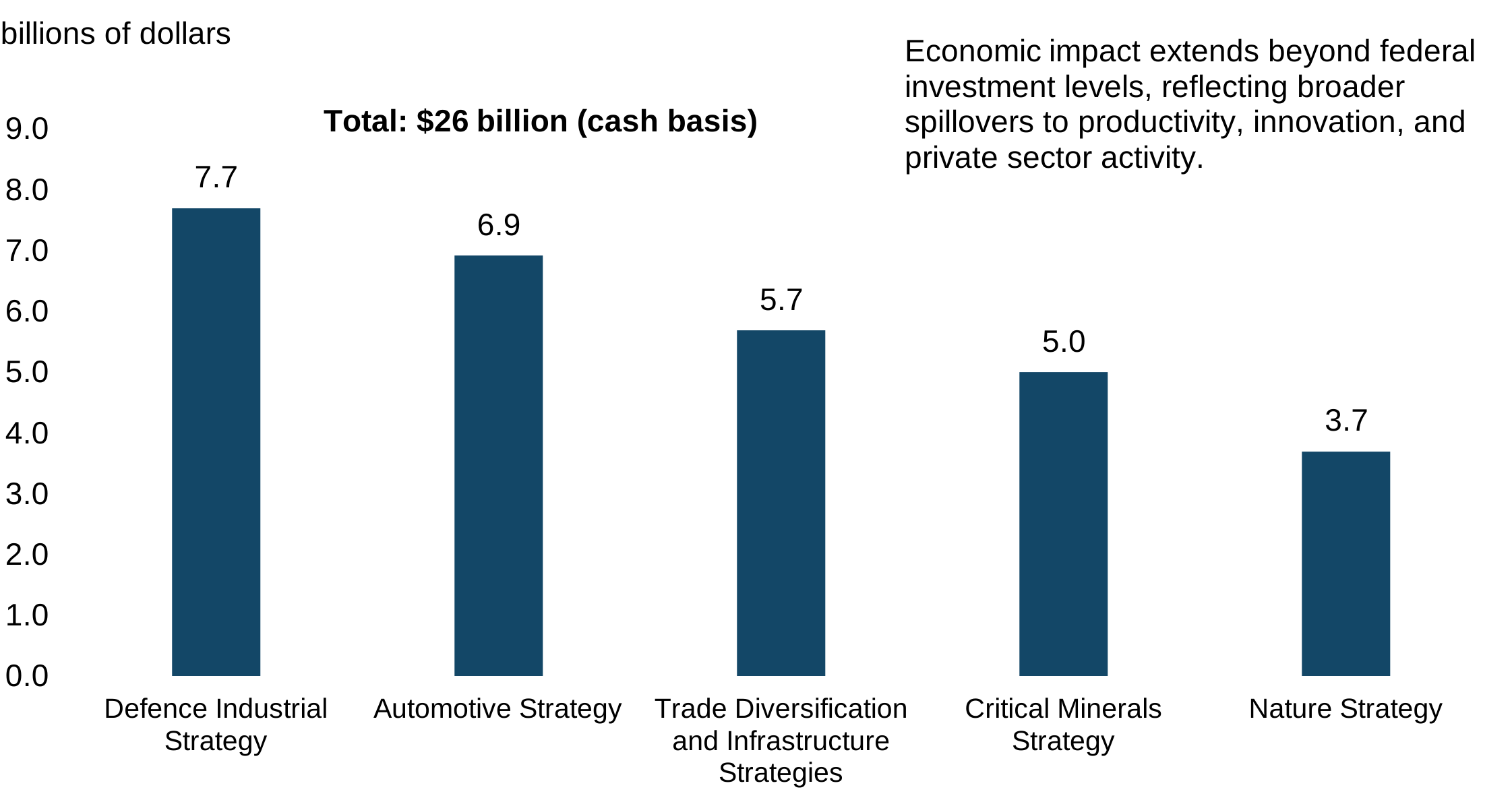
Canada has always been a nation of builders. To secure a more prosperous, competitive, and sovereign future, we are building Canada as a clean and conventional energy, mining, industrial, and agricultural superpower. We are improving regulatory efficiency, increasing competition, boosting tax and other incentives for new investments, and investing in trade and supply chain infrastructure.
1.1 Delivering for Canadians
The Canada Strong Fund
The government has set out a bold plan to build a stronger Canada.
We are investing in the foundations of long‑term prosperity: modern infrastructure that better connects our country; responsible resource development that strengthens our economy and enhances energy security; and sustained support for the innovative companies and skilled workers who will shape Canada's future.
This is more than an economic agenda—it is a nation‑building action plan. Build Canada Strong is about constructing a bridge to a better future—project by project, company by company. While the results will build over time, these are investments that will pay dividends for Canadians in the years—and generations—ahead.
Build Canada Strong is about connecting Canadians to one another and ensuring that an Albertan has a stake in a project built in Newfoundland, and vice versa. It is about uniting Canadians around a shared purpose and shared success.
While Canadians will benefit from these nation‑building projects through better jobs, higher economic growth and greater security, the government is determined to ensure that all Canadians also have a stake—a fair stake—in the projects themselves.
To do that, we are changing the equation. The government is launching Canada's first sovereign wealth fund—the Canada Strong Fund. This fund is about making sure that the returns from Build Canada Strong are shared with Canadians.
A Clear Mission
Designed to give all Canadians a direct stake in the Build Canada agenda, it is a Government of Canada fund—and therefore, a fund that belongs to all Canadians. The Fund will invest in strategic Canadian projects and companies alongside other investors—with a clear objective to achieve commercial returns to build the wealth of Canada.
- This is how the Canada Strong Fund will work:
An Initial Endowment that is Designed to Grow
Initially, the government will provide $25 billion over 3 years, on a cash basis, to seed the Canada Strong Fund.
The Fund will increase over time, both from the returns that it generates, and through other assets that the government may allocate to it.
Asset optimisation will help address two complementary priorities: unlocking the full value of existing federal assets and directing that capital toward investments with the highest potential return for Canada and Canadians.
An Investment Strategy that Emphasizes Returns
The Canada Strong Fund will focus on building Canada. From infrastructure to advanced manufacturing to energy and mining, the Fund will have a mandate to deliver market‑rate returns for Canadians across the economy.
Leading Canadian companies will help build our energy, transportation and telecommunications infrastructure and future economy.
Global investors are increasingly looking to Canada as a destination for major new investments, and the federal government is working to ensure these projects move forward.
As Canadian companies and international partners invest and succeed here, Canadians should also have a stake – so that everyone benefits. That is why the Canada Strong Fund will participate alongside other investors on a fully commercial basis.
This represents a new ownership opportunity for Canada and Canadians, with the Fund focused primarily on equity investments.
The Major Projects Office is working closely with project proponents as they move through regulatory approvals, and the government is assessing projects for potential designation under the Building Canada Act.
At the same time, institutions such as the Canada Infrastructure Bank, Export Development Canada, the Business Development Bank of Canada, the Canada Indigenous Loan Guarantee Corporation, and a range of departmental programs are already playing a critical role in advancing large‑scale projects and supporting the growth of Canadian companies.
Where the federal government is active, the Canada Strong Fund will focus on complementing these efforts—investing only in minority positions alongside private capital in this growing pipeline of projects and companies, and generating strong, commercial returns for Canadians.
An Independent, Professional Crown Corporation Focused on Performance
Independence and professional management ensures a sovereign wealth fund can make long‑term, economically sound investment decisions. This structure is widely regarded as global best practice because it strengthens transparency, credibility, and long‑term performance through consistent, expert management.
The Canada Strong Fund will operate at arms-length from government. We will create a new Crown corporation, and its work will be guided by a CEO and a qualified independent board of directors.
This model will ensure that both in the near-term and the long-term the Fund remains focused on its mission – supporting the transformation of the economy and creating wealth for Canadians.
A Simple Way for Canadians to also Directly Participate
We are building Canada together—and the Canada Strong Fund is designed to take that effort even further. The government intends to offer Canadians the opportunity to participate directly in the Fund through a new, broadly accessible retail investment product.
This means that any Canadian who wishes to can invest some of their savings into the Canada Strong Fund.
The government intends to consult on the specific design of this product, but Canadians can expect the following features:
- Broadly accessible to Canadians from coast to coast to coast;
- Easy and simple to purchase, hold, and transact;
- As the Canada Strong Fund succeeds, investors will be able to share in the upside, while their initial invested capital will be protected.
When Canadians invest directly in the Canada Strong Fund, they will help fuel its growth and increase its ability to deliver meaningful benefits across the country.
What Comes Next
The government will establish a dedicated Canada Strong Fund Transition Office to lead a targeted engagement with market participants and regulators, and rapidly finalise the Fund. Further details will be provided in the coming months.
The Canada Strong Fund joins a federal ecosystem of Crown corporations dedicated to helping promising companies and projects succeed either here at home or through exports to the world.
- The government believes that for each of these financing vehicles to have a maximum impact, they must have clear, focused mandates. To ensure clarity of purpose and avoid any risk of duplication, the government will undertake comprehensive mandate reviews for each organization in the federal financing ecosystem.
Canada Strong Fund
Mission: Invest in strategic Canadian projects and companies that will drive the transformation of Canada's economy and create wealth for Canadians, while giving Canadians the opportunity to share directly in the financial returns.
Sources of Capital

Government Funding
- Seed capital

Retail Investment Product
- Offer Canadians an opportunity to invest in the Fund to benefit from the financial returns generated by the Fund's nation-building investments

Other
- Generating full value from federal assets

Initial Deal Flow
- Projects referred to Major Projects Office
- Projects or firms that receive other federal support

Investment Returns
- Reinvested into more projects
- Payments to retail investors
- Return to taxpayer
Investment Policy

Investment Areas
- Strategic Canadian projects and companies

Investment Instruments
- Equity investor (e.g., common shares, preferred shares, trust interests or partnership interests, warrants)

Investment Philosophy
- Invest on equal terms as other investors
Strengthening the Future of Canada's Airports
Airports are vital national assets that support Canada's economic competitiveness, trade, tourism, and regional connectivity. Modern and efficient airport operations are essential to ensuring the long-term stability of Canada's air sector.
As set out in Budget 2025, the government is committed to reforming Canada's airports system to lower air passenger costs and better position airports to attract private investment. In this context, since the budget, the government has begun to consider reforms to modernise the governance of airport authorities, explore options to update the framework for airport rents, and to increase the capacity of airports for economic development and reinvestment in infrastructure.
The government is also assessing opportunities to unlock the full value of airports in support of investments in Canada's long-term growth, including through alternative models of ownership. This work will be advanced with the input of the airport authorities and other stakeholders including airlines and local governments.
- Additionally, the Spring Economic Update 2026 announces the government's intention to introduce legislation to ensure it can obtain the information necessary for a comprehensive evaluation of airport reforms.
Timely Resolution of Air Passenger Complaints
The Government of Canada created the Air Passenger Protection Regulations in 2019 to establish minimum requirements for airlines to protect the rights of passengers in Canada, including compensation obligations. They create a set of minimum obligations from airlines towards passengers—however, there is a significant backlog of passenger complaints.
- The Spring Economic Update 2026 announces the government's intention to clear the backlog of air travel complaints by engaging a neutral, third-party dispute resolution organisation based on a proven model in the U.K. and E.U. Beyond the backlog, the government also intends to develop a simpler and more effective regulatory regime, so that rules are clearer and passengers are fairly and more quickly compensated when air travel does not go as planned.
1.2 Building to Grow
The bold and ambitious plan set out in Budget 2025 is already translating into action—advancing major projects, cutting red tape, and launching generational infrastructure investments that will build stronger communities.
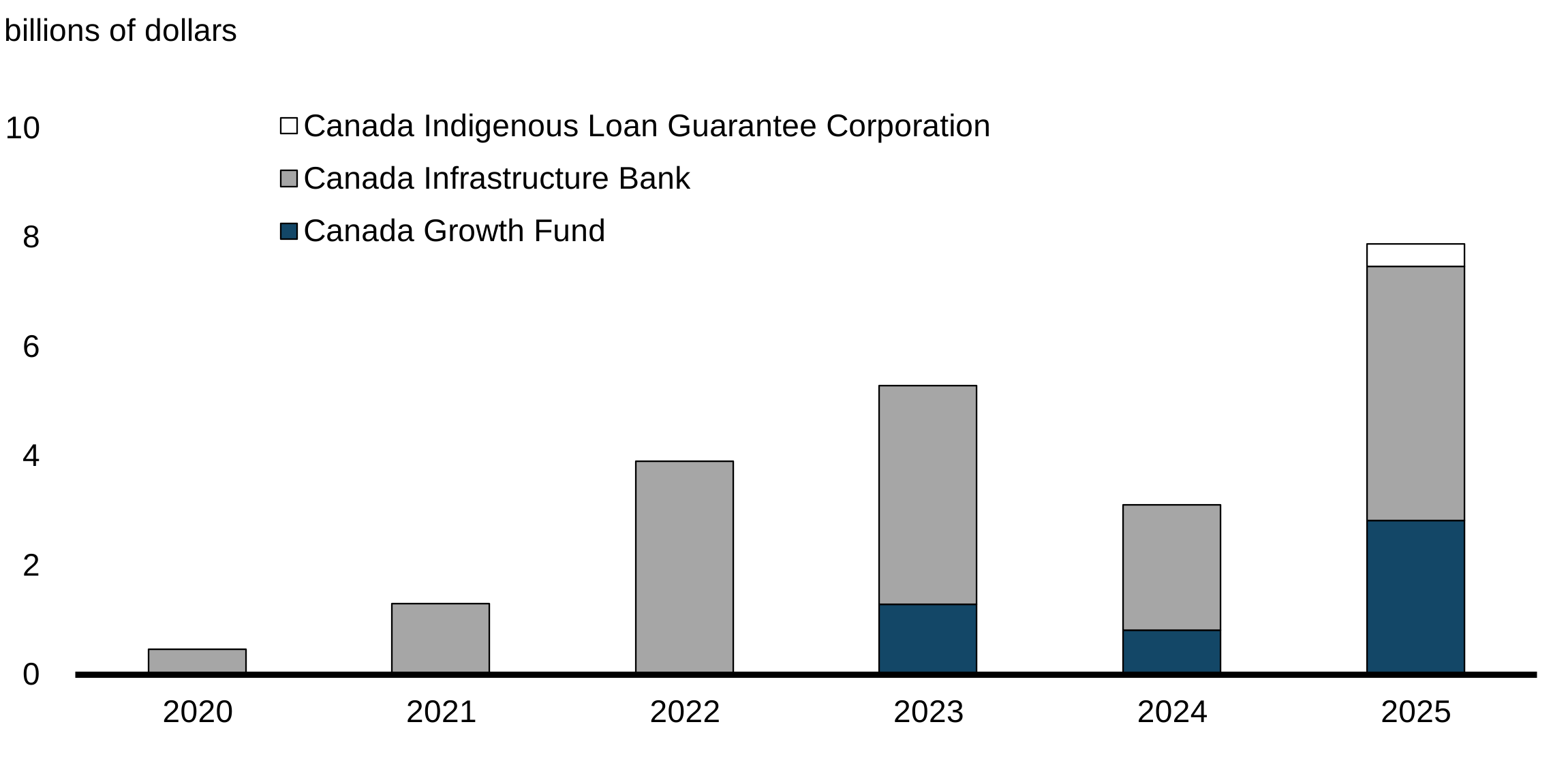
The government has relied on targeted investment vehicles in the past to advance strategic economic objectives. Federal investment vehicles are actively backing projects to crowd in private capital and support growth in priority sectors. Collectively, investments through key federal vehicles have totalled more than $20 billion over 2020-2025 (Chart 1.2), helping to strengthen Canada's productive capacity and economic resilience across key sectors.
Annual Project Financing Provided by Federal Investment Vehicles
These investments help ensure Canada can seize strategic opportunities, boost our global competitiveness, and build a stronger, more resilient economy.
The Spring Economic Update 2026 builds on this momentum, with strategic investments in projects and infrastructure that further support investment, productivity, and growth, enabling Canadians and Canadian businesses to seize new opportunities and drive Canada's economic growth.
Advancing Nation-Building Projects Through the Major Projects Office
The Major Projects Office is advancing nation-building projects faster and more responsibly to help connect our economy, diversify our industries and trade, and create high-paying jobs and careers for generations to come. Working alongside partners, we are unlocking Canada's economic potential, while respecting our environmental responsibilities and the rights of Indigenous people.
The Major Projects Office has announced 15 projects, representing over $125 billion in capital investments, and is developing 6 transformative strategies. On March 12, the government announced four new projects developed out of the former Arctic Economic and Security Corridor strategy and referred them to the Major Projects Office. At a time when Canada's North is undergoing profound change, driven by rising geopolitical pressures and a rapidly warming Arctic, these projects are critical to strengthening sovereignty, resilience, and long-term economic opportunity in the region. On April 9, less than seven months after the referral of the Port of Montreal's Contrecoeur Container Terminal Project, the Prime Minister announced that we are breaking ground after a $1.16 billion financing commitment from the Canada Infrastructure Bank. The government also announced an investment from the Canada Growth Fund in Nouveau Monde Graphite on April 9. The government will continue to refer projects and finance projects on a rolling basis.
The Major Projects Office will derisk nation-building projects in order to attract the financing required to move them forward. To fill financing gaps, the government is deploying available capital from the Canada Infrastructure Bank, Canada Growth Fund, Canada Indigenous Loan Guarantee Corporation, and Export Development Canada. These Crown corporations will advance financing solutions that deliver value for money for taxpayers.
Referred projects to date represent over $125 billion in capital expenditure by the private sector, federal, and provincial governments
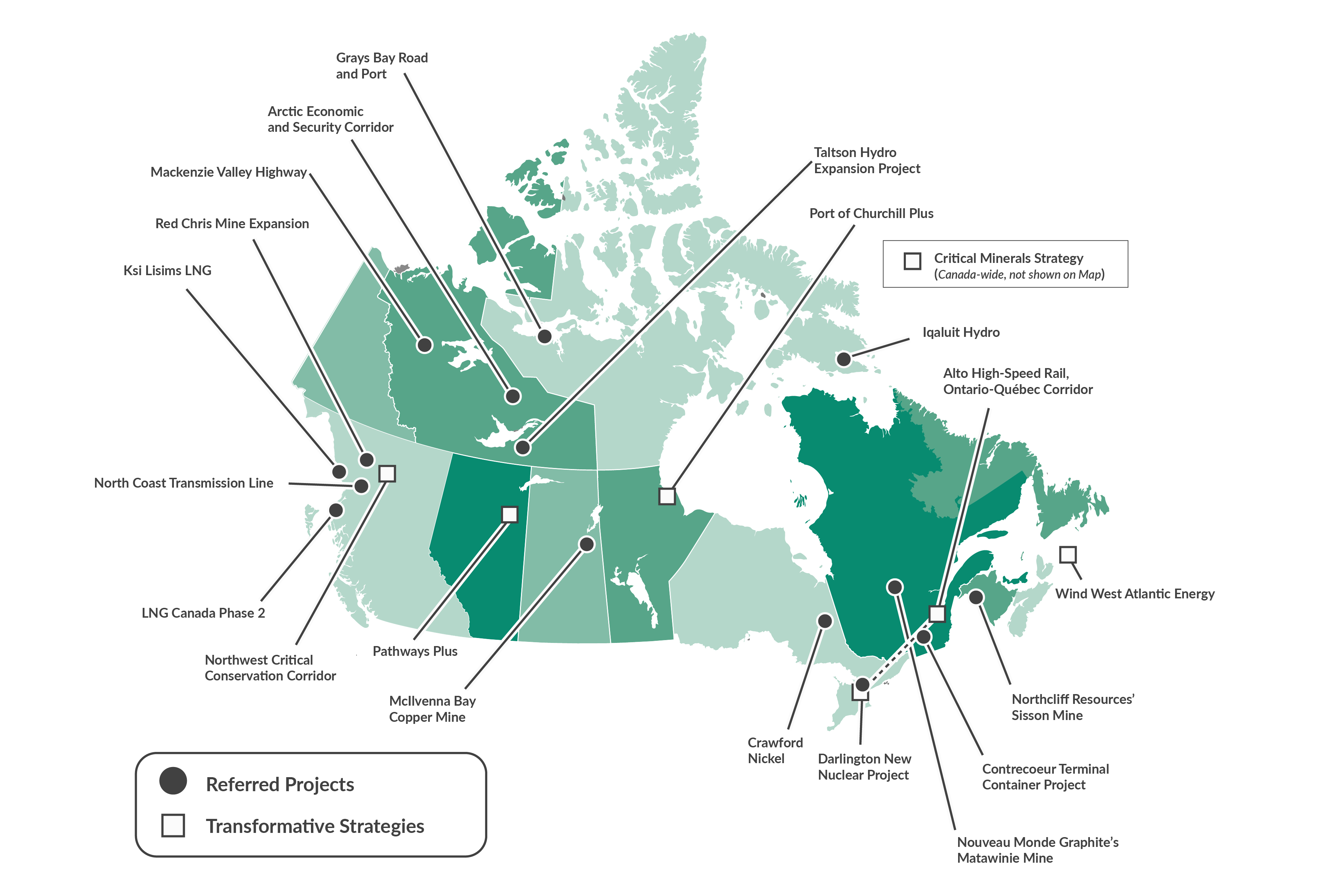
Projects Referred to the Major Projects Office
15 projects
6 transformative strategies
Will support over 60,000 jobs
Represents over $125 billion in new investment
| Projects | Proponent | Sector | Location |
|---|---|---|---|
| Canada Nickel's Crawford Project | Canada Nickel Company | Mining | Timmins, Ontario |
| Contrecoeur Terminal Container Project | Montreal Port Authority | Industrial | Contrecoeur, QC |
| Darlington New Nuclear Project | Ontario Power Generation | Electricity | Bowmanville, ON |
| Iqaluit Nukkiksautiit Hydro Project | Nunavut Nukkiksautiit Corporation | Electricity | Iqaluit, Nunavut |
| Ksi Lisims LNG | Western LNG, Nisga'a Nation, Rockies LNG Partners | Energy | Pearse Island, British Columbia |
| LNG Canada Phase 2 | LNG Canada | Energy | Kitimat, BC |
| McIlvenna Bay Foran Copper Mine Project | Foran Mining | Mining | East-Central, SK |
| North Coast Transmission Line (NCTL) | B.C. Hydro | Electricity | Northwestern British Columbia |
| Northcliff Resources' Sisson Mine | Northcliff Resources Ltd. | Mining | Sisson Brook, New Brunswick |
| Nouveau Monde Graphite's Matawinie Mine | Nouveau Monde Graphite | Mining | Saint-Michel-des-Saints, Québec |
| Red Chris Mine Expansion | Newmont Mining & Imperial Metals | Mining | Northwestern British Columbia |
| Taltson Hydro Expansion | Government of the Northwest Territories (GNWT) | Electricity | Great Slave Lake region, Northwest Territories |
| Mackenzie Valley Highway | Government of the Northwest Territories | Transport | Wrigley to Inuvik, NWT |
| Grays Bay Road and Port (GBRP) | West Kitikmeot Resources Corporation | Transport | Kitikmeot Region, Nunavut |
| Arctic Economic and Security Corridor (AESC) | Tłı̨chǫ Gov't, Dene First Nation, and the GNWT | Transport | Slave Geological Province, Northwest Territories |
| Strategy | Sector | Location |
|---|---|---|
| Alto High-Speed Rail | Transportation | Ontario-Quebec Corridor |
| Critical Minerals Strategy | Mining | All provinces except for PEI |
| Northwest Critical Conservation Corridor | Electricity, Mining | Northwestern British Columbia, Southern Yukon |
| Pathways Plus | Energy | Alberta |
| Port of Churchill Plus | Transportation | Manitoba |
| Wind West Atlantic Energy | Energy | Nova Scotia, New Brunswick, PEI, Newfoundland and Labrador |
Establishing One Project, One Review
The Government of Canada is advancing efforts to realise "one project, one review" by working with provinces and territories to establish cooperation agreements. On June 2, 2025, Canada's First Ministers agreed to "work together toward efficiently and effectively implementing 'one project, one review' with the goal of a single assessment for all projects." This will implement a more efficient assessment process that minimises duplication and delivers major projects faster while reinforcing strong environmental protections.
Co-operation agreements with provinces enable the use of new flexibilities in the Impact Assessment Act. These flexibilities include the ability to provide for substitution to a single harmonised process that draws on the best available provincial and federal expertise. Cooperation agreements can also allow for early assessment decisions and full substitution to a provincial process that meets both federal and provincial requirements. They do not affect the duty of proponents, provinces, territories, and the federal government to fully consult with Indigenous people whose rights may be affected. This will help ensure accelerated assessments for major projects, including projects of national interest, and signal to investors that Canada's federal and provincial governments are committed to working together to enable development, while protecting Indigenous rights and the environment.
The government has been negotiating agreements with provinces and is delivering results on this commitment. Agreements have already been finalised with Ontario, New Brunswick, Prince Edward Island, Alberta, Manitoba and Nova Scotia and a draft agreement with Newfoundland and Labrador has been published for public comment and others are under discussion. In 2019, British Columbia was the first province to sign a cooperation agreement with Canada.
The government is currently developing policy, operational, regulatory and legislative measures to achieve all federal decisions on major projects within a maximum of two years, down from the previous five-year target. These measures will support timely decisions, reduce risks for proponents, boost investor confidence, and support Canada's competitiveness in a fast‑changing global economy.
Growing the Indigenous Loan Guarantee Program
The Indigenous Loan Guarantee Program provides Indigenous groups access to the capital they need to overcome historic barriers and be meaningful equity partners in major projects. The government announced updates to the program in Budget 2025, to support Indigenous investors in greenfield (new build) projects that will generate economic prosperity for future generations as well as provide loan guarantees to support debt financing for Indigenous-led projects. This builds upon previous enhancements, including doubling the size of the program from $5 billion to $10 billion, and expanding eligibility of projects to sectors beyond energy and natural resources.
Since Budget 2025, the program announced its second loan guarantee, which supports an investment by two First Nations in Ontario for a nearly 20 per cent stake in Hydro One's Chatham to Lakeshore transmission line. This builds on its first loan guarantee, announced in May 2025, of $400 million to support an investment by 38 First Nations in British Columbia for a 12.5 per cent stake in Enbridge's Westcoast pipeline system.
Prioritising Nation-Building Projects in Tax Processes
Corporate taxpayers contemplating significant transactions often require certainty on tax treatment before going ahead with a major project. The Canada Revenue Agency (CRA) supports this need by issuing timely and binding advance income tax rulings, which enable businesses to move forward with confidence. Tax rulings help ensure that tax legislation is applied consistently and predictably across transactions to support transparency, fairness, and informed decision-making.
- To support the government's objective of building a strong Canadian economy, the Spring Economic Update 2026 announces that the CRA will prioritise requests for advance income tax rulings related to large-scale, nation-building projects—such as housing and infrastructure—as well as projects of national importance. Priority will also be given to advance income tax ruling requests relating to investments that enhance productivity and strengthen critical sectors of Canada's economy, including clean economy initiatives and projects that may benefit from Canada's suite of clean economy investment tax credits.
In Budget 2025, the government reaffirmed its commitment to the clean economy investment tax credits by increasing CRA resources by $146 million over five years, starting in 2025-26, for the administration of these measures. With this additional funding, the CRA is expected to increase processing of claims by more than 4.5-fold by July 2026. This targeted investment will help the CRA reduce the backlog of claims over the course of 2026 and ensure a more timely delivery of these credits going forward.
Advancing Critical Minerals Projects
Critical minerals are essential to the technologies and industries that power the modern economy and contribute to a more secure future. They are used in a wide range of essential products ranging from mobile phones and solar panels to electric vehicle batteries, medical devices and defence applications. Global demand for critical minerals is set to grow rapidly over the next two decades, and Canada is well-positioned to continue building on its position as a global leader in the responsible development of critical minerals. As geopolitical competition intensifies, securing supply chains for these critical minerals has become a strategic imperative. To help combat rising risks across global critical minerals supply chains and to strengthen our economic security, the government is taking action to grow Canada's critical minerals industry and to develop resilient value chains through trusted international partnerships.
Canada is advancing critical minerals production and processing projects across the country, supported by targeted federal actions and partnerships. This includes working through the Critical Minerals Production Alliance, a Canada-led G7 initiative to diversify and secure global critical minerals production and supply. The following highlights selected projects along the critical minerals value chain.
| Project | Type | Location | Federal investment |
|---|---|---|---|

Nouveau Monde Graphite – Matawinie Mine
|
Graphite mine | Saint-Michel-des-Saints, Québec |
|

Rio Tinto Fer et Titane – Scandium Oxide
|
Commercial-scale scandium oxide production | Sorel-Tracy, Québec |
|

Focus Graphite
|
Graphite for defence and advanced manufacturing | Baie-Comeau, Québec |
|

Frontier Lithium Processing Facility
|
Lithium processing facility | Thunder Bay, Ontario |
|

British Columbia Hydro Transmission System Upgrades
|
Electricity transmission capacity for critical minerals projects | Kamloops, British Columbia, and Northwest British Columbia |
|

E3 Lithium – Clearwater Project
|
Lithium refining demonstration program | Olds, Alberta |
|

Cyclic Materials
|
Rare earth elements recycling | Kingston, Ontario |
|

Saskatchewan Power Corporation
|
Electricity grid connection to support critical minerals mining | Athabasca Basin region and Regina, Saskatchewan |
|
Expanding the Carbon Capture, Utilization, and Storage Investment Tax Credit to Enhanced Oil Recovery
The refundable Carbon Capture, Utilization, and Storage (CCUS) investment tax credit provides support for investments in CCUS technologies.
The extent to which the CCUS tax credit is available to an eligible CCUS project and associated eligible equipment depends on the end use of the carbon dioxide (CO2) that is captured. Currently, eligible uses include dedicated geological storage and storage in concrete, but not enhanced oil recovery (EOR).
- Following through on the commitment made by the government in the November 27, 2025, Canada-Alberta Memorandum of Understanding, the Spring Economic Update 2026 proposes that EOR be made an eligible use for the purposes of the CCUS tax credit.
Credit rates would be set at 30 per cent for direct air capture equipment, 25 per cent on other capture equipment, and 18.75 per cent on transportation and storage/use equipment. These rates reflect the additional revenue stream available to CCUS projects that perform EOR. Like other forms of eligible CO2 uses, CCUS projects that perform EOR would be required to permanently store the captured CO2.
EOR would be made an eligible use starting the Day of the Spring Economic Update 2026, subject to the designation of a jurisdiction by the Minister of the Environment.
It is estimated that the proposal will increase federal revenues by $395 million over four years, starting in 2027-28.
Implementing Accelerated Capital Cost Allowance Rates for Low-Carbon Liquefied Natural Gas Facilities
As a leading global energy producer, Canada is supporting investment in lower-emissions liquefied natural gas (LNG) through targeted tax measures. Budget 2025 proposed to reinstate the accelerated capital cost allowances (CCAs) for eligible LNG equipment and related buildings, but only for low-carbon LNG facilities.
- The Spring Economic Update 2026 proposes the implementation details for this measure.
- To be eligible for an accelerated CCA, the expected emissions intensity of an LNG facility's on-site liquefaction activities, measured in tonnes of carbon dioxide equivalent per tonne of LNG produced annually (tCO₂e/tLNG), would have to be less than or equal to 0.20 tCO2e/tLNG. The accelerated CCA rate would be 50 per cent for liquefaction equipment and 10 per cent for facility non-residential buildings.
Facilities with an expected emissions intensity higher than 0.20 tCO₂e/tLNG would not be eligible for the measure.
The measure would apply to property acquired on or after November 4, 2025 and before 2035.
Launch of the Build Communities Strong Fund
Building the future we want starts with building the communities we want. In Budget 2025, the government announced the Build Communities Strong Fund (BCSF) to revitalise local infrastructure—the hospitals, universities, and colleges that serve our people, the roads and bridges that move our goods, and the water and transit systems that sustain our towns.
The BCSF will build new infrastructure to speed up work and bring down costs. When colleges and universities have aging buildings, when hospitals are over capacity, and when water systems fail, people and communities are adversely impacted. The Fund will spur economic activity, create new careers in the skilled trades, and give investors the confidence to build around reliable public infrastructure.
The Build Communities Strong Fund launched on April 7, 2026, with a $51 billion investment over 10 years, starting in 2026-27, and $3 billion ongoing.
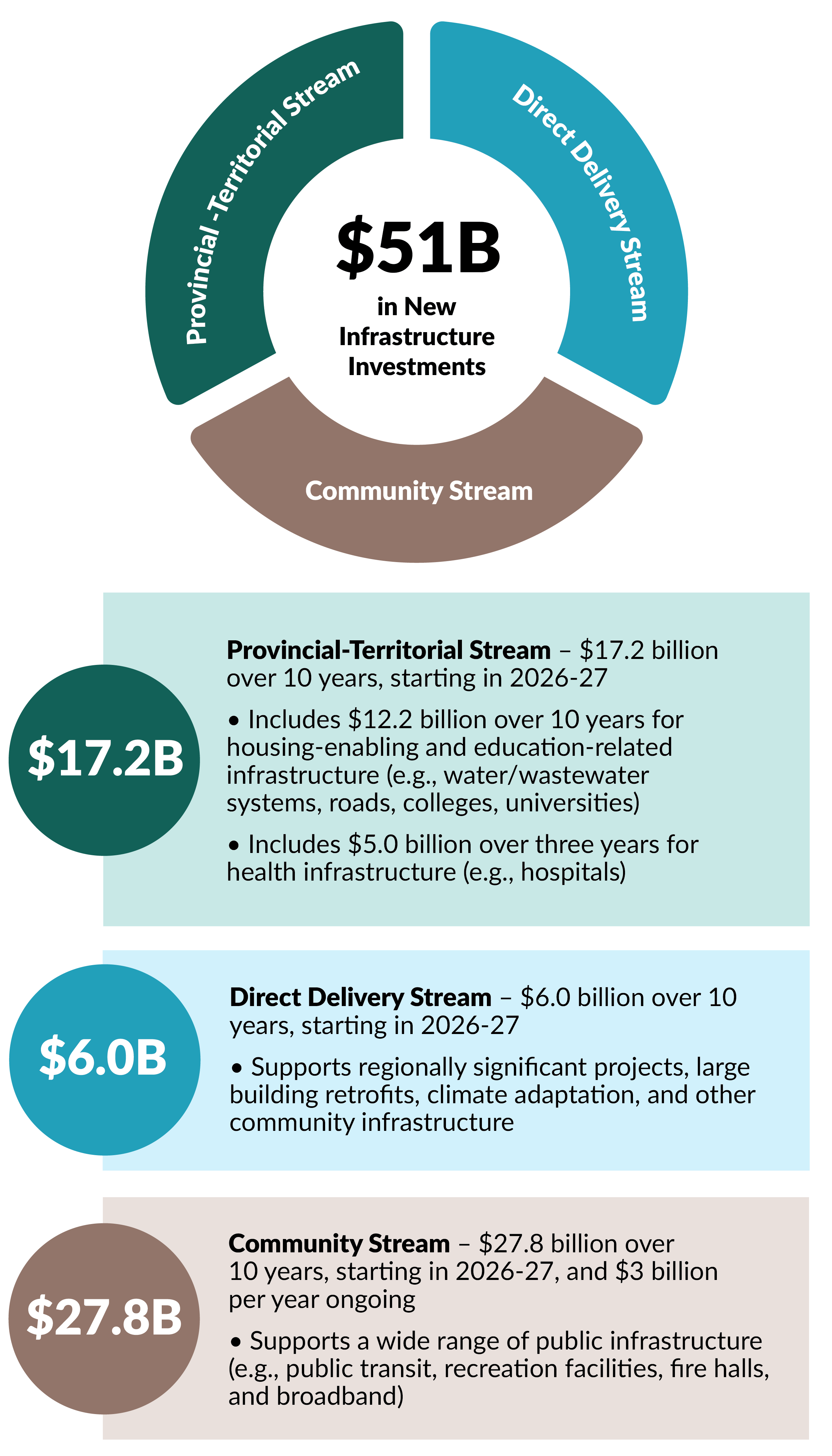
Under this program, the federal government is working with provinces and territories to develop successful partnerships through negotiated bilateral agreements to lower the costs to build new homes.
Jurisdictions with the highest development charges will be required to reduce them for three years, with flexibility for municipalities where these charges are not a barrier. Other jurisdictions must maintain existing development charge restrictions (such as freezes or deferrals) and avoid introducing new taxes that limit housing supply. As part of the government's partnership with Ontario, described in Chapter 2, the province has agreed to reduce development charges by up to 50 per cent for three years in its largest and fastest-growing cities, covering approximately 80 per cent of the province's population.
The Government's Vision: Artificial Intelligence for All
The new National AI Strategy will respond to our consultation with over 11,000+ submissions from Canadians and 28 expert Task Force members. Canadians want AI that is safe and sovereign, and to drive AI adoption, create new economic opportunities, strengthen public services, and improve our quality of life. The government will advance these objectives through the six pillars of a forthcoming AI Strategy:
Pillar 1: Protecting Canadians and Safeguarding our Democracy
AI will only deliver on its promise if Canadians trust it. That requires modern privacy and online safety laws, strong national AI safety capabilities, and secure government systems.
Pillar 2: Empowering Canadians
Canada must become an AI skills nation, where AI creates good jobs for Canadians, by giving access to AI training and education for all Canadians, and by representing and including Canadian voices, languages, and culture.
Pillar 3: Powering AI Adoption for Shared Prosperity
The gains of AI will come from putting it to work across the Canadian economy and developing pro-worker, industrial AI technologies. AI for All will support accelerated adoption among small- and medium-sized enterprises and transform public service delivery to deliver better services to Canadians.
Pillar 4: Building the Canadian Sovereign AI Foundation
AI for All will support the building of sovereign compute infrastructure at scale — resilient, sustainable, and under Canadian governance, and grow Canada's exceptional AI researchers and talent pool.
Pillar 5: Scaling Canadian Champions
To scale great AI companies in Canada, AI for All will unlock growth capital and leverage government as a strategic anchor customer.
Pillar 6: Building Trusted Partnerships and Global Alliances
Canada will work with a variety of trusted partners to align standards, co invest in innovation, and help Canadian companies access global markets—while shaping an AI ecosystem anchored in democratic values.
Making the Employee Ownership Trust Tax Exemption Permanent
An Employee Ownership Trust (EOT) is a form of employee ownership where a trust holds shares of a corporation for the benefit of its employees. EOTs may be used to facilitate the purchase of a business by its employees and provide an additional option for succession planning. A temporary $10 million capital gains tax exemption, in effect for the 2024, 2025, and 2026 tax years, was introduced in the 2023 Fall Economic Statement to incentivise EOT creation. This exemption was expanded to include sales to worker cooperatives, as was announced in Budget 2024.
Building and buying Canadian is a core mission of our government—and EOTs empower Canadian workers to buy into their businesses. With a generational wealth transfer set to occur over the coming decades—EOTs will enable workers to participate directly in building Canada strong.
- To ensure that eligible businesses and workers can benefit from employee ownership, the Spring Economic Update 2026 proposes to make this tax exemption permanent.
Improving Administration for the Scientific Research and Experimental Development Tax Incentive Program
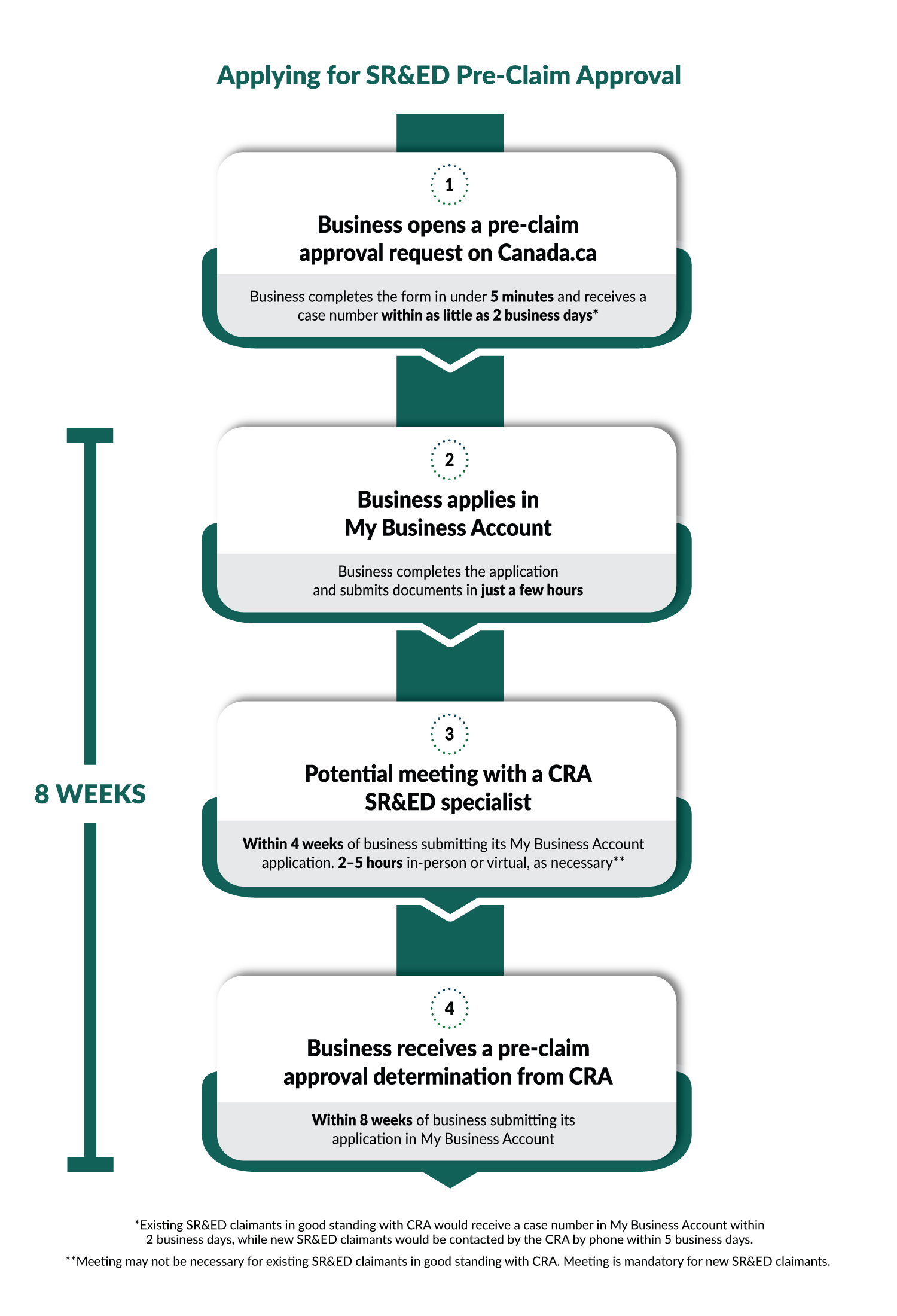
As announced in Budget 2025, on April 1, 2026, the Canada Revenue Agency (CRA) introduced an elective pre-claim approval process to provide businesses with an up-front technical approval of their eligible Scientific Research and Experimental Development (SR&ED) projects, before businesses undertake any work or incur costs.
The CRA incorporated feedback from businesses and industry associations into the design of the pre-claim approval process, which can be completed in four easy steps and provides businesses with an eligibility determination within eight weeks. For claims submitted through this elective process that require an expenditure review, processing time will be cut in half to 90 days from 180 days.
These improvements underscore the government's commitment to co‑developing solutions with industry partners and to continuing to modernise the SR&ED program's administration to meet businesses' needs.
1.3 Supporting Strategic Sector Initiatives
The global trade landscape is rapidly changing, as the United States fundamentally transforms all of its trading relationships. The effect is profound—displacing workers, disrupting supply chains, forcing companies to rethink where they source their materials and products, and causing uncertainty that is curbing investment.
To help businesses and workers adapt and remain competitive, the government introduced strategic support initiatives, including the newly launched automotive strategy, alongside targeted actions to strengthen domestic market conditions and meet labour needs. Together, these actions stand to reinforce Canada's industrial strengths, expand market opportunities, and secure high‑quality jobs across the country.
Measures Taken to Support Workers and Businesses
Behind every tariff announcement is a worker wondering about their job, a family worried about their income, or a business or community concerned about its future. Our approach is clear: support Canadian workers, defend Canadian industries, and invest in long-term resilience.
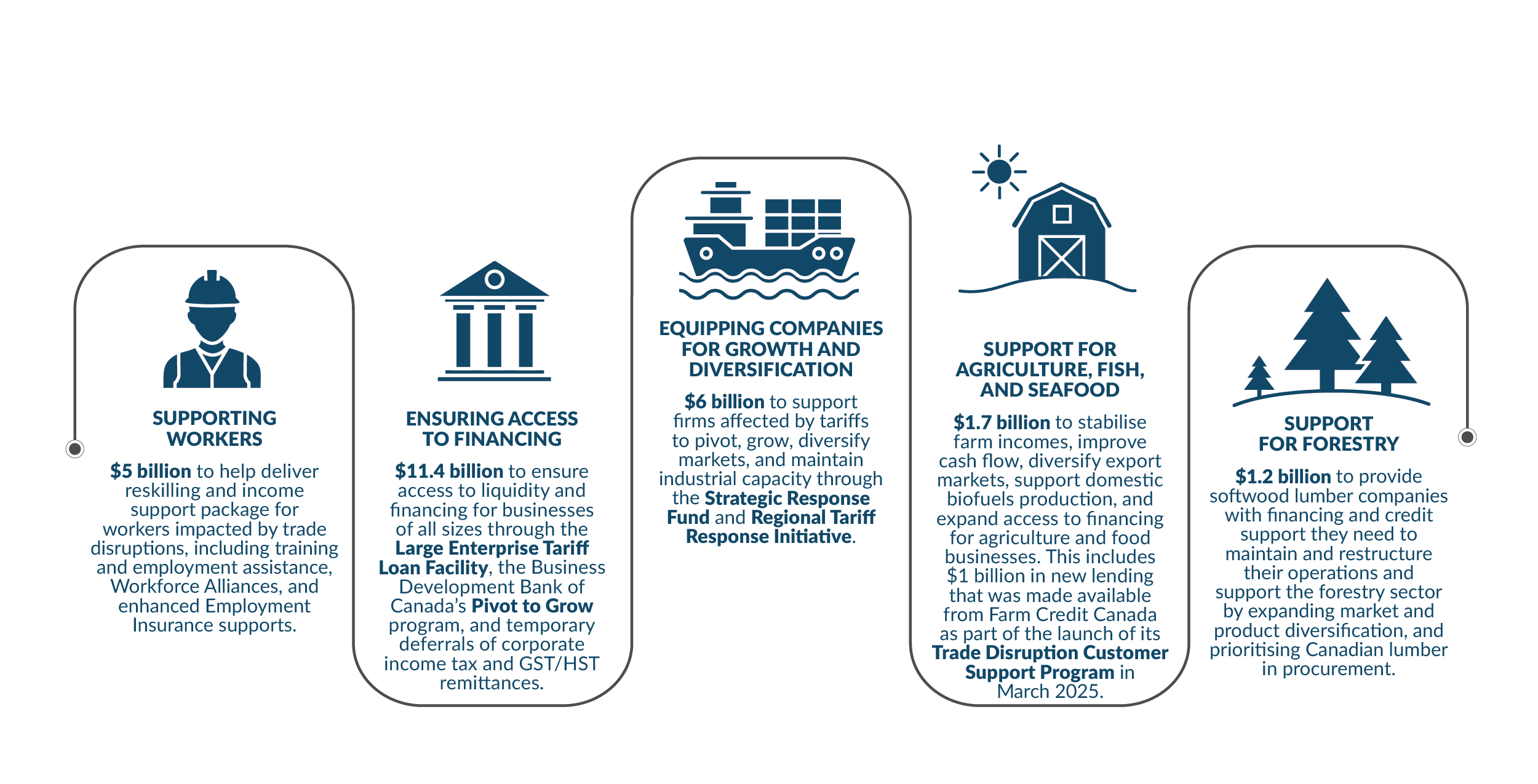
These initiatives will help workers acquire new skills and businesses retool their production and diversify their products, while spurring more domestic demand for Canadian businesses. Building on the $25 billion in supports set out in Budget 2025, the government subsequently announced an additional $1.6 billion over six years, starting in 2025-26, for workers and businesses affected by tariffs and trade disruptions.
The Spring Economic Update 2026 outlines these previously announced measures, including:
Worker Supports

Extension of temporary flexibilities to the Employment Insurance Work-Sharing Program for one additional year, until March 2027. These flexibilities will continue to help employers and employees avoid layoffs while supplementing reduced income with Employment Insurance benefits.

Extension of temporary Employment Insurance measures—for six additional months until October 2026—to ensure that income supports remain generous for workers whose jobs are impacted by tariffs. These include:
- Waiving the one-week EI waiting period.
- Suspending the treatment of monies paid on separation.
- Providing 20 additional weeks of regular benefits for long-tenured workers.

The Worker Retention Grant for employers to help them support their Work-Sharing employees to upskill and adapt to changing labour market needs. Newly launched on February 17, 2026, this top-up supplements employees' incomes while they train during lost work time.
Business Supports

Temporary freight rate relief for steel and lumber, to decrease domestic transportation costs and encourage consumption of Canadian-made products.

The Business Development Bank of Canada's Softwood Lumber Guarantee Program ensures softwood lumber companies have the financing and credit support they need to maintain and restructure their operations during this period of transformation.

The government also created a Canadian Forest Sector Transformation Task Force to examine and report on how the forest industry can maintain its competitiveness over the long term and launched a single window service to support forest sector employers and workers navigate and apply to federal programs.

Temporarily increase the Advance Payments Program's interest-free limit to $250,000 for the 2026 program year for all producers, except for canola producers. This is in addition to the announcement in September 2025 to temporarily increase the limit to $500,000 for canola producers for the 2026 program. This will result in interest savings for producers while increasing access to cash flow to help cover costs until they sell their products.
To help mitigate the impacts of Canada's tariff regime on downstream producers, the government established a tariff remission framework to provide tariff relief in situations where inputs cannot be sourced domestically and to address other exceptional circumstances. The government continues to prioritise timely relief to eligible companies, including pertaining to imports under its China tariffs, U.S. tariffs, steel tariff rate quotas, and steel derivative tariffs. Additionally, horizontal relief from counter tariffs against the U.S. is available for aluminum inputs to Canadian manufacturing, processing, agricultural production, and food and beverage packaging, as well as for steel inputs to autos, aerospace, and related parts production. This horizontal relief is immediately accessible for all eligible importers without the need for an application.
Moving Forward With the Automotive Strategy
For over 100 years, Canada's automotive industry has been a cornerstone of Canada's economy, supporting hundreds of thousands of well‑paying jobs across the country. Canada's automotive industry is on the frontline of global trade shifts, with more than 90 per cent of Canadian-made vehicles and 60 per cent of Canadian-made auto parts currently exported to the U.S.
As an energy superpower, the rise of electrified and connected vehicles presents a unique opportunity to transform Canada's automotive industry. To that end, the government launched a new automotive strategy in February 2026. As set out below, over $6.9 billion has been announced to support the automotive sector.
1. Boosting Automotive Investment

- Up to $3 billion through the Strategic Response Fund
- Up to $100 million through the Regional Tariff Response Initiative
- Enhanced productivity support through the Productivity Super-Deduction
- Reduced tax rates for zero-emission technology manufacturers
2. Strengthening Climate Goals

- Introducing stronger greenhouse gas emissions standards to replace the Electric Vehicle Availability Standard
- Flexible pathways for automakers to meet Canada's climate objectives
3. Making Electric Vehicles Affordable and Reliable

- $2.3 billion Electric Vehicle Affordability Program
- On March 31, 2026, the program portal opened for eligible purchases and leases made on or after February 16, 2026
- National Charging Infrastructure Strategy
- lncludes $1.5 billion through the Canada lnfrastructure Bank's Charging and Hydrogen Refuelling Infrastructure lnitiative
4. Protecting Canadian Auto Workers

- New Worker Retention Grant to help employers retain staff
- Skills development investments through a new Workforce Alliance (industry, labour, training providers)
- Employment assistance and reskilling for displaced workers via Labour Market Development Agreements
In response to persisting and unjustified U.S. tariffs on our vehicle exports, we will maintain our reciprocal counter tariffs to ensure a level playing field for Canadian automotive manufacturers in the domestic market.
Canada's automotive duty remission framework further leverages these counter tariffs, creating a strong incentive for manufacturers to sustain their vehicle assembly levels in Canada if they wish to benefit from duty relief for their American-made imports. In February 2026, Canada launched public consultations, which have now concluded, to explore how this framework could be improved as a targeted, performance-based tool that further consolidates domestic production, attracts new investment, and enhances the long-term competitiveness of Canada's automotive sector. As a starting point, the government is considering a potential system where companies earn tradeable credits based on their production in Canada.
Canada will also leverage new and existing trade agreements, including the recent agreement with China, to support new investment in the sector, diversify Canada's auto export markets, and position Canada as a global leader in electric vehicles.
Extending Alcohol Excise Duty Relief to Support Canadian Breweries, Distilleries, and Wineries
The government recognises the important contributions of Canada's breweries, distilleries and wineries to the economy, including job creation and the production of high-quality Canadian products. In recent years, producers have faced rising cost pressures from global economic uncertainty, supply chain disruptions, and higher input costs.
To help the sector manage challenges from high price increases, Budget 2023 introduced a temporary 2 per cent cap on the annual inflation adjustment for excise duties on beer, wine, and spirits, effective April 1, 2023. On March 9, 2024, the government announced a two-year extension of this cap and introduced a temporary 50 per cent reduction in the excise duty rate on the first 15,000 hectolitres of beer brewed in Canada.
On April 1, 2026, the government announced its intention to further extend both measures for an additional two years. Together, these measures are expected to provide about $30 million in total relief through to 2028, including up to about $90,000 in tax savings in 2026-27 for a craft brewery on the first 15,000 hectolitres.
Update on the Buy Canadian Policy
Central to the government's strategy to build a more resilient economy is Buying Canadian and being our own best customer.
Since the Buy Canadian policy came into force on December 16, 2025, it is already reshaping how the federal government spends—prioritising Canadian content, materials, suppliers, and workers. From steel and aluminum to wood products, the government's purchasing of goods and services is being used as a powerful tool to back key industries and strengthen domestic supply chains.
This policy is already making a difference. The federal government purchases about $37 billion in goods and services each year. As of mid-April 2026, just a couple of months after its implementation, the Buy Canadian policy has already applied to a portfolio of solicitations valued at around $3.6 billion with $527.9 million worth of contracts awarded to date. This includes the procurement of vaccines for provincial and territorial partners, as well as facility management services, breathing apparatus maintenance, and communication bridge systems for the Department of National Defence.
The government is also bringing provinces, territories and municipalities on board with the Buy Canadian policy. It extends across the federal government and across all federal funding streams, including grants and contributions. As a result, in Toronto, new subway trains for Line 2 will be built with at least 55 per cent Canadian content—supporting good jobs and reinforcing Canada's industrial base. The government hopes to expand this collaboration and welcomes all partners to support buying Canadian, including industry and other levels of government.
Building on this momentum, the government will launch a new Small and Medium Business Procurement Program later this spring to make it easier for Canadian firms to compete and win in federal procurements, by modernising digital tools and reducing barriers.
Update on the Temporary to Permanent Resident Pathways
To build the strong economy that Canada needs, the government is taking back control to return immigration to sustainable levels, while ensuring immigration contributes to the economic and social fabric of the country. Recent actions to control immigration are working: asylum claims were down by 64 per cent between January and February 2026 compared to the same period in 2024, while new temporary foreign worker and international student arrivals between January and February 2026 were 71 per cent and 75 per cent lower compared to the same period in 2024.
In parallel, we are attracting and retaining highly skilled immigrants, including those who are already living in, working in, and contributing to our country. As announced in Budget 2025, the government is delivering two one-time, two-year initiatives to:
- fast-track permanent residence for a total of 33,000 skilled temporary workers who are already working in Canada and contributing to their communities—with a focus on immigrants in rural areas; and
- provide stability for Protected Persons in Canada by processing applications from up to 115,000 individuals who have been recognised as needing protection by the Immigration and Refugee Board of Canada or by Immigration, Refugees and Citizenship Canada.
1.4 Expanding Trade at Home and Abroad
Building a more competitive and diversified Canadian economy means growing our trade opportunities at home and abroad. Canada already has a suite of measures to promote investment in Canada.
To make it easier for businesses and workers to succeed, the government is now advancing measures that remove trade barriers within and outside of Canada, so firms can scale and compete more effectively. The government is also taking steps to make generational investments in infrastructure to help firms move goods to markets more reliably and competitively, while also driving growth in communities across Canada.
Advancing Internal Trade in Canada
More internal trade will boost productivity and make Canada's economy more resilient to disruptions to international trade. According to a recent study by the International Monetary Fund, eliminating all internal trade barriers could raise the level of Canada's real gross domestic product (GDP) by nearly 7 per cent over the long run. This would amount to an increase of about $210 billion in annual GDP or $5,000 per person in today's terms. While the government has made progress to reduce internal trade barriers, more work needs to be done by all partners to keep momentum.
This is why the federal government continues to take action and work with provincial and territorial partners to create an economy where businesses can grow without borders, workers can move without friction, and Canadians can benefit from lower costs, stronger competition, and greater opportunity. Recent progress on advancing internal trade includes the following:
-
As of June 2025, all 53 federal exceptions to the Canadian Free Trade Agreement (CFTA) have been removed.
-
The federal Free Trade and Labour Mobility in Canada Act is now in place, reducing federal barriers by requiring regulators to recognise comparable provincial and territorial requirements—making it easier for businesses to trade and for skilled workers to work across Canada.
-
To enhance transparency and certainty for financial service suppliers, federal, provincial, and territorial governments welcome the entry into force of the new Financial Services Chapter under the CFTA.
-
Federal, provincial, and territorial governments are working to strengthen Chapter 7 of the CFTA, which will implement a 30-day service standard and reduce administrative requirements for labour mobility applicants in all regulated professions and trades in Canada.
-
Federal, provincial, and territorial governments have agreed to sign the Canadian Mutual Recognition Agreement on the Sale of Goods, introducing a simple principle—if a good can be legally sold in one jurisdiction, it can be sold in another without additional rules or approvals.
-
Participating provinces and territories reaffirmed progress on the direct-to-consumer alcohol sales agreement at the Committee on Internal Trade meeting on March 30, 2026, prioritising implementation by the May 2026 deadline, depending on legislative requirements for each jurisdiction.
-
Launched the Domestic Trade Commissioners Network to help businesses build connections, solidify partnerships, expand their markets and strengthen Canadian supply chains through domestic trade missions.
Opening and Expanding New Trade Markets
Canada's economic prosperity and resilience rely on increasing and diversifying our exports. With preferential access to 1.5 billion consumers across 15 free trade agreements, spanning 51 countries and nearly two thirds of global GDP, Canada is well positioned to expand its global reach. To advance the objective of doubling overseas exports over a decade, the government is pursuing a multi-faceted approach to create new opportunities through the removal of trade barriers.
The government has recently signed important new agreements, including:
- The Canada-China strategic partnership in which China agreed to reduce or suspend tariffs for key agricultural and seafood exports.
- A new free trade agreement with Indonesia.
The Comprehensive and Progressive Agreement for Trans-Pacific Partnership (CPTPP) has also been expanded to include the United Kingdom.
The government is also committed to seeking new free trade agreements (FTAs):
- In March 2026, Canada and India committed to conclude an FTA by the end of this year.
- In November 2025, Canada and the United Arab Emirates announced their intention to negotiate an FTA.
- Canada is working to finalise FTA negotiations with the Association of Southeast Asian Nations, and has launched bilateral FTA negotiations with the Philippines and exploratory discussions with Thailand.
- Canada has resumed FTA negotiations with Mercosur countries (Argentina, Bolivia, Brazil, Paraguay, and Uruguay) with a view to concluding an agreement as soon as possible.
Canada will look to leverage existing agreements, such as the CPTPP and the Canada-European Union Comprehensive Economic and Trade Agreement. The government is deploying intensive efforts, including trade missions and attracting new investment to Canada, with these reliable partners.
Along with an extensive agenda for trade negotiations, the government is pursuing partnerships in key sectors, such as energy, critical minerals, clean energy technologies, defence, artificial intelligence, and agriculture.
Maintaining and Improving Market Access to the United States
As Canada diversifies and deepens its trade relationships, the U.S. market remains a top destination for Canadian exports. Canada has the best free trade deal of all countries with the United States.
The Canada-United States-Mexico Agreement (CUSMA) underpins broad exemptions from certain U.S. tariffs and ensures that approximately 85 per cent of Canada's exports to the U.S. remain tariff-free. With CUSMA, the effective U.S. average tariff rate on Canadian goods is 5.2 per cent—the lowest among all of the U.S.'s major trading partners. The government is working to ensure that the review of CUSMA continues to provide predictable and favourable conditions for Canadian trade and investment with the United States and Mexico.
The government will also continue to engage with the U.S. Administration to advocate for the removal of remaining U.S. sectoral tariffs that affect exports for key sectors of the Canadian economy, including U.S. tariffs on steel, aluminum, automotive, and forestry.
Building Trade-Enabling Infrastructure
To help achieve Canada's ambitious target of doubling non-U.S. exports over the next decade and to ensure that Canadian businesses can compete and succeed in today's economy, the government has committed $6 billion to Canada's Trade Infrastructure Strategy. This investment represents a generational investment in strengthening the infrastructure that connects Canada to global markets—creating good jobs, expanding opportunities for workers and businesses, and building a more resilient, secure, and sovereign Canada.
Recent progress includes:
- Launching the $5 billion Trade Diversification Corridors Fund to help build and modernise Canada's ports, railways, airports, bridges, and highways. This will help made-in-Canada goods reach overseas markets by increasing the capacity and efficiency of trade-enabling transportation infrastructure and reinforce Canada's position as a reliable trading partner.
- Launching the $1 billion Arctic Infrastructure Fund to support critical Arctic transportation infrastructure—including airports, ports, all season roads, and highways—with dual civilian and military applications. These investments will strengthen Northern communities, enhance economic development, and help secure Canada's Arctic sovereignty.
- On March 12, the government announced that the Arctic Infrastructure Fund will support the modernisation of the Rankin Inlet and Inuvik airports to accommodate larger aircraft and enable faster, more affordable year‑round military and civilian access.
- The Northern projects recently referred to the Major Projects Office will strengthen an all‑season northern transportation network, improve connectivity, lower costs, enable resource development, support Indigenous economic participation, and strengthen Canada's Arctic and Northern sovereignty.
Building More Efficient and Reliable Supply Chains
Canada's supply chains face longstanding challenges that increase costs, reduce reliability, and weaken competitiveness. Trade-enabling transportation infrastructure continues to lag global peers, with inefficiencies particularly visible at key gateways. To address these challenges, the government is examining options to strengthen Canada's supply chains including improving how trade corridors are planned and governed, accelerating the delivery of trade-enabling infrastructure, reducing regulatory burden on businesses, and modernising trade processes.
Hosting an Investment Summit
Inward direct investment provides high-value, long‑term capital that creates high‑quality jobs, boosts productivity, and brings new technologies and skills to Canada. It also enables major projects, strengthens global supply‑chain integration, and enhances Canada's competitiveness and economic resilience.
Canada is already emerging as a top destination for global investment, with inward direct investment at its highest level in nearly two decades. Building on this momentum, the government has set a target to attract $500 billion in private investment over five years.
- As announced on April 17, the Spring Economic Update 2026 proposes to facilitate the delivery of a premier Investment Summit in September 2026. This event will showcase Canada as a compelling investment destination and a trusted convener of global capital, with a focus on priority sectors such as energy and critical minerals, artificial intelligence, defence, and infrastructure.
1.5 Advancing Clean Growth and Conservation
As the global economy moves toward lower‑carbon pathways, addressing climate change and protecting Canada's natural ecosystems have become essential to sustaining both economic opportunity and environmental well‑being. Budget 2025 outlined the government's Climate Competitiveness Strategy, which created conditions for Canada to compete effectively through this transition.
The government is continuing to build on this framework by facilitating sustainable investments and by helping developing countries phase out high emitting energy sources, adopt clean technologies, and build the infrastructure needed to strengthen resilience through continued contributions to international climate finance.
At the same time, safeguarding Canada's nature protects the ecological foundations of our economy, restores habitats, and enhances species protection. Through these complementary actions, the government aims to advance economic prosperity while contributing meaningfully to global climate and biodiversity objectives.
Clean Economy Business Tax Incentives
Federal policy creates material after-tax uplift for clean economy investment

Canada's framework is internationally competitive
- Refundable investment tax credits plus expensing—and reduced tax rate for applicable manufacturing projects—can generate negative Marginal Effective Tax Rates for targeted investments.

Immediate expensing and accelerated depreciation materially improves rate of return
- 100% first-year write-off for clean energy equipment, zero-emission vehicles, manufacturing assets, patents/computers/data network infrastructure and scientific research/experimental development (SR&ED) capital expenditures.
- Up to 3× enhanced first-year write-off for other capital assets.
- Most measures available through 2029 (phase-out 2030–2033), creating a defined near-term investment window.

Refundable investment tax credits (ITCs) provide large capital subsidies (15%–60%)
- Up to 30% Clean Technology ITC (2023–2034), $13.1 billion in expected support.
- Up to 37.5%–60% Carbon Capture, Utilization and Storage ITC (2022–2040), $14.5 billion in expected support.
- Up to 15%–40% Clean Hydrogen ITC (2023-2034), $7.0 billion in expected support.
- Up to 30% Clean Technology Manufacturing ITC (2024–2034), $7.3 billion in expected support.
- Up to 15% Clean Electricity ITC (2024-2034), $27.3 billion in expected support.
- Refundability supports firms regardless of near-term profitability.

Other key tax support measures that enhance lifecycle returns
- Reduced zero-emission technology manufacturing corporate tax rate: 7.5% / 4.5% through 2034 (phase-out begins 2032).
- Canadian Renewable and Conservation Expenses can be fully deducted in the year incurred, carried forward indefinitely, or transferred to flow-through share investors—supports early-stage capital formation.
- SR&ED: provides broad-based support for research and development through a 15% general credit; 35% refundable credit for qualifying Canadian private and public corporations.
- Atlantic ITC provides additional 10% regional support.
Continuing to Support International Climate Finance
Climate change is a global challenge that requires global solutions, and all countries are being called to act. International climate finance plays a key role in enabling developing countries to reduce emissions and adapt to the growing impacts of climate change. This strengthens communities' economic resilience and supports sustainable development.
- The Spring Economic Update 2026 proposes to provide $3.0 billion over five years on a cash basis, starting in 2026-27, to Global Affairs Canada, and $167.9 million over five years on a cash basis, starting in 2026-27, to Environment and Climate Change Canada to continue delivering climate-related supports to vulnerable countries.
- In addition, the Spring Economic Update 2026 proposes to provide $2.0 billion in paid-in capital for FinDev Canada, as well as $732 million over three years on a cash basis, starting in 2028-29, to expand FinDev Canada's concessional finance facility. These measures will help to mobilise private capital at scale into climate-related businesses and projects in emerging markets and developing economies, including mobilising over $3 in private capital for every $1 of public investment through FinDev's concessional finance facility.
Together with other existing sources of climate finance, such as support provided through multilateral development banks and Export Development Canada, as well as private finance catalysed by public resources, the government's goal is for Canada to deliver over $13 billion in climate-related support to developing countries over the next five years.
Hosting a Sustainable Finance Conference
The government is committed to mobilise public and private capital to promote investment in sustainability as part of the transition to net-zero. To help credibly identify "green" and "transition" activities in priority economic sectors, the government is supporting the arm's-length development of made-in-Canada sustainable investment guidelines, also known as a taxonomy.
The Canadian Climate Institute, working collaboratively with Business Future Pathways, an investor-led initiative, are leading this work and have established an independent Taxonomy Council that will oversee the process. Advisory groups will include independent experts and representatives from academia, the financial sector and civil society, climate scientists, and Indigenous communities.
- The Spring Economic Update 2026 proposes to support Canadian Climate Institute hosting a Sustainable Finance conference in the coming year. This event will bring together domestic and international stakeholders to promote progress on the Canadian taxonomy and discuss sustainable investment opportunities in Canada.
A Force of Nature—Canada's Strategy to Protect Nature
As we build Canada strong, we are protecting what matters most, including the magnificent land and waters we have inherited. The beauty of Canada's natural environment is a treasure to be protected. Canada is one of the most nature-rich countries on earth, with 20 per cent of the world's fresh water, 25 per cent of global wetlands, nearly a quarter of the boreal forest, the world's longest coastline, and habitat for approximately 80,000 species.
The government is committed to protecting and conserving Canada's natural heritage for future generations while growing our economy.
Path to Canada's 30x30 conservation targets
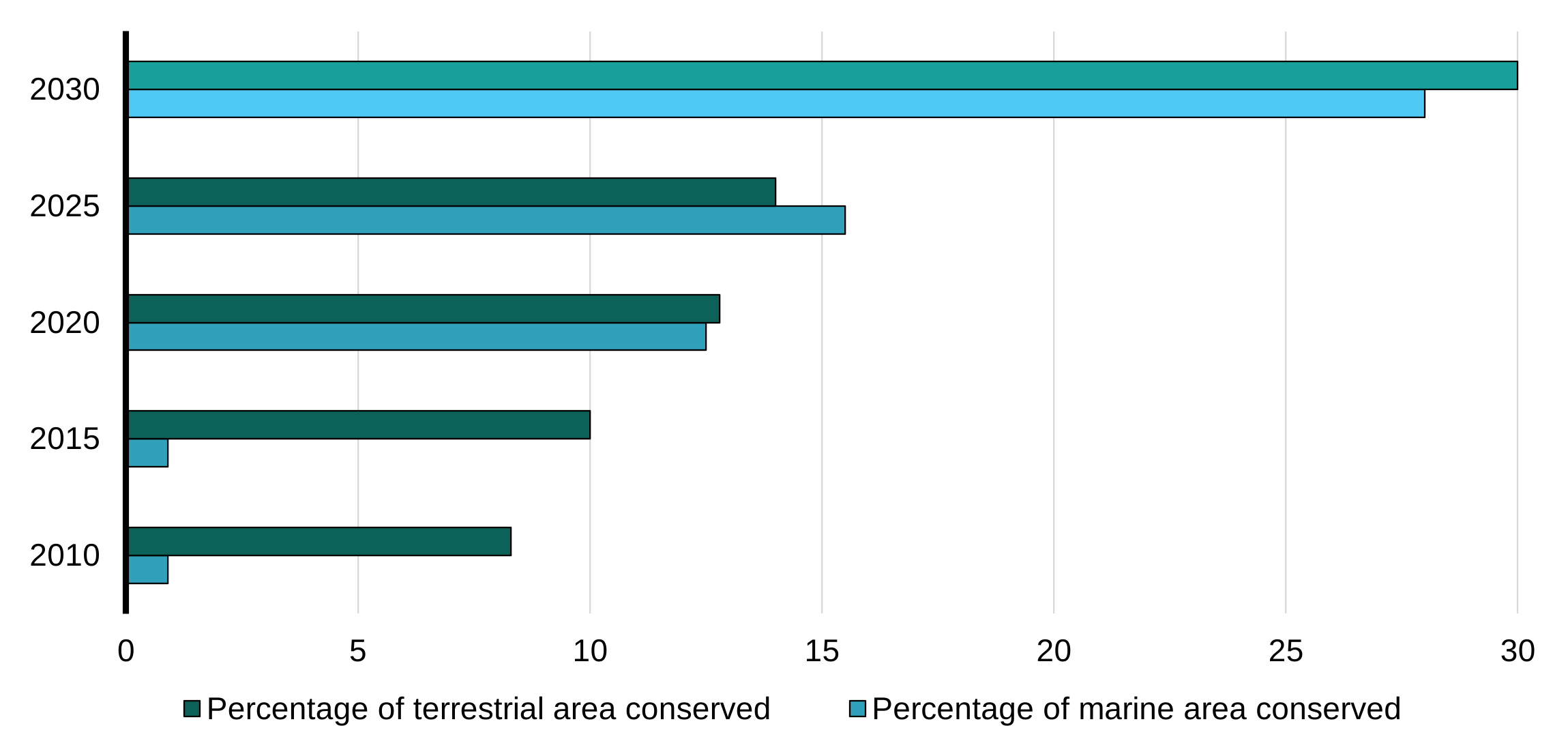
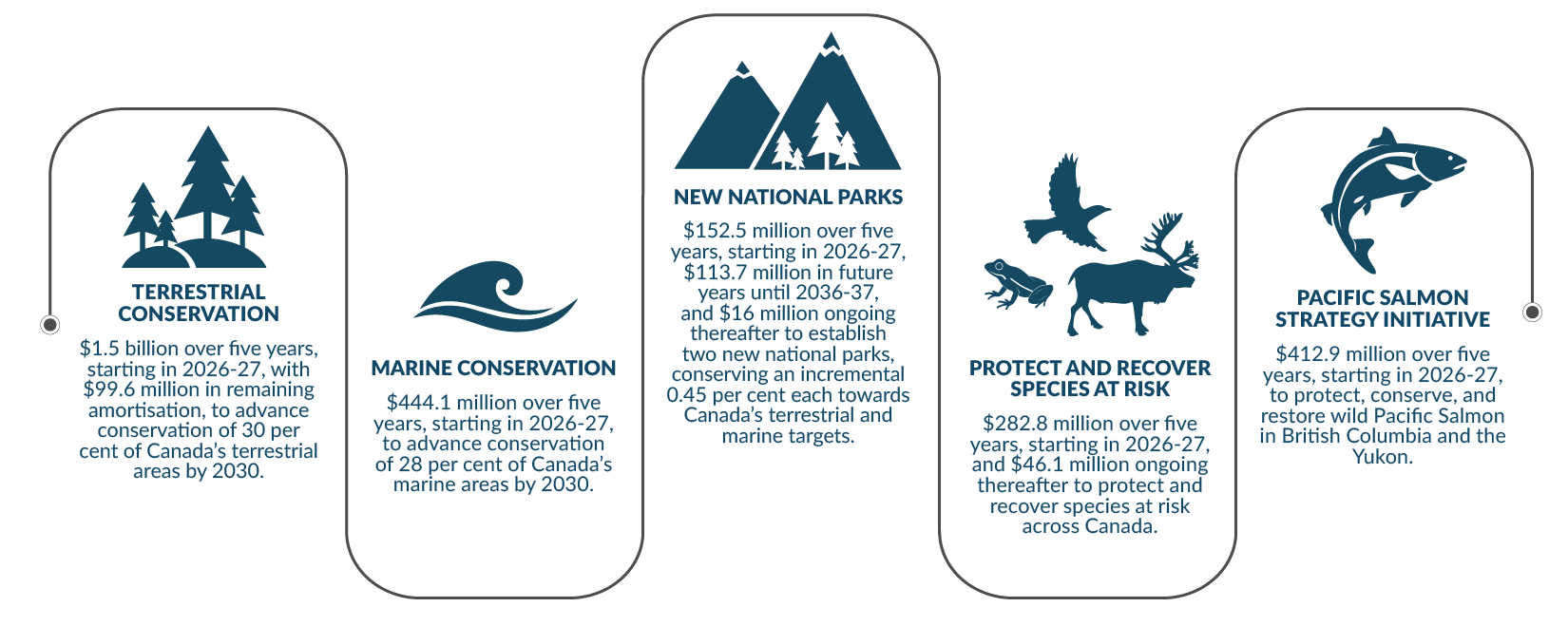
With $3.5 billion over five years, starting in 2026-27, $819.9 million in future years until 2036-37, with $74.6 million in remaining amortisation, and $129.3 million ongoing thereafter ($3.7 billion over five years, starting in 2026-27, $792 million in future years until 2036-37, and $129.3 million ongoing thereafter, on a cash basis), A Force of Nature: Canada's Strategy to Protect Nature, is the government's plan to work with partners from coast-to-coast-to-coast to deliver on Canada's commitment to conserve 30 per cent of lands and waters by 2030.
Protecting Canada's Whales
Canada's oceans are home to more than 30 species of whales, which play a critical role in the health of our oceans and carry important cultural significance for many Indigenous and coastal communities. Since 2018, the Government of Canada has made significant investments—through programs such as the Whales Initiative and the Oceans Protection Plan—to support recovery efforts and mitigate the impacts of key threats to the North Atlantic Right Whale, the St. Lawrence Estuary Beluga, the Southern Resident Killer Whale, and other endangered whales. In addition to the recently announced Nature Strategy:
- The Spring Economic Update 2026 proposes to provide $160.8 million over five years, starting in 2026-27, with $3 million in remaining amortisation to Fisheries and Oceans Canada and Transport Canada to continue protecting Canada's whales and their habitat across all coasts.
- Recognising the potential for increased marine traffic on the West Coast as Canada embarks on its Trade Diversification Strategy, the Spring Economic Update 2026 also proposes to provide an additional $91.3 million over five years, starting in 2026-27, with $3.7 million in remaining amortisation and $16.5 million ongoing to Transport Canada, Fisheries and Oceans Canada, and the Canadian Coast Guard to implement a regional noise monitoring and management program and to address other threats to the endangered Southern Resident Killer Whale population. Of this amount, $20.9 million over five years, starting in 2026-27, and $4.2 million ongoing will be sourced from existing resources.
In March 2026, the government also pre-published amendments to the Marine Mammal Regulations under the Fisheries Act to increase the vessel approach distance from 200 metres to 1,000 metres for the Southern Resident Killer Whale to mitigate the threats posed by physical and acoustic disturbance from vessel traffic.
A Stronger Grid for a Stronger Canada
Clean, affordable, and dependable electricity is central to Canada's long-term economic strength. Currently accounting for about 20 per cent of total final energy use, electricity's share is projected to double in the decades ahead as industries electrify and new technologies scale. The electricity stack—spanning generation, transmission and distribution, storage, and end-use applications—is an increasingly important driver of innovation and productivity.
Meeting this growth will require significant investment. While provinces and territories are already making substantial investments, the scale and pace of rising demand require sustained and coordinated action to ensure Canada's electricity system expands in time to maintain reliability and international competitiveness.
To inform its approach, the Government of Canada will soon release a discussion paper seeking input on how it can work with provinces and territories, Indigenous partners, and other stakeholders to strengthen efforts to connect, modernise and expand the grid.
The nuclear sector is a strategic asset for Canada's clean electricity future and long-term economic competitiveness. Nuclear energy has the capacity to scale and help meet electrification imperatives by providing reliable, non-emitting, baseload power that strengthens grid resilience as demand grows. Beyond its role in electricity supply, Canada's nuclear sector is a high-value-added industry that supports national priorities such as the development of cutting-edge Canadian R&D, the diversification of Canada's trade relationships, and bolstering Canada's role as a middle power. Given the importance of nuclear energy to Canada's electricity system and economy, the Government of Canada will soon release a Nuclear Energy Strategy to provide a clear and coordinated federal perspective on the sector's future development.
1.6 Defending Our Sovereignty
The world is becoming more challenging and divided. The assumptions that shaped decades of Canadian defence and security are being upended. The threats we face are numerous and growing—ranging from incursions into our Arctic to attacks targeting our cyberspace. The very nature of warfare is changing rapidly, driven by the proliferation of drones, autonomous systems, and weapons in orbit. We know that the world has changed, and that Canada must change with it.
In this context, Canada is strengthening its sovereign capabilities in critical sectors, and deepening cooperation with trusted partners, to safeguard our security and resilience. This includes generational investments to rebuild, rearm, and reinvest in the Canadian Armed Forces. These investments will be guided by Canada's first-ever Defence Industrial Strategy, helping deliver greater strategic autonomy and economic benefits for Canada, supported by more timely and transparent procurement through the new Defence Investment Agency.
Defending Canada's sovereignty also means honouring the service and sacrifice of those who have helped defend our people, our values, and our country. Our government is committed to working with the Last Post Fund to ensure the National Field of Honour in Pointe-Claire, Québec, remains a dignified and respectful resting place for Veterans and their families and to preserve Canada's proud military legacy for generations to come. This commitment reflects our enduring responsibility to honour those who have served.
The government also continues to deliver on its commitment to enhance border security and the safety of Canadians through the continued implementation of the $1.3 billion Border Plan.
The Spring Economic Update 2026 provides an update on the implementation of the government's ambitious plan and introduces new and targeted measures to further protect Canada's sovereignty and security.
Fulfilling Our NATO Defence Spending Commitments
In March 2026, NATO confirmed that Canada achieved its 2 per cent of GDP defence expenditure target—half a decade ahead of the previous government's schedule, and the first time since the fall of the Berlin Wall. In 2025-26, we spent more than $63 billion on our defence, the single largest year-on-year increase in defence investment in generations as part of an ambitious plan to rebuild, rearm, and reinvest in the Canadian Armed Forces.
Canada is making critical contributions to defending the Alliance's territory. Canada is leading the Multinational Brigade in Latvia on NATO's Eastern flank, and making unprecedented investments in Arctic and northern surveillance, communications, command and control, and presence.
Building on this progress, and the generational defence investments made in Budget 2025, Canada is on a path to meet the NATO Defence Investment Pledge of investing 5 per cent of GDP in defence by 2035.
What 2% Means for Canada
Enhancing Canadian Armed Forces (CAF) Presence

- Increased military support to Ukraine
- Enhancing international defence engagements
Securing Our Arctic

- Advancing Northern Operational Support Hubs for CAF presence and responsiveness
- Improving northern basing infrastructure
Delivering New Military Capabilities and Investing in Foundations of Defence

- Enhancing fleet and equipment readiness and building housing for CAF members
- Procuring long‑range planes for the Royal Canadian Air Force to detect and track submarines and ships
- Building River‑class destroyers to provide modern warships
- Equipping the Canadian Army with modern rifles
Supporting the Women and Men Who Serve

- Implementing the largest pay raise for the CAF in a generation, with all members receiving a pay raise
- Launching the Military Service Pay Benefit specifically tied to time in service so pay cheques honour years in uniform
Strengthening Canada's Economy and Defence Industry
- Catalysing investment in Canada and building Canadian industry, from aerospace to AI.
- Integrating small- and medium-sized enterprises into defence supply chains
Defence Industrial Strategy
To protect Canada's sovereignty, build our prosperity, and strengthen our strategic autonomy, the Canadian government must change how we invest in defence. Canada's defence procurement has long been too complicated, too slow, and too reliant on international suppliers, limiting the growth of our defence industries. This has left our workers and businesses with fewer opportunities, our domestic industries without the demand necessary to scale, and critically, the women and men of our military without the equipment they need to defend our sovereignty and that of our Allies.
In February 2026, the government launched the new Defence Industrial Strategy (DIS), a whole-of-government approach to transform Canada's defence industry. The strategy will prioritise Canadian suppliers and materials, invest in Canadian innovation and commercialisation, and streamline procurement to give businesses a consistent and predictable demand outlook. This will enable Canada's aerospace, cyber, and other industries to scale up operations to sell more at home and to trusted partners around the world, creating high-paying careers for Canadians across the country.
The DIS positions Canadian industry to take advantage of the government's generational investments in defence, creating significant economic benefits for years to come. Over the next ten years, the DIS will increase our defence exports by 50 per cent, raise the share of defence acquisitions awarded to Canadian firms to 70 per cent, and result in a step change in the size of Canada's defence industry.
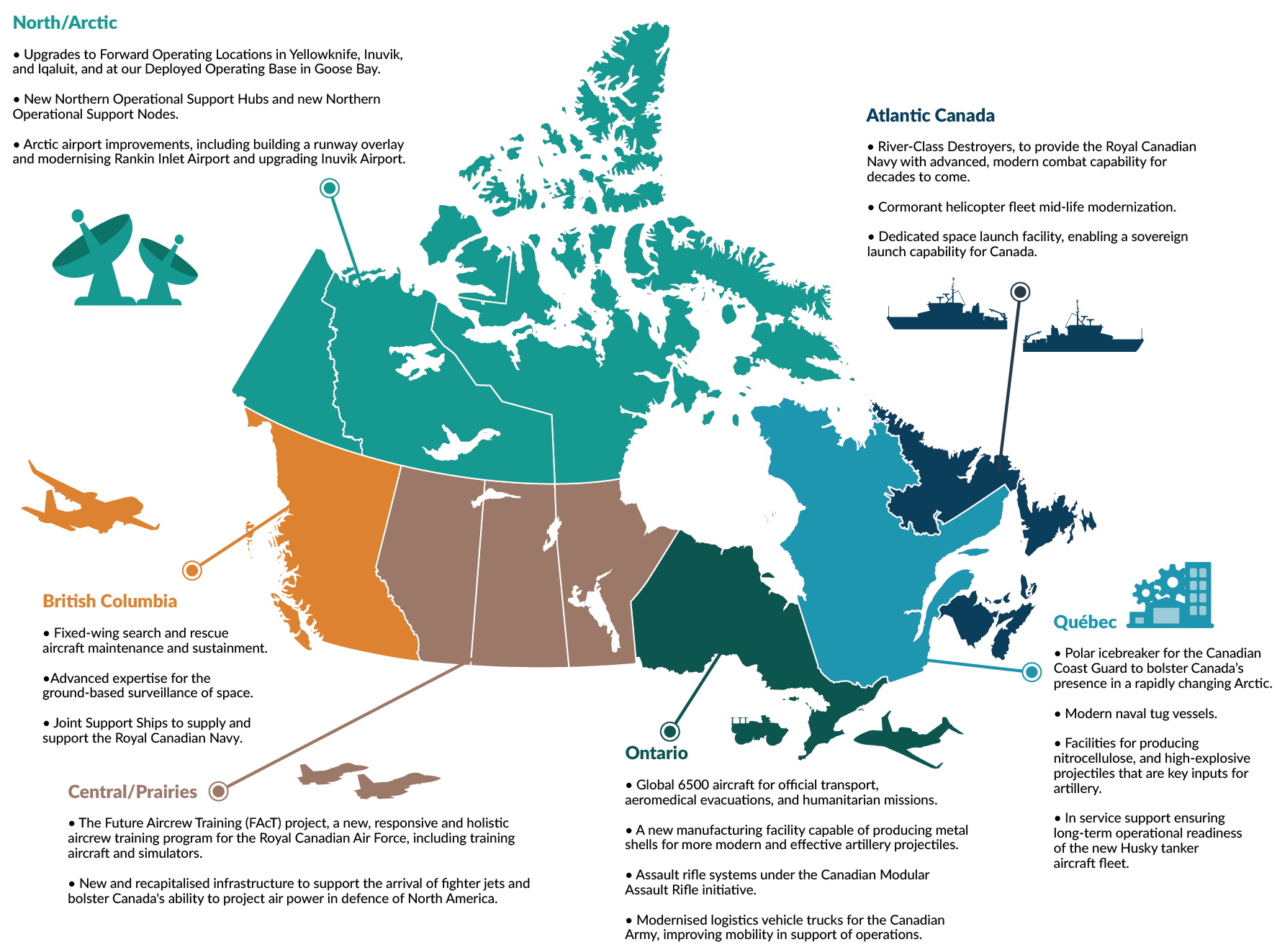
The strategy will help give the Canadian Armed Forces the tools and equipment they need to keep Canada safe. It will raise maritime fleet serviceability to 75 per cent, land fleets to 80 per cent, and aerospace fleets to 85 per cent to bolster Canadian defence.
Defence Investment Agency
The Defence Investment Agency (DIA) is at the centre of the Defence Industrial Strategy. The DIA will be responsible for re-equipping our military and driving economic benefits for Canada through the government's generational investment in defence. The DIA is designed to accelerate the timeline of defence procurements, leverage defence procurements to strengthen Canada's defence industrial base, and attract investment into Canada's defence industry, contributing to growing Canada's economy.
The DIA was launched in October, 2025, as a Special Operating Agency housed within Public Services and Procurement Canada, and is rapidly advancing major defence procurements, such as Arctic Over-the-Horizon Radar and the Canadian Patrol Submarine Project, to support the Canadian Armed Forces and the Canadian Coast Guard across air, land, sea and digital domains.
The government's intention is to establish the DIA as a stand-alone entity to further deliver on its important mandate.
- The Spring Economic Update 2026 proposes to provide $103.8 million over five years, starting in 2026-27, and $22.3 million ongoing to establish and operate the DIA as a stand-alone entity.
- The Spring Economic Update 2026 also announces the government's intention to introduce enabling legislation to establish the DIA as a stand-alone entity and legislative amendments to the Defence Production Act to provide the DIA with expanded authorities.
Canada's Support for Ukraine
More than four years after Russia's full-scale, illegal invasion of Ukraine—violating sovereignty, territorial integrity, and independence—Canada remains a steadfast partner. A secure, peaceful, and stable Ukraine that is resilient to Russian aggression enhances our collective security and prosperity.
Canada is strengthening Ukraine's military capacity through sustained operational support. Operation UNIFIER, launched in 2014 following Russia's first invasion, has enabled the Canadian Armed Forces (CAF) to train over 47,000 members of the Armed Forces of Ukraine, covering a range of basic and advanced military skills, including tactical medical training, combat engineering, and leadership skills and education.
In February 2026, the government announced the renewal of Operation UNIFIER for an additional three years, starting in 2026-27. Under the renewed mandate, the number of CAF personnel dedicated to the operation will increase, providing greater flexibility and enabling Canada to further adapt and respond to Ukraine's evolving operational needs.
- The Spring Economic Update 2026 proposes to provide $2.0 billion over three years on a cash basis, starting in 2026-27, to the Department of National Defence, the Communications Security Establishment, Global Affairs Canada, and the Canadian Security Intelligence Service to support Operation UNIFIER.
1.7 Driving Productivity and Affordability Through Competition
To unlock economic growth and bring down costs for Canadians, the government must ensure the domestic economy operates at its full potential. Stronger competition pushes businesses to become more productive, encouraging them to innovate, adopt new technologies, and operate more efficiently. Over time, these productivity gains translate into lower costs, greater choice, better wages, and better-quality goods and services for Canadians.
Whole-of-Government Competition Plan
A lack of competition weighs on productivity growth and directly impacts affordability. To drive lasting improvements in affordability, competition across Canada's economy must be strengthened. Building on recent and ongoing actions to enhance competition:
- The Spring Economic Update 2026 announces the government's intention to launch a Whole-of-Government Competition Plan to ensure that competition is prioritised throughout the federal government's policies.
The plan would seek to ensure that existing and future policies across the federal government prioritise the promotion of competition and limit to the extent possible the potential negative impacts on competition that can, often inadvertently, stem from government policies. The plan will focus on removing inefficient government policies that impede competition arising from regulation, procurement, and industrial support. The Minister of Finance and National Revenue will provide further information on this initiative in the coming months.
Telecommunications Competition Roadmap
In today's world, Internet and mobile services are essential for daily life, but competition and affordability for Canadians remains a challenge.
The government will take a comprehensive, national approach to telecom competition and drive meaningful outcomes for Canadian consumers by implementing a Telecommunications Competition Roadmap. The Roadmap puts Canadians first, through actions that will improve choice, transparency, prices, and networks.
Parts of the Roadmap are already underway. Shortly after taking office in 2025, our government upheld the Canadian Radio-television and Telecommunications Commission's (CRTC) decision on mandatory wholesale Internet access, which requires large players to give access to their fibre‑to‑the‑home networks to competitors. Final rates for competitor access are expected in 2026 to help competitors enter new markets quickly and offer more affordable Internet options.
Recent amendments to the Telecommunications Act also require transparency on contracts and make it easier for Canadians to more easily renew or switch between home Internet, home phone, and cell phone plans, and take advantage of better pricing. New rules on these matters were announced by the CRTC in March and April of 2026.
The Roadmap includes multiple ongoing and planned government actions, including publishing roaming benchmarks, pursuing a "dig once" policy approach to nation-building projects as outlined in Budget 2025, and building on efforts to enable emerging satellite technologies. Its publication will allow Canadians to easily see results and keep track of ongoing efforts in the short term. Further information on the Roadmap will be provided in the coming months.
A Strong Financial Sector
Greater competition, innovation, and efficiency in financial services means more options, better quality products, and more affordable financial services. Over the coming months, the government will continue to advance initiatives to promote competition and lower financial costs, helping Canadians keep more money in their pockets.
Lowering Financial Costs for Canadians
Recent Government Initiatives

March 12, 2026 – cap on NSF fees
New regulations to cap NSF fees at $10, down from $45 to $50, are expected to save consumers upwards of $600 million annually.

Regulating investment account transfers
The government intends to publish draft regulations for consultation in the coming weeks to prohibit investment account transfer fees by federally regulated financial institutions, currently costing Canadians on average $150 per transfer, and to reduce the time to transfer accounts.

Report on bank fees
The Financial Consumer Agency of Canada has been asked to prepare a report on the structure, level, and transparency of fees charged by banks.

Consumer-driven banking
Amendments to complete the Consumer-Driven Banking Act have been passed, which will give consumers greater control over their finances.

Low-cost and no-cost accounts
Updated industry commitment to offer modernised low-cost and no-cost accounts is now in effect.
Following the passage of the Stablecoin Act:
- The Spring Economic Update 2026 announces the government's intention to engage with federally regulated financial institutions to better understand considerations related to their development and potential use of stablecoins, and other tokenised assets and whether additional regulatory clarity is needed. This engagement would be complemented by targeted discussions with industry, regulators and the provinces and territories. The focus would be on supporting innovation while maintaining financial stability, protecting consumers—including in the context of insolvency of stablecoin issuers—and preserving regulatory integrity.
- As this work progresses, the government expects to outline next steps, including in the context of Budget 2026, to inform its ongoing policy approach to stablecoins.
The government remains committed to the future of Canada's Real-Time Rail (RTR). Launching in 2026, the RTR is a cornerstone of our modernisation agenda that will serve as a powerful engine for national productivity and economic growth. This critical national payments infrastructure will be a catalyst for competition, empowering a more dynamic and inclusive financial sector. The government will continue to engage with all relevant stakeholders to ensure the accelerated development of the RTR's future capabilities. The government is also advancing payments modernisation by strengthening the supervision of payment service providers and expanding their access to national payment systems.
Finally, the government intends to implement changes to provide more flexibility for federally regulated financial institutions to make investments that support innovative financial services and benefit the economy as a whole.
- The Spring Economic Update 2026 announces that the government will bring forward regulations this spring allowing federally regulated financial institutions to make a broader range of investments to improve financial services.
- To support these regulations, the government proposes to amend the Bank Act to ensure the review for national security risks of investments in Canadian businesses by foreign banks and their affiliates is consistent with how other foreign investments in Canada are assessed.
Gender and Diversity Impacts Spotlight
Building Canada includes investments to protect nature and contributions to global climate finance efforts to support vulnerable countries tackling climate change.
- Continuing to Support International Climate Finance will benefit people in developing countries by helping reduce greenhouse gas emissions and strengthen preparedness for climate impacts such as floods, droughts, and extreme heat. Marginalised and vulnerable groups—including women and girls, and rural communities—are disproportionately affected by climate change. For example, during extreme weather disasters, women and children are 14 times more likely to die than men, due in part to more limited access to information and resources. Climate finance support is expected to particularly benefit these populations.
- Significant investments for Canada's Strategy to Protect Nature will benefit all Canadians by conserving more lands and waters by 2030, protecting species at risk, preserving biodiversity, and supporting climate resilience. The measures are expected to benefit Indigenous people, including through the expansion of the Indigenous Guardians program, and people working in the conservation field, and have long-term benefits for young people and future generations.
| 2025-2026 | 2026-2027 | 2027-2028 | 2028-2029 | 2029-2030 | 2030-2031 | Total | |
|---|---|---|---|---|---|---|---|
| 1.1 Delivering for Canadians | 0 | 2 | 2 | 2 | 1 | 1 | 6 |
| The Canada Strong Fund - Transition Office | 0 | 2 | 2 | 2 | 1 | 1 | 6 |
| 1.2 Building to Grow | 0 | 10 | 20 | -45 | -55 | -60 | -130 |
| Expanding the Carbon Capture, Utilization, and Storage Investment Tax Credit to Enhance Oil Recovery* | 0 | 0 | -10 | -75 | -115 | -195 | -395 |
| Implementing Accelerated Capital Cost Allowance Rates for Low-Carbon Liquefied Natural Gas Facilities* | 0 | 0 | 50 | 120 | 160 | 310 | 640 |
Less: Funds Previously Provisioned in the Fiscal Framework |
0 | 0 | -50 | -120 | -155 | -255 | -580 |
| Making the Employee Ownership Trust Tax Exemption Permanent | 0 | 10 | 30 | 30 | 55 | 80 | 205 |
| 1.3 Supporting Strategic Sector Initiatives | 26 | 1,545 | 812 | 424 | 538 | 586 | 3,932 |
| Measures Taken to Support Workers and Businesses - Worker Supports1 | 26 | 893 | 396 | 14 | 0 | 0 | 1,327 |
| Measures Taken to Support Workers and Businesses - Business Supports2 | 0 | 192 | 8 | 8 | 8 | 8 | 224 |
| Moving Forward With the Automotive Strategy - EV Affordability Program3* | 0 | 450 | 387 | 391 | 519 | 567 | 2,314 |
| Extending Alcohol Excise Duty Relief to Support Canadian Breweries, Distilleries, and Wineries4 | 0 | 11 | 22 | 11 | 11 | 11 | 66 |
| 1.4 Expanding Trade at Home and Abroad | 0 | 11 | 0 | 0 | 0 | 0 | 11 |
| Hosting an Investment Summit5 | 0 | 11 | 0 | 0 | 0 | 0 | 11 |
| 1.5 Advancing Clean Growth and Conservation | 0 | 708 | 671 | 759 | 852 | 818 | 3,808 |
| Continuing to Support International Climate Finance | 0 | 537 | 475 | 546 | 543 | 527 | 2,628 |
Less: Funds Previously Provisioned in the Fiscal Framework |
0 | -200 | -200 | -200 | -260 | -260 | -1,120 |
Less: Funds Sourced From Existing Departmental Resources |
0 | -353 | -253 | -203 | -129 | -77 | -1,015 |
| A Force of Nature - Enhanced Nature Legacy6* | 0 | 280 | 302 | 306 | 300 | 298 | 1,485 |
Less: Funds Sourced From Existing Departmental Resources |
0 | -17 | -121 | -135 | -80 | -108 | -462 |
| A Force of Nature - Marine Conservation Target6* | 0 | 89 | 89 | 89 | 89 | 89 | 444 |
| A Force of Nature - New National Parks6* | 0 | 32 | 35 | 16 | 53 | 16 | 152 |
| A Force of Nature - Protect and Recover Species at Risk6* | 0 | 57 | 57 | 56 | 56 | 56 | 283 |
| A Force of Nature - Pacific Salmon Strategy Initiative6 | 0 | 83 | 83 | 83 | 83 | 83 | 413 |
| A Force of Nature - Other Measures6* | 0 | 159 | 156 | 154 | 149 | 149 | 768 |
| Protecting Canada's Whales* | 0 | 45 | 53 | 51 | 53 | 50 | 252 |
Less: Funds Sourced From Existing Departmental Resources |
0 | -4 | -4 | -4 | -4 | -4 | -21 |
| 1.6 Defending Our Sovereignty | 0 | 519 | 723 | 768 | 35 | 29 | 2,074 |
| Defence Investment Agency | 0 | 30 | 30 | 30 | 30 | 30 | 150 |
Less: Funds Previously Provisioned in the Fiscal Framework |
0 | -8 | -8 | -8 | -8 | -8 | -39 |
Less: Funds Sourced From Existing Departmental Resources |
0 | -3 | -2 | -2 | 0 | 0 | -8 |
| Canada's Support for Ukraine - Operation UNIFIER* | 0 | 499 | 703 | 748 | 13 | 7 | 1,970 |
| Additional Investments – Building Canada: All for Canada | 0 | 13 | 45 | 69 | 28 | 28 | 183 |
| EV Affordability Program and Immediate Expensing* | 0 | -3 | -4 | 0 | 0 | 0 | -7 |
| The Spring Economic Update proposes to amend the Income Tax Regulations, effective February 16, 2026, to designate the Electric Vehicle Affordability Program (EVAP) as a prescribed program under 1102(26) of the Income Tax Regulations. As a result, businesses will not be permitted to claim both an EVAP rebate and immediate expensing for the same electric vehicle, consistent with the tax treatment under the former iZEV program. | |||||||
| Supporting the Harbourfront Centre7 | 0 | 12 | 12 | 7 | 7 | 7 | 43 |
| Funding proposed for PCH to support the Harbourfront Centre to help maintain operating support for the Centre's arts, cultural, educational and recreational programming and for time-limited funding for capital repairs. | |||||||
| CITT Safeguard Inquiries | 0 | 4 | 0 | 0 | 0 | 0 | 5 |
| Funding proposed for the CITT to conduct safeguard inquiries into imports of certain canned and frozen vegetables and wood products. | |||||||
| Implementing the Strong and Free Elections Act8 | 0 | 2 | 2 | 2 | 2 | 2 | 11 |
Less: Funds Previously Provisioned in the Fiscal Framework |
0 | -4 | -4 | -4 | -4 | -4 | -18 |
| Funding proposed for Elections Canada to administer targeted, priority updates to the Canada Elections Act aimed at strengthening and protecting Canada's federal elections and electoral actors from evolving threats. | |||||||
| Expanding the Rapid Response Mechanism9 | 0 | 3 | 7 | 7 | 7 | 7 | 32 |
Less: Funds Sourced From Existing Departmental Resources |
0 | -3 | -7 | -7 | -7 | -7 | -32 |
| Funding proposed for GAC to expand the Rapid Response Mechanism, which works to identify and counter foreign information manipulation and interference against Canada. Funding would be sourced from DND reference levels. | |||||||
| Providing CBSA Service at the Port of Quebec10* | 0 | 1 | 2 | 7 | 7 | 7 | 23 |
Less: Funds Sourced From Existing Departmental Resources |
0 | -1 | 0 | -3 | -3 | -3 | -11 |
| Funding proposed for the CBSA to service the Port of Quebec to ensure the safety and security of our borders while supporting trade. | |||||||
| Enhancing the Integrity of Immigration Holding Centres | 0 | 0 | 119 | 119 | 0 | 0 | 238 |
Less: Funds Sourced From Existing Departmental Resources |
0 | 0 | -88 | -66 | 0 | 0 | -153 |
| Funding proposed for the CBSA to contract guards with higher security training at Immigration Holding Centres, thereby increasing the integrity of our immigration system. | |||||||
| Enhancing Safety in Federal Secure Facilities* | 0 | 1 | 6 | 7 | 19 | 19 | 52 |
| Funding proposed for the CSC and CBSA to pilot and deploy technologies to prevent unauthorised communications and contraband delivery in correctional facilities and immigration holding centres to support safety and enhance institutional security. | |||||||
| Chapter 1 - Net Fiscal Impact | 26 | 2,807 | 2,273 | 1,977 | 1,399 | 1,401 | 9,883 |
| Of which, capital investment: | 0 | 3 | -1 | -48 | -75 | -110 | -230 |
1 Measures Taken to Support Workers and Businesses - Worker Supports were announced on November 26, 2025; March 11, 2026; and March 20, 2026. 2 Measures Taken to Support Workers and Businesses – Business Supports were announced on November 26, 2025; and April 1, 2026. 3 Moving Forward With the Automotive Strategy - EV Affordability Program was announced on February 5, 2026. 4 Extending Alcohol Excise Duty Relief to Support Canadian Breweries, Distilleries, and Wineries was announced on April 1, 2026. 5 Hosting an Investment Summit was announced on April 17, 2026. 6 A Force of Nature—Canada's Strategy to Protect Nature was announced on March 31, 2026. 7 Supporting the Harbourfront Centre was announced on March 31, 2026. 8 Implementing the Strong and Free Elections Act was announced on March 26, 2026. 9 Expanding the Rapid Response Mechanism was announced on March 26, 2026. 10 Providing CBSA Service at the Port of Quebec was announced on April 24, 2026. *Measure includes funding classified as a capital investment. Note: Numbers may not add due to rounding. A glossary of abbreviations used in this table can be found at the end of Annex 1. |
|||||||
Page details
- Date modified: