
Annex 1:
Details of economic and fiscal projections
Economic Projections
The average of private sector forecasts has been used as the basis for economic and fiscal planning since 1994, helping to ensure objectivity, transparency, and independence in the government's forecast.
The Department of Finance Canada regularly surveys private sector forecasters on their economic outlook. In an environment shaped by recent U.S. trade policy and geopolitical developments, the outlook continues to evolve. The economic forecast reported here is based on a survey conducted in March 2026.
The March survey includes the views of 11 private sector economists:
- BMO Capital Markets;
- CIBC World Markets;
- Desjardins;
- Industrial Alliance Insurance and Financial Services Inc.;
- Laurentian Bank Securities;
- National Bank Financial Markets;
- Royal Bank of Canada;
- Scotiabank;
- Signal49 Research (formerly The Conference Board of Canada);
- TD Bank Financial Group; and,
- The University of Toronto (Policy and Economic Analysis Program).
The global and Canadian economies have continued to grow over the last year. But risks to the outlook have increased. The historic rise in U.S. tariffs is reshaping global trade and weighing on confidence, investment, and growth. More recently, the conflict in the Middle East has added to these risks by pushing oil prices higher, which is expected to raise inflation and costs for households and businesses. Supply chain pressures, heightened uncertainty, and tighter financial conditions could further weigh on global growth. At the same time, Canada will benefit from improved terms of trade and could gain from stronger global demand for secure and reliable energy supply.
In the March survey, private sector forecasters incorporated the most recent tariff measures, trade policy developments, and their expectations regarding potential tariff de-escalation. Economists generally expected current U.S. tariffs on trading partners, including Canada, to remain in place over the forecast horizon, with no return to broadly open, low-tariff global trade. Trade uncertainty was expected to remain elevated, weighing on business investment and household confidence, with some easing beginning in 2027.
Private sector economists also incorporated the initial impacts of the conflict in the Middle East, raising near-term oil price assumptions and, in turn, CPI and GDP inflation (Table A1.1). Overall, they did not expect material impacts on real GDP or unemployment, assuming a relatively short conflict, with oil prices beginning to normalise in the second half of the year.
Risks around the outlook are unusually high. To support prudent economic and fiscal planning, the Department of Finance Canada has developed scenarios to assess the implications of these risks for the economic and fiscal outlook (see the Economic Scenario Analysis section).
Comparisons of the March survey real GDP growth forecast to those of other institutions can be found in Table A1.2.
Following volatile real GDP growth in recent quarters, the Canadian economy is expected to see moderate growth of 1.4 per cent in the first quarter. Exports are expected to remain subdued as U.S. tariffs continue to weigh on demand for Canadian steel, aluminum, copper, lumber, and autos. Domestic demand remains moderate in the near term as businesses continue to adjust investment in the face of uncertainty, while households remain prudent. Nonetheless, consumption is expected to be the main driver of growth over the near term, supported by improved household balance sheets and previous declines in interest rates. Real GDP growth is projected to gradually pick up through 2026, supported by export stabilisation and a recovery in domestic demand.
Overall, private sector forecasters expected real GDP growth of 1.1 per cent in 2026, rising to 1.9 per cent in 2027 and beyond as the economy adjusts to the new trading environment. This is slightly below the Budget 2025 outlook of 1.2 per cent for 2026 and 2.0 per cent in the outer years. Real GDP is not expected to return to its pre-tariff path, remaining about 1.6 per cent lower by 2029 relative to the pre-tariff 2024 Fall Economic Statement outlook.
The unemployment rate is expected to average 6.5 per cent in 2026, down from the 6.8 per cent expected in Budget 2025, and to continue its downward trend reaching 6.0 per cent by 2029, same as in Budget 2025.
As a result of the conflict in the Middle East, private sector economists have significantly raised their outlook for crude oil prices, with WTI expected to average US$80 per barrel in the second quarter of this year (US$15 per barrel above Budget 2025). The price of oil is expected to average US$73 per barrel in 2026 compared to the Budget 2025 forecast of US$65 per barrel. It is then expected to decline to US$66 per barrel in 2027, in line with Budget 2025.
Higher oil prices are expected to push CPI inflation to 2.5 per cent in 2026 (up from 2.0 per cent in Budget 2025). Inflation is then expected to slow to 1.9 per cent in 2027 and stabilise at 2.0 per cent from 2028 onwards, the same as in Budget 2025.
The survey sees the Bank of Canada keeping its policy rate at 2.25 per cent through 2026, with gradual increases beginning in early 2027 as the economy firms up. Short-term rates are expected to reach 2.7 per cent by 2028, a slightly higher peak compared to Budget 2025. Short-term rates then settle at 2.6 per cent by 2029, same as in Budget 2025.
The 10-year bond rate is expected to increase from an average of 3.4 per cent in 2026 to 3.6 per cent in 2027 and 3.7 from 2028 onwards, higher than the expectations in Budget 2025. The increase in long-term yields over the forecast reflects the expectation of larger global sovereign borrowing needs, particularly in the U.S. and Europe.
In the U.S., AI investment and solid consumption, supported partly by strong equity markets, are driving growth. While real GDP growth in the U.S. has been revised up to 2.4 per cent in 2026 (previously 1.6 per cent), this has not translated into stronger near-term Canadian growth expectations. Economists expected U.S. growth to settle at 2.0 per cent in 2027 and beyond, same as in Budget 2025.
Private sector economists expected the Canadian dollar to average 73.7 U.S. cents this year and gradually rise to 75.8 cents by 2029, about a cent and a half below the Budget 2025 outlook. The limited near-term appreciation despite higher WTI prices likely reflects expectations of continued strength in the U.S. dollar amid heightened geopolitical uncertainty.
Economists had revised up their outlook for GDP inflation in 2026 to 2.8 per cent (compared to 1.8 per cent in Budget 2025) as a result of higher oil prices and domestic inflation in the near term. With the expected normalisation in oil prices and inflation, GDP inflation was expected to average 1.8 per cent in 2027 and 1.9 per cent in 2028, down from 2.0 per cent in both years in Budget 2025.
Reflecting stronger-than-expected results in the second half of 2025 and stronger near-term GDP inflation outlook resulting from the impacts of the Middle East conflict, the level of nominal GDP was projected to exceed the Budget 2025 outlook by $46 billion in 2026 and $34 billion in 2027. On average, over 2026-2029, the March survey forecast is about $35 billion higher per year.
According to forecasters in the survey, risks to the outlook remain elevated. On the downside, persistent trade tensions could weigh more heavily on business investment and household spending. A prolonged conflict in the Middle East could also further raise oil prices, disrupt supply chains, and weigh on growth and employment while increasing inflationary pressures.
On the upside, stronger impacts from recent government initiatives could support growth more than anticipated. Canada could also benefit more substantially from the positive terms‑of‑trade effects associated with higher oil prices—factors that may not be fully reflected in current private sector forecasts. As a net exporter of energy—and a reliable supplier at a time of heightened geopolitical uncertainty—Canada could see increased demand for secure energy supply, providing an offsetting boost through higher incomes, investment, and activity in energy‑related regions.
The overall fiscal impact of the conflict in the Middle East will depend importantly on its duration and intensity, including how long oil prices remain elevated, how global growth is affected, and how interest rates evolve. The box below illustrates the sensitivity of economic and fiscal outcomes to oil price movements.
| 2025 | 2026 | 2027 | 2028 | 2029 | 2030 | 2025-2029 | |
|---|---|---|---|---|---|---|---|
| Real GDP growth1 | |||||||
| Budget 2025 | 1.6 | 1.2 | 2.0 | 1.9 | 2.0 | – | 1.7 |
| Spring Economic Update 2026 | 1.7 | 1.1 | 1.9 | 1.9 | 1.9 | 1.8 | 1.7 |
| GDP inflation1 | |||||||
| Budget 2025 | 2.3 | 1.8 | 2.0 | 2.0 | 2.0 | – | 2.0 |
| Spring Economic Update 2026 | 2.6 | 2.8 | 1.8 | 1.9 | 2.0 | 2.0 | 2.2 |
| Nominal GDP growth1 | |||||||
| Budget 2025 | 3.9 | 3.0 | 4.1 | 4.0 | 4.0 | – | 3.8 |
| Spring Economic Update 2026 | 4.3 | 4.0 | 3.7 | 3.8 | 3.9 | 3.8 | 3.9 |
| Nominal GDP level (billions of dollars)1 | |||||||
| Budget 2025 | 3,229 | 3,326 | 3,461 | 3,599 | 3,743 | – | |
| Spring Economic Update 2026 | 3,243 | 3,372 | 3,496 | 3,630 | 3,772 | 3,917 | |
| Difference between Spring Economic Update 2026 and Budget 2025
|
15 | 46 | 34 | 30 | 29 | – | 31 |
| 3-month treasury bill rate | |||||||
| Budget 2025 | 2.6 | 2.3 | 2.5 | 2.6 | 2.6 | – | 2.5 |
| Spring Economic Update 2026 | 2.6 | 2.2 | 2.5 | 2.7 | 2.6 | 2.6 | 2.5 |
| 10-year government bond rate | |||||||
| Budget 2025 | 3.3 | 3.4 | 3.5 | 3.6 | 3.6 | – | 3.4 |
| Spring Economic Update 2026 | 3.2 | 3.4 | 3.6 | 3.7 | 3.7 | 3.7 | 3.5 |
| Exchange rate (US cents/C$) | |||||||
| Budget 2025 | 72.2 | 75.1 | 76.4 | 77.0 | 77.4 | – | 75.6 |
| Spring Economic Update 2026 | 71.5 | 73.7 | 75.4 | 75.5 | 75.8 | 76.0 | 74.4 |
| Unemployment rate | |||||||
| Budget 2025 | 7.0 | 6.8 | 6.4 | 6.1 | 6.0 | – | 6.4 |
| Spring Economic Update 2026 | 6.9 | 6.5 | 6.2 | 6.1 | 6.0 | 5.9 | 6.3 |
| Consumer Price Index inflation | |||||||
| Budget 2025 | 2.1 | 2.0 | 2.0 | 2.0 | 2.0 | – | 2.0 |
| Spring Economic Update 2026 | 2.1 | 2.5 | 1.9 | 2.0 | 2.0 | 2.0 | 2.1 |
| U.S. real GDP growth | |||||||
| Budget 2025 | 1.6 | 1.6 | 2.0 | 2.0 | 2.0 | – | 1.8 |
| Spring Economic Update 2026 | 2.2 | 2.4 | 2.0 | 2.0 | 2.0 | 2.0 | 2.1 |
| West Texas Intermediate crude oil price ($US per barrel) | |||||||
| Budget 2025 | 66 | 65 | 67 | 69 | 71 | – | 68 |
| Spring Economic Update 2026 | 65 | 73 | 66 | 66 | 69 | 70 | 68 |
Notes: Forecast averages may not equal average of years due to rounding. Numbers may not add due to rounding. 1 Budget 2025 forecasts have been restated to reflect the historical revisions in the Canadian System of National Accounts published along with the National Accounts for the fourth quarter of 2025 on February 27, 2026. Sources: Statistics Canada; for Budget 2025, Department of Finance Canada August 2025 survey of private sector economists, which has been adjusted to incorporate the actual results of the National Accounts for the second quarter of 2025 released on August 29, 2025; for Spring Economic Update 2026, Department of Finance Canada March 2026 survey of private sector economists; Department of Finance Canada calculations. |
|||||||
| 2026 | 2027 | 2028 | 2029 | 2030 | |
|---|---|---|---|---|---|
| Spring Economic Update 2026 | 1.1 | 1.9 | 1.9 | 1.9 | 1.8 |
| Bank of Canada | 1.1 | 1.5 | – | – | – |
| International Monetary Fund (IMF) | 1.5 | 1.9 | 1.7 | 1.7 | 1.7 |
| Organisation for Economic Co-operation and Development (OECD) | 1.2 | 1.7 | – | – | – |
| Parliamentary Budget Officer (PBO) | 1.3 | 1.8 | 1.8 | 1.7 | 1.7 |
Sources: For Spring Economic Update 2026, see Table A1.1; OECD Interim Economic Outlook – March 2026; PBO, Economic and Fiscal Outlook – September 2025; IMF, World Economic Outlook – April 2026; Bank of Canada, Monetary Policy Report – January 2026. |
|||||
Economic and Fiscal Impact Sensitivity to Higher Oil Prices
Changes in global oil prices can have important implications for Canada's economy and public finances. The oil and gas sector is an integral part of the Canadian economy, accounting for about 5 per cent of GDP, 10 per cent of business investment, and 13 per cent of exports.
As a net energy exporter, Canada primarily benefits from higher oil prices through an improvement in its terms of trade, which raises national income. Although the oil and gas sector's share in the economy has declined since 2014, it remains sufficiently large so that higher prices continue to generate material income gains. These gains are mostly reflected in higher profits and investment in the energy sector, increased government revenues, and spillovers to wages and employment, especially in energy-producing regions.
At the same time, higher oil prices also create economic headwinds. They raise costs for households and businesses through higher gasoline and energy prices. They also tend to appreciate the Canadian dollar, which can reduce demand for non-energy exports. As a result, while nominal GDP and income are higher, the net impact on real GDP is more modest and can be mixed in the near term.
To illustrate the sensitivity of the Canadian economy to changes in oil prices, the Department of Finance Canada often relies on model-based rules of thumb:
- Economic impact: The economic impact of higher oil prices is more pronounced when they are expected to be persistent rather than temporary, as they more materially influence investment, hiring, and consumption decisions. For example, a persistent 10 per cent increase in WTI prices (about US$6.50 per barrel from early-2026 levels) raises the level of nominal GDP by about 0.5 per cent in the first year and 0.6 per cent in the second year, or roughly $18 billion and $22 billion, respectively. In contrast, if the WTI price increase is temporary and lasts two quarters, the nominal GDP impact is about $9 billion in the first year and only $1 billion in the second year.
- Federal fiscal impact: In the persistent oil price increase, federal revenues increase by about $3.5 billion by the second year, primarily through higher corporate and personal income taxes. This is partly offset by roughly $1.5 billion higher expenses, including increased public debt charges and indexation of programs, such as Old Age Security. The federal budgetary balance improves on net by about $2.0 billion. If the oil price increase lasts two quarters, the budgetary balance impact is about half of that under the persistent increase in the first year ($1.1 billion) and is negligible in the second year.
| Persistent | Temporary | |||
|---|---|---|---|---|
| First Year | Second Year | First Year | Second Year | |
| Nominal GDP Level (per cent) | 0.5 | 0.6 | 0.3 | 0.0 |
| Nominal GDP Level ($billions) | 18 | 22 | 9 | 1 |
| Real GDP Level (per cent) | 0.1 | 0.1 | 0.0 | 0.0 |
| Federal Revenues ($billions) | 2.6 | 3.5 | 1.4 | 0.0 |
| Federal Budgetary Balance ($billions) | 2.0 | 2.0 | 1.1 | 0.1 |
Note: Estimates are rounded. |
||||
While informative, these rules of thumb simplify complex relationships. They represent point estimates and impacts can be non-linear, depending on the size, duration, and nature of price fluctuations. Actual effects on economic activity and the fiscal bottom line depend on several key factors:
- Size of the price increase: For moderate changes in oil prices, the economic impacts tend to scale proportionally. However, large increases can have stronger and less predictable effects, as behavioural responses, price expectations, and confidence channels may amplify the overall impact.
- Sources of the price increase: The economic impact depends on whether the oil price increase is supply- or demand-driven. Supply-driven price increases tend to slow global growth and coincide with a tightening of financial conditions, limiting Canadian real GDP gains despite higher nominal income. In contrast, demand-driven price increases that reflect stronger global activity can have a larger positive effect, supporting both energy and non-energy exports and more sustained investment. For example, a persistent 10 per cent increase in WTI triggered by tighter supply conditions raises Canadian real GDP by a little under 0.1 per cent in the first year, compared to roughly 0.4 per cent if the shock is caused by stronger demand.
- Uncertainties: The transmission of higher oil prices through domestic investment and broader activity may be weaker than prior to the 2015 oil price shock, reflecting ample global supply capacity prior to the conflict and uncertainty about future demand. Moreover, because investment in the Canadian oil and gas sector is expected to remain modest and the current oil price shock is more risk-driven, the Canadian dollar response to higher oil prices may be smaller or delayed relative to what models would predict. Over the medium term, stronger demand for secure supply and improved market access could support additional investments in the Canadian oil and gas sector.
Aggregate effects mask important distributional differences, with gains concentrated in energy-producing regions, while higher energy costs weigh more broadly on households and energy-intensive industries. These estimates are based on historical relationships and model-based analysis and may vary with the broader economic context (see the Economic Scenario Analysis section).
Fiscal Projections
The fiscal outlook presented in the Spring Economic Update is based on the economic projections from the March 2026 survey of private sector forecasters, detailed in the previous section.
The projections across this annex are consistent with the Government of Canada accounting policies, aligning with the Public Accounts of Canada and Canadian public sector accounting standards. In addition, the Update includes an outlook for capital investments, where presentations are specifically indicated to be in accordance with the government's Capital Budgeting Framework, detailed in Budget 2025, Annex 2.
Changes to Fiscal Projections Since Budget 2025
This section outlines changes to the fiscal outlook since Budget 2025. Table A1.3 provides an overview of all sources of change in the projected budgetary balance. Subsequent tables provide details on the outlook for capital investments and the day-to-day operating balance (Tables A1.4 and A1.5), as well on economic and fiscal developments including year-to-date financial results (Table A1.6).
Overall, projections in this Spring Economic Update suggest that the government is on track to meet its two fiscal anchors announced in Budget 2025. While risks remain elevated, greater-than-expected economic resilience has improved the near-term outlook, with a 2025-26 deficit now projected to be $66.9 billion—$11.5 billion lower than in Budget 2025— or 2.1 per cent of GDP. The deficit is expected to decline to $53.2 billion, or 1.4 per cent of GDP by 2030-31, consistent with the commitment to maintain a declining deficit-to-GDP ratio. In addition, the federal debt-to-GDP ratio is expected to remain relatively stable between 2027-28 and 2030-31, and be more than a full percentage point lower than projected in Budget 2025.
| Projection | ||||||||
|---|---|---|---|---|---|---|---|---|
| 2024–2025 | 2025–2026 | 2026–2027 | 2027–2028 | 2028–2029 | 2029–2030 | 2030–2031 | ||
| Budgetary balance – Budget 2025 | -36.3 | -78.3 | -65.4 | -63.5 | -57.9 | -56.6 | ||
| Economic and fiscal developments since Budget 2025 | 17.7 | 15.7 | 10.7 | 8.6 | 7.6 | |||
| Budgetary balance before policy actions and measures | -36.3 | -60.6 | -49.7 | -52.8 | -49.3 | -49.0 | -46.4 | |
| Policy actions taken since Budget 2025 | -1.3 | -4.4 | -4.0 | -2.8 | -2.4 | -2.1 | ||
| Spring Economic Update 2026 (by chapter) | ||||||||
| 1. Building Canada: All for Canada | 0.0 | -2.8 | -2.3 | -2.0 | -1.4 | -1.4 | ||
| 2. Benefits for Canadians: A Canada for All | -4.9 | -8.5 | -4.1 | -3.6 | -3.4 | -3.2 | ||
| Subtotal – Spring Economic Update 2026 measures | -4.9 | -11.3 | -6.3 | -5.6 | -4.8 | -4.6 | ||
| Total – Policy actions and Spring Economic Update 2026 measures | -6.2 | -15.7 | -10.3 | -8.4 | -7.1 | -6.8 | ||
| Budgetary balance | -36.3 | -66.9 | -65.3 | -63.1 | -57.7 | -56.2 | -53.2 | |
| Budgetary balance (per cent of GDP) | -1.2 | -2.1 | -1.9 | -1.8 | -1.6 | -1.5 | -1.4 | |
| Federal debt (per cent of GDP) | 40.7 | 41.1 | 41.5 | 41.8 | 41.9 | 41.8 | 41.6 | |
| Budgetary balance – Budget 2025 | -36.3 | -78.3 | -65.4 | -63.5 | -57.9 | -56.6 | ||
| Budgetary balance (per cent of GDP) | -1.6 | -2.5 | -2.0 | -1.9 | -1.6 | -1.5 | ||
| Federal debt (per cent of GDP) | 41.2 | 42.4 | 43.1 | 43.3 | 43.3 | 43.1 | ||
Note: A negative number implies a deterioration in the budgetary balance (lower revenue or higher expenses). A positive number implies an improvement in the budgetary balance (higher revenue or lower expenses). |
||||||||
Capital Investment Outlook
Through the Capital Budgeting Framework, detailed in Budget 2025, the government is prioritising spending that supports capital formation and crowds in private sector investment for long-term growth. This framework provides a consistent way to classify spending, including tax expenditures, as either capital investment, which contributes to capital formation, or day-to-day operating spending.
As shown in Table A1.4 below, capital investments are expected to increase by close to $20 billion across the forecast horizon, from $40.5 billion in 2025-26 to $59.3 billion in 2030-31. Compared to Budget 2025, capital investments are expected to be somewhat lower in the near term, mainly due to revised projections for the Clean Economy investment tax credits, but higher from 2029-30 onwards. With new measures in this Spring Economic Update, capital investments over the 2025-26 to 2030-31 period would total $331.9 billion on an accrual basis, and $511.9 billion on a cash basis. A more detailed outlook for capital investments is available in Table A1.16.
| Projection | ||||||
|---|---|---|---|---|---|---|
| 2025-2026 | 2026-2027 | 2027-2028 | 2028-2029 | 2029-2030 | 2030-2031 | |
| Capital investments in Budget 2025 | 45.4 | 56.7 | 58.0 | 59.6 | 59.6 | |
| Impact of updated projections
|
-5.2 | -2.1 | -0.5 | -1.4 | 0.8 | |
| Impact of new measures since Budget 2025
|
0.4 | 0.3 | 0.4 | 0.3 | 0.2 | 0.1 |
| Capital Investments in the Spring Economic Update 2026 | 40.5 | 54.9 | 57.9 | 58.6 | 60.6 | 59.3 |
| Capital Investments in the Spring Economic Update 2026 (cash basis) | 66.2 | 86.4 | 89.8 | 90.1 | 89.1 | 90.3 |
As shown in Table A1.5, from 2028-29 through to 2030-31, projected revenues are expected to more than offset day-to-day operating spending, meeting the government's fiscal anchor of balancing day-to-day operating spending with revenues.
| Projection | ||||||
|---|---|---|---|---|---|---|
| 2025–2026 | 2026–2027 | 2027–2028 | 2028–2029 | 2029–2030 | 2030–2031 | |
| A. Total expenses, including net actuarial losses | 578.3 | 595.0 | 609.9 | 623.7 | 645.9 | 666.9 |
| B. Capital investments (expenses) | 34.0 | 47.4 | 51.2 | 51.6 | 53.8 | 54.2 |
| C. Day-to-day operating expenses (A minus B) | 544.3 | 547.6 | 558.7 | 572.0 | 592.2 | 612.7 |
| D. Budgetary revenues | 511.5 | 529.6 | 546.8 | 565.9 | 589.8 | 613.7 |
| E. Capital investments (revenues) | 6.5 | 7.5 | 6.7 | 7.0 | 6.8 | 5.2 |
| F. Day-to-day operating balance (D plus E minus C) | -26.4 | -10.5 | -5.2 | 0.9 | 4.5 | 6.1 |
Economic and Fiscal Developments Since Budget 2025
Table A1.6 shows how much of the change in the budgetary balance since Budget 2025 is driven by economic and fiscal developments. This table does not include policy actions and measures introduced since Budget 2025.
| Projection | |||||
|---|---|---|---|---|---|
| 2025–2026 | 2026–2027 | 2027–2028 | 2028–2029 | 2029–2030 | |
| Economic and fiscal developments by component1 | |||||
| Change in budgetary revenues | |||||
| (1.1) Income taxes
|
6.8 | 10.0 | 8.2 | 8.2 | 9.7 |
| (1.2) Excise taxes and duties
|
-1.2 | -0.4 | -1.8 | -2.2 | -2.4 |
| (1.3) Employment insurance premiums
|
0.4 | 0.3 | 0.1 | 0.3 | 0.4 |
| (1.4) Other revenues2
|
1.0 | -0.8 | -0.4 | 0.1 | -0.4 |
| (1) Total budgetary revenues | 7.0 | 9.1 | 6.1 | 6.4 | 7.3 |
| Change in program expenses | |||||
| (2.1) Major transfers to persons
|
1.4 | -0.3 | -0.6 | -0.5 | -0.1 |
| (2.2) Major transfers to provinces, territories and municipalities
|
0.0 | -0.6 | 0.0 | -0.1 | 0.1 |
| (2.3a) Direct program expenses: reclassification3
|
6.7 | 0.0 | 0.0 | 0.0 | 0.0 |
| (2.3b) Direct program expenses: other changes4
|
7.5 | 6.1 | 4.4 | 2.1 | -0.8 |
| (2) Total program expenses, excluding net actuarial losses | 15.6 | 5.3 | 3.8 | 1.5 | -0.7 |
| (3.1) Public debt charges
|
1.6 | 1.3 | 0.4 | -0.2 | 0.4 |
| (3.2a) Net actuarial losses (gains): reclassification3
|
-6.7 | 0.0 | 0.0 | 0.0 | 0.0 |
| (3.2b) Net actuarial losses (gains): other changes
|
0.1 | 0.1 | 0.4 | 0.8 | 0.6 |
| (3) Total expenses | 10.7 | 6.6 | 4.7 | 2.2 | 0.3 |
| (4) Total economic and fiscal developments | 17.7 | 15.7 | 10.7 | 8.6 | 7.6 |
1 A negative number implies a deterioration in the budgetary balance (lower revenues or higher spending). A positive number implies an improvement in the budgetary balance (higher revenues or lower spending). 2 Pillar II and Output-Based Pricing System in this table only for presentation purposes. 3 Budget 2025 incorporated accelerated amortisation expenses associated with employee future benefit plan amendments as direct program expenses. These expenses have been reclassified as net actuarial losses without impacting the budgetary balance. 4 Includes pollution pricing proceeds returned in this table only for presentation purposes. |
|||||
Budgetary revenue projections have increased relative to Budget 2025 by an average of $7.2 billion annually from 2025-26 to 2029-30, due to stronger personal and corporate income tax revenues. This strength has been somewhat offset by lower projected Goods and Services Tax (GST) revenues.
- Income tax revenues have been revised up over the forecast horizon by $8.6 billion annually, on average. This strength is primarily driven by upwards revisions to both personal and corporate income tax. Both strength in year-to-date results and a stronger outlook for nominal GDP support this upward revision. In particular, this is driven by higher revenues from the financial sector and resilience in the labour market.
- Excise taxes and duties have been revised down in 2025-26 and over the remainder of the horizon due to lower GST and excise taxes growth, owing to lower outlook for taxable consumption. This is somewhat offset by impact of countermeasures in response to the U.S. tariffs early in the forecast horizon.
- Revenues generated from Employment Insurance (EI) premiums are projected to be higher across the horizon mainly driven by growth in insurable earnings.
- Other revenues have been revised up in 2025-26 due to higher expected net profits from enterprise Crown corporations, net foreign exchange revenue and return on investments, partially offset by lower expected other program revenue. Over the remainder of the forecast horizon, other revenues are projected to be lower than in Budget 2025. This is largely driven by lower other program revenues, including lower projected offshore oil revenues, and are partially offset by higher expected revenues from enterprise Crown corporations.
Total expense projections are reduced in 2025-26 relative to Budget 2025, from lower projected public debt charges and program expenses including major transfers to persons and direct program expenses. In 2025-26, some expenses were reclassified to match how they will appear in the 2026 Public Accounts of Canada. This change shifts certain costs from direct program expenses to net actuarial losses (gains). It does not affect the total amount of projected spending or the overall budgetary balance. From 2026-27 to 2029-30, the outlook for program expenses has decreased relative to Budget 2025 by an average of $2.5 billion per year.
- Major transfers to persons are projected to decrease in 2025-26 relative to Budget 2025, due to a reduction in projected EI benefits from lower unemployment rate projections. Major transfers to persons are projected to increase over most of the remainder of the forecast horizon, in part from an increase in EI benefits, driven by higher earnings that results in increase in average weekly benefit. Higher projected CPI inflation is also supporting an increase in indexed benefits including the Canada Child Benefit and elderly benefits, offset in some years for elderly benefits by slower growth in the number of beneficiaries consistent with available 2025-26 results.
- Major transfers to provinces, territories, and municipalities have increased due to higher projected nominal GDP, which results in upward revisions to Equalization and Canada Health Transfer payments in the outer years, partially offset by higher projected recoveries with respect to the Quebec Abatement. There is also an increase in 2026-27, as $695 million in future funding for Canada-wide early learning and child care was moved into that year. This was to support the extension of Ontario's bilateral agreement, as announced in December 2025.
- Direct program expenses are $14.2 billion lower in 2025-26, of which $6.7 billion is from the reclassification to net actuarial losses discussed above and shown in Table A1.6. Other changes reflect year to date results in 2025-26, revised allowances for liabilities for natural disasters, and revised timing and production schedules for programming such as Clean Economy investment tax credits and electric vehicle battery manufacturing supports. Direct program expenses are lower on average from 2026-27 to 2029-30, reflecting revised timing and spending against previously announced measures, partially offset by revised estimates for current service costs for pensions and other employee future benefits, the allowance for doubtful accounts on taxes receivable, and environmental liabilities.
Public debt charges are lower in 2025-26 and 2026-27 due to lower average effective interest rates, and improvements in the budgetary balance. This begins to shift in 2027-28, due to higher average interest rates which largely offset lower cumulative borrowing requirements over the remainder of the horizon.
Net actuarial losses, which represent the amortisation of changes in the value of the government's accrued obligations for pensions and other employee future benefits and pension fund assets, are higher in 2025-26 primarily driven by the reclassification of certain expenses from direct program expenses. For 2026-27 to 2029-30, net actuarial losses are expected to be lower on average, reflecting updated actuarial assumptions.
Summary Statement of Transactions
| Projection | |||||||
|---|---|---|---|---|---|---|---|
| 2024– 2025 | 2025– 2026 | 2026– 2027 | 2027– 2028 | 2028– 2029 | 2029– 2030 | 2030– 2031 | |
| Budgetary revenues | 511.0 | 511.5 | 529.6 | 546.8 | 565.9 | 589.8 | 613.7 |
| Program expenses, excluding net actuarial losses | 489.9 | 512.8 | 536.1 | 543.9 | 555.9 | 575.4 | 591.6 |
| Public debt charges | 53.4 | 54.0 | 58.7 | 65.7 | 71.6 | 75.7 | 80.9 |
| Total expenses, excluding net actuarial losses | 543.3 | 566.8 | 594.8 | 609.6 | 627.5 | 651.1 | 672.5 |
| Budgetary balance before net actuarial losses | -32.3 | -55.3 | -65.2 | -62.8 | -61.6 | -61.3 | -58.8 |
| Net actuarial losses | -4.0 | -11.6 | -0.1 | -0.4 | 3.9 | 5.2 | 5.6 |
| Spring Update 2026 budgetary balance | -36.3 | -66.9 | -65.3 | -63.1 | -57.7 | -56.2 | -53.2 |
| Financial Position | |||||||
| Total liabilities | 2,182.3 | 2,329.0 | 2,480.8 | 2,646.9 | 2,804.9 | 2,930.8 | 3,046.7 |
| Financial assets | 788.8 | 856.0 | 924.8 | 1,007.6 | 1,088.6 | 1,141.5 | 1,184.0 |
| Net debt | 1,393.6 | 1,473.0 | 1,556.0 | 1,639.3 | 1,716.3 | 1,789.3 | 1,862.7 |
| Non-financial assets | 127.1 | 139.1 | 156.8 | 177.0 | 196.2 | 213.1 | 233.3 |
| Federal debt1 | 1,266.5 | 1,333.9 | 1,399.3 | 1,462.4 | 1,520.1 | 1,576.3 | 1,629.4 |
| Per cent of GDP | |||||||
| Budgetary revenues | 16.4 | 15.8 | 15.7 | 15.6 | 15.6 | 15.6 | 15.7 |
| Program expenses, excluding net actuarial losses | 15.8 | 15.8 | 15.9 | 15.6 | 15.3 | 15.3 | 15.1 |
| Public debt charges | 1.7 | 1.7 | 1.7 | 1.9 | 2.0 | 2.0 | 2.1 |
| Budgetary balance | -1.2 | -2.1 | -1.9 | -1.8 | -1.6 | -1.5 | -1.4 |
| Federal debt | 40.7 | 41.1 | 41.5 | 41.8 | 41.9 | 41.8 | 41.6 |
1 The projected level of federal debt for 2025-26 includes an estimate of other comprehensive income of $1.8 billion for enterprise Crown corporations and other government business enterprises, and an estimate of $2.4 billion for net remeasurement losses on swap agreements, foreign exchange forward agreements, and other financial instruments. |
|||||||
Outlook for Budgetary Revenues
Table A1.8 provides projected budgetary revenues by major component in the fiscal framework.
| Projection | |||||||
|---|---|---|---|---|---|---|---|
| 2024– 2025 |
2025– 2026 |
2026– 2027 |
2027– 2028 |
2028– 2029 |
2029– 2030 |
2030– 2031 |
|
| Income tax revenues | |||||||
| Personal income tax | 234.3 | 240.0 | 251.6 | 262.1 | 273.7 | 285.1 | 297.0 |
| Corporate income tax | 97.0 | 101.5 | 99.7 | 99.1 | 99.1 | 103.1 | 106.6 |
| Non-resident income tax | 13.5 | 14.1 | 14.3 | 14.6 | 14.9 | 15.1 | 15.3 |
| Total | 344.8 | 355.6 | 365.7 | 375.8 | 387.6 | 403.3 | 418.9 |
| Excise tax and duty revenues | |||||||
| Goods and Services Tax
|
52.5 | 50.0 | 53.4 | 54.6 | 56.2 | 58.6 | 61.2 |
| Customs import duties
|
6.3 | 10.1 | 8.3 | 7.3 | 7.5 | 7.7 | 8.0 |
| Other excise taxes/duties
|
13.1 | 13.2 | 10.9 | 13.4 | 13.5 | 13.6 | 13.7 |
| Total
|
71.9 | 73.3 | 72.6 | 75.3 | 77.2 | 79.9 | 82.9 |
| Other taxes | 0.0 | 0.0 | 2.7 | 1.9 | 2.1 | 2.1 | 2.1 |
| Total tax revenues | 416.7 | 428.8 | 441.0 | 453.0 | 466.9 | 485.3 | 503.9 |
| Employment Insurance premium revenues | 31.5 | 32.6 | 33.9 | 35.4 | 36.8 | 38.3 | 39.8 |
| Other revenues | |||||||
| Enterprise Crown corporations | 8.0 | 12.0 | 14.5 | 16.7 | 19.3 | 21.5 | 23.8 |
| Other programs1 | 47.9 | 31.5 | 33.7 | 34.9 | 36.0 | 37.5 | 38.7 |
| Net foreign exchange revenues and return on investments |
6.8 | 6.5 | 6.7 | 6.8 | 7.0 | 7.3 | 7.5 |
| Total | 62.7 | 50.0 | 54.8 | 58.5 | 62.3 | 66.3 | 70.0 |
| Total budgetary revenues | 511.0 | 511.5 | 529.6 | 546.8 | 565.9 | 589.8 | 613.7 |
| Per cent of GDP | |||||||
| Total tax revenues | 13.4 | 13.2 | 13.1 | 13.0 | 12.9 | 12.9 | 12.9 |
| Employment Insurance premium revenues | 1.0 | 1.0 | 1.0 | 1.0 | 1.0 | 1.0 | 1.0 |
| Other revenues | 2.0 | 1.5 | 1.6 | 1.7 | 1.7 | 1.8 | 1.8 |
| Total budgetary revenues | 16.4 | 15.8 | 15.7 | 15.6 | 15.6 | 15.6 | 15.7 |
Note: Totals may not add due to rounding. 1 Other programs includes Pollution pricing proceeds to be returned to Canadians. |
|||||||
Income Tax Revenues
Personal income tax revenues are projected to increase by 2.4 per cent to $240.0 billion in 2025-26. Softness in the growth of personal income tax revenues primarily reflects measures such as the cancellation of the proposed increase in the capital gains inclusion rate and the reduction of the lowest personal income tax rate. Over the remainder of the forecast horizon, growth in personal income tax revenue is projected to average 4.4 per cent per year, in-line with the outlook for growth in wages and salaries.
Corporate income tax revenues are forecast to grow to $101.5 billion in 2025-26, reflecting steady profits, particularly in the financial sector. They are then expected to moderate from 2026-27 to 2028-29, partly due to fiscal measures such as the implementation of accelerated investment incentives, before growing by 4.0 percent in 2029-30, reflecting a return to the long-term historical trend.
Income taxes paid by non-residents on Canadian-sourced income, notably dividends and interest payments, are expected to grow by 3.9 per cent to $14.1 billion in 2025-26, reflecting resilience in the stock market. Over the remainder of the forecast horizon, growth in non-resident income tax revenues is expected to average 1.7 per cent per year, reflecting a slowdown in dividends and interest payments to non-residents.
Excise Tax and Duty Revenues
GST revenues are forecast to fall 4.8 per cent to $50.0 billion in 2025-26 reflecting lower revenues and the impact of the new Canada Groceries and Essentials Benefit. Over the remainder of the forecast period, GST revenues are expected to grow in line with the taxable consumption outlook, increasing on average by 4.1 per cent per year.
Customs import duties are forecast to substantially increase by 61.4 per cent to $10.1 billion in 2025-26. This growth primarily reflects higher early-year revenues, driven by the application of countermeasures in response to the U.S. tariffs. The forecasted revenues from the countermeasures are net of estimated remissions and other relief (e.g., Duty Deferral Program). The current projections account for the application of the countermeasures until the end of 2026-27. Customs import duties are sensitive to potential trade policy changes, which could introduce additional volatility in the revenue forecast.
Other excise taxes and duties are projected to reach $13.2 billion in 2025-26, an increase of 0.4 per cent. This reflects moderate growth in motive fuel consumption and declining tobacco sales, partially offset by other excise tax components, such as the Air Travellers Security Charge. In 2026-27, these revenues are projected to decline to $10.9 billion or 17.4 per cent, reflecting the temporary relief of the federal excise tax on gasoline and diesel fuel in response to elevated oil prices associated with the conflict in the Middle East. Over the remainder of the forecast period, revenues from other excise taxes and duties are projected to recover, reaching $13.7 billion by 2030-31.
Other taxes represent revenues from the Pillar Two global minimum tax, agreed to on October 2021 by the members of the OECD/G20 Inclusive Framework. Revenues from these taxes are projected to be $2.7 billion in 2026-27, reflecting revenue from the January 2024 implementation date to 2026-27, then return to $2.0 billion on average annually from 2027-28 to 2030-31.
Employment Insurance Premium Revenues
Employment Insurance (EI) premium revenues are projected to increase by 3.4 per cent in 2025-26, supported by continued labour force strength. Over the remainder of the forecast horizon, premium revenues are expected to grow at an average annual rate of 4.0 per cent, reflecting steady gains in insurable earnings and labour force participation trends embedded in the economic outlook.
In addition to economic drivers, the EI Operating AccountFootnote 1 is impacted by policy measures introduced to support workers, such as Team Canada Strong measures, Extending temporary and Work-sharing measures, Support for seasonal workers and Worker retention grant (details in Chapter 1 and 2). These measures are expected to result in $3.7 billion in incremental costs over five years, placing upward pressure on EI premium rate and influencing the pace at which the account is balanced.
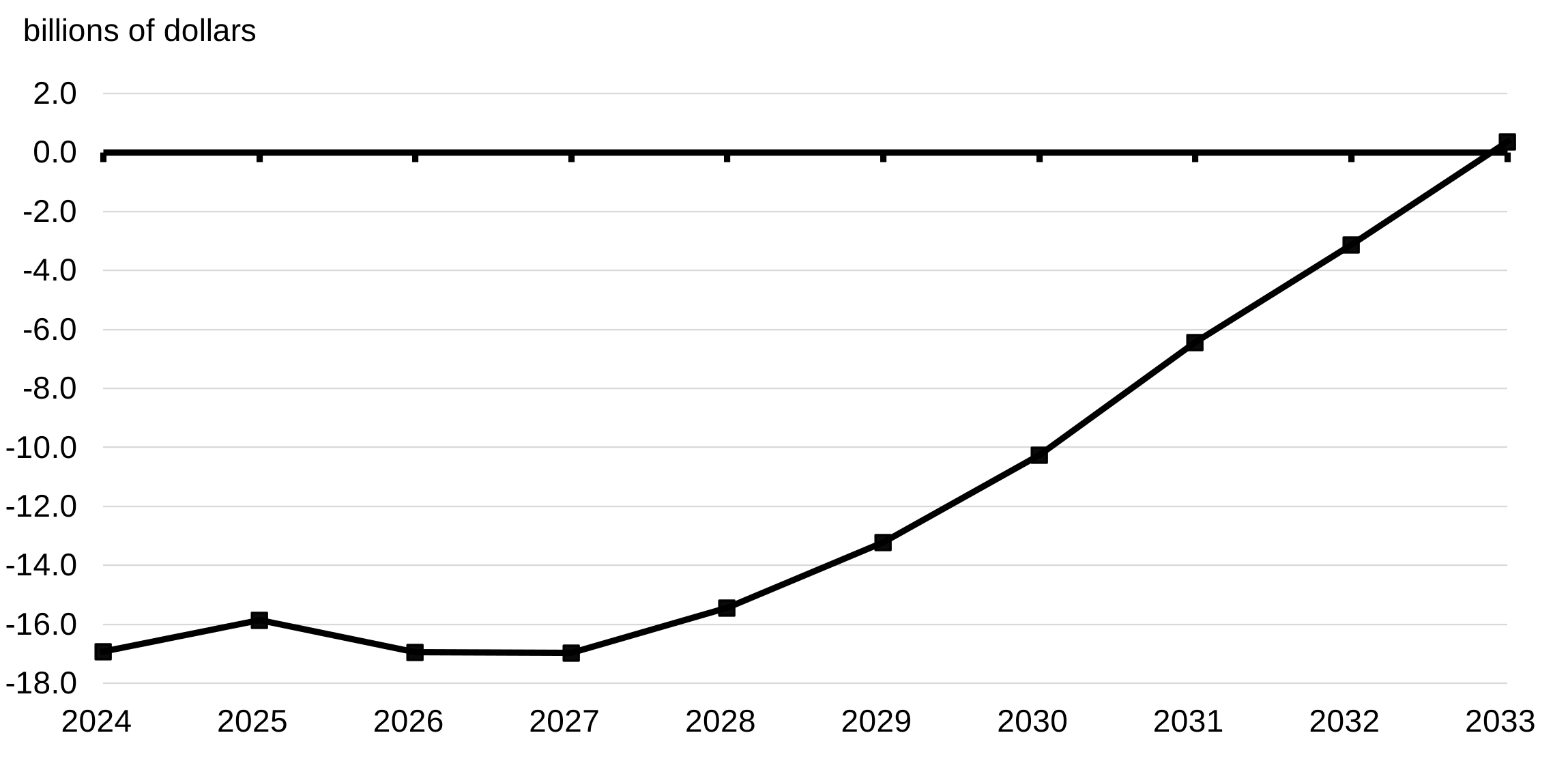
The EI Operating Account is expected to start recording annual surpluses in 2028-29 and to achieve a cumulative balance, meaning premium revenues will equal expenditures, in 2033.
Based on the current underlying economic conditions and year-to-date EI revenue and expenditures results, the outlook assumes a forecasted premium rate of $1.64 per $100 of insurable earnings for 2027 (compared to $1.63 in 2026). The actual EI premium rate for 2027 will be set by the EI Commission, based on the recommendations and projections of the Office of the Chief Actuary in accordance with the legislated 7-year break-even mechanism.
Cumulative Balance in EI Operating Account
Other Revenues
Other revenues consist of three broad components:
- Enterprise Crown corporation revenues are projected to increase by 49.7 per cent to $12.0 billion in 2025-26, largely reflecting higher expected net profits from the Bank of Canada and increased revenues from growth in the Government of Canada's holdings of Canada Mortgage Bonds (CMBs). Over the remainder of the forecast horizon, growth is projected to average 14.6 per cent annually, driven by net profits of enterprise Crown corporations and interest revenues from CMBs, partially offset by increases in expected losses from Canada Post.
- Other program revenues include proceeds from the federal pollution pricing framework for presentation purposes as the fuel charge ceased to apply effective April 1, 2025, and to capture the residual value related to the Output-Based Pricing System. Driven primarily by this change, other program revenues are projected to decrease by 34.3 per cent to $31.5 billion in 2025-26, reflecting the cessation of the fuel charge. Other program revenues are also projected to be lower due to a decrease in interest and penalty revenue driven by lower interest rates, and the waiving of interest and penalties as part of the tax relief and support provided to businesses in response to tariffs. Over the remainder of the forecast horizon, growth is projected to average 4.2 per cent annually.
- Net foreign exchange revenues and return on investments, which consist mainly of returns on Canada's official international reserves held in the Exchange Fund Account (EFA), are volatile and sensitive to fluctuations in foreign exchange rates and foreign interest rates. Assets in the EFA are mainly invested in debt securities of sovereigns and their agencies. They are held to aid in the control and protection of the external value of the Canadian dollar and to provide a source of liquidity for the government, if required. Net foreign exchange revenues and return on investments are projected to decline in 2025-26, largely due to lower short-term interest rates and lower returns on assets held in the EFA, partly offset by smaller net losses on sales of EFA securities. Subsequently, these revenues are projected to grow on average by 2.9 per cent annually over the remainder of the forecast horizon.
Canada's Surtaxes in Response to U.S. Tariffs on Canadian Goods
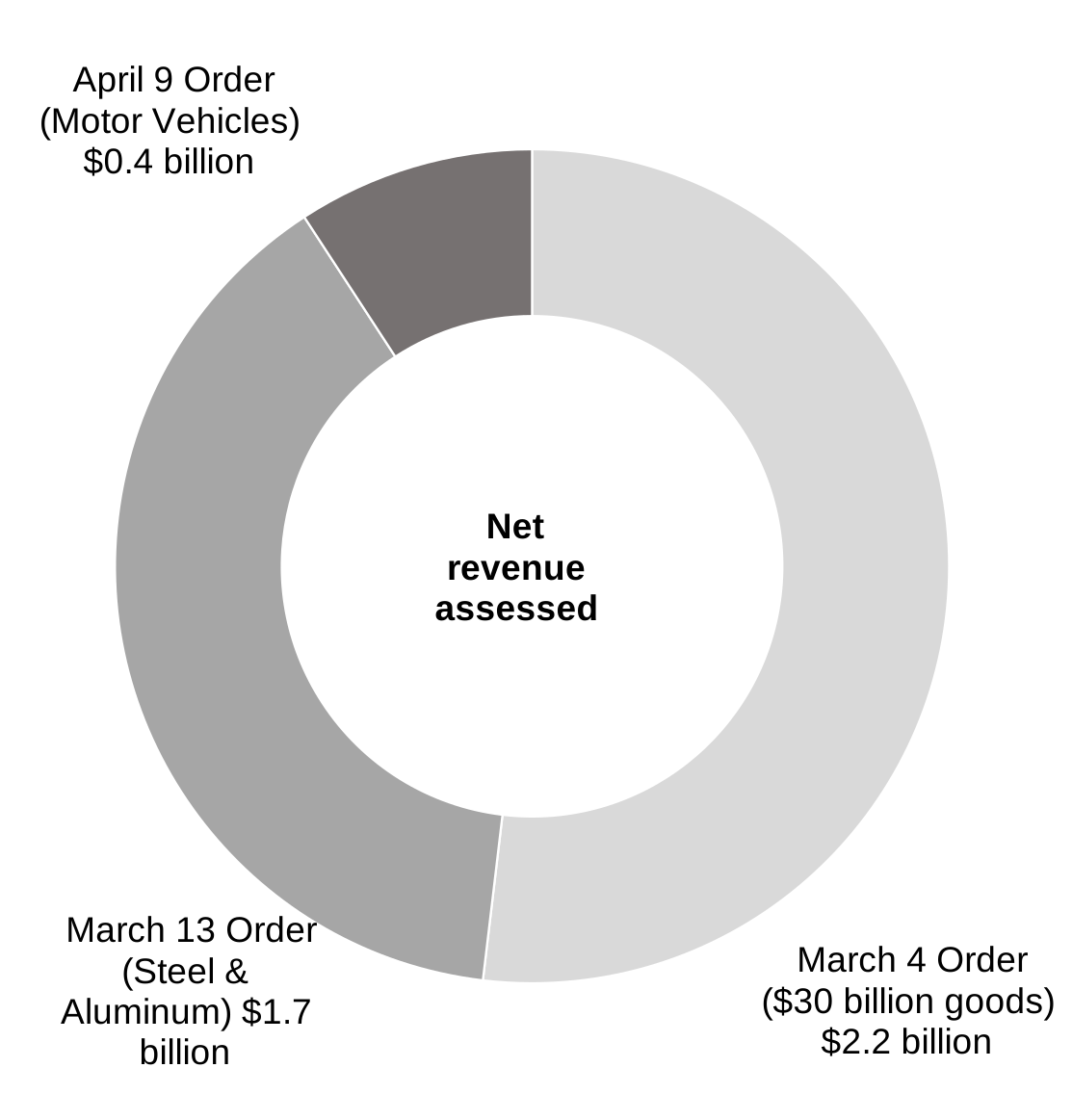
$9.7 billion in gross revenue has been assessed from Canada's countermeasures in response to U.S. tariffs. A total of $5.5 billion in revenue has been remitted to mitigate the impact of the countermeasures on the Canadian economy. The net revenue assessed is $4.3 billion and remains subject to revision.
The revenue projections assume these countermeasures will remain in place through 2026-27. The continued application of the countermeasures is subject to outcomes of discussions with the United States to resolve U.S. tariffs applied on Canadian exports of steel, aluminum and motor vehicles.
Canada's Surtaxes on Certain Imported Goods From China
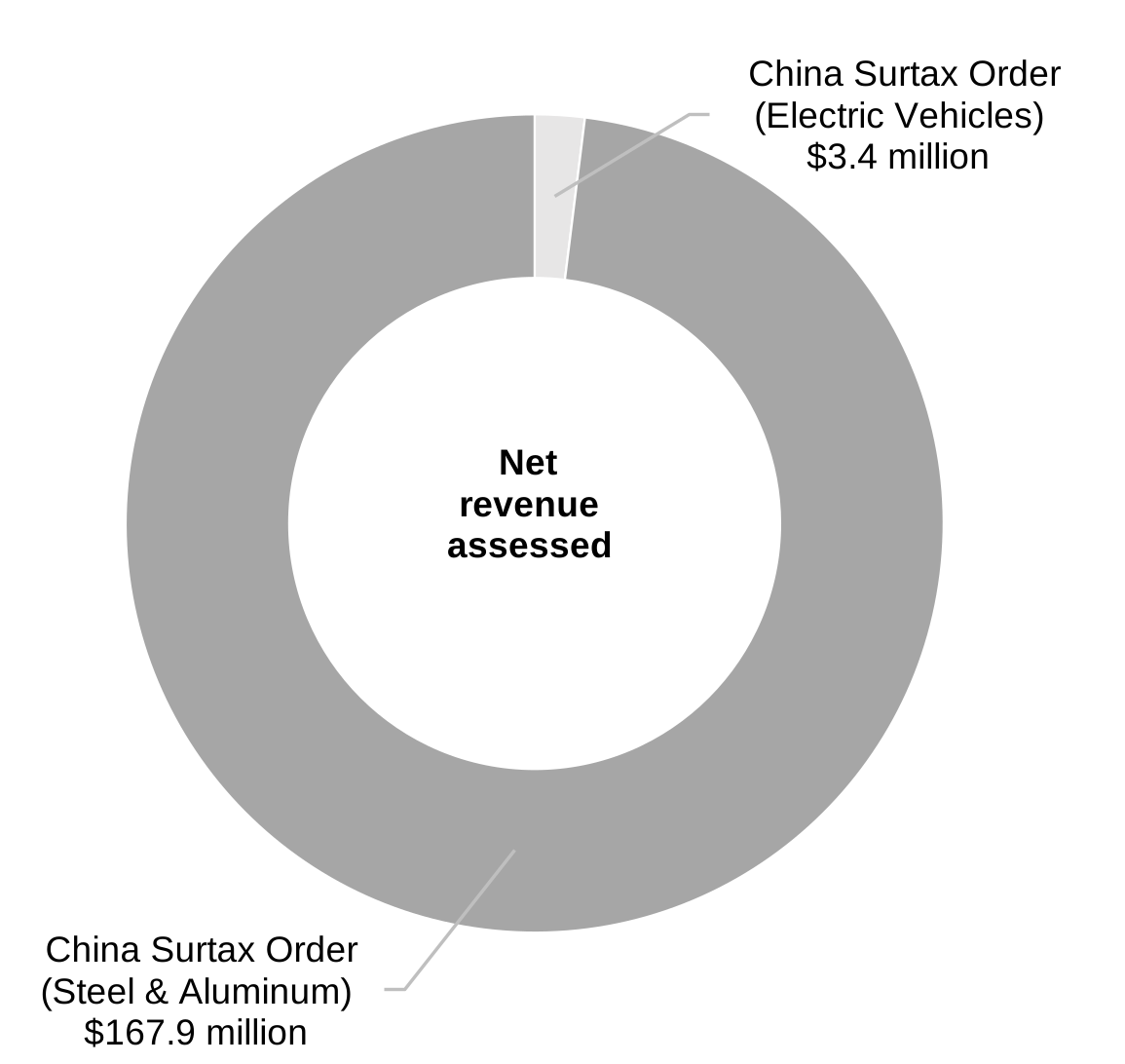
$374 million in gross revenue has been assessed from the China Surtax Order. A total of $203 million in revenue has been remitted to mitigate the impact on the Canadian economy. The net revenue assessed is $171 million and remains subject to revision.
Under a new strategic partnership with China, Canada will allow up to 49,000 Chinese electric vehicles (EVs) into the Canadian market, with the most-favoured-nation tariff rate of 6.1 per cent. Accordingly, the 100 per cent surtax on imported Chinese EVs was repealed, effective March 1, 2026.
In addition, the China Surtax Remission Order has also been amended to extend additional remission of surtaxes on goods originating from China due to both temporary and ongoing short supply for specific companies, and to provide new remission on certain products. These amendments extend the availability of relief for covered goods to December 31, 2026.
The figures in Chart A1.2 and A1.3 below detail the net revenue assessed as of April 17, 2026. As additional claims for remission are processed for these surtaxes, the total amount of relief provided will increase, which will result in downward revisions to net revenues assessed.
Net Revenues Assessed From U.S. Countermeasures
Net Revenues Assessed From China Surtax Order
Outlook for Expenses
Table A1.9 provides an overview of the projection for total expenses by major component.
| Projection | |||||||
|---|---|---|---|---|---|---|---|
| 2024– 2025 | 2025– 2026 | 2026– 2027 | 2027– 2028 | 2028– 2029 | 2029– 2030 | 2030– 2031 | |
| Major transfers to persons | |||||||
| Elderly benefits | 80.3 | 83.0 | 89.3 | 94.3 | 99.0 | 103.8 | 108.5 |
| Employment Insurance benefits | 24.9 | 29.0 | 32.7 | 32.1 | 32.9 | 34.2 | 35.1 |
| Canada Child Benefit | 28.6 | 30.2 | 31.2 | 32.1 | 32.8 | 33.5 | 34.2 |
| COVID-19 income support for workers1 | -2.2 | 0.0 | 0.0 | 0.0 | 0.0 | 0.0 | 0.0 |
| Total | 131.6 | 142.2 | 153.3 | 158.6 | 164.7 | 171.5 | 177.8 |
| Major transfers to provinces, territories, and municipalities | |||||||
| Canada Health Transfer | 52.1 | 54.7 | 57.4 | 60.3 | 62.6 | 65.0 | 67.5 |
| Canada Social Transfer | 16.9 | 17.4 | 17.9 | 18.5 | 19.0 | 19.6 | 20.2 |
| Equalization | 25.3 | 26.2 | 27.2 | 28.2 | 29.3 | 30.4 | 31.6 |
| Territorial Formula Financing | 5.2 | 5.5 | 5.8 | 6.3 | 6.6 | 6.8 | 7.0 |
| Health agreements with provinces and territories | 4.3 | 4.3 | 4.3 | 3.1 | 2.5 | 2.5 | 2.5 |
| Canada-wide early learning and child care | 6.6 | 7.9 | 8.6 | 8.0 | 8.2 | 8.5 | 8.1 |
| Build Communities Strong Fund – Community Stream | 2.4 | 2.5 | 2.5 | 2.6 | 2.6 | 2.7 | 2.8 |
| Other fiscal arrangements2 | -7.6 | -7.6 | -8.2 | -8.5 | -8.9 | -9.3 | -9.7 |
| Total | 105.1 | 110.8 | 115.6 | 118.4 | 122.0 | 126.2 | 130.0 |
| Pollution pricing proceeds returned to Canadians | 15.6 | 4.9 | 0.2 | 0.1 | 0.0 | 0.0 | 0.0 |
| Direct program expenses | |||||||
| Other transfer payments | 107.1 | 113.7 | 121.5 | 122.6 | 120.2 | 124.9 | 126.6 |
| Other direct program expenses | 130.5 | 141.1 | 145.6 | 144.1 | 149.0 | 152.8 | 157.2 |
| Total | 237.6 | 254.7 | 267.1 | 266.7 | 269.2 | 277.7 | 283.8 |
| Total program expenses, excluding net actuarial losses | 489.9 | 512.8 | 536.1 | 543.9 | 555.9 | 575.4 | 591.6 |
| Public debt charges | 53.4 | 54.0 | 58.7 | 65.7 | 71.6 | 75.7 | 80.9 |
| Total expenses, excluding net actuarial losses | 543.3 | 566.8 | 594.8 | 609.6 | 627.5 | 651.1 | 672.5 |
| Net actuarial losses (gains) | 4.0 | 11.6 | 0.1 | 0.4 | -3.9 | -5.2 | -5.6 |
| Total expenses | 547.3 | 578.3 | 595.0 | 609.9 | 623.7 | 645.9 | 666.9 |
| Per cent of GDP | |||||||
| Major transfers to persons | 4.2 | 4.4 | 4.5 | 4.5 | 4.5 | 4.5 | 4.5 |
| Major transfers to provinces, territories, and municipalities | 3.4 | 3.4 | 3.4 | 3.4 | 3.4 | 3.3 | 3.3 |
| Direct program expenses | 7.6 | 7.9 | 7.9 | 7.6 | 7.4 | 7.4 | 7.2 |
| Total program expenses, excluding net actuarial losses | 15.8 | 15.8 | 15.9 | 15.6 | 15.3 | 15.3 | 15.1 |
| Total expenses | 17.6 | 17.8 | 17.6 | 17.4 | 17.2 | 17.1 | 17.0 |
Note: Totals may not add due to rounding. 1 COVID -19 income support for workers were provided during the pandemic through the Canada Emergency Response Benefit, Canada Recovery Benefits, and the Canada Worker Lockdown Benefit. These temporary programs are now closed, with nominal projected amounts in 2025-26 of $0.2 billion mainly reflecting redeterminations of benefit overpayments. These are included in other transfer payments, consistent with their expected presentation in Public Accounts 2026. 2 Other fiscal arrangements include the Quebec Abatement (offsetting amounts to reflect the historical transfer of tax points and resulting reduction in federal tax collected for the Youth Allowances Recovery and Alternative Payments for Standing Programs); statutory subsidies; and payments for the transfer of Hibernia Net Profits Interest and Incidental Net Profits Interest net revenues to Newfoundland and Labrador. |
|||||||
Major Transfers to Persons
Major transfers to persons are expected to increase from $142.2 billion in 2025-26 to $177.8 billion in 2030-31:
- Elderly benefits are projected to reach $83.0 billion in 2025-26, up 3.4 per cent. Over the remainder of the forecast horizon, elderly benefits are forecast to grow by 5.5 per cent on average annually. Growth in elderly benefits is due to the increasing population of seniors and projected consumer price inflation, to which benefits are fully indexed.
- EI benefits are projected to increase by 16.6 per cent to reach $29.0 billion in 2025-26, largely reflecting the higher unemployment rate in 2025. EI benefits are expected to grow at an average of 3.9 per cent annually over the remainder of the forecast horizon, mainly driven by strength in earnings that lead to higher average weekly benefits, and steady growth in employment that results in an increase in potential claimants.
- Canada Child Benefit payments are projected to increase 5.8 per cent to $30.2 billion in 2025-26, largely reflecting the indexation of benefits to consumer price inflation. Payments are expected to grow at an average of 2.5 per cent annually over the remainder of the forecast horizon.
Major Transfers to Provinces, Territories, and Municipalities
Major transfers to provinces, territories, and municipalities are expected to increase from $110.8 billion in 2025-26 to $130.0 billion in 2030-31:
- The Canada Health Transfer (CHT) is projected to increase from $54.7 billion in 2025-26 to $67.5 billion in 2030-31, supported by the CHT growth guarantee of at least 5 per cent for five years (in effect from 2023-24 to 2027-28), after which it will grow in line with a three-year moving average of nominal GDP growth, with funding guaranteed to grow by at least 3 per cent per year.
- The Canada Social Transfer will increase from $17.4 billion in 2025-26 to $20.2 billion in 2030-31, reflecting legislated growth of 3 per cent per year.
- Equalization payments are indexed to the three-year average of nominal GDP growth and are projected to grow 3.9 per cent annually, on average, from $26.2 billion in 2025-26 to $31.6 billion in 2030‑31.
- Territorial Formula Financing is projected to grow 5.0 per cent annually, on average, from 2025-26 to 2030-31 due to growth in provincial/local expenditures, which are major components of the formula.
- Health agreements with provinces and territories are projected to remain at $4.3 billion in 2025-26 and 2026-27, reflecting $2.5 billion per year for tailored bilateral agreements, and $1.2 billion per year in transfers supporting home and community care and mental health and addictions services that expire after 2026-27. Another $600 million per year in transfers for long-term care expires after 2027-28.
- Canada-wide early learning and child care (CWELCC) transfer payments are expected to increase from $7.9 billion in 2025-26 to $8.1 billion in 2030-31. This includes the final two years of funding for the Early Learning and Child Care Infrastructure Fund which provided $625 million over four years (in effect from 2023-24 to 2026-27) and renewal of the CWELCC agreements starting in 2026-27.
- Build Communities Strong Fund – Community Stream, previously the Canada Community-Building Fund, is projected to grow from $2.5 billion in 2025-26 to $2.8 billion in 2030-31. The fund is indexed at 2 per cent per year with increases applied in $100 million increments.
- Other fiscal arrangements are projected to reduce transfers by $7.6 billion in 2025-26, increasing to $9.7 billion by 2030-31 due to the Quebec Abatement. This reflects the value of the historical transfer of tax points to Quebec in the 1960s and 1970s, which results in a commensurate reduction in cash transfers to the province.
Pollution Pricing Proceeds Returned to Canadians
The government repealed the federal fuel charge effective April 1, 2025; the federal Output-Based Pricing System remains in place. All direct proceeds from the federal pollution pricing system are returned over time in the province or territory where they were collected. As a result, the fuel‑charge proceeds return mechanisms for households (the Canada Carbon Rebate for individuals), small and medium‑sized enterprises, farmers, and Indigenous governments in provinces where the fuel charge applied are being wound down. Proceeds returned are projected to decline from $15.6 billion in 2024-25 to $4.9 billion in 2025-26, reflecting residual payments under these streams and the Output‑Based Pricing System proceeds returned. From 2026-27 onward, amounts reflect maintenance of the federal Output-Based Pricing System only.
Direct Program Expenses
Direct program expenses consist of other transfer payments administered by departments, and other direct program expenses. Growth in direct program expenses from 2025-26 to 2030-31 is driven disproportionately by investments identified in the Capital Budgeting Framework, which are growing faster than day-to-day expenses. Growth in capital investment expenses, most of which are in direct program expenses, averages 9.7 per cent, while growth in direct program expenses excluding capital investments averages under 1 per cent. Growth in direct program expenses in total from 2025-26 to 2030-31 is expected to average 2.2 per cent.
Other transfer payments administered by departments are projected to increase from $113.7 billion in 2025-26 to $126.6 billion in 2030-31. Projected growth reflects much of the programming identified under the Capital Budgeting Framework, such as support for electric vehicle battery manufacturing, Clean Economy investment tax credits, and public infrastructure investments.
Other direct program expenses reflect the cost of doing business for more than 100 government departments, agencies, and Crown corporations, as well as an allowance for doubtful accounts on taxes receivable. These expenses are forecasted to increase from $141.1 billion in 2025-26 to $157.2 billion in 2030-31, with growth muted by the phase-in of savings under the Comprehensive Expenditure Review beginning in 2026-27. Growth in later years reflects rebuilding, rearming, and reinvesting in the Canadian Armed Forces, as well as investments identified in the Capital Budgeting Framework, including capital amortisation expense and expenses of the Canadian Infrastructure Bank.
Public Debt Charges
Public debt charges are expected to increase from $54.0 billion in 2025-26 to $80.9 billion in 2030-31 due to projected increases in the stock of debt and higher interest rates. As a share of GDP, public debt charges are projected to rise from 1.7 per cent in 2025-26 to 2.1 per cent in 2030-31.
Net Actuarial Losses
Net actuarial losses, which represent changes in the value of the government's obligations for pensions and other employee future benefits, are expected to decline over most years of the forecast horizon, from a projected loss of $11.6 billion in 2025-26 to a projected net gain of $5.6 billion in 2030-31. This reflects the impact of benefit plan amendments in 2025-26 announced in Budget 2025, which result in the pulling forward of the amortisation of actuarial losses into that year, the end of the amortisation period of certain prior years' net actuarial losses, as well projected gains over the forecast horizon due to higher expected interest rates used to measure the present value of the obligations. The forecast of these net actuarial losses, including gains in the outer years of the forecast horizon, is volatile and sensitive to projections of future interest rates. To isolate these measurement impacts from underlying trends in government spending, expenses in Table A1.9 and the budgetary balance in Table A1.7 are shown before and after net actuarial losses.
Contingent Liabilities
Contingent liabilities are possible obligations that stem from past events or transactions that may result in a future payment. The key elements are:
- There is uncertainty as to whether an obligation exists
- A future event will resolve the uncertainty as to whether the government owes money
- The future event is outside the government's control
The government's contingent liabilities include claims, comprising pending and threatened litigation, specific claims, and comprehensive land claims, guarantees provided by the government, assessed taxes under appeal, callable share capital in international organisations, and insurance programs of agent enterprise Crown corporations.
The federal government records contingent liabilities in line with public sector accounting standards to provide a complete, transparent, and accurate picture of the government's financial position based on the available information.
As of March 31, 2025, the government had recorded a provision, or liability, of $54.7 billion for contingent liabilities.
Professional and Special Services in the Government of Canada
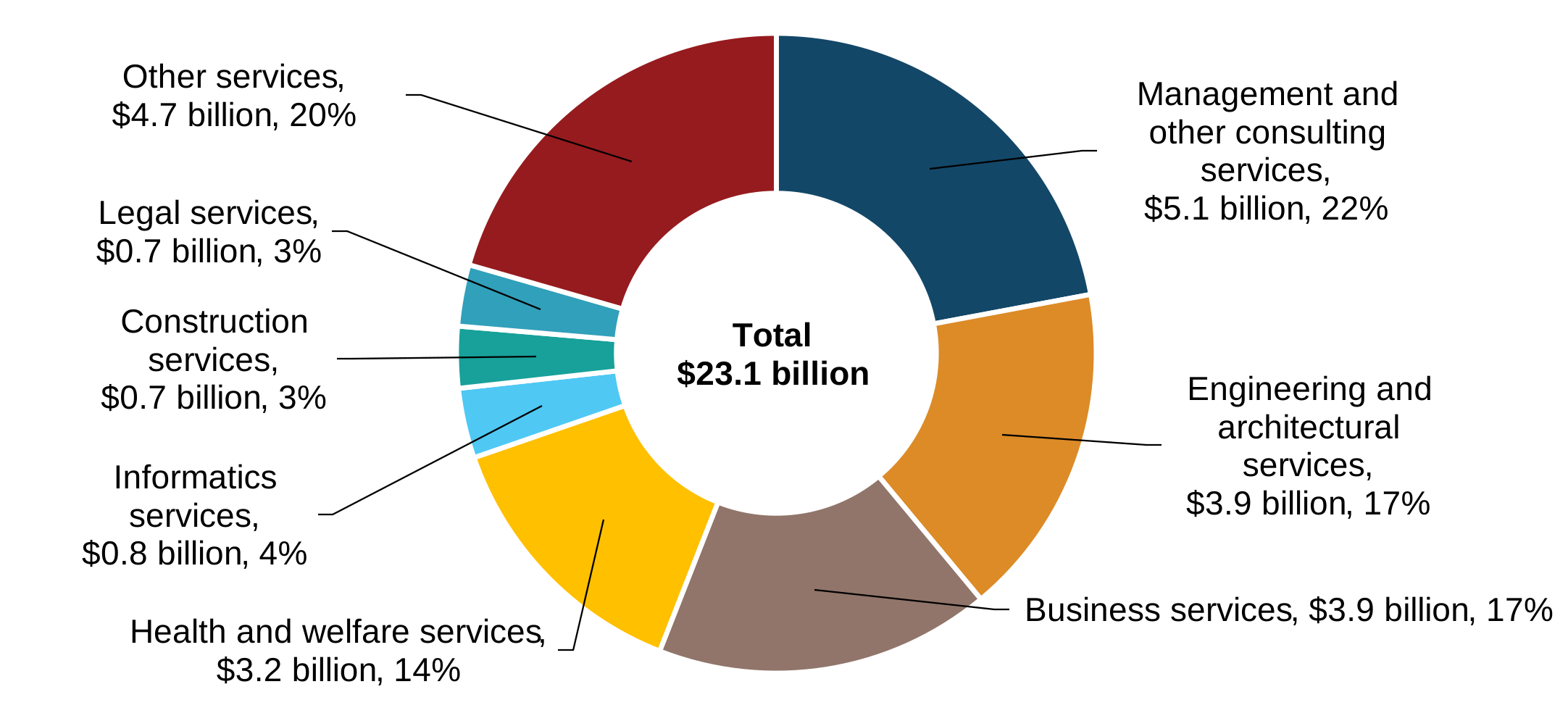
As announced in this Spring Economic Update, the government will reduce spending on external management and other consulting by 20 per cent over the next three years.
Management consulting represents a smaller component of professional services spending. Combined with other consulting related sub-components of professional services spending (e.g., training and IT consulting), the government spent about $5 billion on management and other consulting in 2024-25. Spending on professional and special services totaled $23.1 billion in 2024-25.
Other professional and special services include defence-related expenditures (e.g., structural design to deliver on major projects), essential service delivery (including the health care of veterans and the Canadian Armed Forces, and the delivery of health information and claims processing services for Indigenous Services Canada's Non-Insured Health Benefits program), and internal services within the government (e.g., Department of Justice legal advice for other departments).
Key Components of Professional and Special Services Expenditures, 2024-25
Financial Source/Requirement
The financial source/requirement measures the difference between cash coming into the government and cash going out. In contrast, the budgetary balance is presented on a full accrual basis of accounting, meaning that government revenues and expenses are recorded when they are earned or incurred, regardless of when the cash is received or paid.
Table A1.10 provides a reconciliation of the two measures, starting with the budgetary balance. Non-budgetary transactions shown in the table reflect the reversal of certain revenues and expenses included in the budgetary balance that have no impact on cash flows in the year, such as the amortisation of non-financial assets. They also include the addition of changes in asset and liability balances that have no accrual impact in a year but do result in the inflow or outflow of cash, such as the payment of accounts payable. An increase in a liability or decrease in an asset represents a financial source, whereas a decrease in a liability or increase in an asset represents a financial requirement. The sum of the budgetary balance and changes in asset and liability balances reflected under non-budgetary transactions is equal to the government's net source of (+), or requirement for (-), cash.
| Projection | ||||||||
|---|---|---|---|---|---|---|---|---|
| 2024–2025 | 2025–2026 | 2026–2027 | 2027–2028 | 2028–2029 | 2029-2030 | 2030-2031 | ||
| Budgetary balance | -36.3 | -66.9 | -65.3 | -63.1 | -57.7 | -56.2 | -53.2 | |
| Non-budgetary transactions | ||||||||
| Pensions and other accounts | 9.1 | 13.5 | 10.1 | 10.5 | 4.7 | -0.4 | -3.2 | |
| Non-financial assets | -10.5 | -12.0 | -17.7 | -20.2 | -19.3 | -16.9 | -20.2 | |
| Loans, investments, and advances | ||||||||
| Enterprise Crown corporations
|
-61.1 | -54.9 | -59.5 | -64.6 | -64.7 | -31.4 | -20.9 | |
| Other
|
-6.6 | -9.4 | -8.3 | -7.3 | -4.2 | -7.9 | -7.8 | |
| Total
|
-67.7 | -64.3 | -67.8 | -71.8 | -69.0 | -39.3 | -28.7 | |
| Other transactions | ||||||||
| Accounts payable, receivable, accruals, and allowances
|
-14.6 | 24.0 | 7.3 | 0.8 | -2.5 | -6.4 | -5.8 | |
| Foreign exchange activities and derivatives
|
-10.0 | 0.3 | 0.0 | -5.1 | -5.3 | -5.4 | -5.4 | |
| Total
|
-24.6 | 24.3 | 7.3 | -4.3 | -7.8 | -11.9 | -11.2 | |
| Total non-budgetary transactions | -93.7 | -38.5 | -68.1 | -85.9 | -91.3 | -68.4 | -63.2 | |
| Financial source (requirement) | -130.0 | -105.3 | -133.4 | -149.0 | -149.0 | -124.6 | -116.4 | |
As shown in Table A1.10, a financial requirement is projected in each year over the forecast horizon, reflecting financial requirements associated with the projected budgetary deficits, as well as forecast requirements from non-budgetary activities.
An annual financial source is projected for pensions and other accounts up to 2028-29, followed by projected requirements thereafter. Pensions and other accounts include the activities of the Government of Canada's employee pension plans and those of federally appointed judges and Members of Parliament, as well as a variety of other employee future benefit plans, such as health care and dental plans, and disability and other benefits for veterans and others. A financial source for pensions and other accounts reflects the difference between non-cash pension and benefit expenses recorded as part of the budgetary balance, such as the amortisation of net actuarial losses and the accrual of future benefits earned by employees during the year, and actual cash outflows for benefit payments.
Financial requirements for non-financial assets mainly reflect the difference between cash outlays for the acquisition of new tangible capital assets and the amortisation of capital assets included in the budgetary balance. They also include disposals of tangible capital assets and changes in inventories and prepaid expenses. Financial requirements are projected in each year over the forecast horizon, reflecting forecast net growth in non-financial assets.
Loans, investments, and advances include the government's equity in enterprise Crown corporations, including Canada Mortgage and Housing Corporation, Export Development Canada, the Business Development Bank of Canada, and Farm Credit Canada, loans to enterprise Crown corporations to finance their activities, and the up-to $30 billion in annual purchases of Canada Mortgage Bonds issued by Canada Mortgage and Housing Corporation. They also include loans, investments, and advances to national and provincial governments and international organisations, and under government programs.
In general, loans, investments, and advances are expected to generate additional revenues for the government in the form of interest or additional net profits of enterprise Crown corporations, which partly offset debt charges associated with these borrowing requirements. These revenues are reflected in the budgetary balance projections.
Other transactions include the payment of tax refunds and other accounts payable, the collection of taxes and other accounts receivable, the conversion of other accrual adjustments included in the budgetary balance into cash, as well as foreign exchange activities and derivatives. The projected financial source in 2025-26 reflects several factors, including a projected net increase in contingent liabilities and growth in amounts payable to taxpayers (i.e., expenses or adjustments to revenues not paid in the year). Projected net cash requirements for other transactions over the later years of the forecast horizon mainly reflect changes in accounts payable and accounts receivable and forecast increases in the government's official international reserves held in the Exchange Fund Account.
Economic Scenario Analysis
The Canadian economy has thus far remained resilient in the face of a global economic landscape transformation and new tariffs. Firms are adapting by diversifying suppliers and markets, enhancing supply chains' resilience. The March 2026 survey of private sector economists expects trade policy uncertainty to remain elevated, with some easing beginning in 2027. However, forecasters do not project a return to broadly open, low-tariff global trade.
As a trading nation, Canada is particularly exposed to global uncertainty. Geopolitical risk is currently elevated, introducing significant uncertainty into the global outlook. The conflict in the Middle East has led to sharply higher energy prices and disrupted crude oil production, exports, and refining capacity. While the consensus forecast expects a relatively short-lived conflict with a mostly temporary surge in oil prices, the path forward remains highly uncertain. Current WTI prices and futures‑implied prices are both higher than the March survey WTI projections.
As a net oil exporter, Canada stands to benefit from improved terms of trade and potentially stronger investment. For example, if WTI followed current futures prices and averaged around US$80 in 2026 compared to the US$73 expected in the March survey, nominal GDP would be about $17 billion higher, and the federal budgetary balance would improve by $1.9 billion. However, the net impact on real growth will depend on the scale and duration of the oil price increase. Uncertainty also extends beyond energy markets. Spillovers through global supply chains and transportation networks could dampen global activity, particularly if disruptions affect non-energy trade flows and raise costs through less efficient routing. An ongoing conflict could also trigger a more abrupt repricing of inflation risks and result in tighter financial conditions through higher interest rates.
The Department of Finance Canada has prepared two economic scenarios to support prudent fiscal planning and assess risks to the March survey forecast around higher oil prices (Table A1.11).
Higher Investment Scenario
In the Higher Investment scenario, the Middle East conflict leads to a prolonged reduction in global oil supply due to damage to oil infrastructure and production shut-ins. WTI oil prices rise to an average of US$115 per barrel in the second quarter of 2026. Prices are assumed to gradually decrease thereafter but remain elevated throughout the forecast horizon, as the conflict has a lasting impact on oil supply conditions and geopolitical risk in the region.
The sharper and more persistent rise in oil prices contributes to stronger inflation and higher interest rates worldwide. Demand for Canadian exports is reduced as tighter financial conditions and further erosion of household purchasing power weigh on global economic activity. This exacerbates challenges in key domestic export sectors that are already under strain with tariffs.
Despite these challenges, Canada benefits from improved terms of trade, boosting national income. These income gains initially accrue to the energy sector but gradually spread across the broader economy through higher profits and wages. Canada is also viewed as a stable and reliable energy supplier amid continued elevated geopolitical risks, supporting stronger demand for its exports. Elevated oil prices and stronger demand for Canadian crude oil, combined with policy efforts to accelerate major projects and catalyse new private investment, contribute to increased investment in the oil and gas sector and other industries, with positive spillovers to the broader economy, helping to offset the negative economic impact of weaker global demand.
With higher oil prices, the level of nominal GDP is on average $37 billion higher per year relative to the March survey forecast over 2026-2030.
- Canadian real GDP growth is modestly higher over the forecast horizon, averaging 1.8 per cent from 2026 to 2030 compared to 1.7 per cent in the March survey. Reflecting the effects of improved business investment on the economy's productive capacity, the level of real GDP is about 0.4 per cent higher than the survey forecast by 2030.
- The unemployment rate falls somewhat more quickly as a result, averaging 6.1 per cent over the same period (versus 6.2 per cent in the survey).
- Higher oil prices have a direct effect on gasoline and other petroleum fuels. Headline CPI inflation rises to 2.9 per cent in 2026 before slowing to 2.0 per cent in 2027. In comparison, CPI inflation in the survey reaches 2.5 per cent in 2026 and 1.9 per cent in 2027.
- With upward pressures on core inflation broadly contained, monetary policy is slightly more restrictive over the forecast relative to the March survey. The 3-month treasury bill rate averages 2.3 per cent and 2.6 per cent in 2026 and 2027, respectively, compared to 2.2 per cent and 2.5 per cent in the survey.
- GDP inflation is significantly higher due to higher oil prices, reaching 4.2 per cent in 2026, relative to 2.8 per cent in the survey.
Global Supply Disruptions Scenario
The Global Supply Disruptions scenario assumes that oil price increases in the Higher Investment scenario are compounded by broader adverse global disruptions due to persistent export constraints from the Middle East and damage to critical energy infrastructures.
Higher energy costs cascade through supply chains and raise input costs beyond energy-intensive sectors. Increased fuel costs and rerouted trade flows drive persistently higher shipping and freight insurance rates, pushing up prices for affected commodities, such as chemicals, metals, and fertilizers, and weighing on global production and trade. While supply chain disruptions intensify, they remain less severe than during the pandemic.
Relative to the Higher Investment scenario, inflationary pressures become broader, affecting both energy and non-energy products and eventually passing through to consumer prices. Monetary policy worldwide is more restrictive, while inflation concerns in markets drive up term premia, exerting a stronger drag on global activity. These developments, together with ongoing geopolitical uncertainty, weigh on business and consumer confidence, lower asset values, and dampen consumption and investment decisions.
These pressures make it more difficult and costly for Canadian businesses to adjust to tariffs and strengthen supply chains, which, in turn, significantly affects exports, consumption, investment, and productivity. The investment response of Canadian energy producers is also notably more subdued than in the Higher Investment scenario despite higher oil prices due to heightened uncertainty, including about future energy demand.
This scenario results in a prolonged period of slower economic growth and higher unemployment. Despite this, nominal GDP remains higher than the March survey in the first two years of the survey ($37 billion and $16 billion, respectively) due to the impact of higher oil prices on the terms of trade. However, as prices normalise, weaker real economic activity weighs on the level of nominal GDP, which falls below the March survey forecast from 2028 to 2030 by an average of $9 billion annually. Overall, over the forecast horizon, nominal GDP is $5 billion higher on average per year compared to the survey forecast, significantly lower than in the Higher Investment scenario.
- Canadian real GDP growth is weaker in 2026 and 2027, as cost pressures build and weigh on economic activity. Real growth reaches 0.8 per cent in 2026 and 1.0 per cent in 2027, compared to 1.1 per cent and 1.9 per cent in the March survey. By 2030, the level of real GDP is about 0.8 per cent lower than the forecast level in the survey.
- The unemployment rate remains elevated relative to the survey outlook, averaging 6.8 per cent in both 2026 and 2027 (versus 6.5 per cent and 6.2 per cent in the survey).
- Inflation is broader and more persistent, extending beyond energy-related components and affecting core inflation. Headline CPI inflation rises to 3.1 per cent in 2026 and 2.3 per cent in 2027, relative to 2.5 per cent and 1.9 per cent in the survey.
- Persistent inflation exerts upward pressure on short-term interest rates, but this effect is partially offset by weaker demand conditions. Short-term interest rates increase faster than in the March survey over the near term, averaging 2.5 per cent in 2026 and 2.8 per cent in 2027, compared to 2.2 per cent and 2.5 per cent in the survey.
- GDP inflation exceeds the March survey forecast on average over 2026-2030, as stronger gains in the terms of trade are further compounded by higher and more persistent domestic inflation. GDP inflation reaches 4.3 per cent in 2026 and 2.0 per cent in 2027, as opposed to 2.8 per cent and 1.8 per cent in the survey.
| 2026 | 2027 | 2028 | 2029 | 2030 | 2026-2030 | |
|---|---|---|---|---|---|---|
| Real GDP growth | ||||||
| Spring Economic Update 2026 | 1.1 | 1.9 | 1.9 | 1.9 | 1.8 | 1.7 |
| Higher Investment Scenario | 1.2 | 1.9 | 2.0 | 2.0 | 1.9 | 1.8 |
| Global Supply Disruptions Scenario | 0.8 | 1.0 | 1.8 | 2.2 | 2.1 | 1.6 |
| GDP inflation | ||||||
| Spring Economic Update 2026 | 2.8 | 1.8 | 1.9 | 2.0 | 2.0 | 2.1 |
| Higher Investment Scenario | 4.2 | 1.7 | 1.3 | 1.6 | 1.9 | 2.1 |
| Global Supply Disruptions Scenario | 4.3 | 2.0 | 1.4 | 1.5 | 1.9 | 2.2 |
| Nominal GDP growth | ||||||
| Spring Economic Update 2026 | 4.0 | 3.7 | 3.8 | 3.9 | 3.8 | 3.8 |
| Higher Investment Scenario | 5.5 | 3.6 | 3.4 | 3.7 | 3.8 | 4.0 |
| Global Supply Disruptions Scenario | 5.1 | 3.0 | 3.2 | 3.8 | 3.9 | 3.8 |
| Nominal GDP level (billions of dollars) | ||||||
| Spring Economic Update 2026 | 3,372 | 3,496 | 3,630 | 3,772 | 3,917 | |
| Higher Investment Scenario | 3,420 | 3,545 | 3,664 | 3,798 | 3,944 | |
| Global Supply Disruptions Scenario | 3,409 | 3,512 | 3,623 | 3,760 | 3,908 | |
| Difference between Higher Investment Scenario and Spring Economic Update 2026
|
48 | 49 | 34 | 26 | 26 | 37 |
| Difference between Global Supply Disruptions Scenario and Spring Economic Update 2026
|
37 | 16 | -7 | -12 | -9 | 5 |
| 3-month treasury bill rate | ||||||
| Spring Economic Update 2026 | 2.2 | 2.5 | 2.7 | 2.6 | 2.6 | 2.5 |
| Higher Investment Scenario | 2.3 | 2.6 | 2.8 | 2.8 | 2.7 | 2.6 |
| Global Supply Disruptions Scenario | 2.5 | 2.8 | 2.6 | 2.5 | 2.6 | 2.6 |
| 10-year government bond rate | ||||||
| Spring Economic Update 2026 | 3.4 | 3.6 | 3.7 | 3.7 | 3.7 | 3.6 |
| Higher Investment Scenario | 3.5 | 3.9 | 4.0 | 3.9 | 3.8 | 3.8 |
| Global Supply Disruptions Scenario | 3.8 | 4.1 | 4.1 | 4.0 | 3.9 | 4.0 |
| Unemployment rate | ||||||
| Spring Economic Update 2026 | 6.5 | 6.2 | 6.1 | 6.0 | 5.9 | 6.2 |
| Higher Investment Scenario | 6.5 | 6.1 | 6.0 | 5.9 | 5.9 | 6.1 |
| Global Supply Disruptions Scenario | 6.8 | 6.8 | 6.6 | 6.2 | 6.1 | 6.5 |
| Consumer Price Index inflation | ||||||
| Spring Economic Update 2026 | 2.5 | 1.9 | 2.0 | 2.0 | 2.0 | 2.1 |
| Higher Investment Scenario | 2.9 | 2.0 | 1.8 | 1.9 | 2.0 | 2.1 |
| Global Supply Disruptions Scenario | 3.1 | 2.3 | 1.9 | 1.8 | 2.0 | 2.2 |
| U.S. real GDP growth | ||||||
| Spring Economic Update 2026 | 2.4 | 2.0 | 2.0 | 2.0 | 2.0 | 2.1 |
| Higher Investment Scenario | 2.1 | 1.6 | 2.3 | 2.3 | 2.1 | 2.1 |
| Global Supply Disruptions Scenario | 2.1 | 1.3 | 2.0 | 2.3 | 2.1 | 2.0 |
| West Texas Intermediate crude oil price ($US per barrel) | ||||||
| Spring Economic Update 2026 | 73 | 66 | 66 | 69 | 70 | 69 |
| Higher Investment Scenario | 95 | 82 | 75 | 72 | 72 | 79 |
| Global Supply Disruptions Scenario | 95 | 82 | 75 | 72 | 72 | 79 |
Notes: Forecast averages may not equal average of years due to rounding. Numbers may not add due to rounding. Sources: Statistics Canada; Department of Finance Canada March 2026 survey of private sector economists; Department of Finance Canada calculations. |
||||||
Fiscal Impacts of Economic Scenarios
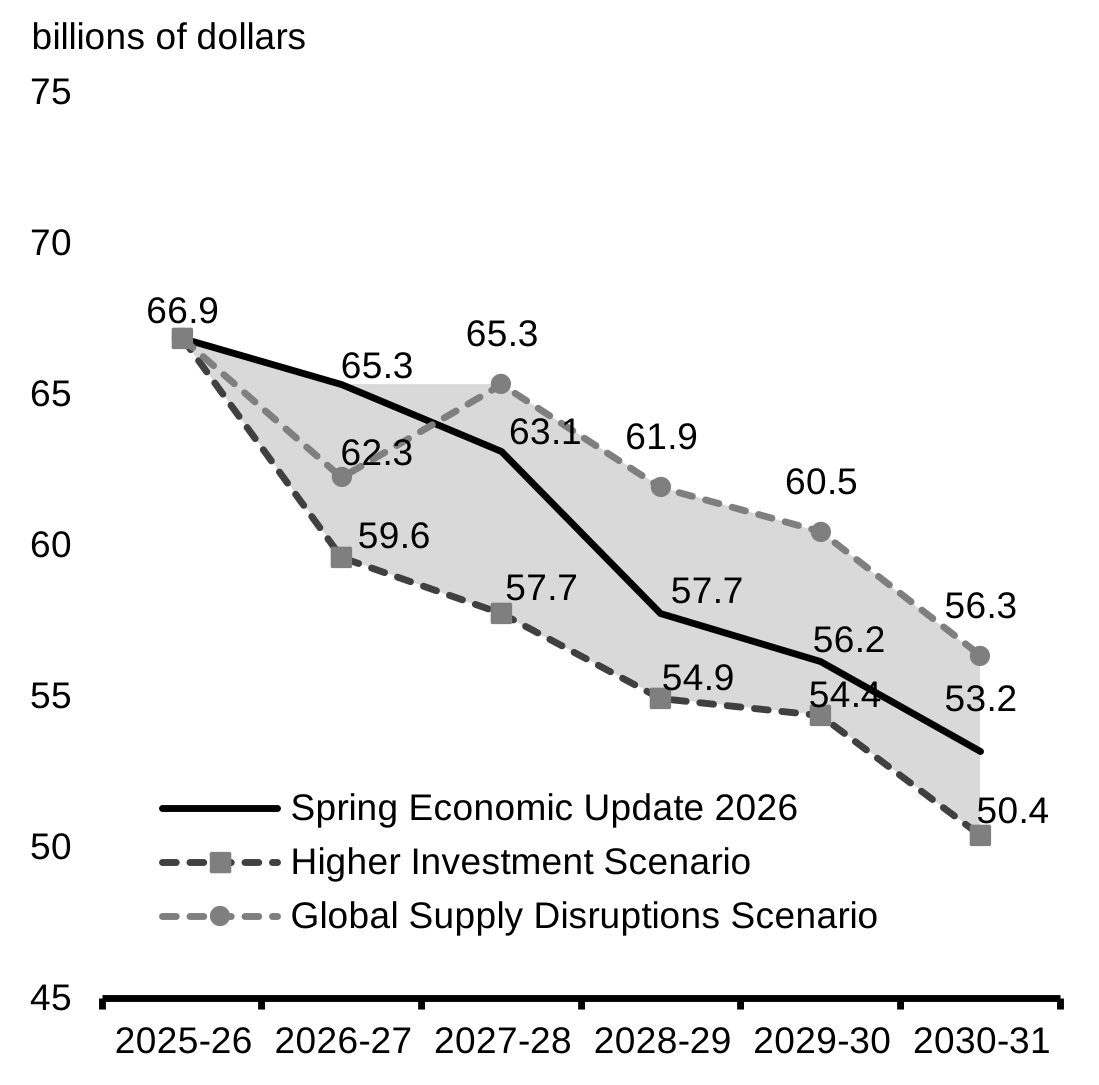
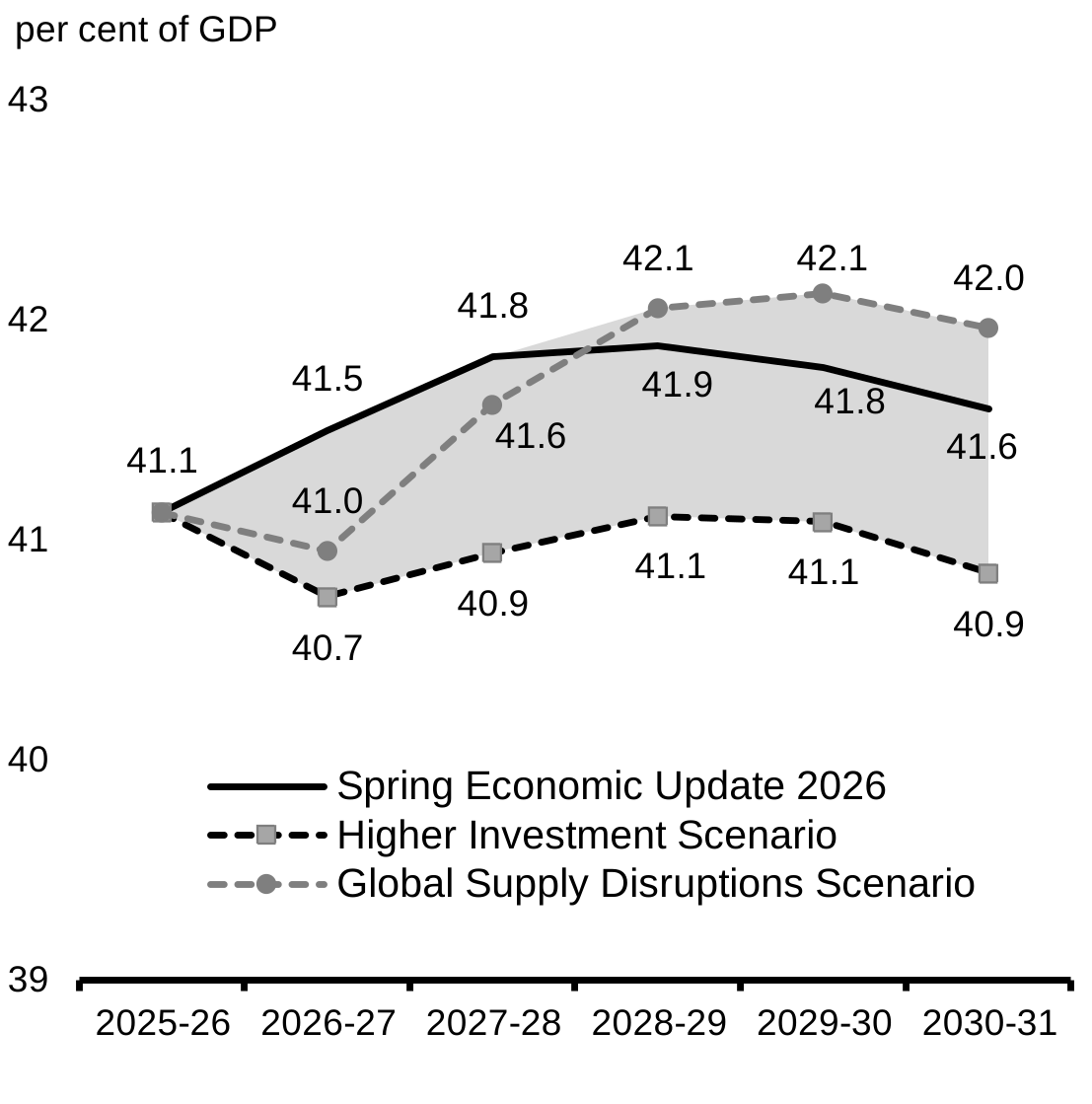
The potential impact of the economic scenarios on the projected federal deficit and federal debt to-GDP ratio is shown in Chart A1.5 and A1.6 below.
Federal Deficit Under Economic Scenarios
Federal Debt-to-GDP Ratio Under Economic Scenarios
Higher Investment Scenario Fiscal Impact
In the Higher Investment scenario, the budgetary balance would improve by $5.7 billion in 2026-27 and $3.2 billion, per year on average over the remainder of the forecast horizon. With the stronger outlook for nominal GDP, revenues would be revised up by $7.0 billion in 2026-27, and $5.5 billion, per year on average over the remainder of the forecast horizon. As a result of modestly higher interest rates, and slightly higher CPI inflation in the near term, public debt charges and program expenses are revised up by $1.2 billion in 2026-27, and an average of $2.3 billion, per year, over the remainder of the forecast horizon.
As a result of the stronger nominal GDP, the federal debt-to-GDP ratio would be expected to decrease to 40.7 per cent in 2026-27 and increase to 40.9 per cent in 2030-31.
Global Supply Disruptions Scenario Fiscal Impact
In the Global Supply Disruptions scenario, the deficit would improve by about $3.1 billion in 2026-27 but deteriorate by an average of $3.5 billion annually over the remainder of the forecast horizon. Revenues are projected to increase by $5.9 billion in 2026-27, and $1.5 billion, per year on average, over the remainder of the forecast horizon. As a result of broader, more persistent inflation and higher interest rates, expenses are forecast to increase by $2.8 billion in 2026-27, and $5.0 billion, per year on average, over the remainder of the forecast horizon.
In this scenario, the federal debt-to-GDP ratio would drop to 41.0 in 2026-27, and increase to 42.0 per cent in 2030-31.
Long-Term Debt Projections
Keeping the federal debt-to-GDP ratio on a stable or declining trajectory over the long term will help ensure that future generations are not unduly burdened by debt and that adequate fiscal room is preserved to respond to emerging fiscal pressures, challenges, and risks.
Long-term fiscal and economic projections can help assess whether the current fiscal policy trajectory is sustainable or whether policy adjustment may be needed. These simulations are not forecasts or predictions; rather they are useful indicators of how economic and fiscal variables may interact under a defined set of conditions and assumptions.
Building on the Spring Economic Update 2026 forecasts and extended using a set of reasonable assumptions described below, the baseline long-term fiscal projections continue to show the federal debt-to-GDP ratio declining over the long-term projection horizon (Chart A1.7).
Long-term projections can also be used to illustrate that fiscal sustainability depends not only on sound fiscal management, but also on strong economic policies and growth-enhancing investments that support economic growth over the longer term, such as those introduced by the government over the past year. As an illustration, sensitivity analysis suggests that higher average annual economic growth by 0.25 percentage points over the long term would put the federal debt-to-GDP ratio on a notably steeper downward path.
Long-Term Federal Debt Projections
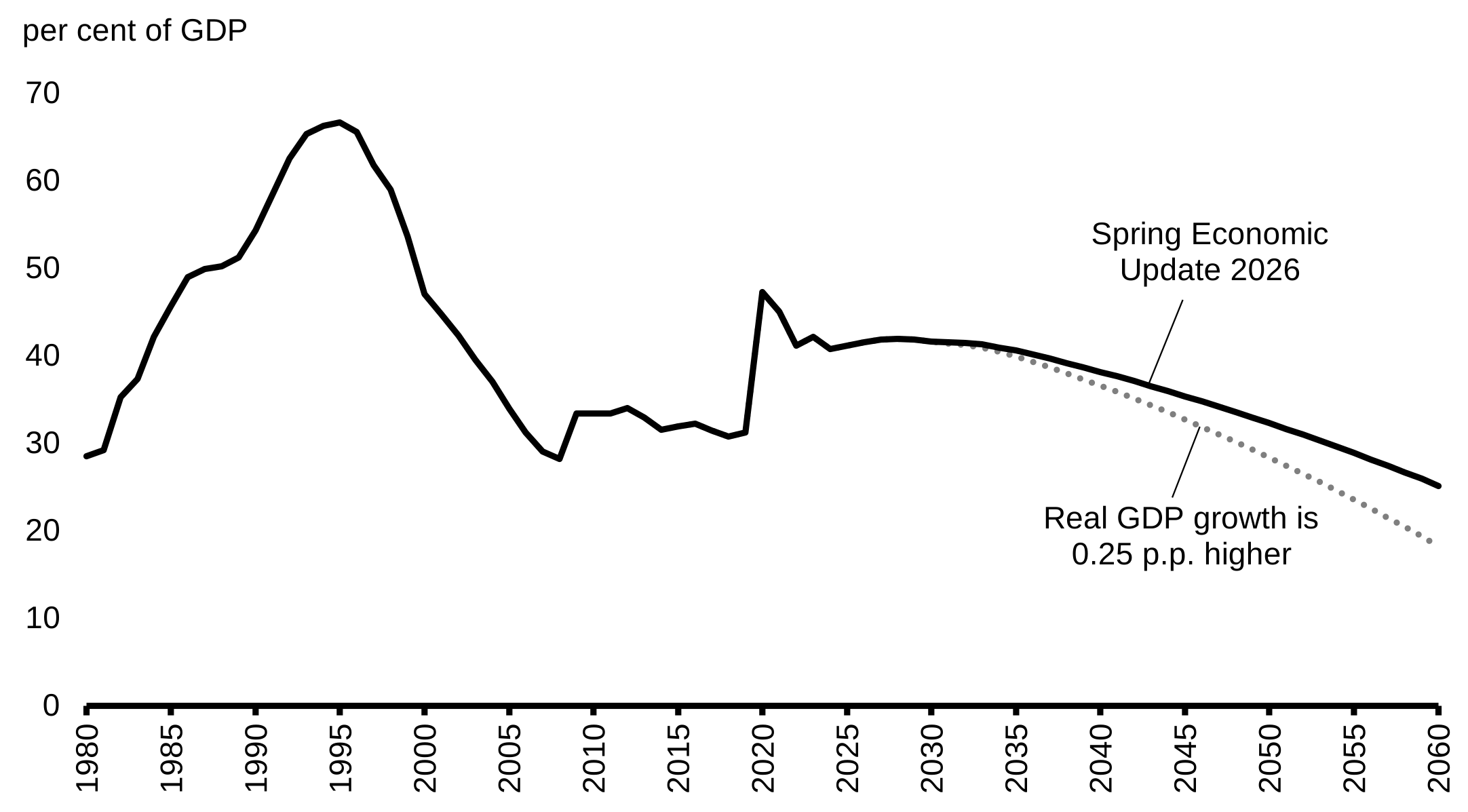
Keeping the federal debt-to-GDP ratio from rising over the long term will help ensure enough fiscal capacity remains to adequately manage future fiscal pressures not accounted for in the baseline long-term projection, including, among others, from recessions, additional defence spending, climate change, and the transition to net-zero emissions.
To form the long-term economic projections, the medium-term (2026 to 2030) economic forecasts presented in the Spring Economic Update 2026 are extended to 2060 using the Department of Finance Canada's long-term economic projection model. In this model, annual real GDP growth depends on labour productivity growth (0.9 per cent per year), which is calibrated over its 2000-2025 historical average, and labour supply growth (average of 0.6 per cent per year), which is based on demographic projections produced by Statistics Canada and projections for the labour force participation rate and average hours worked using econometric models developed by the Department. Assuming a constant 2 per cent annual rate for GDP inflation, nominal GDP is projected to grow by an average of 3.5 per cent per year from 2031 to 2060 (Table A1.12).
| 2000–2025 | 2026–2030 | 2031–2060 | |
|---|---|---|---|
| Real GDP growth | 2.1 | 1.7 | 1.5 |
| Contributions of (percentage points): | |||
| Labour supply growth
|
1.3 | 0.4 | 0.6 |
| Working-age population
|
1.5 | 0.7 | 0.7 |
| Labour force participation
|
0.0 | -0.3 | -0.1 |
| Unemployment rate
|
0.0 | 0.2 | 0.0 |
| Average hours worked
|
-0.2 | -0.2 | -0.1 |
| Labour productivity growth
|
0.9 | 1.3 | 0.9 |
| Nominal GDP growth | 4.7 | 3.8 | 3.5 |
Note: Contributions may not add up due to rounding. Sources: Statistics Canada; Department of Finance Canada March 2026 survey of private sector economists; Department of Finance Canada calculations. |
|||
The long-term federal debt projections are developed through an accounting model in which each revenue and expense category is modelled as a function of its underlying demographic and economic variables, with the relationships defined by a mix of current government policies and assumptions. The key assumptions underlying fiscal projections from 2031-32 through 2060-61 are as follows:
- All tax revenues as well as a direct program expenses grow broadly with nominal GDP, with the exception of a number of measures that will no longer be available after a certain date, such as the Clean Economy investment tax credits, which are incorporated based on their projected costs.
- The Canada Health Transfer, Canada Social Transfer, and Equalization grow with their respective legislated escalators. The remaining major transfers to provinces, territories, and municipalities grow according to their respective factors, such as nominal GDP, the respective populations, inflation, and current legislation or agreements.
- Elderly benefits and Canada Child Benefit payments grow in line with the respective populations and are indexed to inflation. Employment Insurance (EI) benefits grow in line with the number of beneficiaries and the growth in average weekly earnings. The EI premium rate grows according to current program parameters.
- The effective interest rate on federal market debt is assumed to gradually increase from about 3.2 per cent in 2030-31 to 3.5 per cent by 2060-61.
As with any projection that extends over several decades, long-term federal debt projections are subject to considerable uncertainty and are sensitive to the underlying assumptions. Sensitivity analysis helps illustrate how changes in key assumptions can affect the deficit-to-GDP ratio and the federal debt-to-GDP ratio at the end of the long-term projection horizon (Tables A1.13 and A1.14).
| Baseline2 | High | Low | |
|---|---|---|---|
| Demographic: | |||
| Fertility rate (average births per woman) | 1.3 births | +0.5 births | -0.5 births |
| Immigration (per cent of population) | 0.9 | +0.25 p.p. | -0.25 p.p. |
| Life expectancy at 65 | 23 years | +3 years | -3 years |
| Economic: | |||
| Total labour force participation rate (per cent) | 63.6 | +2.0 p.p. | -2.0 p.p. |
| Average weekly hours worked (hours) | 32.4 | +1.0 hour | -1.0 hour |
| Unemployment rate (per cent) | 5.9 | +1.0 p.p. | -1.0 p.p. |
| Labour productivity (per cent) | 0.9 | +0.25 p.p. | -0.25 p.p. |
| Interest rates (per cent) | 3.3 | +1.0 p.p. | -1.0 p.p. |
Note: p.p. = percentage point. 1 These alternative assumptions are applied starting in 2031 except for changes in life expectancy, which are gradually applied over the projection horizon. 2 Baseline shown as the average over the period 2031 to 2060. |
|||
| Baseline | High | Low | ||||
|---|---|---|---|---|---|---|
| Budgetary Balance | Debt | Budgetary Balance | Debt | Budgetary Balance | Debt | |
| Demographic: | ||||||
| Fertility rate | -0.1 | 25.1 | -0.2 | 28.3 | 0.0 | 21.7 |
| Immigration | -0.1 | 25.1 | 0.4 | 18.1 | -0.7 | 33.9 |
| Life expectancy at 65 | -0.1 | 25.1 | -0.6 | 29.5 | 0.2 | 21.5 |
| Economic: | ||||||
| Total labour force participation rate | -0.1 | 25.1 | 0.2 | 20.1 | -0.4 | 31.0 |
| Average weekly hours worked | -0.1 | 25.1 | 0.2 | 20.2 | -0.4 | 30.9 |
| Unemployment rate | -0.1 | 25.1 | -0.2 | 26.9 | 0.0 | 23.4 |
| Labour productivity | -0.1 | 25.1 | 0.4 | 18.1 | -0.7 | 32.9 |
| Interest rates | -0.1 | 25.1 | -0.9 | 36.8 | 0.5 | 16.0 |
Policy Actions Taken Since Budget 2025
To ensure transparency, Table A1.15 lists all policy actions taken since Budget 2025, helping to ensure that Canadians continue to be well served by the programs they rely on and that government operations carry on efficiently. These actions also include time-limited funding renewals to support programs with sunsetting authorities. For these programs, time-limited renewals reflect decisions taken at this time and do not determine long‑term funding, permanent base funding, or whether a program may be funded again in the future.
| Dept. | 2025-2026 | 2026-2027 | 2027-2028 | 2028-2029 | 2029-2030 | 2030-2031 | |
|---|---|---|---|---|---|---|---|
| Transport, Infrastructure and Environment | 16 | 1,277 | 353 | 323 | 262 | 256 | |
| Extending Support for Eastern Ferries and Marine Atlantic Inc. | TC, MAI | 16 | 139 | 167 | 173 | 173 | 173 |
| Extending Support for the Trade and Transportation Information System | TC | .... | 4 | 4 | 4 | 4 | 4 |
| Extending Support for the Operations and Oversight of Federally Owned Bridges | FBCL, WDBA, HICC | .... | 31 | 70 | 61 | 4 | 4 |
| Extending Support for the Safer Skies Initiative's Conflict Zone Information Office | TC | .... | 2 | 2 | 2 | 2 | 2 |
| Extending Support for Regulating Advanced Aviation Technologies | TC | .... | 13 | 13 | 13 | 14 | 14 |
| Extending Support for the Operations of the Canadian Air Transport Security Authority* | CATSA | .... | 734 | 0* | 0* | 0* | 0* |
| Extending Support for the Operations of the Canadian Transportation Agency | CTA | .... | 26 | 26 | - | - | - |
| Extending Support for Safety and Cybersecurity in Connected and Automated Vehicles | TC | .... | 23 | 23 | 24 | 25 | 22 |
| Extending Support for the Implementation of Vehicle GHG Regulations* | ECCC | .... | 5 | 5 | 5 | 5 | 5 |
| Extending Support for the Standards to Support Resilience in Infrastructure Program | SCC | .... | 4 | 4 | 7 | 7 | 7 |
| Extending Support for the Operations of VIA Rail | VIA Rail | .... | 262 | - | - | - | - |
| Extending Support for Transport Canada's Port Assets | TC | .... | 7 | 7 | 6 | - | - |
| Extending Support for Wildfire Risk Mapping* | NRCan | .... | 6 | 6 | 6 | 6 | 6 |
| Extending Support for the National Wildfire Program* | PC | .... | 9 | 9 | 9 | 9 | 9 |
| Extending Support for Enhancing Flood Resilience | PS | .... | 5 | - | - | - | - |
| Extending Support for Core Activities at the Canada Energy Regulator | CER | .... | 8 | 8 | 8 | 8 | 8 |
| Less: Costs to be Recovered
|
.... | -8 | -8 | -8 | -8 | -8 | |
| Extending Support for Engaging Across the Federation on Energy and Natural Resource Projects and Policies | NRCan | .... | 3 | 3 | 3 | 3 | - |
| Extending Support for the Cyber Security and Resilience of Canada's Energy Sector | NRCan | .... | 2 | 2 | 2 | 2 | 2 |
| Extending Support for the Critical Minerals Strategy | NRC | .... | .... | 9 | 6 | 6 | 6 |
| Supports for Businesses and Innovation | 103 | 166 | 75 | 68 | 68 | ||
| Extending Support for the College and Community Innovation Program | NSERC | .... | 33 | 33 | 33 | 33 | 33 |
| Extending Support for Laboratories Canada | PSPC | .... | 8 | 27 | 26 | 26 | 26 |
| Extending Support for CanCode | ISED | .... | 15 | 15 | - | - | - |
| Extending Support for the Northern Ontario Development Program | FedNor | .... | 5 | 5 | 5 | 5 | 5 |
| Extending Support for the Regional Homebuilding Innovation Initiative for Northern Ontario* | FedNor | .... | 1 | 1 | 1 | 1 | 1 |
| Extending Support for the Northern Projects Management Office | CanNor | .... | 1 | 1 | 1 | 1 | 1 |
| Support for Kap Paper1 (new) | FedNor | 14 | - | - | - | - | - |
| Less: Funds Previously Provisioned in the Fiscal Framework
|
NRCan | -14 | - | - | - | - | - |
| Reprofiling Funds for the Forest Innovation Program2 | NRCan | 37 | - | - | - | - | - |
| Less: Funds Sourced From Existing Departmental Resources
|
-37 | - | - | - | - | - | |
| Extending Support for the Business Data Lab | ISED | .... | .... | 1 | 1 | 1 | 1 |
| Extending Support for the Can Health Network | ISED | .... | 8 | 9 | 7 | - | - |
| Extending Support for Business Women in International Trade | GAC | .... | 2 | - | - | - | - |
| Extending Support for Improving Procurement Opportunities for Canadian Businesses | PSPC | .... | 26 | 18 | - | - | - |
| Extending Support for the Connecting Families (Affordable Access) Initiative | ISED | .... | .... | 0* | 0* | 0* | 0* |
| Extending Support for the Agricultural Clean Technology Program* | AAFC | .... | .... | 54 | - | - | - |
| Extending Support for Polar Knowledge Canada | POLAR | .... | 4 | - | - | - | - |
| Public Safety, Defence, and Canada in the World | 71 | 623 | 309 | 294 | 125 | 105 | |
| Extending Support for the Nation's Capital Extraordinary Policing Costs Program | PS | .... | 3 | 3 | 3 | 3 | 3 |
| Extending Support for Indigenous Policing Capacity | PS | .... | 3 | 3 | 3 | - | - |
| Supporting Federal Policing1 | RCMP | 27 | .... | .... | .... | .... | .... |
| Less: Funds Sourced From Existing Departmental Resources
|
-7 | .... | .... | .... | .... | .... | |
| Extending Support for Combatting Drug Impaired Driving | CBSA, RCMP | .... | 7 | .... | .... | .... | .... |
| Extending Support for the Building Safer Communities Fund1 | PS | .... | 55 | 55 | 55 | - | - |
| Extending Support for Addressing Gender-based Violence through the Criminal and Family Justice Systems | JUS | .... | 21 | 21 | 21 | 21 | 21 |
| Extending Support for Responding to Gender-based Violence* | RCMP | .... | 5 | 5 | 5 | 5 | 5 |
| Extending Support for Records Suspension Program Reforms | PS | .... | 6 | 6 | - | - | - |
| Extending Support for Racialized Communities Legal Support | JUS | .... | 4 | 4 | - | - | - |
| Extending Support for Community Justice Centres | JUS | .... | 6 | 6 | 6 | - | - |
| Extending Support for the Memorial Grant Program for First Responders | PS | .... | 29 | 29 | 29 | - | - |
| Extending Support for the Canadian Program for Cyber Security Certification | PSPC, SCC | .... | 5 | 6 | 6 | 6 | 6 |
| Extending Support for Responding to National Security Reviews | CBSA, CSIS, JUS, PS, RCMP | .... | 12 | 10 | 10 | 10 | 10 |
| Extending Support for Combatting Foreign Interference* | RCMP | .... | 17 | 17 | 17 | 17 | 17 |
| Extending Support for the Counter Drone Program* | RCMP | .... | 9 | 9 | 9 | 9 | 9 |
| Enhancing the Defence Platform to Boost Canada's Defence and Security Ecosystem (new) 1 | BDC | 51 | 46 | 40 | 36 | 31 | 10 |
| Canada's Support for Ukraine - Military Assistance | DND | .... | 300 | - | - | - | - |
| Extending Support for the Implementation of the Supply Chains Act | PS | .... | 3 | - | - | - | - |
| Extending Support for the Humanitarian Workforce Program | PS | .... | 36 | 36 | 36 | - | - |
| Extending Support for Defending the Canadian Softwood Lumber Industry | GAC | .... | 31 | 31 | 31 | - | - |
| Extending Support for CanExport: Intellectual Property Support Program | GAC | .... | .... | 2 | 2 | 2 | 2 |
| Extending Support for the Creative Export Strategy | PCH | .... | 19 | 19 | 19 | 19 | 19 |
| Extending Support for the International Convention Attraction Fund1 | DC | .... | 5 | 5 | 5 | - | - |
| Strengthening Canada's Trade Policy Response (new) | FIN | .... | 2 | 2 | 2 | 2 | 2 |
| Immigration, Culture and Communities | 189 | 423 | 279 | 276 | 88 | ||
| Extending Support for the Opportunities Fund for Persons with Disabilities | ESDC | .... | .... | 65 | 65 | 65 | 65 |
| Extending Support for the Enabling Accessibility Fund* | ESDC | .... | 5 | 5 | - | - | - |
| Extending Support for the National Monitoring Mechanism for Disability Rights | CHRC | .... | 1 | .... | .... | .... | .... |
| Extending Support for the Autism And/or Intellectual Disability Knowledge Exchange Network (AIDE Canada) | PHAC | .... | 2 | - | - | - | - |
| Extending Support for Canada's Anti-racism Strategy | PCH | .... | 33 | 33 | - | - | - |
| Extending Support for the Federal Anti-racism Secretariat | ESDC | .... | 3 | 3 | - | - | - |
| Extending Support for Canada's National Museums and the National Battlefields Commission* | CMHR, CMH, CMIP, CMN, NGC, NBC | .... | 17 | 0* | 0* | 0* | 0* |
| Extending Support for Sheltering Asylum Claimants | IRCC | .... | .... | 188 | 188 | 188 | - |
| Extending Support for the Migrant Worker Support Program | ESDC | .... | 20 | - | - | - | - |
| Extending Support for Settlement Services for Newcomers Affected By Gender-based Violence | IRCC | .... | 0* | 0* | - | - | - |
| Extending Support for the Temporary Foreign Worker Program | ESDC | .... | 88 | 88 | - | - | - |
| Extending Support for Implementing the Agriculture and Fish Processing Work Permit | IRCC | .... | .... | 1 | - | - | - |
| Extending Support for Access to Information and Privacy | LAC | .... | .... | 15 | 22 | 22 | 22 |
| Extending Support for the Digital Citizen Initiative | PCH | .... | .... | 4 | 4 | - | - |
| Emergency Shelter Funding for City of Toronto1 (new) | IRCC | 63 | - | - | - | - | - |
Less: Funds Previously Provisioned in the Fiscal Framework |
NRCan | -63 | - | - | - | - | - |
| Canadian Digital Core Library (new) | NRCan | .... | 20 | 20 | - | - | - |
| Reconciliation with Indigenous People | 749 | 1,060 | 179 | 114 | 106 | 106 | |
| Extending Support for the Family Violence Prevention Program | ISC | .... | 13 | 13 | 13 | 13 | 13 |
| First Nations Child and Family Services Program1 | ISC | 0* | 11 | 66 | 59 | 58 | 58 |
| Extending Support for Jordan's Principle1* | ISC | .... | 778 | - | - | - | - |
| Extending Support for the Inuit Child First Initiative1 | ISC | .... | 115 | - | - | - | - |
| Extending Support for Indigenous Youth | CIRNAC | .... | 1 | - | - | - | - |
| Extending Support for the Missing and Murdered Indigenous Women and Girls Initiative | PPSC | .... | 8 | 8 | 8 | 8 | 8 |
| Extending Support for the MMIWG - National Family and Survivors Circle | CIRNAC | .... | 1 | 1 | 1 | - | - |
| Extending Support for Addressing the Legacy of Residential Schools | CIRNAC | .... | 59 | 59 | - | - | - |
| Extending Support for Emergency Management Response and Recovery Activities on Reserve* | ISC | 749 | - | - | - | - | - |
| Extending Support for the Dechinta Centre for Research and Learning | CIRNAC | .... | 3 | - | - | - | - |
| Extending Support for First Nations Fiscal Relationships | ISC | .... | 6 | 6 | 6 | 6 | 6 |
| Extending Support for Additions to Reserve | ISC | .... | 11 | - | - | - | - |
| Extending Support for Flood Mapping on Reserve | CIRNAC | .... | 6 | 6 | 6 | - | - |
| Extending Support for the First Nation Land Governance Registry | CIRNAC | .... | 0* | - | - | - | - |
| Extending Support for First Nations Specific Claims Research | CIRNAC | .... | 4 | - | - | - | - |
| Extending Support for the Indigenous Partnerships Office and Indigenous Natural Resource Partnerships Program | NRCan | .... | .... | 21 | 21 | 21 | 21 |
| Extending Support for Section 35 Negotiations | CIRNAC | .... | 40 | - | - | - | - |
| Extending Support for First Nations Negotiations Funding Support | CIRNAC | .... | 5 | - | - | - | - |
| Health and Safety | 364 | 539 | 302 | 215 | 216 | ||
| Extending Support for Protecting Canadians Against Threats to Public Health* | PHAC | .... | .... | 197 | 198 | 199 | 199 |
| Extending Support for Keeping Food Safe | CFIA, HC | .... | 16 | 16 | 16 | 16 | 16 |
| Extending Support for African Swine Fever Preparedness and Disease Prevention | CFIA, CBSA | .... | 7 | 7 | 7 | - | - |
| Extending Support for Bovine Spongiform Encephalopathy Prevention | CFIA, HC, PHAC | .... | 24 | 24 | 24 | - | - |
| Extending Support for Potato Wart Prevention | CFIA | .... | 6 | 6 | 6 | - | - |
| Extending Support for the Canadian Shellfish Sanitation Program* | CFIA, DFO, ECCC | .... | 12 | 12 | 12 | 1 | 1 |
| Extending Support for the Emergency Response Fund* | CFIA | .... | 27 | 27 | 27 | 0* | 0* |
| Extending Support for Protecting Canadians From Harmful Chemicals* | ECCC, HC | .... | 95 | 104 | 0* | 0* | 0* |
| Extending Support for the Mental Health Commission of Canada | HC | .... | .... | 13 | 12 | - | - |
| Extending Support for the Canadian Safe Sport Program1 | PCH | .... | 4 | - | - | - | - |
| Extending Support for Promoting a Safer Sport Environment1 | PCH | .... | 8 | 8 | - | - | - |
| Extending Support for the Vaccine Impact Assistance Program1 | PHAC | .... | 27 | - | - | - | - |
Less: Funds Sourced From Existing Departmental Resources |
.... | -9 | - | - | - | - | |
| Extending Support for the Administration of the Canadian Dental Care Plan | HC | .... | 149 | 126 | - | - | - |
| Effective Government and Tax Fairness | 226 | 1,322 | 995 | 929 | 867 | 876 | |
| Extending Support for the Operations of the Office of the Privacy Commissioner | OPC | .... | 3 | 3 | 3 | 3 | 3 |
| Extending Support for the Operations of the Office of the Federal Housing Advocate | CHRC | .... | 2 | 2 | - | - | - |
| Extending Support for the Operations of the Administrative Tribunals Support Service of Canada | ATSSC | .... | 5 | 5 | 5 | 5 | 5 |
| Extending Support for the Administration of the First Home Savings Account | CRA | .... | 25 | - | - | - | - |
| Extending Support for Administration of Justice Agreements | JUS | .... | 2 | 2 | 2 | 2 | 2 |
| Extending Support for the Administration of Proactive Pay Equity Across the Federal Government | TBS | .... | 5 | 5 | - | - | - |
| Less: Funds Sourced From Existing Departmental Resources
|
.... | -1 | -1 | - | - | - | |
| Surge Capacity at the Pay Centre to Implement the Comprehensive Expenditure Review | PSPC | .... | 36 | .... | .... | .... | .... |
| Obligations for Federal Public Sector Employee Benefit Plans3 | TBS | .... | 848 | 646 | 646 | 646 | 646 |
| Extending Support for the Administration of Disability Pensions | RCMP | .... | 18 | 18 | 18 | - | - |
| Extending Support for Statistics Canada's Cloud Operations | StatCan | .... | 39 | 39 | 39 | - | - |
| Extending Support for Federal Correctional Institutions1 | CSC | 159 | 206 | 79 | 16 | 16 | 16 |
| Extending Support for Information Technology Capacity* | CSIS | .... | 17 | 19 | 21 | 23 | 25 |
| Support for Cape Breton Operations in Managing Legacy Liabilities | PSPC | .... | 0* | 0* | 0* | 0* | 4 |
| Price and Volume Protection for Federal Real Property1 | PSPC, ESDC | 1 | 32 | 102 | 100 | 99 | 97 |
| Less: Funds from CPP Account (ESDC)
|
.... | -1 | - | - | - | - | |
| Veterans Affairs Canada Adjustments for Non-discretionary Cost Fluctuations1 | VAC | 0* | 4 | - | - | - | - |
| Global Affairs Canada Adjustments for Non-discretionary Cost Fluctuations1 | GAC | 65 | 62 | 62 | 62 | 62 | 62 |
| Government Postage and Banking Costs | PSPC | .... | 10 | - | 7 | - | - |
| Extending Support for Emergency Benefits System Capacity and Maintenance | CRA | .... | 5 | 5 | - | - | - |
| Extending Support for the Canada Financial Crimes Agency | FIN | .... | 1 | 1 | - | - | - |
| Extending Support for Consumer-driven Banking | FIN | .... | .... | 1 | 1 | 1 | 1 |
| Extending Support for Financial Sector Legislative Review | FIN | .... | .... | 0* | 2 | 2 | 2 |
| Prescribed Automobile Limits and Rates for 20261 | — | .... | 5 | 8 | 8 | 9 | 14 |
| Surtax Measures and Remission | -142 | -658 | -638 | -638 | -638 | -638 | |
| Order Imposing a Surtax on the Importation of Certain Steel Goods - Steel Tariff-Rate Quotas4 | — | -79 | -73 | - | - | - | - |
| Expected remission and other duties relief
|
57 | 52 | - | - | - | - | |
| Steel Derivative Goods Surtax Order5 | — | -352 | -1,410 | -1,410 | -1,410 | -1,410 | -1,410 |
| Expected remission and other duties relief
|
233 | 932 | 932 | 932 | 932 | 932 | |
| Imports of EVs from China6 | — | .... | -160 | -160 | -160 | -160 | -160 |
| Fiscal Impact of Non-Announceable Measures7 | 398 | 103 | 1,655 | 1,164 | 1,082 | 1,071 | |
| Net Fiscal Impact – Total Policy Actions Since Budget 2025 | 1,317 | 4,382 | 3,980 | 2,843 | 2,363 | 2,147 | |
| Of which, capital investment:
|
359 | 191 | 67 | 15 | 17 | 17 | |
1 Measure previously included in 2025-26 Supplementary Estimates C, and/or previously announced. 2 Funding profile has been revised to $37 million in 2026-27. 3 Funding to cover employer-related costs of employee insurance programs, including health, dental and disability. 4 Implemented on June 27, 2025, and amended on August 1, 2025 and on December 26, 2025. 5 Announced on November 26, 2025, and implemented on December 26, 2025. 6 Surtaxes on imports of EVs from China were repealed on March 1, 2026. 7 The net fiscal impact of measures that are not announced is presented at the aggregate level and would include provisions for anticipated Cabinet decisions not yet made (including the use of such provisions from previous budgets and updates) and funding decisions related to national security, commercial sensitivity, contract negotiations and litigation issues. |
|||||||
| AAFC | Agriculture and Agri-Food Canada |
|---|---|
| ATSSC | Administrative Tribunals Support Service of Canada |
| BDC | Business Development Bank of Canada |
| CanNor | Canadian Northern Economic Development Agency |
| CATSA | Canadian Air Transport Security Authority |
| CBSA | Canada Border Services Agency |
| CER | Canada Energy Regulator |
| CFIA | Canadian Food Inspection Agency |
| CHRC | Canadian Human Rights Commission |
| CIRNAC | Crown-Indigenous Relations and Northern Affairs Canada |
| CITT | Canadian International Trade Tribunal |
| CRA | Canada Revenue Agency |
| CSC | Correctional Service Canada |
| CMH | Canadian Museum of History |
| CMHR | Canadian Museum for Human Rights |
| CMIP | Canadian Museum of Immigration at Pier 21 |
| CMN | Canadian Museum of Nature |
| CSIS | Canadian Security Intelligence Service |
| CTA | Canada Transportation Agency |
| DC | Destination Canada |
| DFO | Fisheries and Oceans Canada |
| DND | National Defence |
| ECCC | Environment and Climate Change Canada |
| Elections | Office of the Chief Electoral Officer |
| ESDC | Employment and Social Development Canada |
| FBCL | Federal Bridge Corporation Limited |
| FedNor | Federal Economic Development Agency for Northern Ontario |
| FIN | Department of Finance Canada |
| GAC | Global Affairs Canada |
| HC | Health Canada |
| HICC | Housing, Infrastructure and Communities Canada |
| IIC | Invest in Canada |
| IRCC | Immigration, Refugees and Citizenship Canada |
| ISC | Indigenous Services Canada |
| ISED | Innovation, Science and Economic Development Canada |
| JUS | Department of Justice |
| LAC | Library and Archives Canada |
| MAI | Marine Atlantic Inc. |
| NBC | National Battlefields Commission |
| NGC | National Gallery of Canada |
| NRC | National Research Council Canada |
| NRCan | Natural Resources Canada |
| NSERC | Natural Sciences and Engineering Research Council |
| OPC | Privacy Commissioner of Canada |
| PC | Parks Canada |
| PCH | Canadian Heritage |
| PHAC | Public Health Agency of Canada |
| Polar | Polar Knowledge Canada |
| PPSC | Public Prosecution Service of Canada |
| PS | Public Safety |
| PSPC | Public Services and Procurement Canada |
| RCMP | Royal Canadian Mounted Police |
| SCC | Standards Council of Canada |
| StatCan | Statistics Canada |
| TBS | Treasury Board of Canada Secretariat |
| TC | Transport Canada |
| VAC | Veterans Affairs of Canada |
| VIA Rail | VIA Rail Canada Inc. |
| WDBA | Windsor-Detroit Bridge Authority |
Capital Investment Outlook (Detailed)
Table A1.16 provides further detail on projections for major capital investments, under the Capital Budgeting Framework. A summary of definitions and categories of the framework is included below, for ease of reference. Projections are based on reporting from other government departments and Department of Finance Canada estimates.
Capital Budgeting Framework – Summary of Definitions & Categories
Objective: Classify federal investments that support capital formation in a consistent and transparent manner, to improve decision‑making, comparability across programs, and alignment with long‑term economic objectives.
Focus is on capital investments that meet the following two criteria:
- Conditionality - funding recipient is required to invest in capital formation to receive the benefit.
- Clear linkage - spending encourages or enables capital investment in identifiable sectors or projects.
Six categories of federal measures are classified as capital investment:

Capital transfers
Transfers to other levels of government and organizations expressly intended for the recipient to invest in infrastructure or a productive asset.

Capital-focused tax incentives
Tax expenditures intended to incentivize new capital formation.

Amortisation of federal capital assets
Expenses recorded to spread the cost of capital assets owned or controlled by the federal government over their useful lives.

Private sector research and development
Direct funding or tax incentives for R&D activities that enable commercialization or scale-up and raise future productive capacity.

Support to unlock large-scale private capital investment
Contractual agreements with proponents involving exceptional, significant operating subsidies designed to unlock incremental large-scale private capital investments.

Measures to grow the housing stock
Measures that accelerate new housing supply.
| Projection | ||||||
|---|---|---|---|---|---|---|
| 2025- 2026 |
2026- 2027 |
2027- 2028 |
2028- 2029 |
2029- 2030 |
2030- 2031 |
|
| Capital transfers | 17.4 | 24.5 | 26.5 | 24.3 | 22.5 | 19.6 |
| Build Communities Strong Fund1 | ||||||
Baseline |
- | 2.5 | 2.6 | 2.6 | 2.7 | 2.8 |
Budget 2025 |
- | 2.3 | 2.7 | 3.2 | 2.3 | 2.2 |
| Investing in Canada Infrastructure Program | ||||||
Baseline |
2.8 | 3.7 | 3.9 | 3.5 | 3.2 | 2.1 |
Budget 2025 |
- | - | -0.3 | -1.2 | 1.5 | - |
| Trade Infrastructure Strategy (Budget 2025) | - | 0.7 | 1.1 | 1.3 | 1.0 | 1.0 |
| Other provincial, territorial, and municipal infrastructure investments2 | ||||||
Baseline |
6.1 | 5.0 | 6.4 | 6.5 | 5.9 | 6.7 |
Budget 2025 |
0.1 | -0.1 | -0.2 | -0.5 | -0.3 | -0.8 |
Spring Economic Update 2026 |
- | -0.1 | - | - | - | - |
| Indigenous community infrastructure | ||||||
Baseline |
3.8 | 2.8 | 2.3 | 1.4 | 1.3 | 1.3 |
Budget 2025 |
- | 0.7 | 0.7 | 0.7 | - | - |
Spring Economic Update 2026 |
0.4 | 0.3 | 0.1 | - | - | - |
| Canada Foundation for Innovation | ||||||
Baseline |
0.5 | 0.5 | 0.7 | 0.6 | 0.5 | 0.5 |
Budget 2025 |
0.1 | 0.1 | 0.1 | 0.1 | 0.1 | 0.1 |
| Strategic Response Fund3 | ||||||
Baseline |
1.8 | 2.2 | 2.1 | 1.9 | 1.4 | 1.5 |
Budget 2025 |
-0.7 | 0.7 | 1.5 | 1.5 | 1.2 | 0.5 |
| Other capital transfers available to the private sector | ||||||
Baseline |
2.1 | 1.9 | 1.5 | 1.3 | 0.5 | 0.5 |
Budget 2025 |
0.1 | 0.1 | 0.2 | 0.3 | 0.2 | 0.2 |
Spring Economic Update 2026 |
- | 0.0 | 0.1 | 0.1 | 0.1 | 0.0 |
| Defence (Budget 2025) | 0.1 | 0.6 | 0.7 | 0.8 | 0.6 | 0.9 |
| Co-Development Funding for High-Speed Rail | ||||||
Baseline |
0.1 | 0.1 | 0.1 | 0.1 | 0.1 | - |
Budget 2025 |
0.3 | 0.5 | 0.3 | 0.2 | 0.1 | 0.1 |
| Capital-focused tax incentives | 4.8 | 7.9 | 8.6 | 9.6 | 10.4 | 10.1 |
| Clean Economy investment tax credits | ||||||
Baseline |
0.4 | 2.9 | 4.5 | 5.3 | 6.2 | 7.4 |
Budget 2025 |
- | - | - | - | - | 0.5 |
Spring Economic Update 2026 |
- | - | 0.0 | -0.1 | -0.1 | -0.2 |
| Accelerated investment incentive and other accelerated capital cost allowance measures4,5 | ||||||
Baseline |
2.7 | 3.1 | 2.4 | 2.4 | 2.3 | 0.3 |
Budget 2025 |
0.0 | 0.3 | 0.4 | 0.4 | 0.4 | 0.5 |
Spring Economic Update 2026 |
0.0 | 0.0 | 0.0 | 0.0 | 0.0 | 0.1 |
| Film and video tax credits | 0.9 | 1.0 | 1.0 | 1.0 | 1.1 | 1.1 |
| Other capital-focused tax incentives4,6 | ||||||
Baseline |
0.6 | 0.6 | 0.5 | 0.5 | 0.5 | 0.5 |
Budget 2025 |
0.1 | 0.1 | 0.0 | - | - | - |
| Amortisation of federal capital | 6.6 | 7.4 | 8.3 | 10.2 | 12.6 | 13.6 |
| Capital amortisation expenses | ||||||
Baseline |
6.6 | 7.3 | 8.1 | 9.7 | 11.4 | 11.9 |
Budget 2025 |
0.0 | 0.0 | 0.2 | 0.5 | 1.0 | 1.6 |
Spring Economic Update 2026 |
- | 0.0 | 0.0 | 0.1 | 0.1 | 0.1 |
| Private sector research and development | 5.9 | 6.0 | 6.2 | 6.2 | 6.4 | 6.4 |
| Industrial Research Assistance Program | ||||||
Baseline |
0.6 | 0.5 | 0.5 | 0.4 | 0.3 | 0.3 |
Budget 2025 |
0.0 | 0.1 | 0.1 | - | - | - |
| Scientific Research and Experimental Development tax incentives4 | ||||||
Baseline |
5.3 | 5.3 | 5.5 | 5.8 | 6.0 | 6.0 |
Budget 2025 |
0.0 | 0.1 | 0.1 | 0.1 | 0.1 | 0.1 |
| Support to unlock large-scale private sector capital investment | 0.1 | 1.3 | 2.2 | 2.6 | 3.0 | 3.7 |
| Support for battery manufacturing4 | 0.1 | 1.3 | 2.2 | 2.6 | 3.0 | 3.7 |
| Measures to grow the housing stock | 5.8 | 7.7 | 6.1 | 5.6 | 5.8 | 5.9 |
| Build Canada Homes (Budget 2025) | - | 1.1 | 1.3 | 1.4 | 1.6 | 1.7 |
| Affordable Housing Fund | ||||||
Baseline |
1.2 | 1.2 | 0.6 | 0.0 | 0.0 | 0.0 |
Budget 2025 |
- | - | - | 0.0 | 0.0 | 0.0 |
| Housing Accelerator Fund | 1.1 | 1.1 | 0.1 | - | - | - |
| Apartment Construction Loan Program | ||||||
Baseline |
0.3 | 0.3 | 0.4 | 0.3 | 0.4 | 0.3 |
Spring Economic Update 2026 |
- | 0.0 | 0.0 | 0.1 | 0.1 | 0.1 |
| Tax measures – rental property and multi-generational units4,7 | 1.1 | 1.6 | 1.9 | 2.1 | 2.3 | 2.7 |
| Indigenous housing | ||||||
Baseline |
1.9 | 2.1 | 1.4 | 1.3 | 1.1 | 1.1 |
Spring Economic Update 20268 |
- | 0.1 | 0.2 | 0.2 | 0.1 | 0.1 |
| Other programs | ||||||
Baseline |
0.4 | 0.6 | 0.5 | 0.3 | 0.4 | 0.1 |
Budget 2025 |
-0.1 | -0.2 | -0.2 | -0.2 | -0.2 | -0.1 |
Spring Economic Update 2026 |
- | 0.0 | 0.0 | 0.0 | 0.0 | 0.0 |
| Total capital investments | 40.5 | 54.9 | 57.9 | 58.6 | 60.6 | 59.3 |
| Baseline | 40.2 | 47.6 | 48.8 | 49.7 | 50.8 | 50.8 |
| Budget 2025 | 0.0 | 7.0 | 8.7 | 8.6 | 9.7 | 8.4 |
| Spring Economic Update 2026 | 0.4 | 0.3 | 0.4 | 0.3 | 0.2 | 0.1 |
| Total capital investments (cash basis)9 | 66.2 | 86.4 | 89.8 | 90.1 | 89.1 | 90.3 |
Notes: Numbers may not add due to rounding. Amounts between −$50 million and $50 million are rounded to 0.0 in this table. Measures with capital amortisation expenses are now consolidated under the amortisation of federal capital category. 1 The Build Communities Strong Fund was included in the Generational Infrastructure Investments lines in Table A2.2 of Budget 2025. 2 Includes programs that have been reclassified as capital investment since Budget 2025, including the National Trade Corridors Fund and Lac-Mégantic Rail Bypass. Includes Canada Community-Building Fund spending in 2025-26. 3 Includes investments previously reported under Strategic Innovation Fund in the Budget 2025 baseline and the Budget 2025 measure, Protecting Workers and Transforming Canada's Strategic Industries – Equipping Companies for Growth and Diversification. 4 Fiscal cost includes an estimate of forgone tax revenue. 5 Includes the Budget 2025 measure, Productivity Super-Deduction. 6 Includes the Budget 2025 measure, Extending the Mineral Exploration Tax Credit. 7 Includes two tax expenditures reclassified as capital investment since Budget 2025, the 36% GST rebate for new residential rental property and the enhanced GST rebate for new residential property (i.e., 100% GST rebate for purpose-built rentals). 8 Includes funding reallocated to Build Canada Homes, Crown-Indigenous Relations and Northern Affairs Canada, Indigenous Services Canada, and Housing, Infrastructure and Communities Canada for Continued Support for the Urban, Rural and Northern Indigenous Housing Strategy. 9 Includes an adjustment for 2025-26 year to date results for capital acquisitions, and alignment with projected financial source requirements. |
||||||
Page details
- Date modified: