Language selection

Search


Spring Economic Update 2026

Our plan: 
Canada strong for all

Building Canada Strong, For All

Over the past year, Canadians have navigated a rapidly changing and increasingly fragmented world. One that is more complex, more volatile and, for many, more costly and unpredictable.

In response, Canada's new government continues to focus on what we can control — building a strong Canadian economy, diversifying our trade partners abroad, delivering responsible fiscal management, and supporting Canadians who are under pressure from everyday expenses — with a boost today and a bridge to a better tomorrow.

In Budget 2025, we outlined our plan to build Canada Strong. Since then, we have moved fast to:

  • Build the major infrastructure, homes, and industries that grow our economy and create lasting prosperity.
  • Empower Canadians with better careers, strong public services in both official languages, and a more affordable life.
  • Protect our communities, our borders, and our way of life.

In our first budget, we made responsible choices to reduce spending to save Canadian taxpayers $60 billion over five years. We are spending less on government operations so Canadians can invest more to build a brighter future for all.

We have the right plan. We're building big, we're moving fast, and we're just getting started. In the past year:

  • 15 nation-building projects have been announced that will support over 60,000 jobs and drive over $125 billion in new investment.
  • The government launched the $1.5 billion First and Last Mile Fund as part of the Critical Minerals Strategy, which will drive billions in further investments and position Canada as a secure supplier of choice.
  • Catalysing half a trillion dollars of investment to build Canadian industry and creating over 125,000 new jobs through our new Defence Industrial Strategy.
  • Building demand for Canadian products, driving changes in how we build homes, and committing support for thousands of new housing units to date through Build Canada Homes' partnerships across the country.
  • More than 12 million Canadians will have more money in their bank accounts starting in June — up to $1,890 this year for a family of four — through our new Canada Groceries and Essentials Benefit.
  • 400,000 children have access to healthy meals, while their parents are saving $800 a year on groceries because we have made the National School Food Program permanent.

The Spring Economic Update 2026 is the next step in our plan to build a stronger, more independent, and resilient Canada for all. It advances our progress of building more affordable homes and the major infrastructure that transforms and connects our economy, while bringing down costs to help you get ahead.

We are providing a clear and transparent account of how Canada's economy is performing in an increasingly uncertain world. This transparency is critical to lift the fog of uncertainty, help businesses seize new opportunities, and give families the confidence to plan for their future.

We are building a Canada that is not just strong, but good; not just prosperous, but fair. A Canada that is not just for some, most of the time, but for all, at all times.

We're building Canada strong, for all.

Delivering for Canadians: Progress Since the Spring of 2025

Since the spring of 2025, Canada's new government has taken decisive action and made targeted investments to deliver results for Canadians.
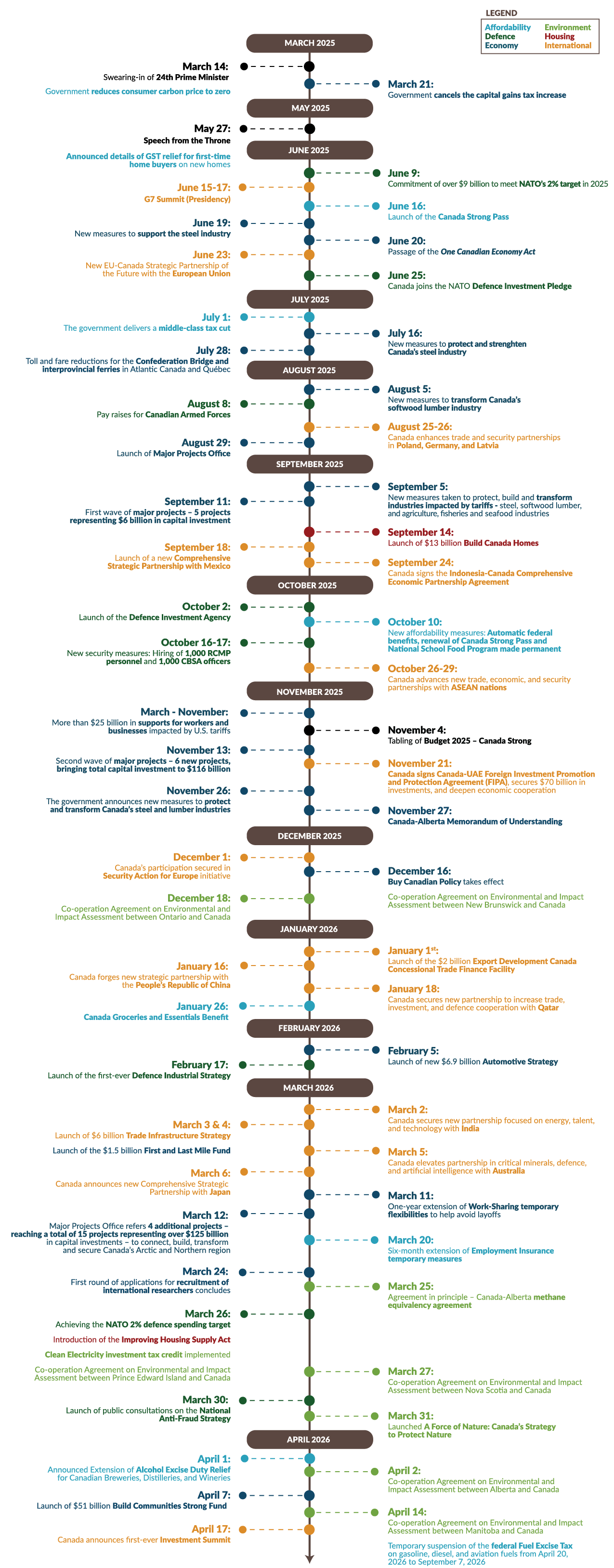
Figure 0.1
Delivering for Canadians: Progress Since the Spring of 2025
Chart image
Text version
Date Event
March 2025
March 14 Swearing-in of 24th Prime Minister. Government reduces consumer carbon price to zero.
March 21 Government cancels the capital gains tax increase
May 2025
May 27 Speech from the Throne
May 27 Announced details of GST relief for first-time home buyers on new homes
June 2025
June 9 Commitment of over $9 billion to meet NATO’s 2% target in 2025
June 15-17 G7 Presidency
June 16 Launch of the Canada Strong Pass
June 19 New measures to support the steel industry
June 20 Passage of the One Canadian Economy Act
June 23 New EU-Canada Strategic Partnership of the Future with the European Union
June 25 Canada joins the NATO Defence Investment Pledge
July 2025
July 1 The government delivers a middle-class tax cut
July 16 New measures to protect and strengthen Canada’s steel industry
July 28 Toll and fare reductions for the Confederation Bridge and interprovincial ferries in Atlantic Canada and Québec
August 2025
August 5 New measures to transform Canada’s softwood lumber industry
August 8 Pay raises for Canadian Armed Forces
August 25-26 Canada enhances trade and security partnerships in Poland, Germany, and Latvia
August 29 Launch of Major Projects Office
September 2025
September 5 New measures taken to protect, build and transform industries impacted by tariffs – steel, softwood lumber, and agriculture, fisheries and seafood industries
September 11 First wave of major projects – 5 projects representing $60 billion in capital investment
September 14 Launch of $13 billion Build Canada Homes
September 18 Launch of a new Comprehensive Strategic Partnership with Mexico
September 24 Canada signs the Indonesia-Canada Comprehensive Economic Partnership Agreement
October 2025
October 2 Launch of the Defence Investment Agency
October 10 New affordability measures: Automatic federal benefits, renewal of Canada Strong Pass and National School Food Program made permanent
October 16-17 New security measures: Hiring of 1,000 RCMP personnel and 1,000 CBSA officers
October 26-29 Canada advances new trade, economic, and security partnerships with ASEAN nations
November 2025
March - November More than $25 billion in supports for workers and businesses impacted by U.S. tariffs
November 4 Tabling of Budget 2025 – Canada Strong
November 13 Second wave of major projects – 6 new projects, bringing total capital investment to $116 billion
November 21 Canada signs Canada-UAE Foreign Investment Promotion and Protection Agreement (FIPA), secures $70 billion in investments, and deepen economic cooperation
November 26 Prime Minister Carney announces new measures to protect and transform Canada’s steel and lumber industries
November 27 Canada-Alberta Memorandum of Understanding 
December 2025
December 1 Canada’s participation secured in Security Action for Europe initiative
December 16 Buy Canadian Policy takes effect Co-operation Agreement on Environmental and Impact Assessment between New Brunswick and Canada
December 18 Co-operation Agreement on Environmental and Impact Assessment between Ontario and Canada
January 2026
January 1st Launch of the $2 billion Export Development Canada Concessional Trade Finance Facility
January 16 Canada forges new strategic partnership with the People’s Republic of China
January 18 Canada secures new partnership to increase trade, investment, and defence cooperation with Qatar
January 26 Canada Groceries and Essentials Benefit
February 2026
February 5 Launch of new $6.9 billion Automotive Strategy
February 17 Launch of the first-ever Defence Industrial Strategy
March 2026
March 2 Canada secures new partnership  focused on energy, talent, and technology with India
March 3 & 4 Launch of $6 billion Trade Infrastructure Strategy Launch of the $1.5 billion First and Last Mile Fund
March 5 Canada elevates partnership in critical minerals, defence, and artificial intelligence with Australia
March 6 Canada announces new Comprehensive Strategic Partnership with Japan
March 11 One-year extension of Work-Sharing temporary flexibilities to help avoid layoffs
March 12 Major Projects Office refers 4 additional projects – reaching a total of 15 projects representing over $125 billion in capital investments – to connect, build, transform and secure Canada’s Arctic and Northern region.
March 20 Six-month extension of Employment Insurance temporary measures
March 24 First round of applications for recruitment of international researchers concludes
March 25 Agreement in principle – Canada-Alberta methane equivalency agreement
March 26 Achieving the NATO 2% defence spending target
March 26 Introduction of the Improving Housing Supply Act Clean Electricity investment tax credit implemented Co-operation Agreement on Environmental and Impact Assessment between Prince Edward Island and Canada
March 27 Co-operation Agreement on Environmental and Impact Assessment between Nova Scotia and Canada
March 30 Launch of public consultations on the National Anti-Fraud Strategy
March 31 Launched A Force of Nature: Canada’s Strategy to Protect Nature
April 2026
April 1 Announced Extension of Alcohol Excise Duty Relief for Canadian Breweries, Distilleries, and Wineries
April 2 Co-operation Agreement on Environmental and Impact Assessment between Alberta and Canada
April 7 Launch of $51 billion Build Communities Strong Fund
April 14 Co-operation Agreement on Environmental and Impact Assessment between Manitoba and Canada
April 14 Temporary suspension of the federal Fuel Excise Tax on gasoline, diesel, and aviation fuels from April 20, 2026 to September 7, 2026.
April 17 Canada announces first-ever Investment Summit

The Spring Economic Update 2026

The Spring Economic Update 2026 maintains Canada's fiscal strength — while investing for Canadians where it counts to build Canada's prosperity today and for the next generation. This includes core new investments to invest in Canada's future, with the good-paying careers that will build a Canada that is affordable, prosperous, and safe.
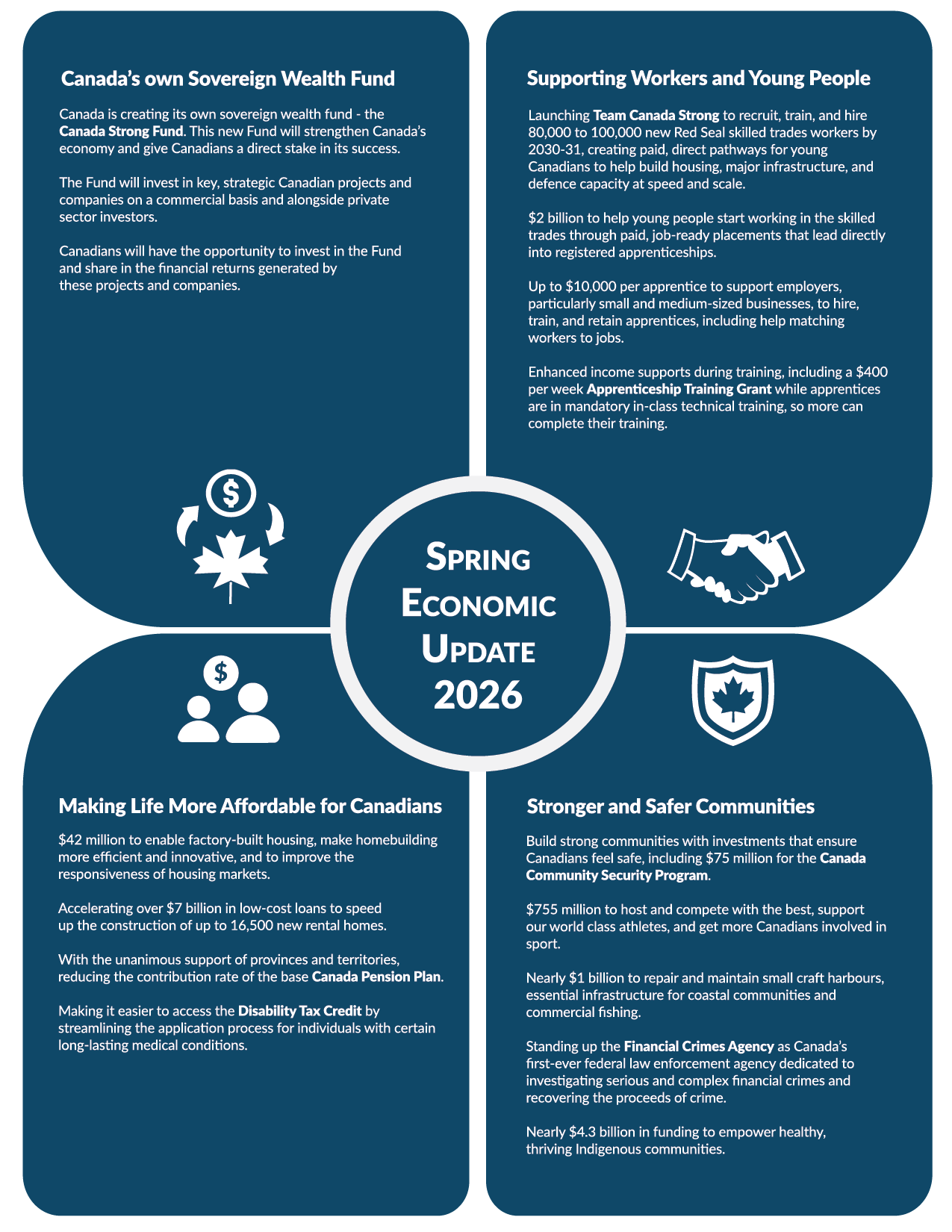
Figure 0.2
Overview of Core New Investments in the Spring Economic Update 2026
Chart image
Text version

Canada’s own Sovereign Wealth Fund

Canada is creating its own sovereign wealth fund - the Canada Strong Fund. This new Fund will strengthen Canada’s economy and give Canadians a direct stake in its success.

The Fund will invest in key, strategic Canadian projects and companies on a commercial basis and alongside private sector investors.

Canadians will have the opportunity to invest in the Fund and share in the financial returns generated by these projects and companies.

Supporting Workers and Young People

Launching Team Canada Strong to recruit, train, and hire 100,000 new Red Seal skilled trades workers by 2030-31, creating paid, direct pathways for young Canadians to help build housing, major infrastructure, and defence capacity at speed and scale.

$2.9 billion to help young people start working in the skilled trades through paid, job-ready placements that lead directly into registered apprenticeships.

Up to $10,000 per apprentice to support employers, particularly small and medium-sized businesses, to hire, train, and retain apprentices, including help matching workers to jobs.

Enhanced income supports during training, including a $400 per week Apprenticeship Training Grant while apprentices are in mandatory in-class technical training, so more can complete their training.

Making Life More Affordable for Canadians

$42 million to enable factory-built housing, make homebuilding more efficient and innovative, and to improve the responsiveness of housing markets.

Accelerating over $7 billion in low-cost loans to speed up the construction of up to 16,500 new rental homes.

With the unanimous support of provinces and territories, reducing the contribution rate of the base Canada Pension Plan.

Making it easier to access the Disability Tax Credit by streamlining the application process for individuals with certain long-lasting medical conditions.

Stronger and Safer Communities

Build strong communities with investments that ensure Canadians feel safe, including $75 million for the Canada Community Security Program.

$755 million to host and compete with the best, support our world class athletes, and get more Canadians involved in sport. 

Nearly $1 billion to repair and maintain small craft harbours, essential infrastructure for coastal communities and commercial fishing.

Standing up the Financial Crimes Agency as Canada’s first-ever federal law enforcement agency dedicated to investigating serious and complex financial crimes and recovering the proceeds of crime.

Nearly $4.3 billion in funding to empower healthy, thriving Indigenous communities.

The world is undergoing a series of fundamental shifts at a speed, scope and scale not seen in generations. Over the past two decades, a series of crises in health, energy, finances, and geopolitics have exposed the risks of extreme global integration. Today, the rules-based international order and the trading system that powered Canada's prosperity for decades are being reshaped.

Long-standing supply chains and trade relationships that once supported stable growth, good jobs, and affordable products are being disrupted. Rising geopolitical tensions, including the conflict in the Middle East and escalating trade pressure such as U.S. tariffs, are adding to cost pressures and driving volatility in energy prices and financial markets.

Global Uncertainty Near Record High
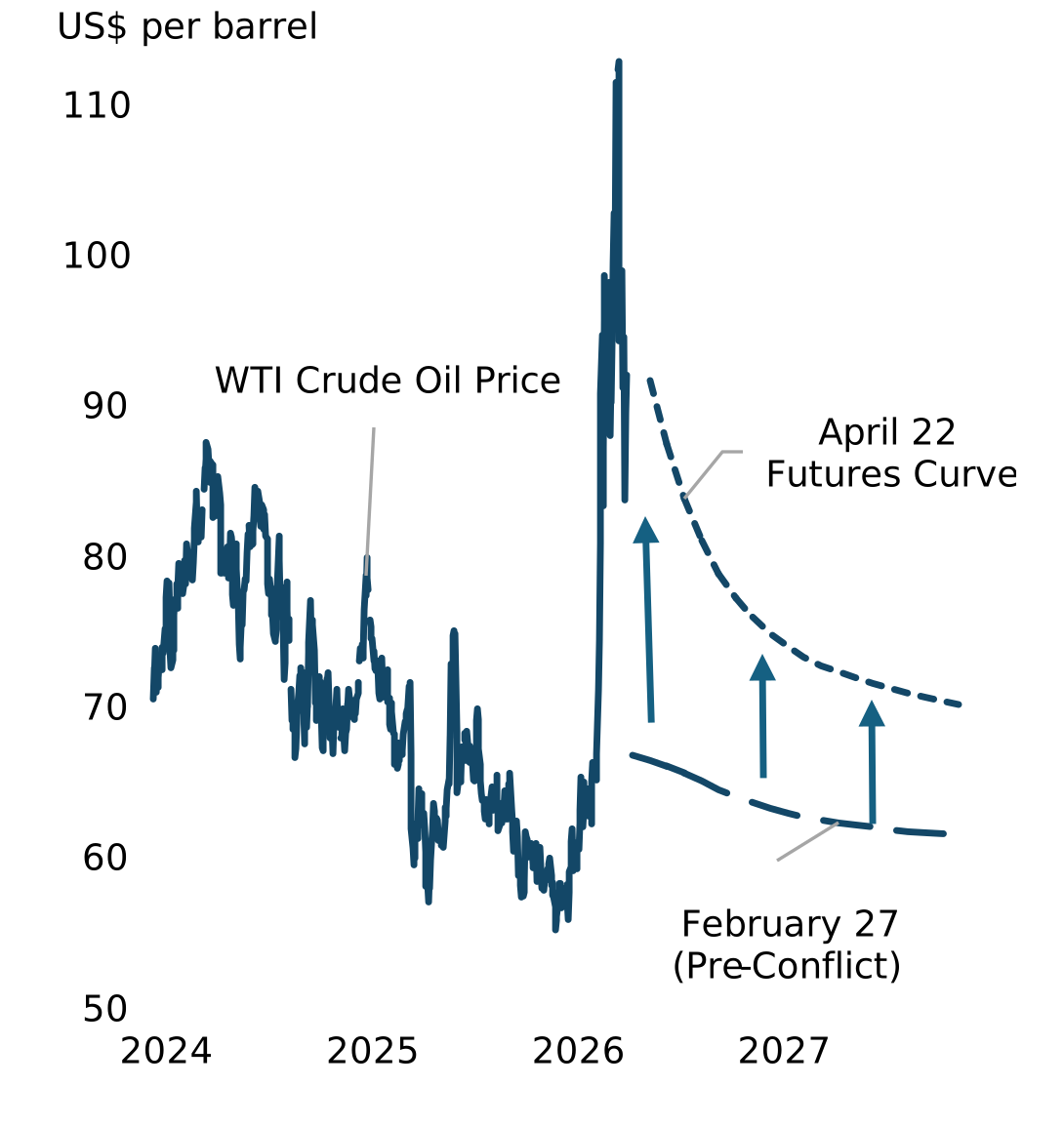
Geopolitical Risk Has Surged, Driving Up Global Oil Prices
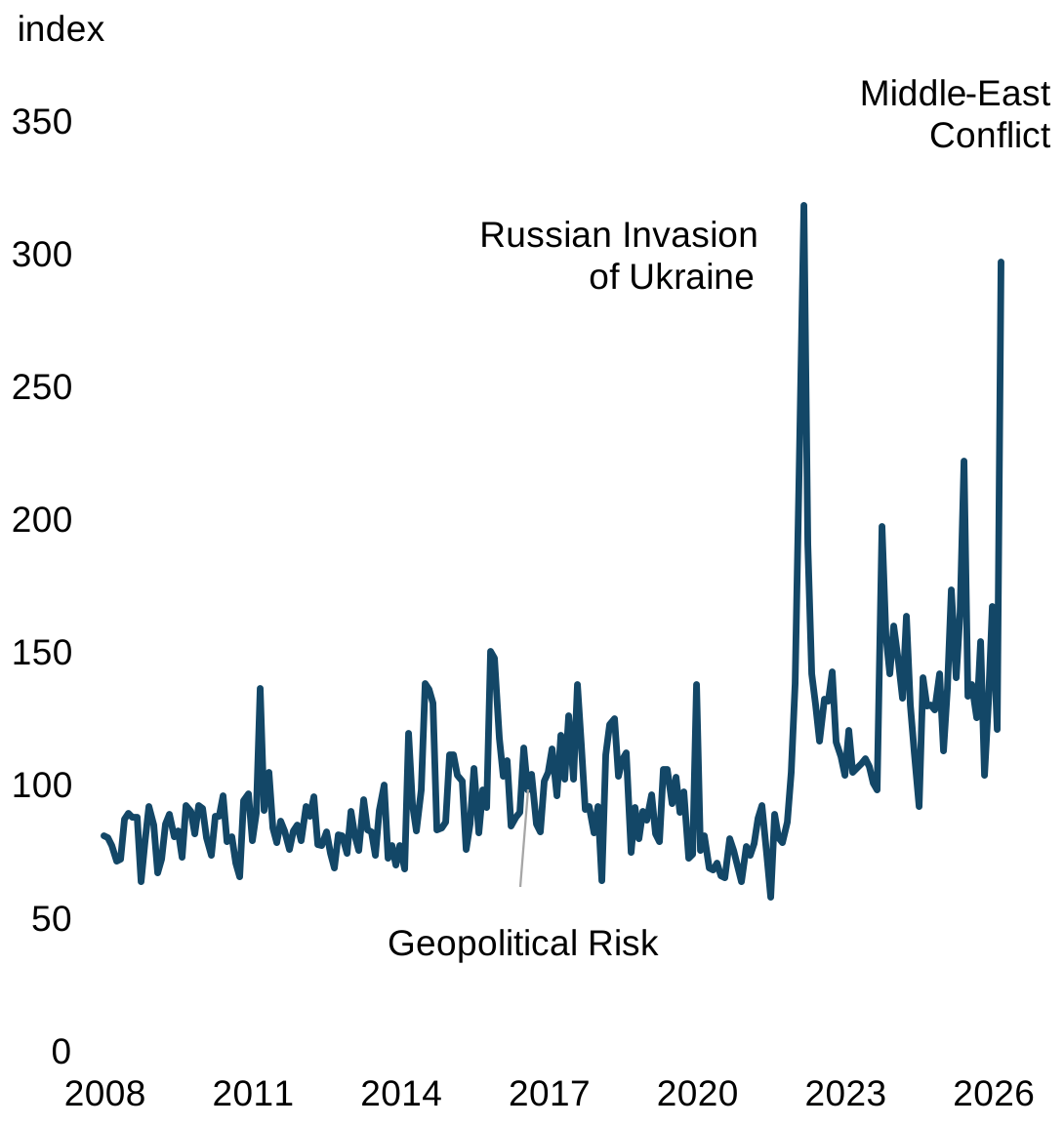
Chart 0.1
Chart image

Sources: PolicyUncertainty.com, Haver Analytics, Bloomberg.

Text version
Year WUI
Jan-08 81.5
Feb-08 80.75
Mar-08 77.64
Apr-08 71.9
May-08 72.57
Jun-08 87.55
Jul-08 89.74
Aug-08 88.55
Sep-08 88.54
Oct-08 64.16
Nov-08 79.08
Dec-08 92.37
Jan-09 85.37
Feb-09 67.45
Mar-09 72.64
Apr-09 85.69
May-09 89.68
Jun-09 81.11
Jul-09 83.44
Aug-09 73.37
Sep-09 92.84
Oct-09 90.58
Nov-09 82.1
Dec-09 92.95
Jan-10 91.58
Feb-10 80.73
Mar-10 74.12
Apr-10 88.76
May-10 88.96
Jun-10 96.45
Jul-10 79.38
Aug-10 80.99
Sep-10 71.17
Oct-10 65.99
Nov-10 94.71
Dec-10 97.2
Jan-11 79.42
Feb-11 90.01
Mar-11 136.89
Apr-11 91.02
May-11 105.34
Jun-11 84.39
Jul-11 78.92
Aug-11 86.95
Sep-11 83.35
Oct-11 76.34
Nov-11 83.16
Dec-11 85.34
Jan-12 79.63
Feb-12 92.45
Mar-12 88.76
Apr-12 96.02
May-12 78.17
Jun-12 77.82
Jul-12 82.81
Aug-12 74.88
Sep-12 69.28
Oct-12 81.66
Nov-12 81.39
Dec-12 74.83
Jan-13 90.66
Feb-13 81.59
Mar-13 75.9
Apr-13 95.11
May-13 83.72
Jun-13 82.97
Jul-13 73.98
Aug-13 90.96
Sep-13 100.46
Oct-13 72.95
Nov-13 77.78
Dec-13 70.37
Jan-14 77.92
Feb-14 69
Mar-14 119.84
Apr-14 93.22
May-14 83.43
Jun-14 98.77
Jul-14 138.75
Aug-14 136.45
Sep-14 131.56
Oct-14 83.66
Nov-14 84.38
Dec-14 86.53
Jan-15 111.99
Feb-15 111.92
Mar-15 104.24
Apr-15 102.19
May-15 76.26
Jun-15 85.91
Jul-15 106.81
Aug-15 82.48
Sep-15 98.77
Oct-15 91.93
Nov-15 150.72
Dec-15 148.24
Jan-16 118.21
Feb-16 103.75
Mar-16 109.72
Apr-16 85.22
May-16 88.33
Jun-16 90.17
Jul-16 114.61
Aug-16 98.74
Sep-16 104.55
Oct-16 85.75
Nov-16 82.92
Dec-16 102.18
Jan-17 105.2
Feb-17 114.21
Mar-17 96.64
Apr-17 119.46
May-17 102.58
Jun-17 126.79
Jul-17 102.81
Aug-17 138.53
Sep-17 115.53
Oct-17 91.46
Nov-17 92.6
Dec-17 82.72
Jan-18 92.43
Feb-18 64.49
Mar-18 111.96
Apr-18 123.26
May-18 125.67
Jun-18 103.97
Jul-18 110.03
Aug-18 112.74
Sep-18 75.05
Oct-18 92.02
Nov-18 80.41
Dec-18 90.61
Jan-19 87.42
Feb-19 96.8
Mar-19 82.33
Apr-19 79.25
May-19 106.47
Jun-19 106.59
Jul-19 93.52
Aug-19 103.4
Sep-19 90.37
Oct-19 97.84
Nov-19 73.08
Dec-19 74.28
Jan-20 138.42
Feb-20 75.96
Mar-20 81.54
Apr-20 69.34
May-20 68.51
Jun-20 71.23
Jul-20 66.47
Aug-20 65.47
Sep-20 80.38
Oct-20 76.08
Nov-20 70.07
Dec-20 64.07
Jan-21 77.42
Feb-21 73.96
Mar-21 78.62
Apr-21 88.17
May-21 93.01
Jun-21 74.13
Jul-21 58.42
Aug-21 89.49
Sep-21 80.7
Oct-21 79.03
Nov-21 86.57
Dec-21 105.35
Jan-22 138.67
Feb-22 216.16
Mar-22 318.95
Apr-22 191.14
May-22 142.26
Jun-22 130.71
Jul-22 117.18
Aug-22 132.86
Sep-22 131.99
Oct-22 143.16
Nov-22 116.72
Dec-22 111.2
Jan-23 104.27
Feb-23 120.99
Mar-23 105.38
Apr-23 106.81
May-23 108.47
Jun-23 110.53
Jul-23 107.45
Aug-23 101.14
Sep-23 98.63
Oct-23 197.89
Nov-23 156.7
Dec-23 142.28
Jan-24 160.37
Feb-24 146.6
Mar-24 133.21
Apr-24 163.95
May-24 130.52
Jun-24 113.09
Jul-24 92.39
Aug-24 140.98
Sep-24 130.36
Oct-24 130.69
Nov-24 128.9
Dec-24 142.37
Jan-25 113.23
Feb-25 136.97
Mar-25 173.91
Apr-25 140.97
May-25 165.66
Jun-25 222.38
Jul-25 134.02
Aug-25 138.56
Sep-25 125.87
Oct-25 154.51
Nov-25 104.34
Dec-25 131.39
Jan-26 167.8
Feb-26 121.62
Mar-26 297.27
Chart 0.2
Chart image

Sources: PolicyUncertainty.com, Haver Analytics, Bloomberg.

Text version

This chart shows the daily WTI price of oil, along with monthly futures pricing. It illustrates that the oil price has surged recently, but is expected to gradually decline through the end of 2027.

The Canadian Economy Is Resilient

In this more fragmented and unpredictable world, Canada's approach is clear: we will be principled and pragmatic. We are acting decisively to protect our economic sovereignty, strengthen our strategic industries, and position Canada for long-term growth.

Canada starts from a position of strength. Our economic fundamentals remain among the strongest in the world, supported by:

  • Talent: A highly skilled, adaptable, and the most educated workforce in the world.
  • Resources: A vast reserve of critical minerals, a clean and conventional energy superpower, and a strong agri-food industry.
  • Resilience: A strong social safety net and stable institutions.
  • Market access: The only G7 country with comprehensive free trade agreements with all other G7 countries.
  • Rule of law: A stable and reliable financial system, an independent judiciary, and transparent governments.
  • Investment attractiveness: A favourable environment for investment that attracts global capital, drives growth, and creates high-paying careers.
  • Tax competitiveness: The lowest overall tax burden in the G7 on new business investment.

Canada Is the Second Fastest-Growing G7 Economy
IMF Forecast for 2026 Real GDP Growth in G7
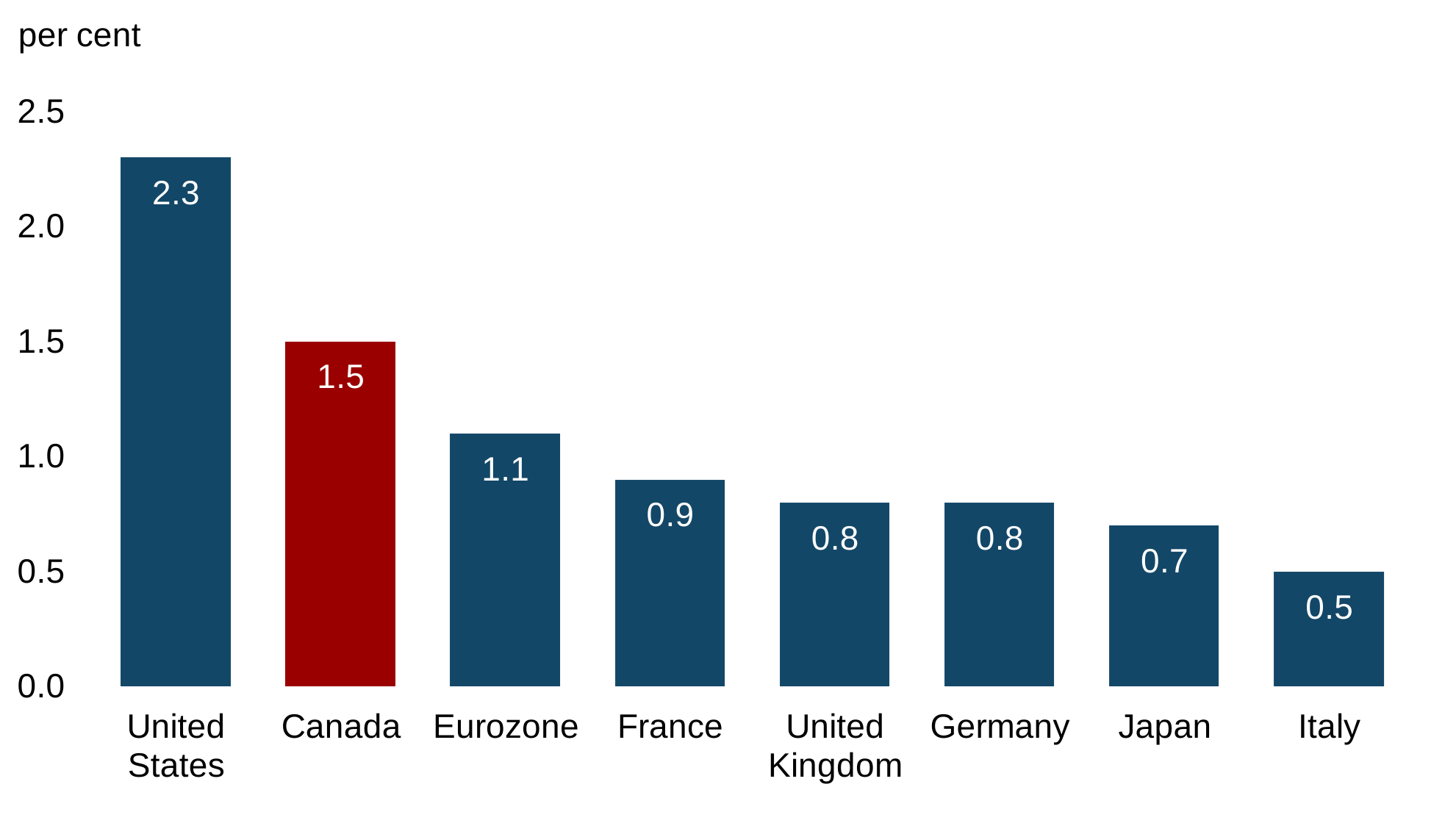
Chart 0.3
Chart image

Source: IMF, World Economic Outlook, April 2026.

Text version
Country Percentage (%)
United States 2.3
Canada 1.5
Eurozone 1.1
France 0.9
United
Kingdom
0.8
Germany 0.8
Japan 0.7
Italy 0.5

Direct Investment Into Canada at a 20-Year High

Canada is emerging as a premier destination for global investment:

  • Direct investment into Canada is at its highest level in nearly two decades.
  • Canada has secured $97 billion in foreign investment and more than 20 new economic and defence partnerships across four continents in the last year.
  • A network of trade agreements spanning 51 countries and nearly two-thirds of global GDP positions Canada at the centre of a reconfigured global economy.

Momentum is building at home:

  • Canadian institutional investors, including pension funds, are stepping up and working with governments to unlock new opportunities.

Attracting New Investment

The Spring Economic Update proposes to further position Canada as a leading investment destination and a trusted convener of global capital through:

  • Canada's first Investment Summit in September 2026.
  • A Sustainable Finance conference in the coming year.

Canada Leads the G7 in Direct Investment Inflows Per Capita
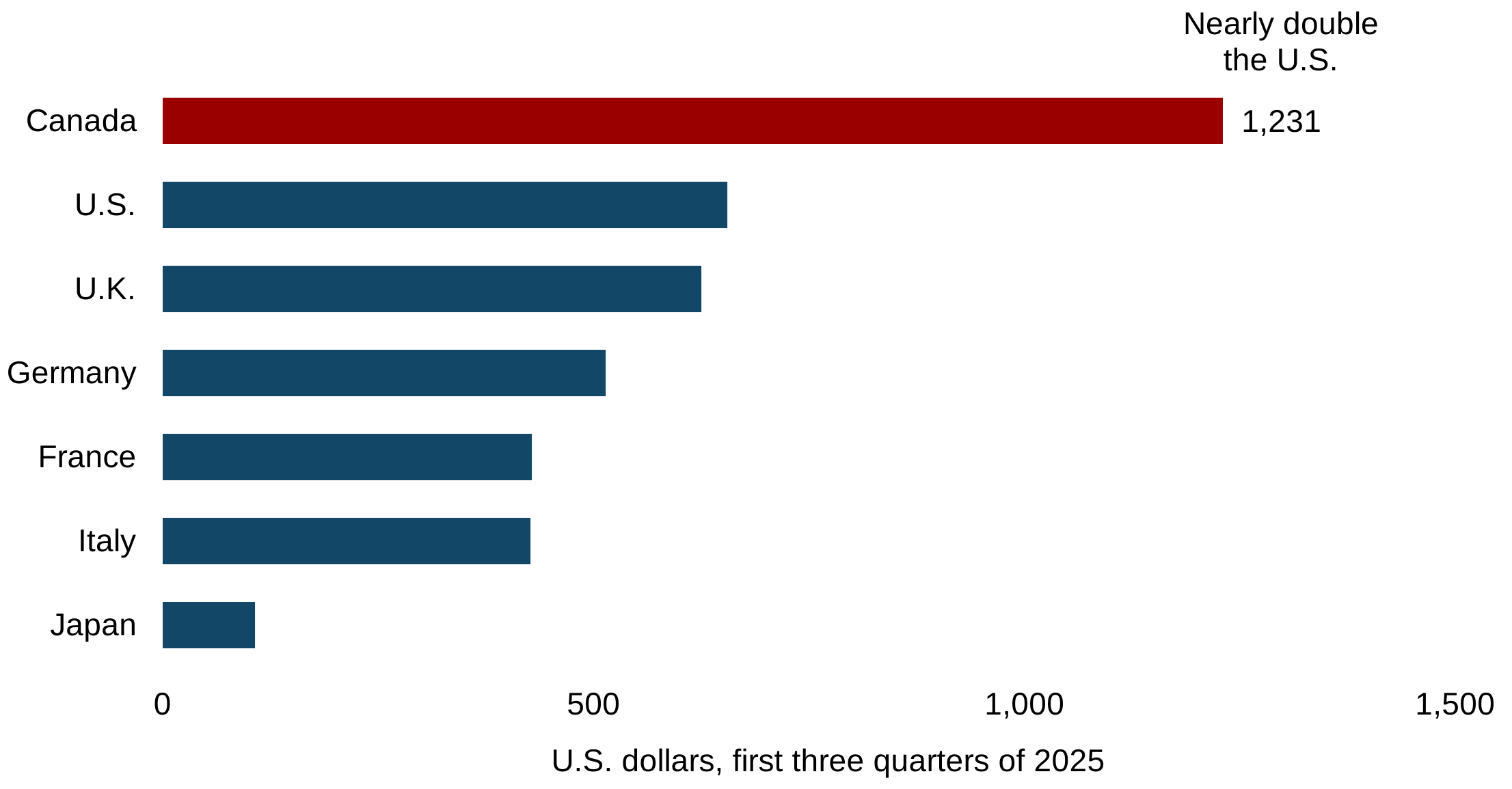
Chart 0.4
Chart image

Source: Organisation for Economic Co-operation and Development.

Text version
2025 Q1 - 2025 Q3
Japan 107
Italy 427
France 429
Germany 515
U.K. 626
U.S. 656
Canada 1,231

Canada Is the Most Competitive Jurisdiction in the G7 for New Business Investment and Trade

Lowest Marginal Effective Tax Rate (METR) in the G7

The METR provides an estimate of the level of taxation on new business investments made by corporations.

Canada's overall METR advantage reflects generous expensing provisions, available broad-based investment tax credits, and value added taxes that provide corporations with input tax credits for tax paid on inputs.
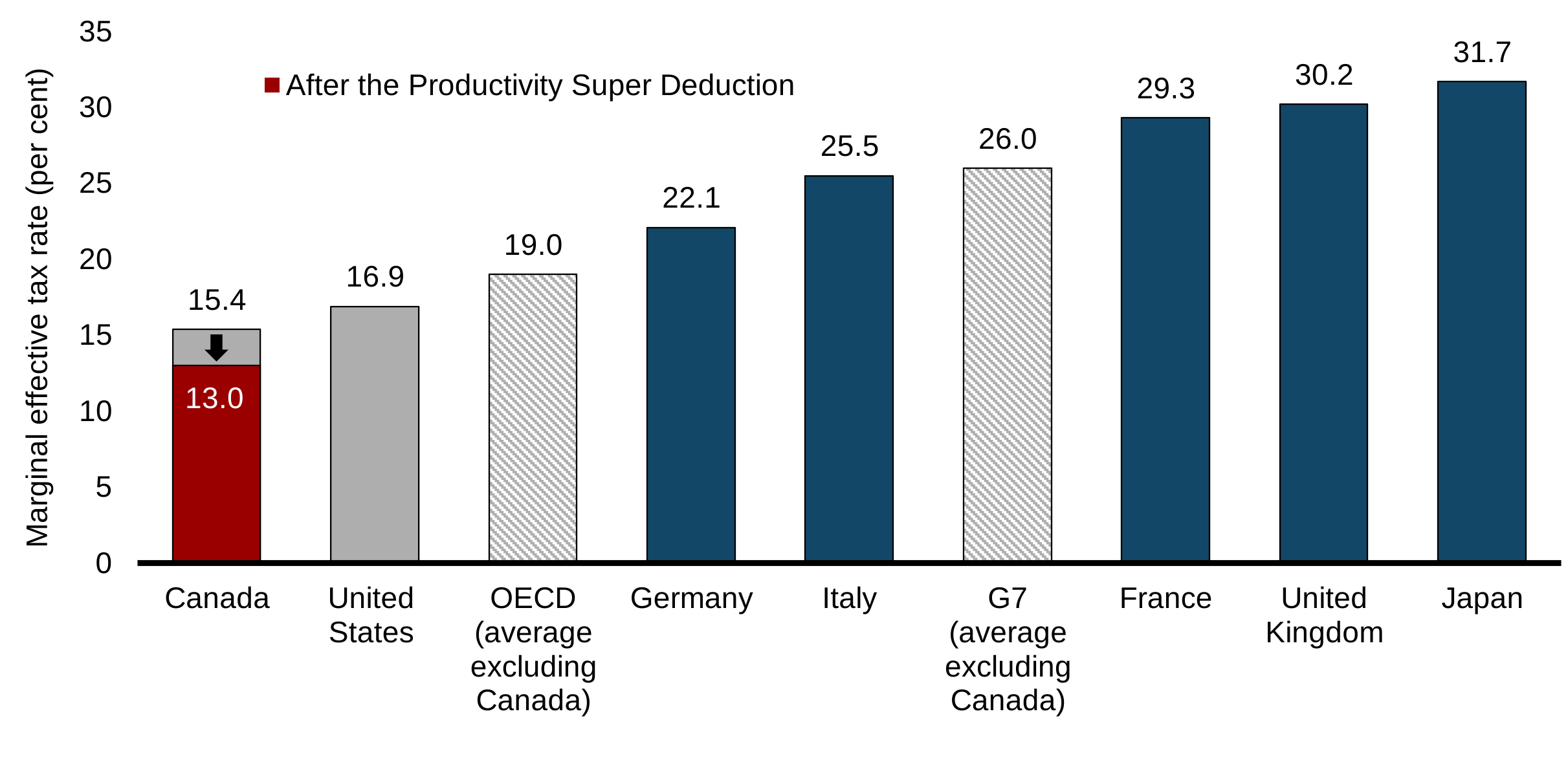
Chart 0.5
Chart image

Source: Department of Finance Canada calculations.

Text version
Country METR
Canada 15.4
United States 16.9
OECD (average excluding Canada) 19.0
Germany 22.1
Italy 25.5
G7 (average excluding Canada) 26.0
France 29.3
United Kingdom 30.2
Japan 31.7

Canada Is Building a World-Class Trade Network

Canada has preferential access to about 1.5 billion consumers across 15 free trade agreements, 51 countries, and nearly two-thirds of global gross domestic product (GDP). Canada is also the only G7 country with a comprehensive free trade agreement with all other G7 countries. To meet our goal of doubling non-U.S. goods and services exports over the next decade, the government is pursuing new opportunities through the negotiation of additional trade agreements.
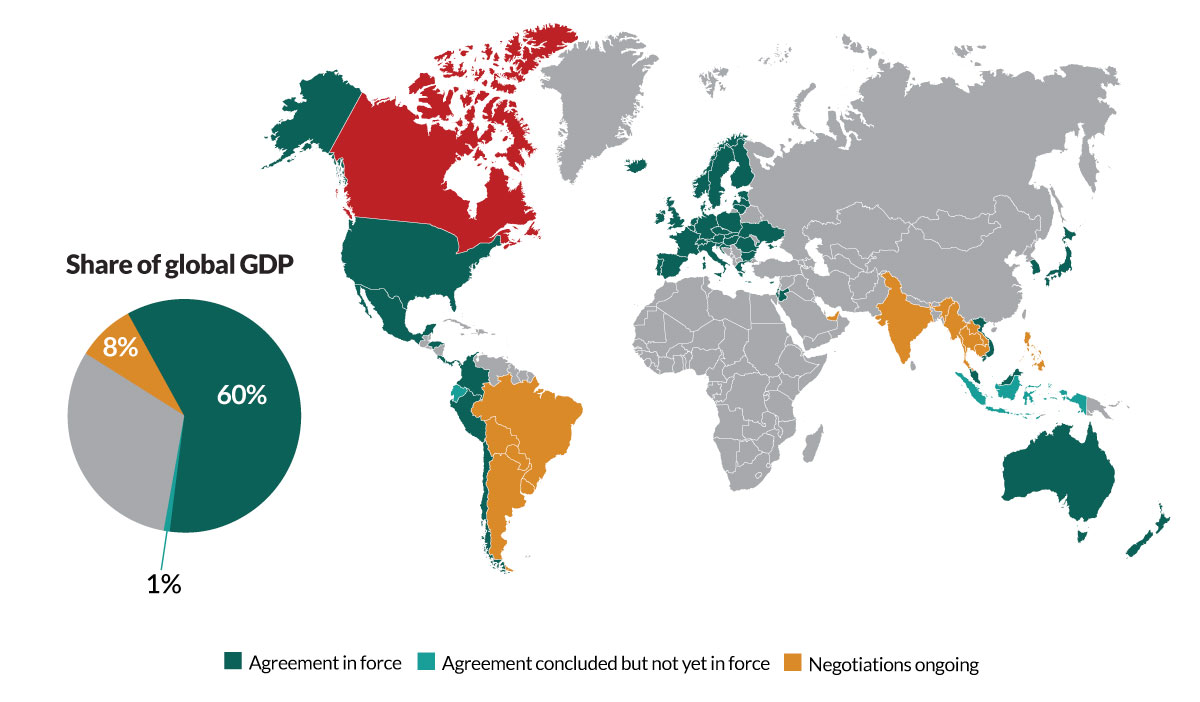
Figure 0.3
Chart image

In this environment, Canada is redefining its international, commercial, and security relationships. We must build strength at home, and we must do it while choosing to work with our allies and forging new relationships with trusted partners. We recognise the world as it is, and we choose to adapt to thrive.

Pivoting Towards New Markets
Canadian Exporters Are Making Headway Into Non-U.S. Markets
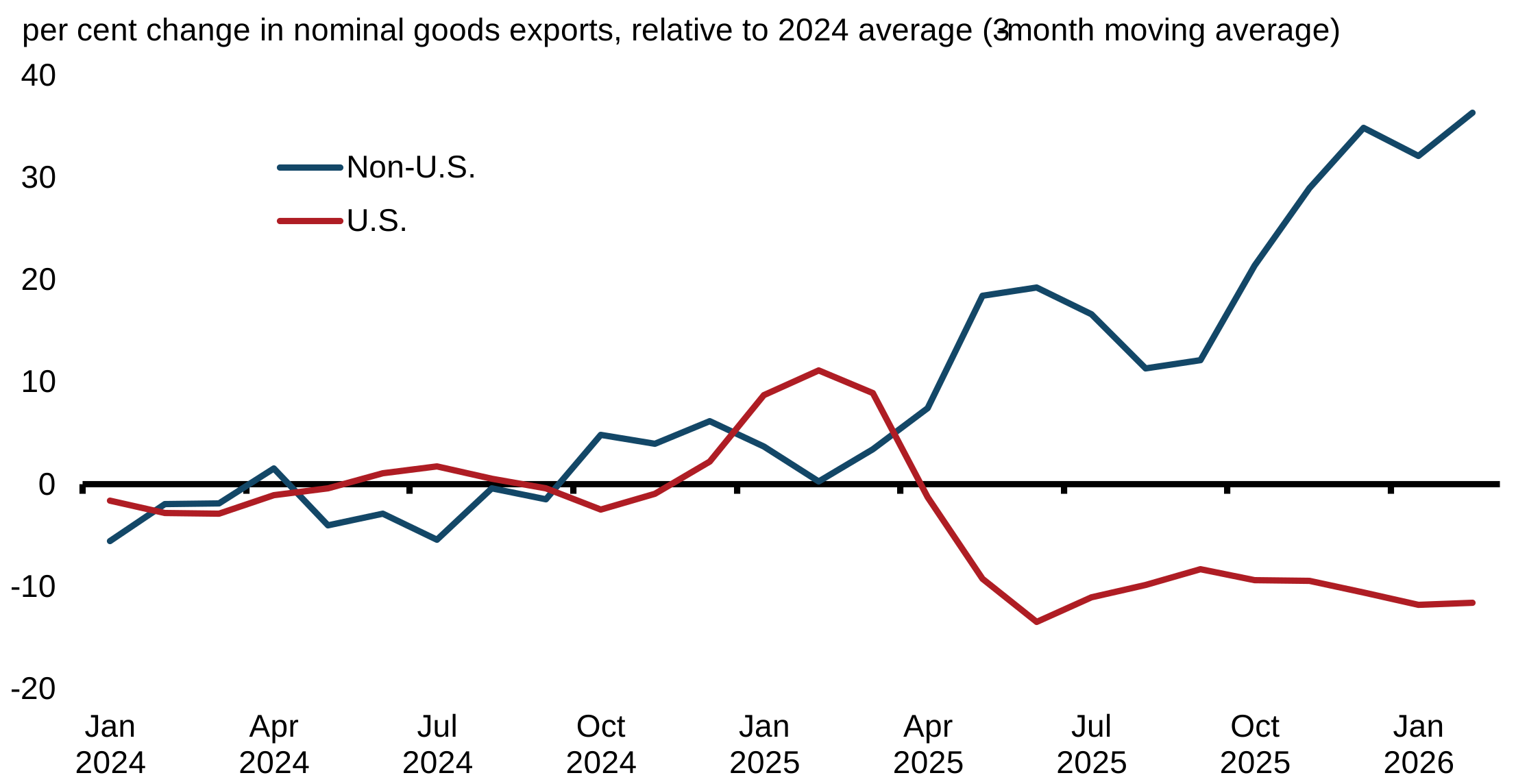
Chart 0.6
Chart image

Sources: Statistics Canada; Department of Finance Canada calculations.

Text version
U.S. Non-U.S.
Jan-2024 -1.6 -5.5
Feb-2024 -2.8 -1.9
Mar-2024 -2.9 -1.9
Apr-2024 -1.1 1.6
May-2024 -0.4 -4.0
Jun-2024 1.1 -2.8
Jul-2024 1.7 -5.4
Aug-2024 0.6 -0.4
Sep-2024 -0.4 -1.4
Oct-2024 -2.5 4.8
Nov-2024 -0.9 4.0
Dec-2024 2.2 6.2
Jan-2025 8.7 3.7
Feb-2025 11.2 0.3
Mar-2025 8.9 3.4
Apr-2025 -1.3 7.4
May-2025 -9.3 18.4
Jun-2025 -13.5 19.2
Jul-2025 -11.0 16.6
Aug-2025 -9.9 11.3
Sep-2025 -8.3 12.1
Oct-2025 -9.4 21.3
Nov-2025 -9.5 28.9
Dec-2025 -10.5 34.8
Jan-2026 -11.8 32.1
Feb-2026 -11.6 36.3

Canada Has the Best Deal of Major U.S. Trading Partners

With approximately 85% of our goods trade tariff-free, Canadian exporters enjoy the lowest average U.S. tariff among all major trading partners, although some sectors remain deeply impacted.
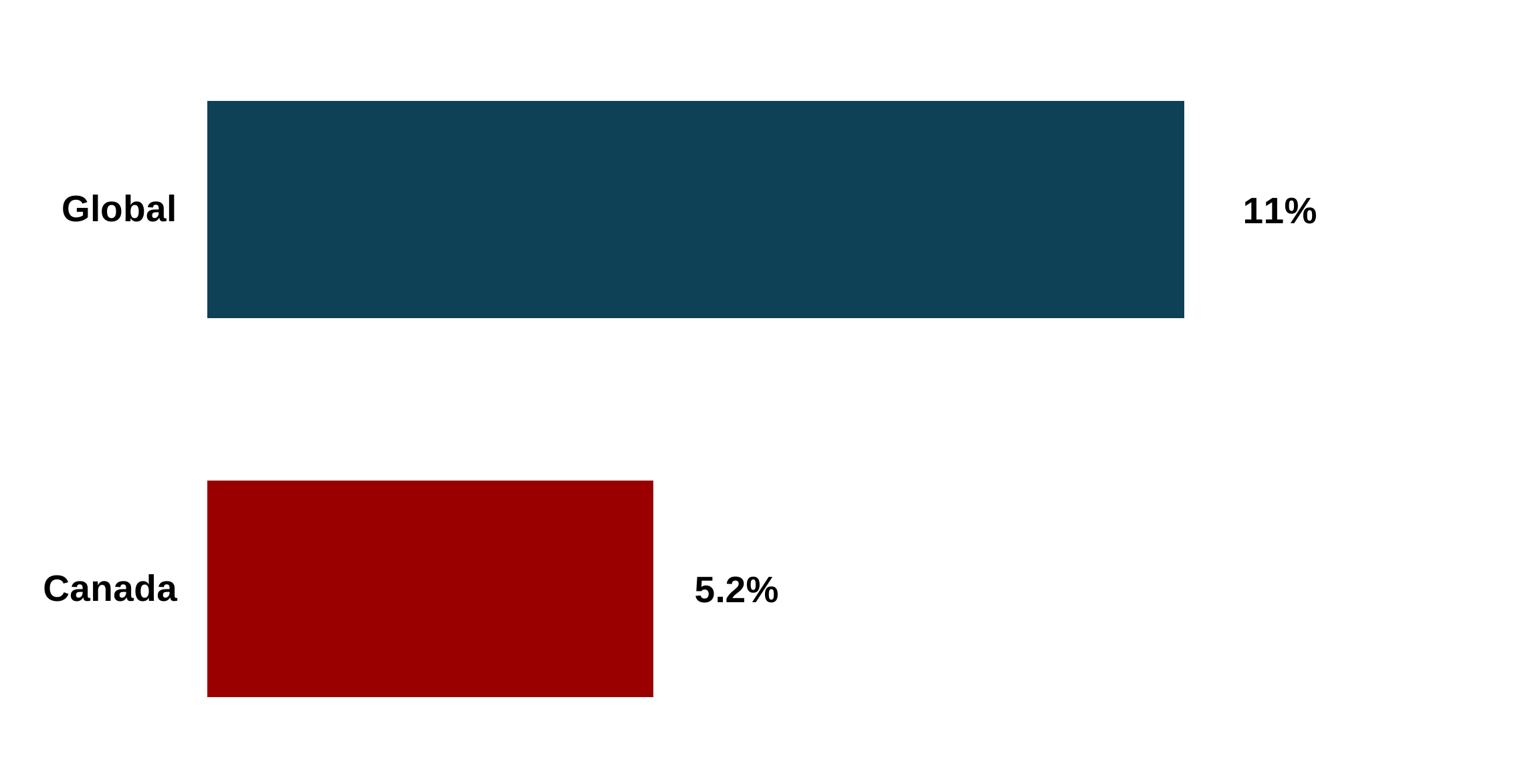
Chart 0.7
Chart image

Sources: Global Affairs Canada, Department of Finance Canada calculations.

Text version
Average Tariff Rate
Canada 5.2
Global 11.4

Canada Maintains Fiscal Discipline

Our focus is clear and disciplined. We are concentrating on what we can control: maintaining fiscal sustainability while making targeted, high-impact investments for Canadians. This means lowering the operating deficit over time, maintaining our fiscal anchors, and ensuring that every dollar spent on behalf of Canadians supports growth, resilience, and improving the well-being of Canadians.

Spring Economic Update projected deficit will be $11 billion lower in 2025-26 than in Budget 2025, and by 2028-29, will entirely support capital investments
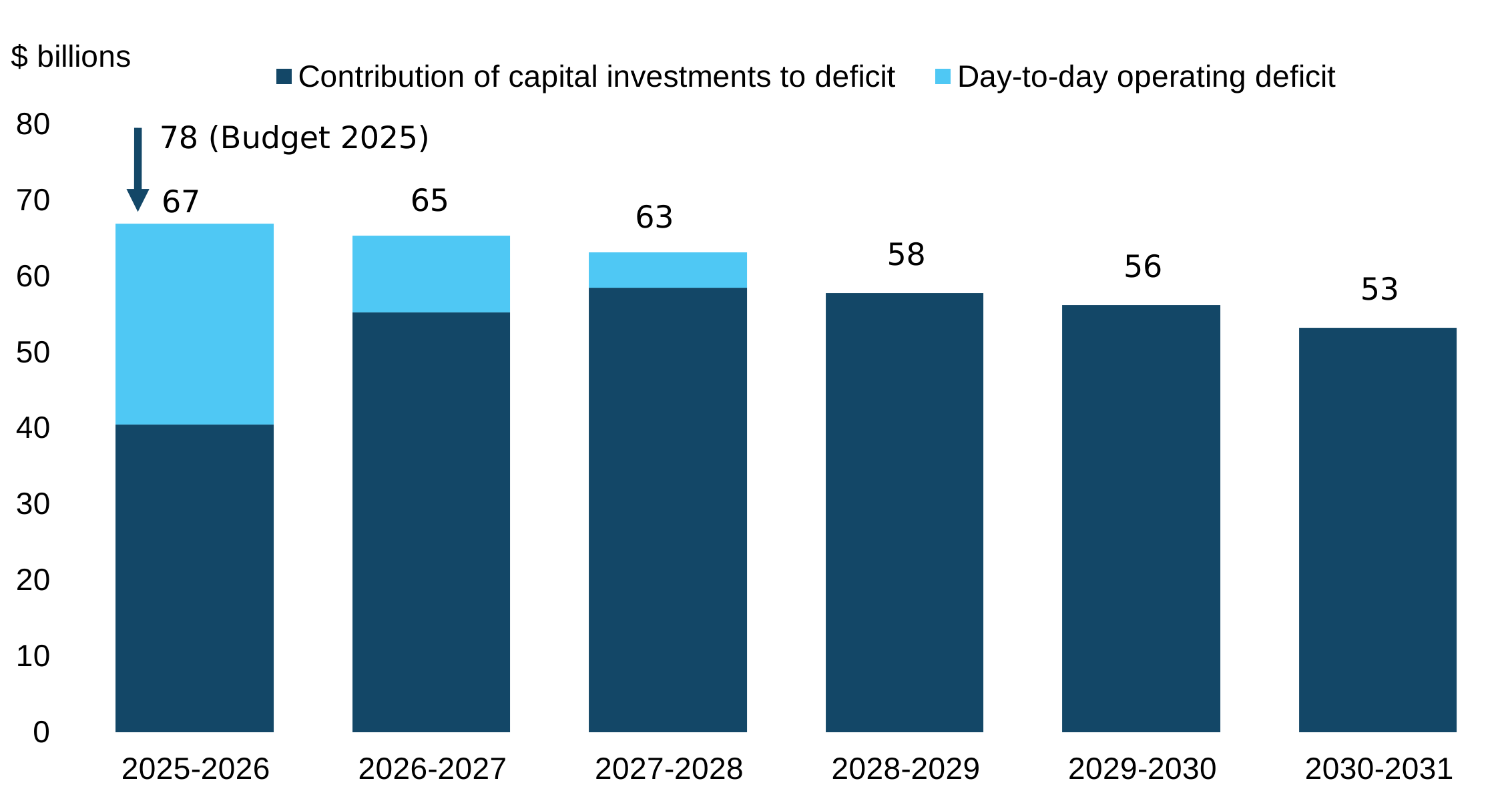
Chart 0.8
Chart image

Source: Department of Finance Canada calculations.

Text version
($B) 2025-2026 2026-2027 2027-2028 2028-2029 2029-2030 2030-2031
Contribution of capital investments to deficit 41 55 58 58 56 53
Day-to-day operating deficit 26 10 5 0 0 0
Total 67 65 63 58 56 53

Canada Has One of the Strongest Fiscal Positions in the G7
Deficit-to-GDP Ratio (All Levels of Government)
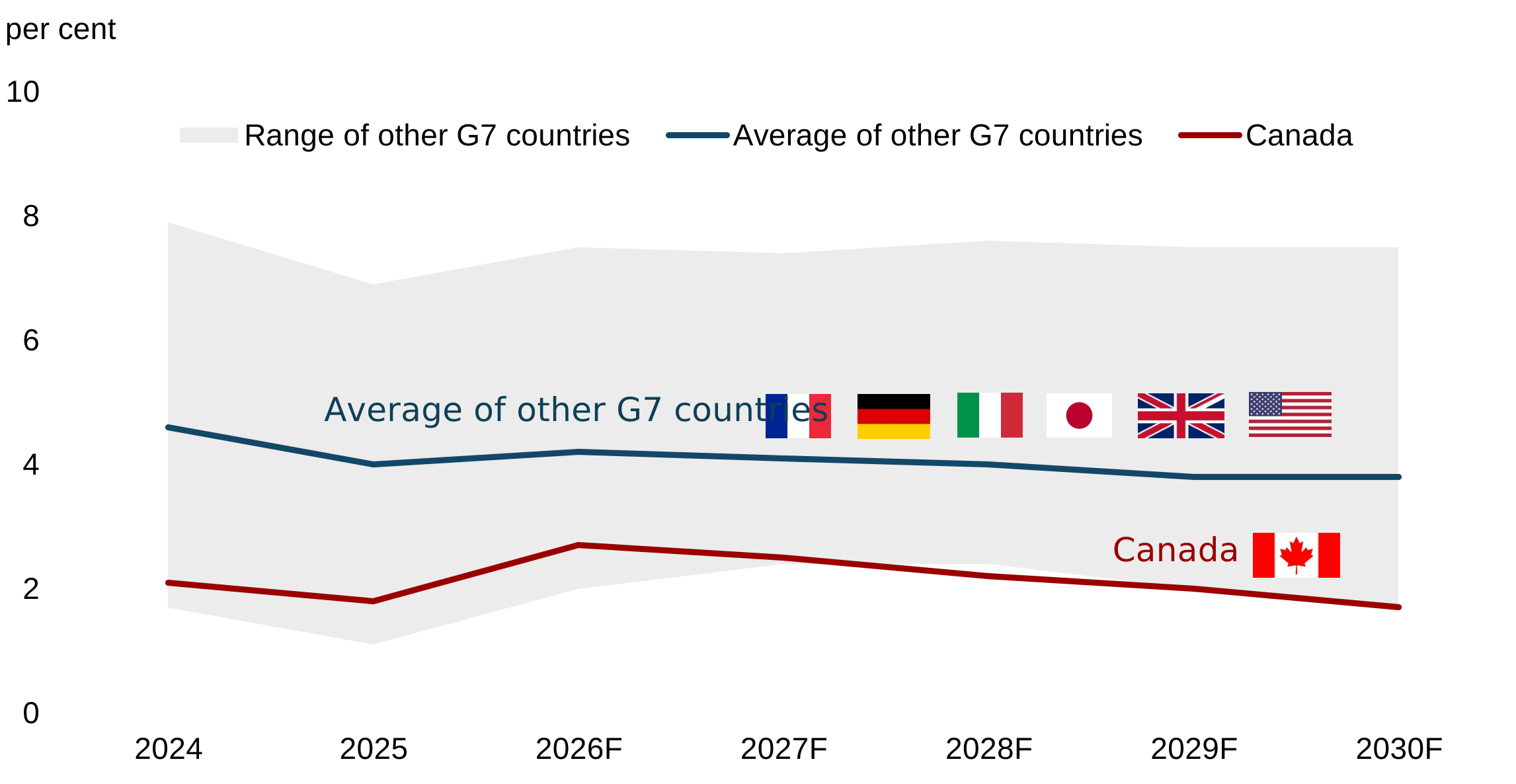
Chart 0.9
Chart image

Source: IMF, Fiscal Monitor, April 2026.

Text version
  2024 2025 2026F 2027F 2028F 2029F 2030F
Canada 2.1 1.8 2.7 2.5 2.2 2.0 1.7
Average of other G7 countries 4.6 4.0 4.2 4.1 4.0 3.8 3.8
Min of other G7 1.7 1.1 2 2.4 2.4 2 1.7
Max of other G7 7.9 6.8 7.5 7.4 7.6 7.5 7.5

Canada’s Strong Fiscal Position Enables Us to Respond to Global Challenges
Canada Has the Lowest Net Debt-to-GDP Ratio in the G7
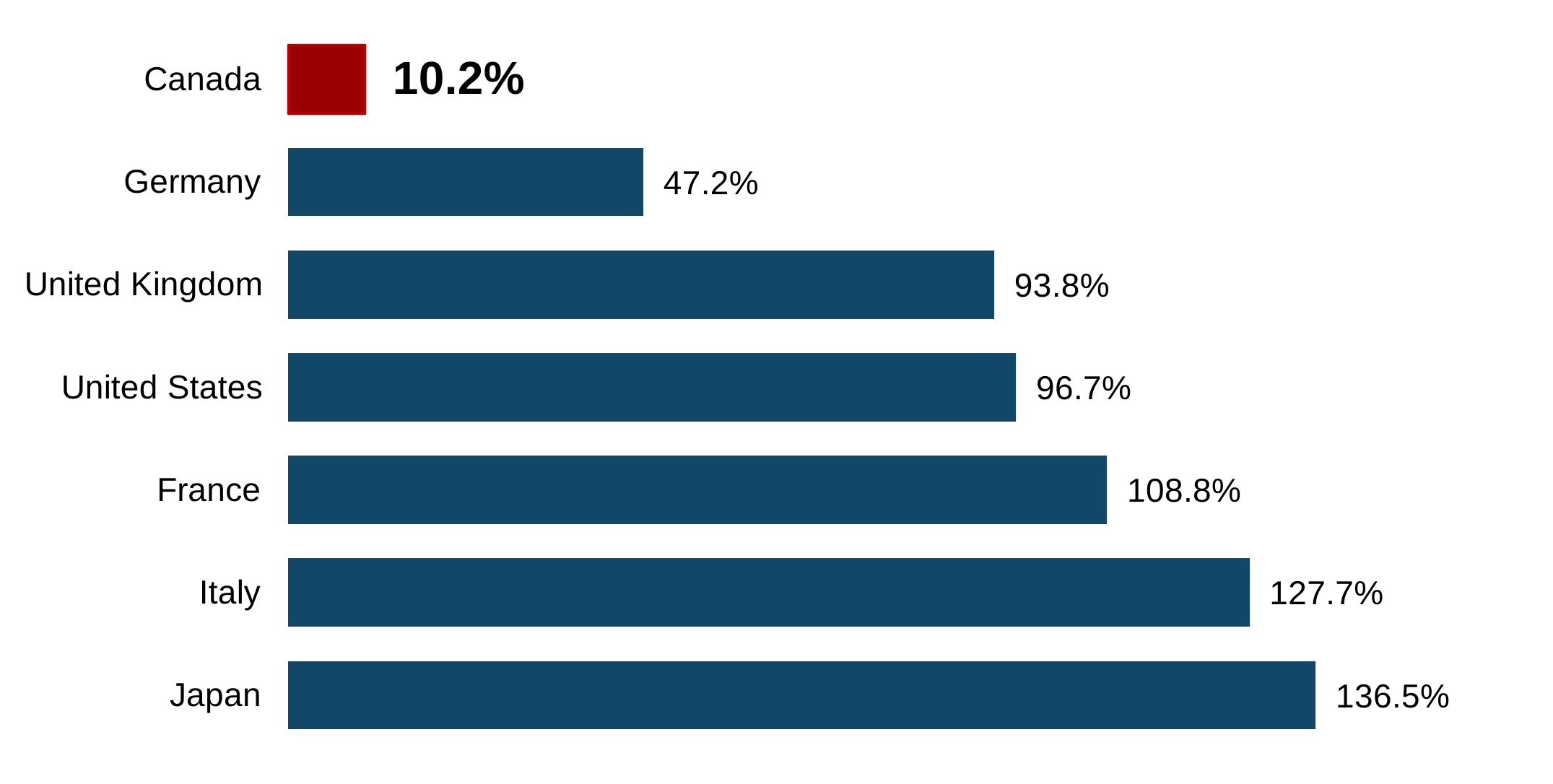
Chart 0.10
Chart image

All Levels of Government Net Debt-to-GDP Ratio, 2025

Source: IMF, Fiscal Monitor, April 2026.

Text version
2025
Japan 1.365
Italy 1.277
France 1.088
United States 0.967
United Kingdom 0.938
Germany 0.472
Canada 0.102

Our government spends less, builds more, and delivers better — we are investing in Canada’s future.

The global landscape is rapidly changing, leaving businesses, workers, and families under a cloud of uncertainty. In response, Canada's new government is focused on what we control: building a stronger economy to bring down costs for Canadians. 

Our plan is moving Canada's economy from reliance to resilience. We are advancing major projects that connect and transform our nation, turbocharging housing construction, catalysing an entirely new housing industry, and forging new economic and security partnerships. Some of the biggest long-term payoffs of this transformation will take time to be felt. To ensure Canadians have the support they need right now, the government is providing a boost today and a bridge to a better tomorrow.

For over a year, Canada's new government has been relentlessly focused on making life more affordable for Canadians:
  • Nearly 22 million Canadians are keeping more of what they earn, with the middle-class tax cut saving a two-income family up to $840 this year.
  • First-time home buyers are saving up to $50,000, with the removal or reduction of the Goods and Services Tax on new homes.
  • The removal of the consumer carbon price driving gas prices down by about 18 cents per litre across most provinces and territories.
  • Reducing Canadians' bills at the gas station by up to 10 cents per litre on regular gasoline and 4 cents on diesel by temporarily suspending the federal fuel excise tax.
  • More than 12 million Canadians will receive hundreds of dollars more in their bank accounts through the new Canada Groceries and Essentials Benefit.
  • Canadians are paying less in banking fees, with new rules capping non-sufficient funds fees at $10 and strengthening consumer protections.
  • Enhanced low-cost and no-cost bank accounts to offer all Canadians access to up to 50 per cent more debit transactions at a cost of no more than $4 per month.
  • Young Canadians are gaining opportunities to work and build careers, with 175,000 placements supported in 2026-27 through Canada Summer Jobs, the horizontal Youth Employment and Skills Strategy, and the Student Work Placement Program.
  • Starting automatic federal benefits for the 2026 tax year, with pre-filled returns for up to 5.5 million low-income Canadians by the 2028 tax year, ensures that support reaches those who need it most.
  • Families and young people are travelling and exploring Canada for less, supported by the renewed Canada Strong Pass.
  • Supporting Canadian brewers, distillers and wineries and helping ease cost pressures with extended tax relief.
Figure 0.4
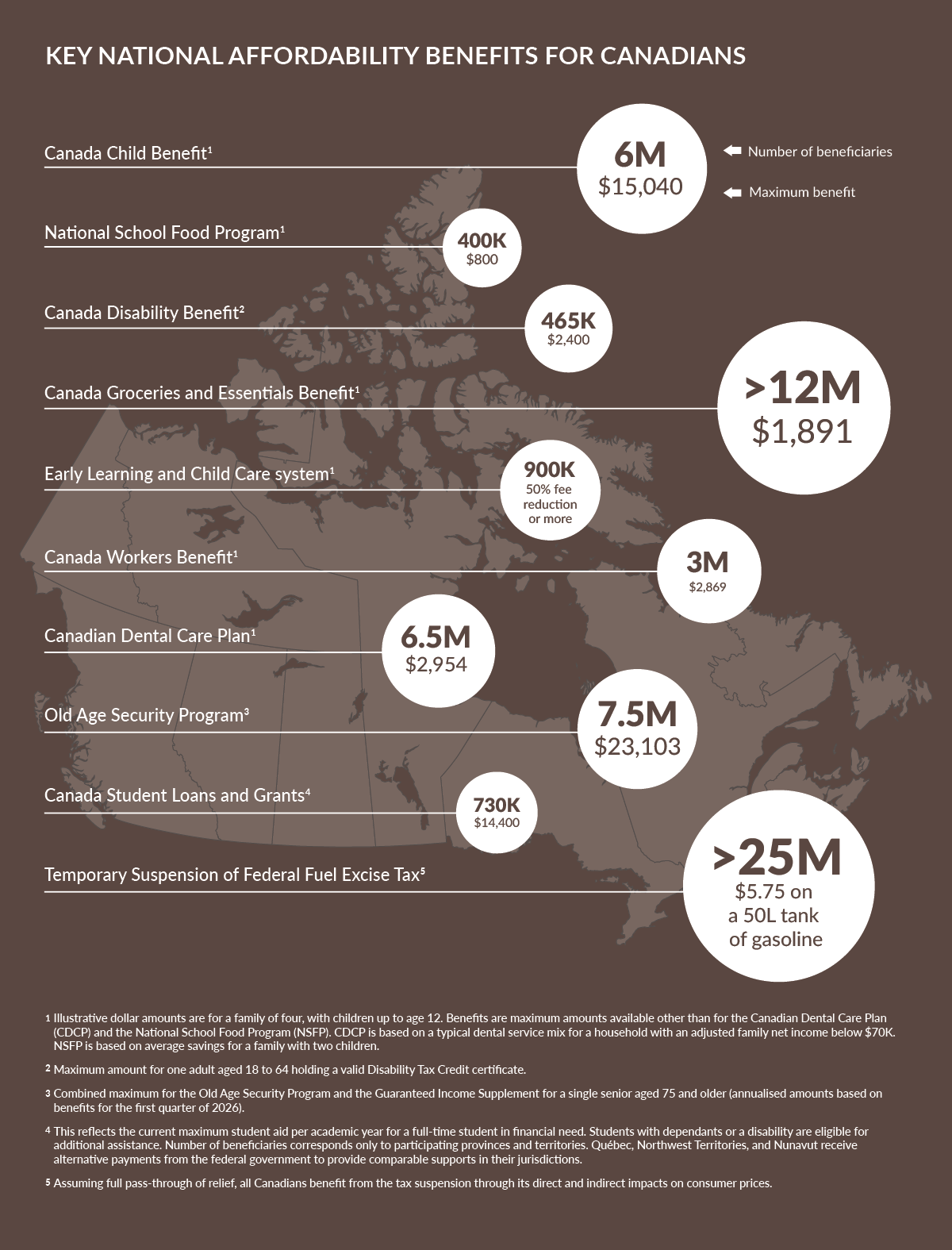
Key National Affordability Benefits for Canadians
Chart image
Text version
Key National Affordability Benefits for Canadians
Program Number of beneficiaries Maximum benefit
Canada Child Benefit1 6M $15,040
National School Food Program1 400K $800
Canada Disability Benefit2 465K $2,400
Canada Groceries and Essentials Benefit1 >12M $1,891
Early Learning Child and Child Care system1 900K 50% fee reduction or more
Canada Workers Benefit1 3M $2,869
Canadian Dental Care Plan1 6.5M $2,954
Old Age Security Program3 7.5M $23,103
Canada Student Loans and Grants4 730K $14,400
Temporary Suspension of Federal Fuel Excise Tax 5 >25M $5.75 on a 50L tank of gasoline

1 Illustrative dollar amounts are for a family of four, with children up to age 12. Benefits are maximum amounts available other than the Canadian Dental Care Plan (CDCP) and the National School Food Program (NSFP). CDCP is based on a typical dental service mix for a household with an adjusted family net income below $70K. NSFP is based on average savings for a family with two children.

2 Maximum amount for one adult aged 18 to 64 holding a valid Disability Tax Credit certificate.

3 Combined maximum for the Old Age Security Program and the Guaranteed Income Supplement for a single senior aged 75 and older (annualised amounts based on benefits for the first quarter of 2026).

4 This reflects the current maximum student aid for the academic year for a full-time student in financial need. Students with dependants or a disability are eligible for additional assistance. Number of beneficiaries corresponds only to participating provinces and territories. Quebec, Northwest Territories, and Yukon receive alternative payments from the federal government to provide comparable supports in their jurisdictions.

5 Assuming full pass-through of relief, all Canadians benefit from the pause in FET through its direct and indirect impacts on consumer prices.

Making Groceries and Essentials More Affordable

Our government has introduced new measures to make groceries and other essentials more affordable for Canadians:

  • The new Canada Groceries and Essentials Benefit will provide additional, significant support for more than 12 million Canadians.

    • Formerly the Goods and Services Tax (GST) Credit, we are increasing its amount by 25 per cent for five years as of July 2026.
    • Combined, this means that a family of four will receive up to $1,890 this year, and about $1,400 a year for the next four years; and a single person will receive up to $950 this year, and about $700 a year for the next four years.
  • An additional $20 million has been provided to the Local Food Infrastructure Fund to ease pressures on food banks, and immediate expensing was announced for greenhouse buildings to support increased domestic supply and investment in food production.
  • We are providing $36 million to address food security and affordability in the North through the Nutrition North Canada Retail Subsidy Program and the Northern Isolated Community Initiatives Fund.
  • We have made the National School Food Program permanent, which will provide up to 400,000 children with meals at school each year, helping families save an average of $800 annually.

June 5

As part of the new Canada Groceries and Essentials Benefit, those eligible will receive — as soon as June 5th — a one-time top-up payment equivalent to a 50 per cent increase in the 2025-26 annual value of the GST Credit.
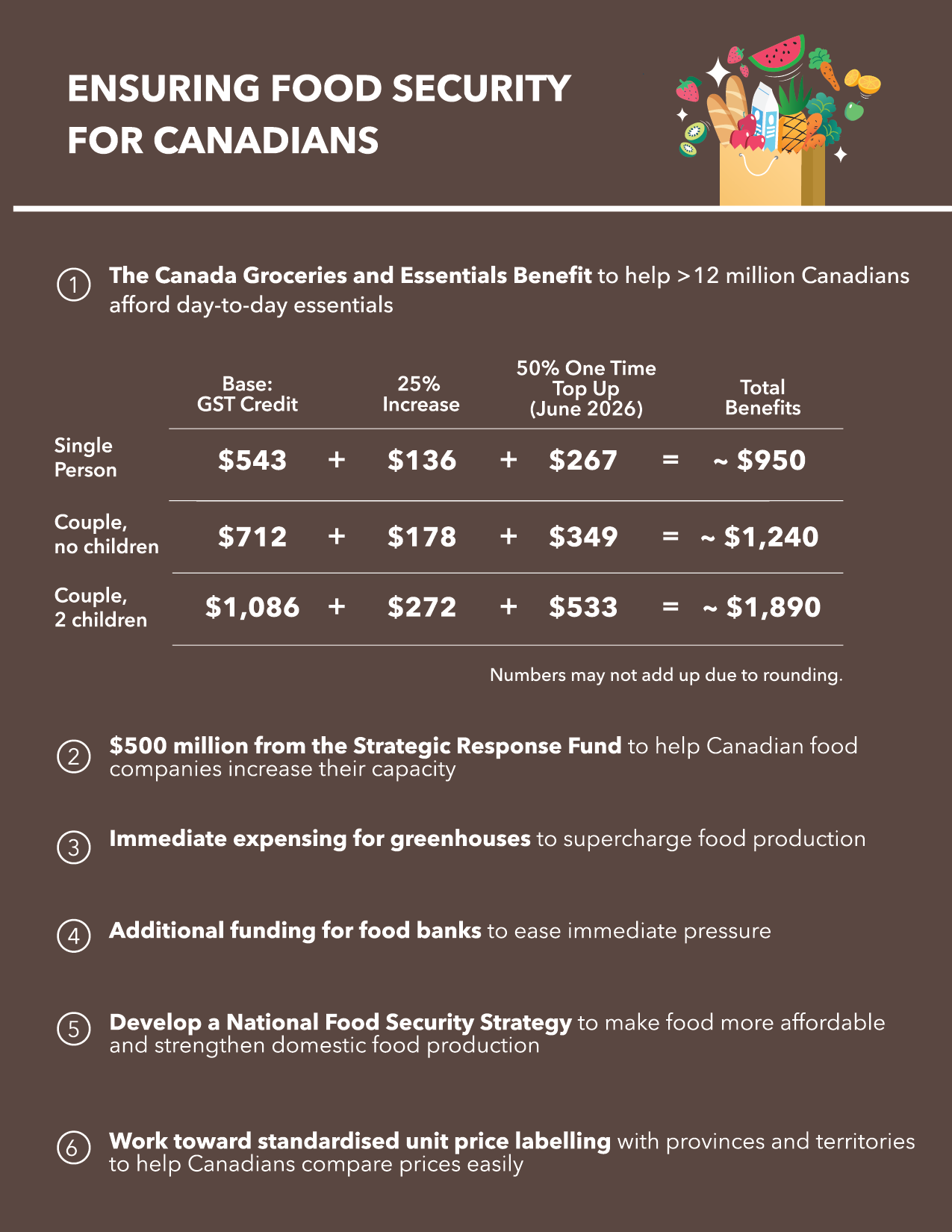
Figure 0.5
Ensuring Food Security for Canadians
Chart image
Text version

Ensuring food security for Canadians

  1. The Canada Groceries and Essentials Benefit to help >12 million Canadians afford day-to-day essentials

    Base GST Credit 25% increase 50% One Time Top Up
    (June 2026)
    Total Benefits
    Single person $543 $136 $267 ~$950
    Couple, no children $712 $178 $349 ~$1,240
    Couple, 2 children $1,086 $272 $533 ~$1,890

    Numbers may not add up due to rounding.

  2. $500 million from the Strategic Response Fund to help Canadian food companies increase their capacity
  3. Immediate expensing for greenhouses to supercharge food production
  4. Additional funding for food banks to ease immediate pressure
  5. Develop a National Food Security Strategy to make food more affordable and strengthen domestic food production
  6. Work towards standardised unit price labelling with provinces and territories to help Canadians compare prices easily

More Competition, Lower Costs

Stronger competition pushes businesses to become more innovative and operate more efficiently. Over time, these productivity gains translate into lower costs, greater choice, and better wages for Canadians. Yet over the past two decades, competitive intensity across the Canadian economy has weakened. Strengthening competition will be essential to delivering sustained affordability gains for Canadians.

At a time when Canadians are facing heightened affordability pressures from sources beyond our control, it is more important than ever that we press harder to find opportunities for improvement within our control. To strengthen productivity and improve affordability, the Spring Economic Update 2026 launches a new Whole-of-Government Competition Plan that will take a focused and coordinated approach to ensure that competition is prioritised throughout the federal government's policies.

The government is focusing on lower mobile and Internet plan prices by building on the 2023 direction to the Canadian Radio-television and Telecommunications Commission (CRTC) that places stronger emphasis on competition, affordability, and consumer interests with a decision to uphold a CRTC ruling on third-party access to fibre infrastructure in August 2025. The government is also implementing a Telecommunications Competition Roadmap outlining actions to improve consumer choice, pricing, and availability of services.

Bringing Down Mobile Plan Costs
Mobile plans that once cost over $100 now cost far less, with more data for Canadians
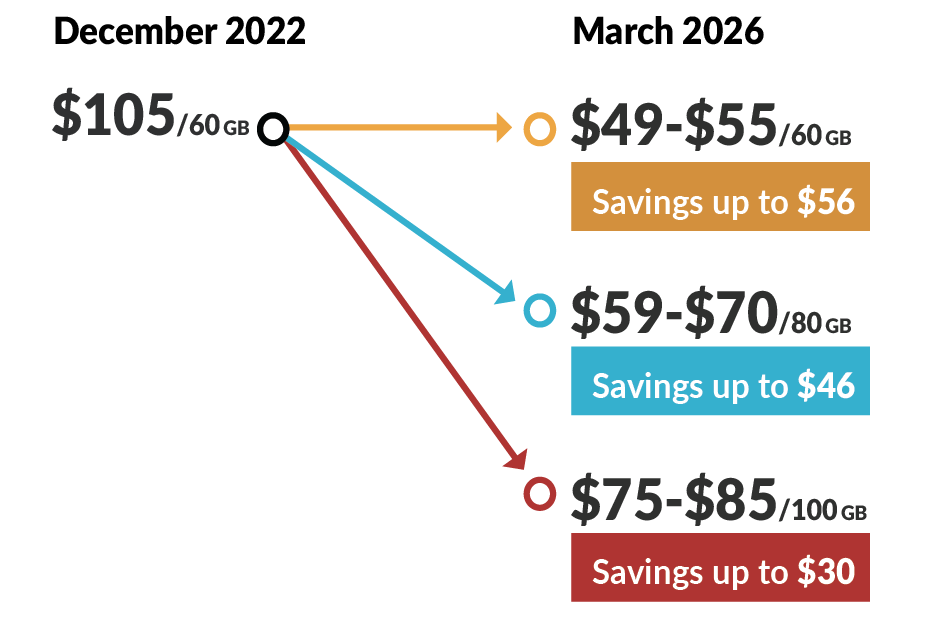
Figure 0.6
Bringing Down Mobile Plan Costs
Chart image

Sources: Company websites.

Notes: Plans were selected based on comparable offerings. Plans with international roaming as a standard feature were excluded, as were plans with time-limited promotional pricing.

Text version

The figure compares mobile plan prices in December 2022 and March 2026. In December 2022, a typical plan with a large data allowance cost $105 per month for 60 GB of data.

By March 2026, several lower-cost options are shown with increased data:

  • Plans costing $49 to $55 per month for 60 GB, representing savings of up to $56
  • Plans costing $59 to $70 per month for 80 GB, representing savings of up to $46
  • Plans costing $75 to $85 per month for 100 GB, representing savings of up to $30

Arrows connect the 2022 price point to each 2026 option, illustrating the reduction in cost and increase in available data.


Competition only works when government ensures markets work. Continued decisive action is needed to strengthen competition and ensure the economy operates at its best, including:

  • Advancing the Whole-of-Government Competition Plan to ensure government policies prioritise competition
  • Providing more choices and more affordable financial services through consumer-driven banking and low-cost accounts
  • Making it easier to renew or switch between home Internet, home phone, and cell phone plans

As Canadians build the strongest economy in the G7, we know that some of the biggest payoffs in our plan will take time. That's why Canada's new government is standing with Canadians through uncertain and rapidly changing times, acting responsibly to provide support today, and making smart, long-term investments that strengthen Canada's economy. This means creating the mechanisms to ensure Canadians thrive today and tomorrow, supporting workers and young people, supercharging the housing sector, combatting financial crimes, and investing in strong communities.

Spring Economic Update 2026 introduces a number of flagship measures:

  • Introducing Canada's Own Sovereign Wealth Fund — the new Canada Strong Fund
  • Launching Team Canada Strong to recruit, train, and hire 80,000 to 100,000 new Red Seal skilled trades workers by 2030-31, aligned to Canada's housing, infrastructure, and defence needs
  • Making life more affordable for Canadians
  • Building stronger and safer communities

Canada will establish its own sovereign wealth fund: Canada Strong Fund

The Canada Strong Fund is a new national investment initiative designed to strengthen Canada's economy and give Canadians a direct stake in its success.

The Fund will invest in key, strategic Canadian projects and companies, creating jobs, supporting innovation, and helping Canada stay competitive in a rapidly changing world.

Canadians will have the opportunity to invest in the Fund and share in the financial returns generated by these projects.

This is about building a stronger, more independent Canada where everyone can take part and benefit.

Canada
Strong
Fund

  • Strategic Investments

    Equity investments in projects and companies that build Canada

  • Nation-Building Outcomes

    A stronger, more competitive, more sovereign Canada

  • Returns to Canadians

    Individual investors to see returns directly based on performance of the Fund

In a more uncertain world, Canada offers stability. In a more divided world, Canada forges partnerships. And in a more competitive world, Canada invests decisively in its future.

Supporting Workers and Young People

Canada's future depends on the people building it. That's why the Spring Economic Update 2026 is focused on helping workers and young people gain the skills, experience, and support they need to succeed.

We're making it easier to learn, train, and find meaningful opportunities:

  • Creating new opportunities for young Canadians

    Launching Team Canada Strong to recruit, train, and hire 80,000 to 100,000 new Red Seal skilled trades workers by 2030-31, aligned to Canada's housing, infrastructure, and defence needs.

  • Expanding training capacity to deliver results at scale

    Modernizing and increasing apprenticeship and Red Seal training capacity, working with unions, employers, provinces and territories, and national institutions to shorten timelines and improve outcomes.

  • Removing financial barriers during apprenticeship training

    Introduce a new and redesigned Apprenticeship Grant that will provide apprentices with a weekly income top-up of $400 per week while they are attending mandatory in-class technical training for a total payment of up to $16,000 per apprentice, paid in addition to Employment Insurance.

  • Making education more affordable

    Extend for the 2026-27 academic year the increases to Canada Student Grants and interest-free Canada Student Loans — 571,000 students are expected to benefit from the increase to non-repayable grants, and 422,000 students could benefit from the weekly loan limit increase.

  • Helping tradespeople go where the work is

    Enhancing the Labour Mobility Deduction will make it more affordable for skilled workers to travel to where jobs are available.

  • Encouraging shared ownership

    Making the Employee Ownership Trust tax exemption permanent will help more workers share in the success of the businesses they help build.


Our plan for a career in skilled trades

Step 1: Join the Team Canada Strong Program

  • Start up to 4-month job placement to gain experience.

Step 2 : Register as an apprentice and begin on-the-job training with either an employer or a union training centre

  • Small and medium enterprises receive $10K wage incentive.

Step 3: Complete your technical training at a college and through your employer or a union training centre

  • Receive a $400 weekly Apprenticeship Grant.
  • Receive income supports if caught between training and work.

Step 4: Get certified

  • Once certified in a Red Seal trade, receive $5K Completion Bonus.

Step 5: Start career as a Red Seal tradesperson

  • Contribute to the Build Canada agenda.

There will be new pathways to skilled trades through the Canadian Armed Forces

Hands-on training through Cadets and Junior Canadian Rangers

Fully funded trades training for young Canadians joining the Canadian Armed Forces Primary Reserve

One process: faster and simpler (50% reduction in total time)

Making Life More Affordable for Canadians

Finding a place to live shouldn't feel out of reach. The Spring Economic Update 2026 builds on Build Canada Homes with a plan to increase supply, lower costs, and help more Canadians find a safe, affordable home.

We're taking action to build more homes, faster and smarter:

  • Cutting red tape to build homes faster

    Streamlining rules and modernising building codes will make it easier to construct new homes, including factory-built and modular housing.

  • Supporting innovation in construction

    Investing in new building technologies will help reduce costs and speed up construction.

  • Accelerating over $7 billion in low-cost financing to the Canada Mortgage and Housing Corporation

    More affordable financing will help builders move projects forward sooner — getting rental homes on the market faster.

  • Helping those most in need

    Extending support for people experiencing homelessness and ensuring survivors of gender-based violence have access to safe housing.

  • Boosting housing supply across Canada

    Through the Improving Housing Supply Act, $1.7 billion will go to provinces and territories to remove barriers and accelerate homebuilding, including reducing development fees and levies on new home construction.

  • Improving cash flows for home buyers

    Extending the grace period during which homeowners are not required to start repaying their Home Buyers' Plan withdrawals from their Registered Retirement Savings Plan.

  • Reducing the contribution rate of the base Canada Pension Plan

    With the unanimous support of provinces and territories.

  • Making it easier to access the Disability Tax Credit

    Streamlining the application process for individuals with certain long-lasting medical conditions.

An Economy Built by Canadians

Budget 2025 is translating our vision into real action through major projects, less red tape, and generational infrastructure investments that move goods to market. The Spring Economic Update 2026 builds on this momentum with strategic investments that support productivity, growth, and competitiveness.

Federal Investments in Sector Strategies Total Over $25 Billion
Sector-specific strategies are helping firms and workers adapt and remain competitive.
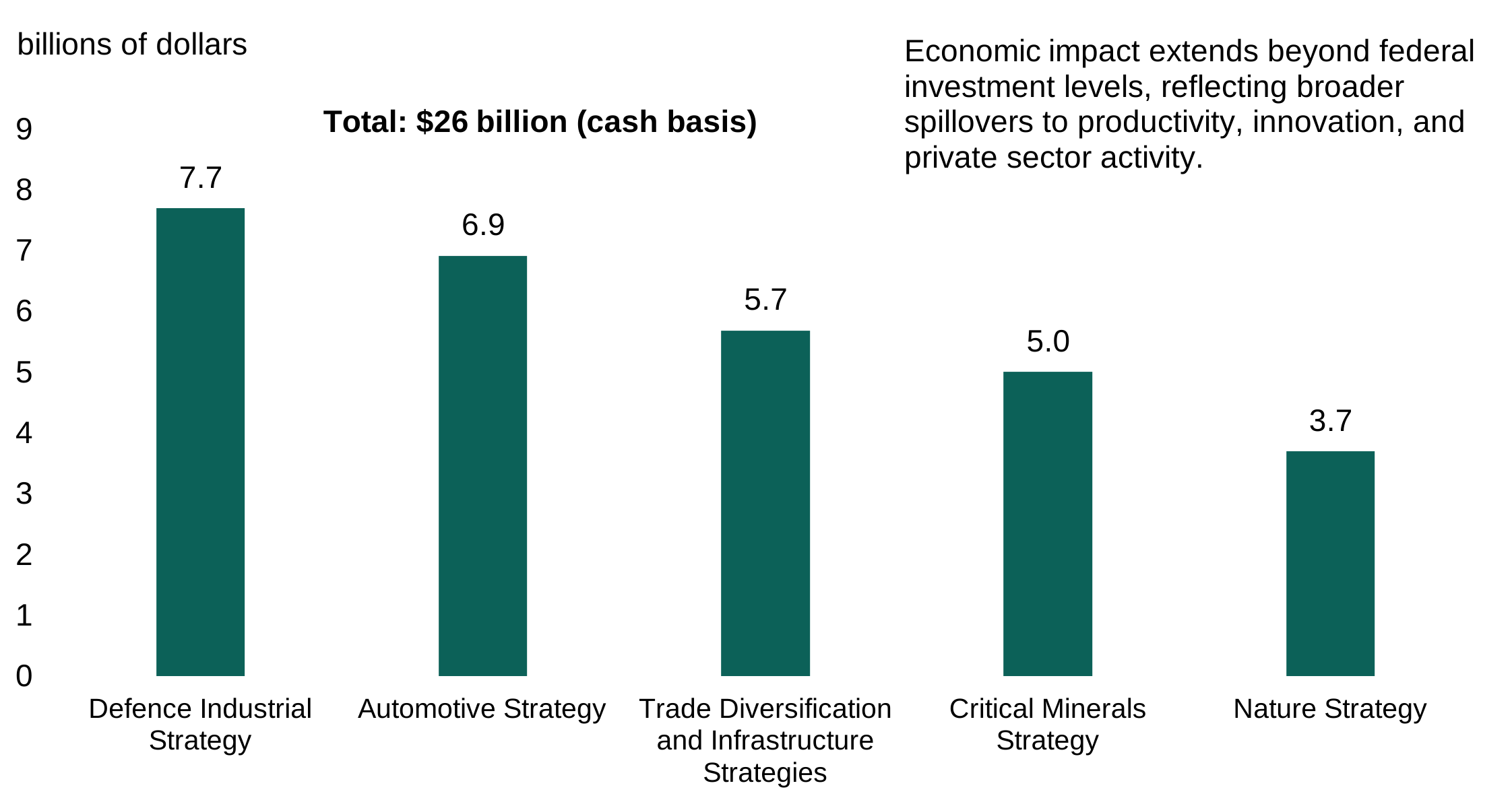
Chart 0.11
Chart image

Notes: Includes existing spending and spending announced in Budget 2025 and this Spring Economic Update (including certain tax measures), covering 2025-2031 on a cash basis. Total is smaller than the sum of individual strategies since some initiatives support multiple strategies.

Text version

The chart shows the expected total federal investment on a cash basis from 2025-26 to 2030-31 across various sector strategies, totaling approximately $26 billion. The strategies include the Defence Industrial Strategy, Automotive Strategy, Trade Diversification and Infrastructure Strategies, Critical Minerals Strategy, and Nature Strategy.

Investment (2025-31) - CASH
Defence Industrial Strategy 7.7
Automotive Strategy 6.9
Trade Diversification and Infrastructure Strategies 5.7

Critical Minerals Strategy 5.0
Nature Strategy 3.7

First Announced in Budget 2025

Trade Diversification and Infrastructure Strategies

To ensure Canadian businesses can expand and double our exports to non-U.S. markets over the next decade, we are providing direct support to exporters, opening access to new markets, and modernising trade-enabling transportation systems and infrastructure.

In order to support trade diversification, the government is examining options to strengthen Canada's supply chains — backed by signing 20 new deals on four continents.

Critical Minerals Strategy

To grow Canada's critical minerals industry, we are promoting domestic production and processing of critical minerals, safeguarding critical minerals value chains for our economic sovereignty, and partnering with Indigenous groups, domestic stakeholders and international allies. Canada has a broad suite of financing tools in place to support this strategically important sector, and initiatives under the Critical Minerals Strategy, including dozens of new partnerships and investments mobilising $18.5 billion in projects across the country — with the Canada-led G7 Critical Minerals Production Alliance. The government has referred five critical minerals projects to the Major Projects Office as part of the two waves of nation building project announcements, such as Nouveau Monde Graphite's Matawinie Mine in Québec and the McIlvenna Bay Foran Copper Mine Project in Saskatchewan.

Defence Industrial Strategy

To build Canada's defence manufacturing and technology base, we are prioritising Canadian suppliers and materials in defence procurement, investing in Canadian defence innovation and commercialisation, and streamlining procurement.

We are positioning Canadian industry to take advantage of the government's generational investments in defence, creating significant economic benefits for years to come — including 125,000 high-paying careers and support an estimated $180 billion total direct investment in in defence procurement by 2035. This will strengthen military supply chains, create good careers at home, and equip the Canadian Armed Forces with the capabilities they need to protect Canada and our Allies.

Since Budget 2025

Automotive Strategy

To strengthen Canada's auto manufacturing sector and protect over 500,000 workers, we are boosting investment, strengthening our climate goals, making electric vehicles more affordable and reliable, and protecting Canadian auto workers.

In response to persisting and unjustified U.S. tariffs on Canadian-made vehicles, we will maintain our reciprocal counter-tariffs and explore ways to leverage Canada's automotive duty remission framework to reinforce domestic production, attract new investment and enhance the sector's long-term competitiveness. We will also seek ways to attract new investment, including by leveraging the recent arrangement on electric vehicles with China.

Nature Strategy

To build the clean and competitive economy of tomorrow, we are making significant investments through the Nature Strategy to help conserve 30 per cent of Canada's lands and waters by 2030, ensure our industrial strategies complement our conservation efforts, and advance actions to value and mobilise capital for nature.

Empowering Canadians

Strong communities are the foundation of a strong Canada. The Spring Economic Update 2026 invests in the services and supports that keep communities safe, welcoming, and resilient — so Canadians can stay informed, access essential services delivered in both official languages, and thrive where they live.

Key actions include:

  • Supporting trusted, independent journalism

    Extending the Canadian Journalism Labour Tax Credit to help sustain high-quality local news and keep Canadians informed.

  • Investing in Indigenous communities

    Providing significant funding for essential services, including health benefits and culturally relevant education, to support stronger, healthier communities.

  • Investing in sport — from playground to podium

    Investing $755 million to expand access to sport, creating opportunities for Canadians to build meaningful relationships within their communities, making full use of existing and new infrastructure, and to support Canada's world class athletes who inspire pride and unity, as we celebrate their accomplishments as a nation.

  • Protecting coastal livelihoods

    Investing nearly $1 billion to repair and maintain small craft harbours — supporting jobs, local economies, and the future of coastal communities.

  • Making it easier to access the Disability Tax Credit

    Streamlining the application process for individuals with certain long-lasting medical conditions and expanding the list of medical practitioners who can certify eligibility for the Disability Tax Credit will help ensure that Canadians with severe disabilities have access to the supports they need, including under the Canada Disability Benefit.

Protecting Communities

Too many Canadians — especially seniors and vulnerable people — are being targeted by scams and financial crime. The Spring Economic Update 2026 takes stronger action to protect people, crack down on criminals, and keep Canadians' money safe:

  • Establish the Financial Crimes Agency as a best-in-class law enforcement agency with the personnel, resources, mandate, and legislative tools needed to tackle sophisticated financial crimes and recover illicit proceeds.
  • Protect Canadians by cracking down on the criminal abuse of money services businesses for money laundering, terrorist financing, sanctions evasion, and fraud through stronger regulations, new enforcement powers, and a ban on crypto ATMs.
  • Advance the National Anti-Fraud Strategy, with a public consultation launched in March 2026, by seeking feedback on the introduction of a multi-sector anti-fraud framework across the financial and telecommunications sectors, and digital platforms, alongside measures to strengthen public awareness of fraud and support law enforcement efforts to combat fraud.
  • Help keep communities safe and inclusive

    Investing in the programs and services that ensure Canadians feel safe, supported, and able to fully participate in community life.

Build in Canada. Invest in Canada. Choose Canada. Buy Canadian. Because what we build belongs to you, your children, and your country.

Page details

Date modified: