
Chapter
3:
A more affordable life
Find out more about the expected gender and diversity impacts for each measure in Chapter 3: A more affordable life.
Canada's new government recognises the cost-of-living pressures facing Canadians. Since taking office, we have made meaningful progress in improving affordability, but many continue to face financial challenges. From rent and groceries to transportation and energy costs, the higher cost of living can make it challenging to make ends meet, plan for the future, and build financial security. And for those who are unhoused to begin with, getting into a safe, warm home can seem out of reach.
In response to these challenges, we are focused on providing Canadians with a boost today and a bridge to a better tomorrow. This means providing immediate help to ease the pressure on household budgets while also building a stronger, more independent, and prosperous economy for all Canadians well into the future.
In a country where we are masters of our destiny, we must be able to live, work, and build our lives as we see fit. It must be one where our workers, caregivers, children, and seniors have access to better opportunities and greater financial security in the years ahead. And it must be one where we never accept that some challenges are too great to overcome. That is why we are taking bold action to deliver a more affordable life for Canadians. Taken together, the measures in Budget 2026 and additional support through the Canada Groceries and Essentials Benefit could lift hundreds of thousands of people out of poverty in 2027.
Putting more money back in Canadians' pockets

The work to create a more affordable life begins with lowering costs on everyday essentials like food, energy, fuel, and child care. It continues with investments to support Canadians transitioning out of homelessness and build more affordable homes for all, while helping Canadians access essential care, new careers, affordable financing, and the tax credits they have earned.
Budget 2026 takes action to make life more affordable and build a stronger Canada for the future. Key measures include:
- Making life more affordable for Canadians with low and modest incomes through the 2027 Canada Groceries and Essentials Benefit Supplement and new investments in Nutrition North Canada.
- Strengthening support for workers through the Build Canada Workers Benefit to keep more money in their pockets.
- Providing more support to low-income caregivers by making the Canada Caregiver Credit fully refundable.
- Putting Canada on a path to end homelessness in 10 years, in collaboration with provinces and territories.
- Boosting the capital of Build Canada Homes to supercharge the construction of affordable and non-market housing.
- Making mortgages more flexible for Canadians and homeownership more attainable.
- Supporting efforts to recruit, train, and hire the next generation of Canada's workers.
- Making health care more accessible, including mental health, addictions, and caregiver supports.
- Strengthening consumer protections and helping Canadians access more affordable financial services.
These measures build on the ambitious affordability agenda we are already implementing to reduce costs for Canadians and drive greater prosperity:
-
Nearly 22 million Canadians are keeping more of what they earn, with the middle-class tax cut saving a two-income family up to $840 this year.
-
First-time home buyers are saving up to $50,000 through the removal or reduction of the Goods and Services Tax (GST) on new homes.
-
Across most provinces and territories, the removal of the consumer carbon price is driving gas prices down by about 18 cents per litre.
-
Canadians are saving up to 10 cents per litre on gasoline, and up to 4 cents per litre on diesel, through the temporary suspension of the federal fuel excise tax.
-
More than 12 million Canadians are receiving hundreds of dollars of additional support through the Canada Groceries and Essentials Benefit, helping them afford healthy food and other everyday necessities.
-
More than 900,000 children now have access to affordable early learning and child care, helping families save on one of their largest household expenses.
-
400,000 more children are receiving nutritious meals through the National School Food Program—lowering overall grocery costs for participating families.
-
Canadians are paying less in banking fees, with new rules that cap non-sufficient fund fees at $10 and strengthen consumer protections.
-
Canadians universally have access to enhanced low-cost and no-cost bank accounts now offering up to 50% more debit transactions for no more than $4 per month.
-
Automatic federal benefits and pre-filled returns will help up to 5.5 million low-income Canadians access more financial supports, ensuring that help reaches those who need it most.
-
175,000 young Canadians have more opportunities to earn money and save for the future through programs like Canada Summer Jobs, the Youth Employment and Skills Strategy, and the Student Work Placement Program.
-
80,000 additional jobs annually supported over the long term through the Productivity Mega Deduction.
3.1 Delivering a boost today
In a more uncertain world, too many Canadians are feeling the pressure of rising costs. That is why Budget 2026 includes concrete measures that address the immediate needs of Canadians and makes investments to build a stronger Canadian economy. By reducing energy and fuel costs, ensuring that child care is more affordable and accessible, lowering food and grocery bills, and strengthening support for workers earning low wages and low-income caregivers, we are giving Canadians the boost they need today.
Providing more help with groceries and everyday essentials
Building a stronger economy will deliver lasting benefits for Canadians, but those gains will take time. Right now, many families are still feeling the pressure of high grocery bills and other everyday costs.
To provide more support now, we introduced the Canada Groceries and Essentials Benefit. This benefit provides quarterly support to more than 12 million individuals and families with low or modest incomes, and is indexed annually to keep pace with the cost of living. Introduced in January 2026 to help offset higher food costs, this benefit has continued to provide additional relief, with a one-time 50% top-up in June 2026 and a 25% increase in the benefit for five years beginning in July 2026. To provide more help with the cost of groceries and other essentials:
- Budget 2026 proposes to enhance this benefit again through the 2027 Canada Groceries and Essentials Benefit Supplement, which would provide a one-time 50% increase for the 2026-27 benefit year, delivered in early 2027. The Supplement would provide up to $339 for a single person without children and up to $679 for a couple with two children. Combined with the June 2026 top-up and the 25% increase in the benefit as of July 2026, this supplement would bring total support in 2026-27 to up to about $1,290 for a single person without children and $2,570 for a couple with two children. It would provide $4.1 billion in additional support to Canadians and is expected to lift an additional 120,000 people out of poverty in 2027.
Budget 2026 also expands and stabilises funding for Nutrition North Canada and associated initiatives, which help lower the cost of imported foods and support local food harvesting and distribution initiatives in remote northern communities.
- Budget 2026 proposes to provide $610.3 million over four years, starting in 2027-28, $118.1 million in 2031-32, and $117 million ongoing to ensure that Nutrition North Canada can maintain and enhance these essential supports.
2027 Canada Groceries and Essentials Benefit Supplement

Strengthening support for workers earning low wages
Working should give people a real chance to build a good life and get ahead, but for many Canadians earning lower wages, everyday costs can still put that goal out of reach. The Canada Workers Benefit provides a refundable tax credit to supplement the earnings of about 3 million low- and modest-income workers each year. This helps them work and contribute to Canada's economy while giving them the boost they need to keep enough money in their pockets.
However, the existing minimum earnings threshold of $3,000 per year means some people with very low earnings do not qualify, despite being workers. Recipients also automatically receive part of the following year's benefit in advance, based on their entitlement from the previous year. This means when their circumstances change, some may receive advance payments that exceed the support they ultimately qualify for.
To better target the benefit to workers who need help most:
- Budget 2026 proposes to introduce the Build Canada Workers Benefit, building on and enhancing the existing Canada Workers Benefit. The new benefit would lower the minimum earnings threshold from $3,000 to $500, and from $1,150 to $200 for the disability supplement. It would also increase the maximum benefit to $1,859 for single individuals without children and $3,143 for families, up from $1,709 and $2,943 respectively under the existing benefit.
These enhancements would increase benefits for about 1.9 million low-income workers, including 180,000 new recipients, starting with the 2027 taxation year. Workers with the lowest earnings could receive up to $675 more, or nearly $1,000 more for those eligible for the disability supplement. Taken together, the Build Canada Workers Benefit would lift an estimated 240,000 people out of poverty and help make work pay for more Canadians.
To better target support to workers based on their current circumstances:
- Budget 2026 also proposes to reduce advance payments by half for the 2027 taxation year, beginning in July 2027, and eliminate advance payments starting with the 2028 taxation year. Workers who are entitled to the Build Canada Workers Benefit would instead receive their full entitlement after filing their tax return for the year.
Making the Canada Caregiver Credit refundable
As Canadians, we take care of each other when help is needed. Caregivers, both paid and unpaid, provide essential support to Canadians with health conditions. More than half of Canadian women are caregivers, with about one quarter of women providing unpaid care to adults with long-term medical conditions or disabilities. These caregivers help family, friends, and people in need remain in their homes and communities.
However, many caregivers have incomes too low to pay tax and therefore do not fully benefit from the existing Canada Caregiver Credit. Making the credit refundable would extend meaningful support to more caregivers and protect and recognise the crucial role they play in keeping our communities and families together and safe. That is why Budget 2026 proposes to:
- Make the Canada Caregiver Credit fully refundable, providing $845 million in additional support over four years, starting in 2027-28, and $245 million per year ongoing. 585,000 caregivers would receive support, including 180,000 who currently receive no benefit. Caregivers would receive up to $1,260 annually (for 2027, indexed thereafter). Making the credit refundable would lift an estimated additional 15,000 individuals out of poverty.
Making the Canada Caregiver Credit refundable

Lowering costs for Canadians at the pump
Global conflict and ongoing supply disruptions in the Middle East are driving up fuel prices around the world. To help Canadians and businesses manage the rising costs of fuel, we temporarily suspended the federal fuel excise tax on gasoline, diesel fuel, and aviation fuels, effective April 20, 2026.
This suspension reduced Canadians' bills at the pump by up to 10 cents per litre on regular gasoline and up to 4 cents on diesel.
In September 2026, we announced that this temporary tax relief would be extended until the end of January 2027. Fuel excise tax rates will then be restored to 50% of their pre-suspension levels until the end of March 2027, before returning to their standard rates on April 1, 2027. This is a responsible measure that addresses a root cause of affordability challenges for Canadians now—the cost of transportation—while balancing fiscal prudence.
Extending the tax relief into early 2027 lowers costs at the pump and across supply chains. It provides important relief to truckers and businesses in the food, agriculture, housing, construction, and delivery sectors. For Canadians, it means continuing to save more than $5 every time they fill a typical 50-litre tank of gasoline while the full relief remains in place. The extension is expected to provide an additional $2.9 billion in fuel tax relief, bringing total estimated tax relief for Canadians to $5.3 billion in 2026-27.
$2 billion investment, retrofitting 1 million homes to save Canadians $1 billion per year
Heating is one of the biggest expenses for Canadians during the winter months, and too often, that money goes to the most expensive and least efficient ways to heat a home. Over seven million households in Canada still heat their homes with oil, propane, diesel, electric baseboards, or outdated furnaces, leaving many families with excessively high energy bills. We are working to give Canadians more choice over how they heat and cool their homes and more control over what they pay for energy.
For many Canadians, heat pumps offer a better option. Heat pumps provide efficient heating in winter and cooling in summer, lowering household energy bills while improving year-round comfort. Families that switch from oil, propane, or electric resistance heating can save an average of over $1,400 a year.
Supporting home retrofits will create opportunities for heating, ventilation, and air conditioning (HVAC) contractors, installers, energy advisors, suppliers, and other skilled trades across the country. Canada's retrofit industry, which employs approximately 174,000 workers, helps households lower their energy bills through heat pumps and other energy-saving upgrades.
On October 8, we announced new measures to make it easier for households to switch to heat pumps while supporting the businesses that deliver those services.
- To lower Canadians' energy bills, the new National Heat Pump Rebate Program will help up to 820,000 households install eligible cold-climate heat pumps. This program would provide enhanced support for lower-income households and provide approvals within 24 hours so Canadians can quickly replace expensive and inefficient heating systems. We announced more than $2 billion over eight years, starting in 2026-27, to Environment and Climate Change Canada to support this effort.
- To help Canadian building and business owners tackle deep retrofits in commercial, institutional, and mid- or high-rise multi-unit residential buildings, we announced the renewal of the Deep Retrofit Accelerator Initiative, providing $107.1 million over three years, starting in 2027-28, to Environment and Climate Change Canada to support its renewal.
Securing the future of a Canada-wide early learning and child care system
Affordable, high-quality child care gives children a good start in life, helps parents work or study, and allows families to save more for the future, while enabling more parents to participate in Canada's economy.
In 2021, the federal government launched a transformative plan to build a Canada-wide early learning and child care system alongside provinces, territories, and Indigenous partners.
As a result, average child care fees in regulated spaces have fallen by at least 50% across the country. Families are now saving thousands of dollars each year—up to $11,255 per child—and more child care spaces are on the way. Governments have also announced measures to create more than 250,000 new affordable, high-quality child care spaces across Canada.
Over $70 billion in signed agreements with provinces and territories has been announced since 2021 to keep child care affordable, including more than $39 billion starting in 2026-27. These investments help parents enter or remain in the workforce, supporting household incomes and Canada's economic growth. In 2025, the labour force participation rate among mothers aged 25 to 54 with young children reached almost 80%—nearly a record high.
The federal government is committed to ensuring that Canadian families and children can continue to benefit from affordable, high-quality child care for years to come. In June 2026, we announced an investment of up to $5.4 billion over two years to keep child care affordable and provide stability while federal, provincial, and territorial governments work to strengthen the system for the future.
In September 2026, we built on this by announcing a four-year extension to the Canada–Ontario arrangement of the federal government's Canada-wide Early Learning and Child Care Agreement. Through the extension, Ontario will receive nearly $12 billion in federal funding over the next four years, from March 31, 2027, to March 31, 2031.
3.2 Providing a bridge to tomorrow
We know affordability is about more than just paying off monthly bills. Affordability is about whether Canadians can find a home, build a secure future, raise a family on a safe street, find a well-paying job, and have the freedom to make their own choices. It's about the confidence that comes from knowing that hard work leads to opportunity and that we can all become masters of our destiny.
Budget 2026 is focused on creating those possibilities. That means increasing housing supply and getting more Canadians into a safe, warm home. It means investing in the infrastructure communities need to grow. And it means building a stronger and more resilient food system for an affordable and food-secure future.
All of our government's efforts are centred on giving Canadians greater freedom, stability, and choice.
Building the homes Canada needs
A safe, warm, and affordable place to live is foundational for Canadians. It gives people the stability to build a career, raise a family, and engage fully in their community. Canada needs a housing system that works for Canadians no matter where they are in life: from emergency and transitional shelter to supportive and community housing, to rental housing or full homeownership. A Canada where we are masters of our destiny is a Canada where we all feel safe and secure, in a place we can proudly call home.
Canada's new government is already taking action to increase housing supply for Canadians. Rental construction is being supported by the Apartment Construction Loan Program, which has committed $32 billion in loans to support the construction of over 80,000 new rental homes across Canada. The Housing Accelerator Fund has helped municipalities change zoning, streamline approvals, and plan for more housing. And agreements with provinces, territories, and municipalities through the Build Communities Strong Fund have contributed $12.2 billion to provinces and territories, including for housing-enabling infrastructure, helping lower development charges and remove barriers to new construction. Together, these measures are helping communities get housing built again: making room for more homes while lowering the cost of constructing them.
In September 2025, we created Build Canada Homes, a new federal housing agency to accelerate the delivery of affordable housing at scale. Build Canada Homes brings together federal land, financing, investment, and development expertise under one roof. Its mandate includes building and enabling affordable, supportive, and transitional housing; providing flexible financing; and working with non-profit, Indigenous, public, and private partners to get projects built. Build Canada Homes became a Crown corporation earlier this year, and its role has since expanded to encompass the real estate and housing development functions previously held by Canada Lands Company Limited.
Budget 2026 builds on this progress with the next step in a housing strategy that provides support across the full housing continuum. This strategy is organised around three pillars:
Figure 3.4 – Supporting Canadians across the housing continuum
Eliminate homelessness
- Support and services that connect people to housing and prevent inflows into homelessness via Reaching Home and Veterans Homelessness Program
- Investments in supportive and transitional housing
- Creation of an Integrated Supports Fund, bringing together housing, health, mental health, addictions, and social supports
- New investments in the Build Communities Strong Fund's Health Infrastructure Fund to build community mental health and addictions facilities
- Support to low-income renters through the Canada Housing Benefit
Expand non-market housing
- Build and finance new affordable housing through Build Canada Homes, including capital investments in:
- non-market housing
- Indigenous housing
- the Canada Rental Protection Fund (i.e., acquisition)
- development on public land
- Bilateral Housing Agreements with Provinces and Territories
Build a housing market that works for all
- Apartment Construction Loan Program
- Mortgage Loan Insurance
- GST rebate on purpose-built rental
- Development charges reductions through Build Communities Strong Fund
- Housing-enabling infrastructure through Canada Housing Infrastructure Fund
- Support for homebuyers through the First-Time Home Buyers' GST rebate, the Tax-Free First Home Savings Account, and RRSP Home Buyer's Plan
- Modernising housing data, support for adoption of AI and e-permitting, standardising modern construction methods, support for firms
Federal interventions cutting across the continuum
- Improving Housing Supply Act to increase supply, including by reducing fees, taxes, and regulations
- Working with municipalities to remove barriers to housing development through Housing Accelerator Fund incentives (e.g., zoning and permitting)
- Building Code harmonisation
- Support Indigenous housing through Urban, Rural and Northern Strategy, Distinction-based and on-reserve programming
Achieving these goals requires a clear partnership across all levels of government. The federal government will put capital, land, financing, and development capacity on the table, while provinces and territories will be expected to fund wraparound services and operations, work with municipalities to remove local barriers, and ultimately deliver results for Canadians.
A shared approach to build homes, faster
Delivering more housing requires all levels of government to use the levers in their respective areas of responsibility. The federal government provides funding, capital, and financing, federal lands, and national policy levers. Provinces and territories set the regulatory and service delivery framework, working with municipalities to remove local barriers. Municipalities control many of the local rules that determine whether and how quickly housing gets built. By working together, we can build a more affordable Canada.
Federal government
National leadership, funding, and enabling conditions
- Funding, capital, and financing (e.g., Build Canada Homes)
- Federal taxation (e.g., GST)
- Banking and financial regulation including mortgage insurance rules (e.g., mortgage financing)
- National Building Code
- Immigration levels planning
- Management and sale of federal lands
- Census and statistical data (e.g., monitoring core housing need)
Provinces and territories
Regulatory frameworks, services, and delivery
- Provincial and territorial taxation (e.g., provincial sales tax and land transfer tax)
- Financial oversight and consumer protection
- Provincial and territorial building codes
- Landlord and tenant rights and responsibilities (e.g., rent control)
- Planning and development
- Community housing funding and delivery
- Management and sale of provincial and territorial lands
Local governments
Local planning, approvals, zoning, and implementation
- Property taxes
- Zoning, permitting, and development cost charges
- Bylaws (e.g., residential occupancy and repair)
- Community housing delivery
- Program delivery and implementation
Pillar 1: Putting Canada on a path to end homelessness in 10 years
Canada has the resources, the people, and the will to end homelessness—but every level of government and each sector has a role to play. It requires forward-thinking action: stable housing and a comprehensive set of services—including health care, mental health and addictions treatment, crisis services, and other community supports. We are committed to changing how Canada addresses homelessness and supports those who are unhoused, because every Canadian should have the security of a warm home. That is why Budget 2026 is putting significant federal resources toward helping create the conditions to end homelessness within 10 years. This is a call to action for every level of government, Indigenous partners, the private sector, and the not-for-profit sector to come together to reach this goal.
Homelessness remains one of Canada's most urgent social challenges. But homelessness is not inevitable. It is the result of gaps across housing, health, mental health, addictions, and social support systems. Addressing it requires coordinated action from all levels of government, Indigenous partners, service providers, communities, and the private and public sectors. Budget 2026 proposes a renewed partnership: one in which the federal government invests capital in housing and infrastructure, while provinces and territories will take the lead in ongoing operations and wraparound services, like health care and mental health and substance abuse supports.
Budget 2026 sets Canada on a path to end homelessness over the next decade through strong measures to provide help, housing, and health to Canadians experiencing homelessness.
- Help: We will work closely with provinces, municipalities, and philanthropy to provide the help people need as they transition from experiencing homelessness and find a permanent home. This includes jobs, training, and income supports.
- Housing: As part of this plan, the Government of Canada is making a historic, multi-billion-dollar investment to build the transitional and permanent housing necessary to pragmatically ending the homelessness crisis.
- Health: For those who need it, we will build the facilities needed to care for and support the most vulnerable in our society.
To deliver on this new partnership and reach the goal of ending homelessness within 10 years, Budget 2026 proposes to provide $11.2 billion, over 4 years, starting in 2027-28, and $17.8 billion in future years. These investments will:
- Help people move from homelessness into stable housing:
- Budget 2026 proposes to provide $1.8 billion over four years, starting in 2027-28, and $3.2 billion in future years to establish a new Integrated Supports Fund, delivered through Build Canada Homes. The Fund would support projects that bring housing together with health, mental health, addictions, and social supports. The Fund would also help develop new transitional and supportive housing, adapt existing buildings, and mobilise public, private, and philanthropic capital behind an integrated housing and care model.
- Budget 2026 also proposes to provide an additional $3.6 billion over four years, starting in 2027-28, and $6.4 billion in future years, through Build Canada Homes to build new supportive and transitional housing across Canada. Federal funding will support capital costs, while provincial and territorial partners will be expected to fund ongoing operations and wraparound services, like job, training, income and health supports. This approach would help ensure that new housing is matched with the care and supports people need to remain housed.
- Build community mental health and addictions facilities: Budget 2026 proposes to provide $2 billion over two years, starting in 2027-28, for the Health Infrastructure Fund. Facilities funded will provide care before people reach a crisis point, helping address the mental health and substance use challenges that are contributing to homelessness, instability, and growing pressures on communities across Canada.
- Maintain support for existing programs to help prevent homelessness: Budget 2026 proposes to provide $2.1 billion over three years, beginning in 2028-29, and $4.4 billion in future years to Housing, Infrastructure and Communities Canada to renew the Reaching Home initiative and the Veterans Homelessness Program for an additional 10 years. This funding will maintain community-led prevention and homelessness services, including dedicated support for veterans experiencing homelessness. To maximise outcomes, Reaching Home will require rigorous reporting, including real-time data, as a condition for continued funding. More details on the enhanced initiative will be released early in the new year.
Recognising the critical role of provinces and territories and sustaining partnerships to support low-income housing:
- Budget 2026 proposes to renew the Canada Housing Benefit for 10 years ($1.7 billion over 3 years, starting in 2028-29, and $3.9 billion in future years), providing direct monthly rental assistance to low-income Canadians, helping prevent homelessness and enabling vulnerable individuals and families to secure and maintain stable housing.
The government will work with the provinces and territories on other elements of their bilateral agreements, ahead of the Spring Economic Update 2027. This work will align these agreements with the goal of putting Canada on a path to end homelessness in 10 years, protect existing non-market housing stock, take into consideration the expanded role of Build Canada Homes, and make responsibilities clearer for delivering affordable housing and targeted affordability supports. As we increase capital investments, provinces and territories will be expected to strengthen funding for operations, health care, and wraparound supports, and to demonstrate progress against shared outcomes.
A new housing partnership with Winnipeg
Why it matters
Homelessness is increasingly visible in communities across Canada. It affects people’s mental health, safety, and well-being. With sustained action and governments working together, we can prevent homelessness, help people move into permanent homes, and reduce the number of people who return to homelessness.
A stable and supportive home provides the foundation for better health, consistent care, recovery, and overall well-being. Bringing housing together with health care and wraparound supports helps shift the response from crisis to early intervention and long-term stability.
What this approach looks like
Centre for Mental Health and Addictions, Winnipeg
 $1+ billion
in new capital
The government is partnering with Manitoba to create the conditions to end homelessness in Winnipeg—bringing over $1 billion in new capital through Build Canada Homes to invest in an integrated approach that includes the Winnipeg Centre for Mental Health and Addictions, which will bring acute and outpatient care together with permanent supportive and transitional housing and wraparound services. Up to $800 million in capital will be provided to build 2,000 new transitional and permanent supportive housing units.
The government is partnering with Manitoba to create the conditions to end homelessness in Winnipeg—bringing over $1 billion in new capital through Build Canada Homes to invest in an integrated approach that includes the Winnipeg Centre for Mental Health and Addictions, which will bring acute and outpatient care together with permanent supportive and transitional housing and wraparound services. Up to $800 million in capital will be provided to build 2,000 new transitional and permanent supportive housing units.
Dunn House, Toronto
In Toronto, a similar approach is already in use at Dunn House, Canada’s first Social Medicine housing project.
 52% reduction
in emergency department visits
79% reduction
in hospital stay length
$2.1 million
in savings within the first two years of operation
Spring House, Toronto
$22 million
Reduction in emergency department visits
 $25 million
additional investment to create 80 new supportive homes in the next phase
Homes. Health. Stronger communities.
Together, we can build a more affordable, inclusive, and healthier Canada.
Pillar 2: Expand non-market housing
Over the past several decades, the growth of Canada's non-market housing supply has simply not kept pace with Canadians' housing needs. As a result, non-market housing today represents only a small share of Canada's housing stock, at about 4%. Budget 2026 charts a new course to triple the pace of non-market housing starts in Canada to 24,000 non-market housing starts each year over the next decade.
By boosting the capital of Build Canada Homes, unlocking federal lands, leveraging private and philanthropic investment, and working in partnership with provinces and territories, we will work to significantly increase annual non-market housing construction. The goal is not simply to fund more projects, but to build a permanent housing delivery system capable of producing affordable homes at scale. To that end:
- Budget 2026 proposes to provide an additional $13 billion over ten years, on a cash basis, starting in 2028-29, to boost the capital of Build Canada Homes and supercharge non-market housing across this country. All told, the investments in this Budget will set Build Canada Homes on a path to deliver 200,000 new homes across the country in the next decade, making its total capitalisation $45 billion. At least 10% of Build Canada Homes' expanded envelope will be dedicated to Indigenous housing projects using a distinctions-based formula.
Examples of Build Canada Homes investments, millions of $

- Vancouver, BC: Supporting housing and affordability outcomes on Heather Lands
- Edmonton, AB: Housing development partnership with the Village at Griesbach to deliver 350 new homes
- Yellowknife, NT: Supporting the delivery of 560 homes in partnership with Housing Northwest Territories
- Winnipeg, MB: Supporting the delivery of 320 mixed-market homes at Naawi-Oodena
- Brantford, ON: Supporting Ojistoh House, a new Indigenous-led 12-unit transitional supportive housing project
- Malartic, QC: Supporting the delivery of 108 affordable homes with Accès Patrimmo
- Dartmouth, NS: Guiding the next stages of development to accelerate housing delivery on federal lands
Turning federal lands and buildings into homes
Federal land is significantly underused as the basis for new homebuilding in Canada. Putting underused federal land to work for housing can lower development costs and make it easier to build homes at more affordable prices, while ensuring valuable public assets deliver greater benefit for Canadians. Budget 2026 strengthens Build Canada Homes' ability to unlock federal land with the recent decision to incorporate elements of the Canada Lands Company Limited. This will bring land, development expertise, and housing investment under one roof, allowing federal properties to move more quickly from identification to construction. In addition to this expanded mandate:
- Budget 2026 proposes to provide $1.5 billion over four years, starting in 2027-28, and $387.4 million in future years to prepare federal lands for housing by funding water, wastewater, roads, and other enabling infrastructure. This investment will help turn underused federal properties into complete communities and lower the cost of delivering affordable homes.
Pillar 3: Building a housing market that works for all
Central to the government's affordability mission is a simple premise: building more homes, at a generational scale and speed, to bring costs down for Canadians. But building homes faster cannot happen by relying on old methods. It requires innovative new approaches to how housing is planned and constructed so that the workers, time, equipment, and materials currently available work efficiently and produce more homes. This is why we are focused on increasing housing construction productivity: better coordination, greater use of modern tools and building methods, and fewer costs and obstacles that slow down construction, including unnecessary fees, levies, taxes, and development charges.
Today, the homebuilding sector produces fewer homes for each worker than it did two decades ago. Canadians expect better, and the opportunity to reverse that trend is substantial. If Canada's residential construction sector could build as efficiently as it did two decades ago, the gains would be equivalent to adding up to 150,000 additional housing starts per year.
We have already taken action to help unlock more housing supply. Through the Improving Housing Supply Act (Bill C-26), the government provided provinces and territories with a $1.7 billion one-time payment, while a new partnership with Ontario is helping cut taxes on housing to boost supply, reducing the cost of a home by up to $200,000. We are also working with communities to lower development charges, which will, in turn, decrease the cost of homebuilding through the Build Communities Strong Fund.
There are encouraging signs of progress. In Ontario, new data tracked by the Building Industry and Land Development Association (BILD) shows that more than 8,400 new homes were sold between April and June, compared with about 3,600 over the same period in 2025, an increase of more than 130%.
- Budget 2026 proposes $100 million over three years, starting in 2027-28, toward a partnership with the Federation of Canadian Municipalities to support municipal e-permitting and the adoption of artificial intelligence, enabling more efficient and effective review and approval processes, to get homes built faster. Already, municipalities are demonstrating the efficiencies gained from digital and AI-enabled permitting: in Edmonton, Alberta, automated reviews have reduced approval times from two weeks to just one day.
- Budget 2026 also proposes $300 million over three years, starting in 2028-29, and $200 million in future years, to Innovation, Science and Economic Development Canada for the Strategic Response Fund to build and expand industrial capacity to accelerate the adoption of modern methods of construction and help lower construction costs.
- Budget 2026 proposes new targeted investments to improve the efficiency of the homebuilding sector, accelerate home construction, and increase housing supply, including: $67.7 million over four years, starting in 2027-28, and $101.2 million in future years to modernise housing data and establish common standards for modern methods of construction. The National Research Council of Canada will also provide more timely updates to the National Model Codes to support the faster adoption of innovative building methods.
Canada needs to build more homes to improve affordability and give people more housing choices. The Productivity Mega Deduction will help builders invest in the machinery, equipment, and technologies needed to complete projects more quickly and efficiently. This will complement the government's broader efforts to expand housing supply to help more Canadians find a home that fits their needs.
We also need to ensure that existing housing is available for Canadians, while at the same time expanding housing supply, including in established neighbourhoods.
- Budget 2026 proposes to extend the ban on foreign purchases of existing residential properties for two years, to January 1, 2029, while exempting new residential properties. This would help protect housing affordability by keeping the vast majority of the market available for Canadians, while unlocking additional investment in new housing supply. We will continue to support a range of policy measures, such as those levied by other levels of government, which address housing market pressures, including speculation. The federal government will propose legislation and launch a regulatory process on this change in short order.
- Budget 2026 announces that the government is delivering on the commitment in the Spring Economic Update 2026 to change mortgage insurance rules to help unlock financing for "missing middle" homes. Changes include new mortgage insurance flexibilities for three- and four-unit homes, and permitting private mortgage insurers to offer mortgage loan insurance on five- to fifty-unit residential properties. The Department of Finance Canada has published a technical backgrounder outlining the parameters for these changes, which will come into effect on February 1, 2027.
A homebuilder plans to construct a $3 million fourplex in their community, adding four new homes to the local housing supply. Under current mortgage loan insurance rules, the project would not qualify because the property's value exceeds the $1.5 million cap and the homebuilder would be required to live in one of the units and rent out the other three. Budget 2026 proposes to expand access to insured construction financing for newly built three- and four-unit housing. With these changes, the homebuilder could obtain a loan insured by any mortgage loan insurer for up to 90% of the property's value, with no maximum property value and no requirement to occupy one of the units. Once construction is complete, the homebuilder could retain the fourplex and rent out all four homes, with an insured mortgage amortised over up to 30 years, or sell the homes to individual buyers. These changes would make it easier for small-scale homebuilders to finance new housing projects, helping bring more homes to market for Canadians to rent or buy.
The Spring Economic Update 2026 announced consultations on new financing measures to help homebuilders build more homes for Canadians to own, faster. Housing, Infrastructure and Communities Canada completed these consultations in September, and we are now exploring a range of options based on the feedback received. These options are focused on lowering construction costs, improving access to capital and financing, and accelerating the construction of homes intended for ownership, particularly for young Canadians and families.
Building the infrastructure that growing communities need
Increasing housing supply is critical to improving affordability. For Canadians moving into the housing the government is getting built, strong infrastructure is essential, from electricity and wastewater systems to roads and transit. Improving housing affordability for people and their families doesn't work if the places where those homes are built cannot support them.
The Canada Infrastructure Bank (CIB) is using flexible, repayable financing to help get the critical infrastructure that communities need built, faster:
- In Brandon, Manitoba, a $42.8 million CIB investment in water and wastewater infrastructure will help make room for approximately 2,300 new homes.
- In Whitehorse, Yukon, a $19.8 million investment is supporting Kwanlin Dün First Nation in bringing essential infrastructure, including roads, water, and utilities, to its settlement lands, paving the way for more than 380 new homes.
- In Toronto and Mississauga, Ontario, a $600 million investment is expanding low-carbon district energy systems to support growing communities while reducing greenhouse gas emissions by approximately 77,800 tonnes annually.
We are also making major investments directly in the infrastructure that growing communities need. Supported by investment of $51 billion over 10 years, starting in 2026-27, and $3 billion per year ongoing, the Build Communities Strong Fund makes generational investments that speed up the construction of the hospitals, recreation centres, universities, and colleges that serve our communities; bridges that move our goods; and water and transit systems that keep our urban centres running.
- Through the Build Communities Strong Fund, Budget 2026 proposes to support projects across the country, including:
- British Columbia
- Chinese Canadian Museum – Wing Sang Building Rooftop Garden Revitalization, Vancouver
- Mackie and Hawthorne Park Fieldhouse Replacements, Delta
- Hume Park Master Plan Implementation, New Westminster
- Chimney Heights Park, Surrey
- Cowichan Valley Basket Society, Duncan
- Alberta
- Silver Springs Community Centre Building Expansion, Calgary
- ArtsCommon 118, Edmonton
- Edmonton Federation of Community Leagues, Edmonton
- Saskatchewan
- NorthWest Regional Recreation, Event and Emergency Protection Complex, Beauval
- Globe Theatre, Regina
- Manitoba
- Tyndall Park Community Centre, Winnipeg
- Rainbow Resource Centre, Winnipeg
- Ontario
- YMCA Community Centre, Barrie
- Northwest London Multi-Use Community Centre, London
- Bright's Grove Library Expansion, Sarnia
- North Bay YMCA Facility Renewal, North Bay
- Water's Bend Park, Nepean
- SEIU National Centre for Training and Development, Toronto
- York University School of Medicine, Vaughan
- Québec
- Agrandissement des plateaux sportifs de l'Omni-Centre, Phase 1, Pincourt
- Requalification de l'église de Notre-Dame-du-Laus, Notre-Dame-du-Laus
- Rénovation et mise aux normes du Pantoum, Québec
- Rénovation de la bibliothèque Annie-Saint-Arneault, La Tuque
- Complexe multisports de Gaspé et Gespeg, Gaspé
- Salle sportive au Centre des loisirs Sainte-Anne, Ville de Sainte-Anne-de-Beaupré
- New Brunswick
- Fredericton Regional Aquatics Centre, Fredericton
- Cornhill Community Hall Kitchen Renovation, Cornhill
- Nova Scotia
- Dickey Park Track and Field Facility Redevelopment, Amherst
- Cape Breton University Collaborative Health Annex and College of Health Integration and Advancement, Sydney
- Prince Edward Island
- Cornwall Civic Centre Accessibility and Climate Adaptation, Cornwall
- Newfoundland and Labrador
- Community Cultural Wellness Centre, Happy Valley-Goose Bay
- Regulation Softball Field Development, Irishtown–Summerside
- Nunavut
- Kipsigak Arena Replacement, Igloolik
- Northwest Territories
- Fort Good Hope Arena Rehabilitation, Fort Good Hope
- Yukon
- Whitehorse Power Centres Project, Whitehorse
Furthermore, as Canada works toward becoming barrier-free by 2040, we are committed to removing barriers in both the built environment and the labour market. In recognition of the 40th anniversary of Rick Hansen's Man in Motion World Tour and the continued leadership of the Rick Hansen Foundation, we will work with provinces, territories, and community partners to advance accessibility across Canada. This includes exploring opportunities to leverage existing federal investments, strengthen partnerships, and mobilise additional resources to make Canada's homes, workplaces, and community spaces more accessible.
We are also helping remove barriers to employment for persons with disabilities. Through its Ready, Willing and Able initiative, Inclusion Canada supported 435 participants with work experience, helped 2,478 employers strengthen their ability to hire and support persons with disabilities, and provided career advancement support to 29 participants in 2025-26. To build on this progress:
- Budget 2026 proposes to allocate $6.9 million in 2027-28 from the Opportunities Fund for Persons with Disabilities to extend Inclusion Canada's Ready, Willing and Able initiative until March 31, 2028, helping more persons with disabilities find meaningful employment and advance in their careers.
| Examples of past commitments | Location |
|---|---|
| Hôpital de Chicoutimi, bloc opératoire – Agrandissement | Saguenay, Québec |

Transforms health care delivery by expanding surgical capacity, advancing specialised care, and modernising hospital infrastructure to improve access, efficiency, and patient outcomes. |
|
| Terrace well redevelopment | Terrace, British Columbia |

Invests to strengthen the reliability of the drinking water supply for this community of over 12,000 residents. |
|
| New fire station in the Goulds | St. John’s, Newfoundland and Labrador |

Provides firefighters with a modern, functional facility featuring three drive-through apparatus bays, kitchen and living areas, sleeping quarters, training facilities, and administrative space, supporting fast, effective emergency response. |
|
| Supporting housing development through enhanced trucked and utilidor infrastructure | Iqaluit, Nunavut |
|
Improves Iqaluit’s capacity to deliver reliable water and sewer services through upgrades to trucked and utilidor infrastructure, enabling the development of 2,000 to 2,500 new housing units by 2031. |
|
| Embleton Community Centre | Brampton, Ontario |

Provides a modern, net-zero carbon community hub that expands access to recreational, fitness, child care, and community programming for residents, enhancing community well-being, promoting active lifestyles, and helping to meet the needs of a growing population. |
|
Helping Canadians get an affordable mortgage
For many Canadians, buying a home is one of life's biggest milestones, and the largest financial commitment they will ever make. Yet the mortgage process is often unclear, leaving too many prospective buyers facing challenges understanding how much they can afford, navigating the mortgage application process, comparing mortgage rates and terms, and finding the mortgage that best meets their needs. Buying a home must be made less difficult for Canadians. A simpler, more transparent mortgage process will help Canadians make informed decisions and find more affordable options.
Budget 2026 proposes several measures to make this process easier and more transparent, while giving Canadians greater choice and flexibility when shopping for a mortgage:
- Budget 2026 proposes to establish new regulations to enhance publicly available information on insured mortgage rates, to be published by the Bank of Canada. Better and more timely information will help borrowers compare and shop for the best available rates.
- Budget 2026 proposes to amend the Canada Revenue Agency Act to provide the Canada Revenue Agency (CRA) with the authority to enter into agreements with mortgage lenders and mortgage insurers to provide an income verification service. This service would make the mortgage application process more reliable and efficient while helping to deter mortgage fraud. Budget 2026 proposes to provide $13 million to the CRA over three years, starting in 2027-28, to develop and pilot the service. Following this initial phase, we intend for the service to be supported through funding arrangements with industry.
- Budget 2026 proposes to amend mortgage insurance rules to raise the home price limit for optional mortgage insurance from $1 million to $1.5 million and permit 30-year amortisations for these insured mortgages, provided that at least one borrower is a first-time home buyer or the home is newly built. These changes would encourage greater competition between lenders and give home buyers more flexibility.
- Budget 2026 announces the government's intention to consult industry and stakeholders on potential reforms to improve transparency around prepayment penalties for insured mortgages. These reforms would help Canadians better understand and compare the costs of paying off their mortgages early.
Securing a resilient food supply chain
Canada is one of the largest exporters of agri-food products in the world. Yet Canadians, like people in many other G7 countries, continue to face high levels of food price inflation. Currently, there is not enough competition in the grocery sector; we are not harnessing enough technology in our agri-food sectors; and our food chains rely too heavily on foreign suppliers.
To change this, in June 2026 we launched Canada's first-ever National Food Security Strategy. The Strategy puts Canadians back in control of what we grow, what we buy, and what we put on our tables, effectively addressing one of the biggest drivers of affordability concerns for Canadians.
Backed by $3.2 billion in investments over 10 years, the Strategy has four objectives:
- Spur grocery store competition and create more choice for Canadians
- Invest $1 billion in food infrastructure to build new and expanded food terminals and hubs—helping independent grocers buy and move competitively priced products without relying on large retail chains.
- Provide the Competition Bureau and Competition Tribunal with nearly $130 million to investigate, prevent, and combat anti-competitive business practices.
- Boost domestic food production across Canada
- Launch a new $1 billion Agri-food Project Finance Fund through Farm Credit Canada to provide seed capital financing for businesses to expand food processing capacity.
- Establish a $150 million Food Security Fund to help small- and medium-sized businesses upgrade their equipment to grow, produce, and process more food in Canada.
- Create a $100 million Collaborative Food Innovation Fund to help producers expand agri-food processing.
- Grow fruits and vegetables year-round
- Invest $750 million to drastically expand year-round Canadian production of fruits and vegetables, including through greenhouses, vertical farms, and other enclosed growing spaces.
- Cut red tape across the agricultural supply chain
- Modernise key regulations; speed up approvals for seeds, feed, fertilisers, and veterinary products; and address backlogs that slow down the system to reduce the regulatory burden on farmers and producers.
- Help provincially licensed food businesses meet federal requirements so that a Canadian product made in one province or territory can more easily reach a shelf in another.
Implementation of the National Food Security Strategy is well underway, with program funding streams now open to applicants across the country and with proposals already under review.
In addition to implementing the National Food Security Strategy, making the National School Food Program permanent, and providing $20 million to the Local Food Infrastructure Fund for food banks, Budget 2026 proposes targeted support to help keep food costs down. That includes funding to:
- Renew the Local Food Infrastructure Fund. The Fund helps food banks and other national, regional, and local organisations buy food and invest in community food infrastructure. This includes the greenhouses, kitchens, food storage facilities, and transportation equipment that grow, process, store, and distribute food closer to home. Budget 2026 proposes to provide $124 million over three years, starting in 2027-28, to Agriculture and Agri-Food Canada to support the Fund.
3.3 Supporting a healthy and secure future
We recognise that building a more affordable life means reducing uncertainty for Canadians wherever it arises. Canadians need confidence that they can manage their finances, plan for the future, and access the care they need when illness or injury occurs. When Canadians have access to reliable financial and health supports, they can navigate life's changes and challenges without falling behind.
Budget 2026 will help Canadians make informed financial decisions, reduce unnecessary costs, and improve access to essential care and medications. Government action will ensure that people have the information, protection, and services they need to navigate their finances with better certainty, helping them respond to unexpected challenges.
Supporting Canadians as they manage their budgets
Everyday financial decisions are harder to make when costs are unclear, fees are difficult to compare, or borrowing rules leave Canadians paying more than necessary. Canadians deserve clear information, fair rules, and financial products that help them keep more of their money.
When Canadians do not have sufficient funds in their bank account to cover a payment, the fees they are charged can be a source of financial hardship. In March 2026, new rules capping non-sufficient funds (NSF) fees at $10 came into force, bringing down fees that previously climbed as high as $48. The recently published Bank Fee Review by the Financial Consumer Agency of Canada estimates that NSF fees exceeded $1 billion in charges in 2025, making them the largest consumer cost among the account service charges for which data were collected.
Budget 2026 proposes additional practical protections to make prices and financial products easier to understand, cut unnecessary borrowing costs, and help Canadians as they manage their budgets.
- Canadians should not have to search through complex documents just to understand the costs of their everyday banking. Budget 2026 announces the government's intention to develop regulations requiring banks to provide consumers with a single clear annual statement of the fees paid on their chequing and savings accounts, as is currently the case in the European Union and the United Kingdom. By consolidating and calculating the true costs of an account, banking costs will become easier to understand, helping Canadians choose the accounts that best fit their needs.
- When a credit card balance carries more than one interest rate, every dollar paid should contribute to paying down the most expensive debt first. Budget 2026 announces the government's intention to consult on legislative amendments that would require credit card payments above the minimum amount to be applied first to balances carrying the highest interest rate, as is currently practised in Québec. This would help Canadians pay down credit card debt faster and save on interest.
- Payday loans can be difficult to repay over short periods. Longer, more flexible repayment options, as already provided in Alberta, would give borrowers more time to repay. Budget 2026 announces the government's intention to amend the payday lending exemption in section 347.1 of the Criminal Code to extend the minimum time for repayment of payday loans to 42 days, require repayment in instalments, and prohibit credit insurance charges on payday loans.
Improving access to mental health and home and community care
Canada's universal health care system is a source of national pride and a cornerstone of Canadian identity. When Canadians can get the care they need, when and where they need it, everyone benefits.
Since 2018-19, the federal government has provided $11 billion to improve access to quality mental health and addictions services, as well as home care and community care, through bilateral agreements with provinces and territories. These supports have been crucial to helping Canadians access the care they need, regardless of their ability to pay.
To address immediate needs in mental health and home and community care delivery, Budget 2026 proposes to:
- Provide $1.2 billion in 2027-28 to extend federal funding agreements with the provinces and territories for mental health and addictions services, as well as home and community care, until March 31, 2028.
Extending this funding will help relieve immediate pressures on provincial and territorial health care systems while creating the conditions for a structured dialogue on the long-term productivity and sustainability of health care systems across Canada. Through a spirit of cooperative federalism, this collaboration can help support a more sustainable, efficient, and responsive health care system for Canadians.
Renewing the Emergency Treatment Fund
The illegal drug crisis takes the lives of an average of 15 Canadians per day, straining Canada's communities, health care systems, and social services. The government is working with communities across the country to respond to this crisis and connect people with the life-saving services and supports they need.
- Budget 2026 proposes to provide $100 million over two years, starting in 2027-28, to renew Health Canada's Emergency Treatment Fund. The Fund supports locally driven responses to urgent substance use and overdose needs, including mobile outreach, naloxone distribution, and land-based healing programs in municipalities and Indigenous communities across Canada.
Improving access to medications
Canadians depend on timely access to critical vaccines and life-saving medicines that keep us safe and healthy and allow us to be active members of our communities. Canadians need to know that treatment will be available when it matters most, whether the medicine is made here in Canada or abroad.
- In June 2026, the Pharmaceutical and Life Sciences Sector Task Force launched by the ministers of Health and Industry published a final report with 39 recommendations to improve access to medicines and support a strong and competitive pharmaceutical and life sciences industry. The government is currently assessing the Task Force's recommendations; further details will be announced in the coming months.
- In the meantime, Budget 2026 is taking steps to support health research into new medical treatments, by proposing to provide $10 million over two years, starting in 2027-28, to the Praxis Spinal Cord Institute, to help it develop new treatments for life-altering medical conditions.
Canadians' health and lives depend on timely access to high-quality medical care. The Productivity Mega Deduction will help health care professionals that own their practice invest in the medical equipment, diagnostic technologies, and other tools that support faster diagnosis and treatment. By helping providers expand and modernise their services, the deduction can help Canadians get answers sooner and spend less time waiting for the care they need.
3.4 Growing our skilled workforce to build Canada Strong
As Canada builds more homes, strengthens infrastructure, and invests in major projects across the country, we need more skilled workers to get the job done, with more than 7 million job openings projected over the next decade.
Canadians across the country are ready to meet the growing demand and contribute to building Canada Strong, yet too many find themselves discouraged by long wait times, insufficient opportunities, and the often-high cost of training. We are stepping up to help them.
Budget 2026 helps more Canadians gain the skills, experience, and support they need to pursue rewarding careers. It supports young people, apprentices, and other workers as they train for in-demand jobs while helping employers find the talent they need. Budget 2026 also outlines admission targets under the 2027-2029 Immigration Levels Plan and announces plans to better align the Temporary Foreign Worker Program with labour market needs. These measures will ensure Canada has the workforce needed to get big things built.
Delivering on Team Canada Strong
Work is already underway to deliver on Team Canada Strong:

In July 2026, the government announced $2 billion over five years, starting in 2026-27, to establish new bilateral agreements with provinces and territories to help more people enter the skilled trades and complete their training faster.

In summer 2026, the Department of National Defence delivered five post-secondary skilled-trades pilot programs across Canada to Cadets and Junior Canadian Rangers. The pilots provided hands-on exposure to young people interested in aerospace, aviation, marine, and construction trades.

Applications for the $5,000 completion bonus will open on November 16, 2026, for apprentices who successfully attain their Red Seal certification.
Additional Team Canada Strong initiatives are set to be launched early next year:

The Team Canada Strong Youth Placements program will provide paid, hands-on work experience to young people interested in the skilled trades. The program is expected to reach 100,000 individuals over five years.

The Build Canada Apprenticeship Service will connect apprentices with jobs at small- and medium-sized employers. Employers who hire a first-year apprentice in an eligible Red Seal trade could receive up to $10,000 to support their hiring and help apprentices continue their training.

The Apprenticeship Training Grant will provide eligible apprentices attending mandatory in-class technical training with a $400 weekly top-up in addition to Employment Insurance, helping reduce financial barriers to training.
Launching Team Canada Strong
Canada's nation-building agenda depends on the men and women who build the homes, transportation networks, energy systems, defence infrastructure, and industrial projects that will drive growth for decades to come. To replace retiring workers and meet growing demand, more than 1.4 million people will be needed in Canada's skilled trades by 2033.
That is why we announced Team Canada Strong in the Spring Economic Update 2026. Our plan is to recruit, train, and hire this next generation of skilled men and women, with the goal of adding up to 100,000 new Red Seal skilled trades workers by 2031. It's a win-win-win proposition: more Canadians, including young Canadians just starting out, will find it possible to pursue rewarding careers.
Employers will have access to talented, well-trained workers. And the major projects that benefit Canada will get built. This ambitious goal will be met by creating clearer pathways into skilled trades through paid work placements, offering better income support during training, and providing incentives to complete apprenticeships and earn Red Seal certification. It will also reduce barriers to labour mobility so that workers can pursue opportunities wherever their skills are needed.
Achieving Team Canada Strong's ambition of adding up to 100,000 new Red Seal skilled trades workers by 2031 will require breaking down barriers that prevent women from entering and advancing in the trades. Across Canada, unions and community organisations are already leading by example.
The Labourers' International Union of North America (LiUNA) is combining hands-on training with advocacy for properly fitting safety equipment, clean and private washrooms, and better child care supports, while its women-led POWER initiative promotes safer, more inclusive workplaces.
The United Brotherhood of Carpenters and Joiners of America's Sisters in the Skilled Trades program helps women complete apprenticeships through child care, travel, and training supports.
In Québec, the Syndicat québécois de la construction and Centrale des syndicats démocratiques are helping recruit, mentor, and retain women apprentices, for the Femmes, Intégration, Construction program offered by Les Elles de la Construction. Organisations like Women Building Futures are connecting women with training and employers, while Blue Door's Construct program provides paid, hands-on construction training and employment supports, expanding its reach beyond the Greater Toronto Area. Building on earlier federal investments and these partnerships, we look forward to helping more women enter, succeed, and build lasting careers in the skilled trades through Team Canada Strong.
To help ensure apprentices have income support throughout their training, we are also taking action to align Employment Insurance benefits with recently announced apprenticeship supports:
- Budget 2026 announces the government's intention to amend the Employment Insurance Act to temporarily increase the minimum number of Employment Insurance regular benefit weeks from 14 to 18 weeks for apprentices who take full-time training, at an estimated cost of $5 million over four years, starting in 2027-28, and $1.1 million in future years.
Helping workers build skills for the jobs of tomorrow
Canada's labour market is evolving rapidly. New technologies and shifts in the global economy are changing the skill sets employers need while also creating new opportunities for workers throughout their careers.
To meet these changing conditions, Canadian workers and employers must adapt. Workers need access to training and employment supports to develop new skills, transition between jobs, and pursue rewarding opportunities in growing sectors. Businesses need access to talented, skilled men and women to innovate, invest, and expand their operations.
We have already acted through Workforce Alliances, supports for workers affected by trade disruptions, and measures to improve and streamline the recognition of foreign credentials. Budget 2026 builds on these efforts by strengthening workforce development for Indigenous workers. This includes:
- Launching a new Partnerships for Indigenous Workforce Readiness Fund. Alongside the existing Indigenous Skills and Employment Training Program, the Fund would continue to support foundational skills and employment training through Indigenous service delivery organisations and provide a streamlined and flexible mechanism to align Indigenous workforce investments with national economic priorities. Budget 2026 proposes to provide $451.8 million over four years beginning in 2027-28, and $48 million ongoing (including new and existing funding) to launch the Fund.
We are also working on an Indigenous-focused stream of the Team Canada Strong initiative to connect Indigenous workers with paid, entry-level trades jobs and get them onto job sites faster. Together, these measures help more Canadians succeed in the labour market and ensure Canadian businesses and major projects have access to the skilled workforce needed to advance Canada's economic priorities.
Helping workers affected by tariffs gain new skills
As trade disruptions continue to adversely impact many Canadians' livelihoods, it is imperative that they be supported in the short term while they acquire the skills needed for tomorrow. Through targeted response measures, we can make the pathways for adapting, retraining, and moving into new positions significantly more accessible for our workers. That provides the immediate certainty, at home and at work, that Canadian workers need as they adapt to changing circumstances beyond our borders.
To support Canadian workers affected by tariffs and other disruptions in trade, we introduced $3.5 billion in Rapid Response Supports for Workers and Employers in August 2026. This includes the new Worker Retention and Retraining Program to help employers keep and retrain their workforce through a difficult period.
In response to the uncertainty brought on by ongoing trade disruptions, some affected workers may decide to upgrade their skills. Budget 2026 proposes to help make this a more accessible and affordable option for Canadians who wish to do so:
- To ensure that workers can continue to benefit from targeted training and employment services delivered in partnership with the provinces and territories, Budget 2026 proposes to provide $170 million in 2027-28 through the Workforce Tariff Response.
Building a more responsive and resilient immigration system
Immigration has been fundamental to who we are as a country and will be important to how we build for our future. Immigrants have built and shaped our past, from helping to settle communities to building leading businesses and advancing scientific discovery. They continue to strengthen our communities, economy, and culture. In exchange for benefiting from the talent, ideas, and entrepreneurship that newcomers bring to our country, Canada has a responsibility to ensure that the people we welcome as our workers and neighbours can build successful, productive lives here. A well-managed immigration system does both.
Our plan to take back control of immigration is working:
- New international student arrivals between January and August 2026 were 71% (156,440) lower than during the same period in 2024.
- New worker arrivals between January and August 2026 were 57% (170,455) lower than during the same period in 2024.
- New asylum claims between January and August 2026 were 68% lower than during the same period in 2024.
Canada's ambitious growth agenda needs targeted, sustainable immigration to help bolster and complement the skills of Canadian workers. At the same time, balance is needed: our immigration system must be responsive to regional and sectoral needs while keeping overall immigration at sustainable levels. This means balancing temporary immigration that responds to immediate workforce pressures with permanent immigration that addresses longer-term economic needs and structural gaps in the labour market.
The 2027-2029 Immigration Levels Plan will continue to seek a balance between the needs of Canada's employers, industries, and communities and our ability to meet the needs of newcomers, while avoiding undue pressures on housing, health care, and social services. The Plan will also support pathways for people already living and working in Canada to continue contributing to our shared economic future.
To that end, Budget 2026 proposes to:
- Implement the 2027-2029 Immigration Levels Plan. The Plan sets targets of 370,000 new temporary resident arrivals and 380,000 permanent resident admissions in each of 2027, 2028, and 2029. Budget 2026 proposes to provide Immigration, Refugees and Citizenship Canada with $56.9 million over four years, starting in 2027-28, with $205.4 million in future years to implement the Plan.
- Help transition the many longstanding temporary residents to permanent residency. Up to 200,000 temporary residents already in Canada would have the opportunity to become permanent residents by the end of 2027. Through collaboration with provinces and territories, this measure would transition 100,000 workers eligible for Express Entry or the Provincial Nominee Program, increasing provincial and territorial share of permanent economic immigration and providing greater flexibility to respond to regional labour market needs. Budget 2026 proposes $302.3 million over four years, starting in 2027-28, with $90.6 million in future years, to support implementation.
- Reform the Temporary Foreign Worker Program to better align with regional labour market needs, in collaboration with provinces and territories, while improving processing time and strengthening employer compliance. Budget 2026 proposes to provide $151.5 million over five years, starting in 2026-27, to Employment and Social Development Canada to implement these reforms.
Immigration levels are moderating from their peaks to more sustainable levels
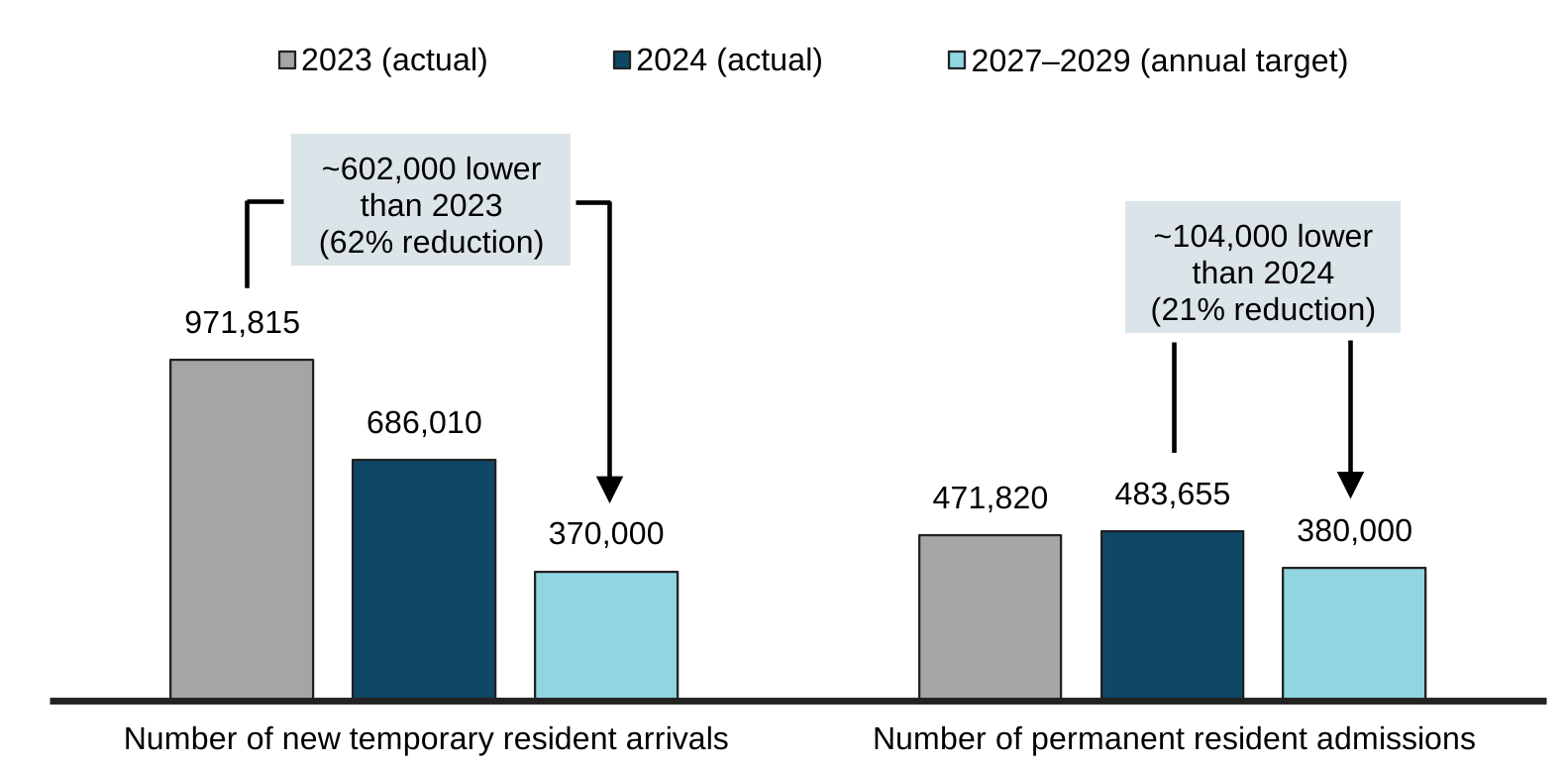
Additional details on the 2027-2029 Immigration Levels Plan will be provided when the Minister of Immigration, Refugees and Citizenship tables the 2026 Annual Report to Parliament on Immigration.
Attracting the talent Canada needs
Canada's economic success has long been supported by a welcoming approach to international talent, helping businesses grow, fuelling entrepreneurship, and bringing new skills and expertise to our economy. A well-managed system for attracting talent helps Canada meet its economic needs while supporting sustainable growth for all.
To help Canadian businesses and industries meet strategic labour market needs, Budget 2025 announced the $1.7 billion International Talent Attraction Strategy and Action Plan. The Action Plan helps businesses access the talent they need while respecting sustainable immigration targets. The Action Plan has helped bring highly skilled workers, researchers, entrepreneurs, and innovators from around the world to Canada, where they are already contributing to economic growth.
Progress includes:
- The appointment of the first 64 Eddie Goldenberg Research Chairs hired under the Canada Global Impact+ Research Talent Initiative. These appointments include world-leading researchers from 13 countries and dozens of Canadians choosing to continue their cutting-edge research at home.
- Providing employers in strategic sectors with expedited access to highly skilled workers through the Temporary Foreign Worker Program's Global Talent Stream, with Labour Market Impact Assessment processing in as few as 10 business days.
- Ongoing efforts to modernise the Express Entry system for economic immigration to better select people with the skills and expertise needed to fill critical gaps and support innovation.
- The development of a new high-impact startup pilot to attract entrepreneurs and innovators with the potential to create jobs and commercialise innovation in Canada.
Budget 2026 will help Canadians manage everyday costs and strengthen pathways to employment and economic opportunity by:
- Funding to support retrofitting one million homes to help Canadian households lower their energy costs, with enhanced support for low- and median-income households, while also supporting retrofits in larger buildings. These investments would also help to reduce greenhouse gas emissions and support employment opportunities in construction, energy efficiency, and skilled trades.
- Creating the conditions to end homelessness in Canada by renewing the Reaching Home Initiative and Veterans Homelessness Program. These investments would primarily benefit low-income Canadians experiencing or at risk of homelessness, including Indigenous people, Black Canadians, 2SLGBTQI+ people, veterans, and persons with disabilities or complex health needs, while helping improve housing stability, health outcomes, and social inclusion.
- Renewing the Local Food Infrastructure Fund to support Canadians most at risk of food insecurity, including Indigenous people, women-led lone-parent households, and those reliant on social assistance. According to Statistics Canada, 24% of Canadians lived in households that reported some form of food insecurity, with higher rates among women-led lone-parent households, those reliant on social assistance, Black and Indigenous people, newcomers, and children.
- Supporting Indigenous participation in major projects and high-demand sectors with the Partnerships for Indigenous Workforce Readiness Fund. Expanding access to skills development, apprenticeships, and Indigenous-led employment delivery would help make these opportunities more accessible, particularly for those who are lower-income, youth, workers with lower education levels, and those in rural or remote communities.
Further information on the expected gender and diversity impacts of Budget 2026 measures across a range of population groups is provided in Annex 4.
| 2026-2027 | 2027- 2028 |
2028- 2029 |
2029- 2030 |
2030- 2031 |
Total | |
|---|---|---|---|---|---|---|
| 3.1 Delivering a boost today | 8,687 | 3,634 | 355 | 377 | 1,061 | 14,113 |
| Providing more help with groceries and everyday essentials | 4,055 | 148 | 151 | 154 | 158 | 4,665 |
| Strengthening support for workers earning low wages | … | 515 | 515 | 515 | 515 | 2,060 |
|
Phasing out of advance payments
|
… | -470 | -871 | -871 | -871 | -3,082 |
| Making the Canada Caregiver Credit refundable | … | 185 | 200 | 220 | 240 | 845 |
| Lowering costs for Canadians at the pump¹ | 2,870 | 0 | 0 | 0 | 0 | 2,870 |
| $2 billion investment, retrofitting 1 million homes to save Canadians $1 billion per year²* | 87 | 210 | 359 | 359 | 324 | 1,339 |
| Securing the future of a Canada-wide early learning and child care system³ | 2,370 | 3,046 | – | – | – | 5,416 |
|
Realignment of existing funding
|
-695 | 0 | 0 | 0 | 695 | 0 |
| 3.2 Providing a bridge to tomorrow | 132 | 3,208 | 4,953 | 4,054 | 4,114 | 16,461 |
| Pillar 1: Putting Canada on a path to end homelessness in 10 years* | … | 2,364 | 3,620 | 2,620 | 2,619 | 11,224 |
| Pillar 2: Expand non-market housing* | … | … | 473 | 495 | 530 | 1,498 |
| Turning federal lands and buildings into homes* | … | 387 | 387 | 387 | 387 | 1,550 |
| Pillar 3: Building a housing market that works for all* | … | 49 | 52 | 151 | 216 | 468 |
| Helping Canadians get an affordable mortgage* | … | 6 | 4 | 4 | 0 | 13 |
| Securing a resilient food supply chain – National Food Security Strategy⁴* | 132 | 360 | 375 | 357 | 361 | 1,585 |
|
Less: Costs to be recovered
|
… | 0* | 0* | 0* | 0* | 0* |
|
Less: Projected revenues
|
… | 0* | 0* | 0* | 0* | 0* |
| Securing a resilient food supply chain – Renewing the Local Food Infrastructure Fund* | … | 41 | 41 | 41 | 0* | 124 |
| 3.3 Supporting a healthy and secure future | … | 1,245 | 65 | – | – | 1,310 |
| Improving access to mental health and home and community care⁵ | … | 1,200 | – | – | – | 1,200 |
| Renewing the Emergency Treatment Fund | … | 40 | 60 | – | – | 100 |
| Improving access to medications | … | 5 | 5 | 0 | 0 | 10 |
| 3.4 Growing our skilled workforce to build Canada Strong | 13 | 347 | 132 | 101 | 129 | 722 |
| Launching Team Canada Strong⁶ | … | 0* | 1 | 2 | 2 | 5 |
| Helping workers build skills for the jobs of tomorrow⁶,⁷ | … | 114 | 113 | 112 | 113 | 452 |
|
Less: Funds sourced from existing departmental resources
|
… | -48 | -48 | -48 | -48 | -192 |
| Helping workers affected by tariffs gain new skills⁶ | … | 170 | 0 | 0 | 0 | 170 |
| Building a more responsive and resilient immigration system | 13 | 228 | 98 | 72 | 100 | 511 |
|
Less: Projected revenues
|
… | -117 | -32 | -38 | -38 | -224 |
| Additional investments – A more affordable life | -195 | -398 | -405 | -410 | -482 | -1,890 |
| Administration of the First Home Savings Account* | … | 20 | 20 | 21 | 0* | 62 |
|
Funding proposed for CRA for continued administration of the First Home Savings Account.
|
||||||
| Asylum processing | 5 | 9 | 37 | 40 | 8 | 98 |
|
Less: Funds sourced from existing departmental resources
|
-35 | 0 | 0 | 0 | 0 | -35 |
|
Funding proposed for the IRB, IRCC and CBSA to reduce asylum inventories and support the effective functioning of Canada's asylum system.
|
||||||
| Enhancing biometrics collection for immigration screening | … | 15 | 15 | 30 | 30 | 90 |
|
Less: Projected revenues
|
… | -6 | -6 | -5 | -5 | -22 |
|
Funding proposed for IRCC to expand screening checks using fingerprints and facial images to more travellers. This would include a new requirement for visa-exempt travellers applying for an electronic Travel Authorization (eTA), an online travel authorisation required before flying to Canada, to submit a facial image remotely to verify their identity and reduce fraud.
|
||||||
| Extending support for the Vaccine Impact Assistance Program | … | 27 | – | – | – | 27 |
|
Less: Funds sourced from existing departmental resources
|
… | -9 | – | – | – | -9 |
|
Funding proposed for PHAC to renew the Vaccine Impact Assistance Program, which provides financial support to people in Canada who have been assessed as having sustained a serious and permanent injury as a result of receiving a HC-authorised vaccine.
|
||||||
| Migrant Worker Support Program | … | 20 | 20 | 20 | 20 | 82 |
|
Funding proposed for ESDC to renew funding for non-profit organisations that help temporary foreign workers understand their rights and get help if they experience abuse, exploitation, or workplace problems.
|
||||||
| Supporting the Autism Framework and Strategy | … | 6 | 6 | – | – | 11 |
|
Less: Funds sourced from existing departmental resources
|
… | -3 | -3 | – | – | -5 |
|
Funding proposed for PHAC to renew funding for AIDE Canada, which provides free autism information and resources for autistic people and their families, and to fund community-led autism projects.
|
||||||
| Projected Employment Insurance premium revenues for measures included in Budget 2026 | -165 | -477 | -496 | -516 | -535 | -2,188 |
|
Includes projected Employment Insurance premium revenues for measures in section 2.3 (Supporting Canadian workers and businesses), in section 3.4 (Launching Team Canada Strong, Helping workers build skills for the jobs of tomorrow, and Helping workers affected by tariffs gain new skills), and in section 6 – Additional investments (Improving technical support for the My Service Canada Account).
|
||||||
| Chapter 3 - Net fiscal impact | 8,637 | 8,037 | 5,099 | 4,121 | 4,822 | 30,715 |
|
Of which, capital investment:
|
135 | 3,115 | 3,762 | 2,878 | 3,009 | 12,899 |
|
1 The extension of the federal fuel excise tax relief on gasoline, diesel, and aviation fuels was announced on September 2, 2026. Note: |
||||||
Page details
- Date modified: