
Annex
3:
Debt management strategy
Introduction
As part of Budget 2025, the Government of Canada released the 2026-27 Debt Management Strategy, which sets out the government's objectives, strategy, and borrowing plans for its domestic debt program and the management of its official international reserves. The Spring Economic Update 2026 provides an update on the strategy.
The Financial Administration Act requires that the Minister of Finance table, in each House of Parliament, a report on the anticipated borrowing to be undertaken in the fiscal year ahead, including the purposes for which the money will be borrowed and the management of the public debt, no later than 30 sitting days after the beginning of the fiscal year. The updated 2026-27 Debt Management Strategy fulfills the legislative requirement set out in the Financial Administration Act.
Objectives
The fundamental objectives of debt management are to raise stable and low-cost funding to meet the financial requirements of the Government of Canada and to maintain a well-functioning market for Government of Canada securities.
The government is committed to managing the debt program in a prudent manner to ensure a balanced debt structure that contributes to maintaining the stability of debt costs and to reducing the risk of the debt portfolio.
Having access to a well-functioning government securities market contributes to lower costs and less volatile pricing for the government, ensuring that funds can be raised efficiently over time to meet the government's financial requirements.
The Debt Management Strategy provides transparency on the government's borrowing plans to support a liquid and well-functioning market for Government of Canada securities and ensures the long-term sustainability of the government's borrowing program.
The government closely monitors financial markets and will adjust issuance if necessary to appropriately respond to shifts in market demand or changes to financial requirements.
Outlook for Government of Canada Debt and Public Debt Charges
As a result of the government's responsible fiscal management, Canada continues to have a desirable fiscal and debt position relative to international peers. Canada continues to have the lowest net debt-to-GDP ratio of G7 countries. And Canada is one of only two AAA-rated G7 countries—with a credit rating of AAA (equivalent) by Moody's, S&P, and DBRS, and AA+ by Fitch. Rating agencies cite Canada's effective and predictable policymaking, stable political institutions, economic resilience and diversity, well-regulated financial markets, and monetary and fiscal policy flexibility as drivers of the strong credit profile.
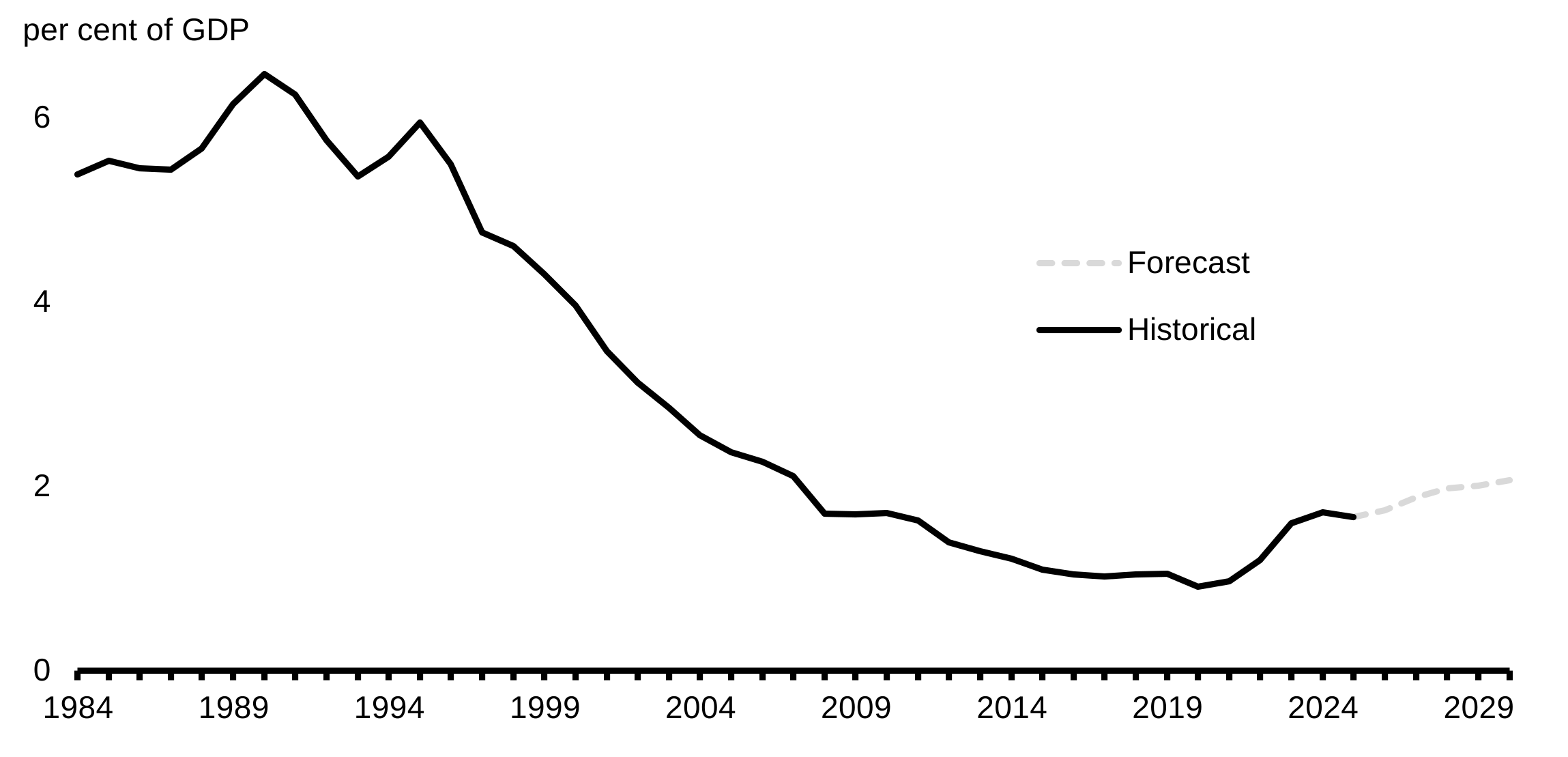
The government continues to monitor public debt charges and is committed to maintaining stable and low debt servicing costs. The government now projects that public debt charges will amount to $58.7 billion in 2026-27, or 1.7 per cent of gross domestic product (GDP), and increase to 2.1 per cent by 2030-31.
Despite the rise of interest rates since 2022, the government's debt charges as a share of GDP remain sustainable, near historical lows, and below the historical average over the past 40 years of 3.2 per cent. Maintaining low debt charges as a percentage of GDP reflects the government's prudent debt management in minimising debt servicing costs over recent years.
Public Debt Charges Since 1984
Update to the 2026-27 Borrowing Program
The projected sources and uses of borrowings for 2026-27 are presented in Table A3.1. Funds borrowed are for the purposes of the government's general revenue, though certain proceeds may be tracked or allocated to specific government expenditures, such as green bonds. The comparison of actual sources and uses of borrowings against projections will be reported in the Debt Management Report for the corresponding fiscal year, which is released soon after the Public Accounts of Canada.
Sources of Borrowings
The preliminary borrowing plan, published in Budget 2025, projected an aggregate principal amount of $594 billion to be borrowed by the government in 2026-27, lower than a forecasted $614 billion in 2025-26.
The updated borrowing plan projects aggregate borrowing of $571 billion in 2026-27, slightly lower than preliminary estimates, reflecting a decrease in projected financial requirements for 2026-27 and somewhat lower refinancing needs (due to lower-than-expected borrowing in 2025-26). The entirety of the change in 2026-27 borrowing needs will be asborbed through lower treasury bill issuance—the bond program will not change from what was projected in Budget 2025. This level of borrowing is consistent with the current legislated limit of $2,541 billion set out in the Borrowing Authority Act.
Table A3.2 outlines the proposed domestic treasury bill and bond issuances by tenor. Actual borrowings for the year may be higher or lower than expected due to economic and fiscal outcomes differing from projections, the timing of cash transactions, and other factors such as changes in foreign reserve needs and Crown corporation borrowings. To adjust for these unexpected changes in financial requirements, debt issuance can be altered during the year, typically first through changes in the issuance of treasury bills. The government may also adjust issuance for bonds in response to larger changes or shifts in market demand.
Uses of Borrowings
Domestic Borrowing
The projected $566 billion of gross domestic issuance in 2026-27 is to meet requirements to refinance $433 billion of maturing debt (seventy-seven per cent of the total borrowings) and projected financial requirements of $133 billion (which includes $30 billion to fund purchases of Canada Mortgage Bonds).
Foreign Borrowing
The government may also borrow an equivalent of $5 billion CAD in foreign currencies, for the purpose of managing its official international reserves as part of its global bond program (more details below).
| Sources of borrowings | 2026-27 |
|---|---|
|
Payable in Canadian currency
|
|
|
Treasury bills1
|
268 |
|
Bonds
|
298 |
|
Total payable in Canadian currency
|
566 |
| Payable in foreign currencies | 5 |
| Total sources of borrowings | 571 |
| Uses of borrowings | |
| Refinancing needs | |
|
Payable in Canadian currency
|
|
|
Treasury bills
|
286 |
|
Bonds
|
147 |
|
Retail debt
|
0 |
|
Total payable in Canadian currency
|
433 |
|
Payable in foreign currencies
|
5 |
| Total refinancing needs | 438 |
| Financial requirement | |
|
Budgetary balance
|
65 |
|
Non-budgetary transactions
|
|
|
Pension and other accounts
|
-10 |
|
Non-financial assets
|
18 |
|
Loans, investments, and advances
|
|
|
Of which:
|
|
|
Loans to enterprise Crown corporations
|
60 |
|
Other
|
8 |
|
Other transactions2
|
-7 |
| Total financial requirement | 133 |
| Total uses of borrowings | 571 |
| Net increase or decrease (-) in cash | 0 |
| Change in other unmatured debt transactions3 | 0 |
|
Source: Department of Finance Canada calculations. Notes: Numbers may not add due to rounding. In the uses of borrowings section, a negative sign denotes a financial source. 1 Treasury bills are rolled over, or refinanced, a number of times during the year. This results in a larger number of new issues per year than the stock outstanding at the end of the fiscal year, which is presented in the table. 2 Other transactions primarily comprise the conversion of accrual transactions to cash inflows and outflows for taxes and other accounts receivable, provincial, and territorial tax collection agreements, amounts payable to taxpayers and other liabilities, and foreign exchange accounts. 3 Includes unamortised discounts on debt issues, accrued interest, obligations related to capital leases and other unmatured debt. |
|
| 2025-26 Estimated |
2026-27 Budget 2025 |
2026-27 Update |
Change from Budget 2025 |
|
|---|---|---|---|---|
| Treasury bills | 286 | 291 | 268 | -23 |
|
2-year
|
120 | 110 | 110 | – |
|
5-year
|
84 | 80 | 80 | – |
|
10-year
|
84 | 80 | 80 | – |
|
30-year
|
24 | 24 | 24 | – |
|
Green bond2
|
5 | 4 | 4 | – |
|
Total bonds
|
317 | 298 | 298 | – |
| Total domestic issuance | 603 | 589 | 566 | -23 |
| Share of long bonds (10-year+) to total bonds | 34% | 35% | 35% | - |
| Share of treasury bills to total issuance | 47% | 49% | 47% | -2% |
|
Sources: Bank of Canada; Department of Finance Canada calculations. Note: Numbers may not add due to rounding. 1 Issuance subject to expenditure availability and market conditions. 2 Green bond issuances may be higher or lower, according to market conditions. |
||||
Composition of Market Debt
The total stock of market debt is projected to reach $1,741 billion by the end of 2026-27 (Table A3.3).
| 2023-24 Actual |
2024-25 Actual |
2025-26 Estimated |
2026-27 Projected |
|
|---|---|---|---|---|
| Domestic bonds | 1,081 | 1,163 | 1,294 | 1,445 |
| Treasury bills | 267 | 285 | 286 | 268 |
| Foreign debt | 22 | 29 | 31 | 28 |
| Total market debt | 1,370 | 1,477 | 1,611 | 1,741 |
Treasury Bill Program
Budget 2025 anticipated a target stock of $291 billion in treasury bills by March 31, 2027. With lower-than-projected bill issuance in 2025-26 and updated 2026-27 financial requirements, the target stock is being revised down moderately to $268 billion. The government considers that the 3-, 6- and 12-month tenors appropriately reflect the market demand for short-term government issuance and will maintain its current bi-weekly auction schedule.
Bond Program
Annual gross bond issuance is projected to be $298 billion in 2026-27, unchanged from the
preliminary projection in Budget 2025. Bond issuance is projected to comprise
53 per cent of total borrowing. Of the bond program, 35 per cent will be in
tenors with maturities of 10 or more years, up slightly from 34 per cent in
2025-26.
Maturity Date Cycles and Benchmark Bond Target Size Ranges
The government will maintain the benchmark target size ranges and number of planned auctions as in the preliminary 2026-27 borrowing plan published in Budget 2025 (see Tables A3.4 and A3.5).
The dates of each auction will continue to be announced through the Quarterly Bond Schedule, which is published on the Bank of Canada's website prior to the start of each quarter.
| Feb. | Mar. | May | June | Aug. | Sept. | Nov. | Dec. | |
|---|---|---|---|---|---|---|---|---|
| 2-year | 26-34 | 26-34 | 26-34 | 26-34 | ||||
| 5-year | 38-46 | 38-46 | ||||||
| 10-year | 38-46 | 38-46 | ||||||
| 30-year | 28-38 | |||||||
|
Source: Department of Finance Canada. |
||||||||
| Sector | Planned Bond Auctions |
|---|---|
| 2-year | 20 |
| 5-year | 16 |
| 10-year | 16 |
| 30-year | 8 |
|
Source: Department of Finance Canada. |
|
Green and Transition Bonds
Following the government's first transaction of 2025-26 in October 2025, a second transaction for the fiscal year was completed in February 2026 via a new 10-year $2 billion issuance. This second issuance saw robust demand from environmentally and socially responsible investors, who represented a majority of buyers, and attracted a mix of both domestic and foreign investors.
Canada's green bond program continues to support the growth of the sustainable finance market in Canada and highlights Canada's investments in climate action and the environment. The government remains committed to regular green bond issuances. As previously announced, the government is exploring the development of a Sustainable Bond Framework—aligned with Made-in-Canada Sustainable Investment Guidelines ("taxonomy") that are being developed—that would allow for the issuance of both green and new transition bonds. The Framework would be expanded to incorporate economic sectors as the taxonomy is being developed.
Borrowing Authority Act
Under the Parliamentary borrowing authority framework enacted on November 23, 2017, Parliamentary authority is granted through the Borrowing Authority Act and Part IV of the Financial Administration Act, which together allow the Minister to borrow money up to a maximum overall amount as approved by Parliament.
On March 27, 2026, Parliament increased the maximum borrowing amount in the Borrowing Authority Act to $2,541 billion, from $2,126 billion. This includes amounts borrowed by agent Crown corporations other than from the Government of Canada, and Canada Mortgage Bonds guaranteed by Canada Mortgage and Housing Corporation (excluding amounts purchased by the Government of Canada). The outstanding borrowings subject to the maximum amount was an estimated $1,921 billion at March 31, 2026, compared to $1,788 billion as at March 31, 2025, and is projected to be $2,073 billion as at March 31, 2027. Final amounts subject to the BAA maximum are published in the annual Public Accounts of Canada.
Canada Mortgage Bonds
As announced in Budget 2025, the Canada Mortgage Bonds (CMB) annual issuance limit for 2026 is $80 billion, up from $60 billion in 2025. This increase in cost-effective mortgage funding for lenders will support the construction of new multi-unit housing across Canada.
As announced in Budget 2025, the government will maintain the pace of its purchases of CMBs at up to $30 billion annually, to allow the private market full access to the additional issuance.
Management of Canada's Official International Reserves
The Exchange Fund Account (EFA), managed by the Minister of Finance on behalf of the Government of Canada, represents the largest component of Canada's official international reserves. It is a portfolio of Canada's liquid foreign exchange reserves and special drawing rights available to aid in the control and protection of the external value of the Canadian dollar and as a source of liquidity to the government, if needed. In addition to the EFA, Canada's official international reserves include Canada's reserve position held at the International Monetary Fund.
The government borrows to invest in liquid reserves, which are maintained at a level at or above 3 per cent of GDP. Foreign currency bond issuance for 2026-27 may be up to an equivalent of $5 billion CAD but may vary depending on market conditions.
Canada's issuance of foreign currency denominated debt is used exclusively to fund official international reserves. Global bonds denominated in US dollars have been issued 12 times since the program re-started in 2009, with the most recent one being in March 2025.
Further information on foreign currency funding and the foreign reserve assets is available in the Report on the Management of Canada's Official International Reserves and in The Fiscal Monitor.
Cash Management and Prudential Liquidity
The core objective of cash management is to ensure that the government always has sufficient cash available to meet its operating and liquidity requirements.
The government holds liquid financial assets in the form of domestic cash deposits and foreign exchange reserves to safeguard its ability to meet payment obligations, including coupon and principal payments, in situations where normal access to funding markets may be disrupted or delayed. The government's overall liquidity levels are managed to normally cover at least one month of projected net cash flows, including coupon payments and debt refinancing needs.
As part of the prudent management of cash balances, the government conducts Receiver General morning auctions to efficiently manage its Canadian-dollar cash balances, ensuring sufficient liquidity for daily operating needs while earning a competitive, market-driven rate of return on excess cash balances.
Aside from cash deployed in the morning Receiver General auctions, the government's cash is on deposit with the Bank of Canada, including operational balances and balances held for prudential liquidity. Periodic updates on the liquidity position are available in The Fiscal Monitor.
The government will continue conducting cash management bond buybacks in 2026-27 to effectively manage the government's cash flows ahead of large bond maturities. Information on these operations is available at Cash Management Bond Buybacks.
Page details
- Date modified: