
Budget in brief

Budget in brief (PDF, 4.1 MB)
Delivering for Canadians: progress since the spring of 2026
Legend
Growth People SovereigntyCanada is ready for this moment
The world has changed. Protectionism, geopolitical competition, and frontier technologies such as artificial intelligence (AI) and quantum computing are reshaping the global economy. The relationships that powered Canada's prosperity for decades can no longer be taken as a given.
Since we were elected, our response has been clear: strengthening our foundations at home, diversifying our partnerships abroad, and making life more affordable for Canadians.
Canada is ready, and Canadians are prepared to seize the moment. Our competitive advantages are among the strongest in the world, ranging from skilled workers and energy and critical minerals to our strong public finances and access to global markets. We have what the world wants and what it takes to chart our own course. That is how we can become masters of our destiny: maîtres chez nous.
Canada acts on its values. We build trust and lead with conviction to shape our future. We are building one Canadian economy, moving nation-building projects forward, buying Canadian, and opening ourselves up to new markets. These investments will create better careers and deliver more of the homes, energy, food, and goods that Canadians need.
These actions are also laying the foundations for Canada's Investment Supercycle—turning today's nation-building investments into a flywheel of new opportunities, private investment, and growth.
At the same time, we are making life more affordable today while tackling the underlying drivers of rising costs by building more homes, helping people transition out of homelessness and into stable housing, strengthening competition, and removing internal barriers within Canada. This is how we give Canadians a boost today and a bridge to tomorrow.
We are also investing in the people, places, and institutions that bring Canadians together to reinforce the foundations of a strong and united Canada.
The results are beginning to show. Private employment, and investment are rising. Exports are diversifying. Major projects are moving forward across the country. New sources of growth are emerging. Canadians are resilient and ready to build.
Canada has a plan. Investment is growing. Now we build.
1. Position of strength
A generational shift is testing every major economy. Canada's response began with a clear-eyed assessment of the challenges before us and confidence in our ability to chart our own future.
The global economic order is experiencing its most consequential transformation in close to a century. The conflict in the Middle East has driven up energy prices. Protectionism is rising. Supply chains are being reorganised around security and sovereignty. Capital is seeking countries that can offer stability, energy and resources, talent, and trusted access to global markets. Uncertainty has become a defining feature of the global economy.
Global Trade Policy Uncertainty Index
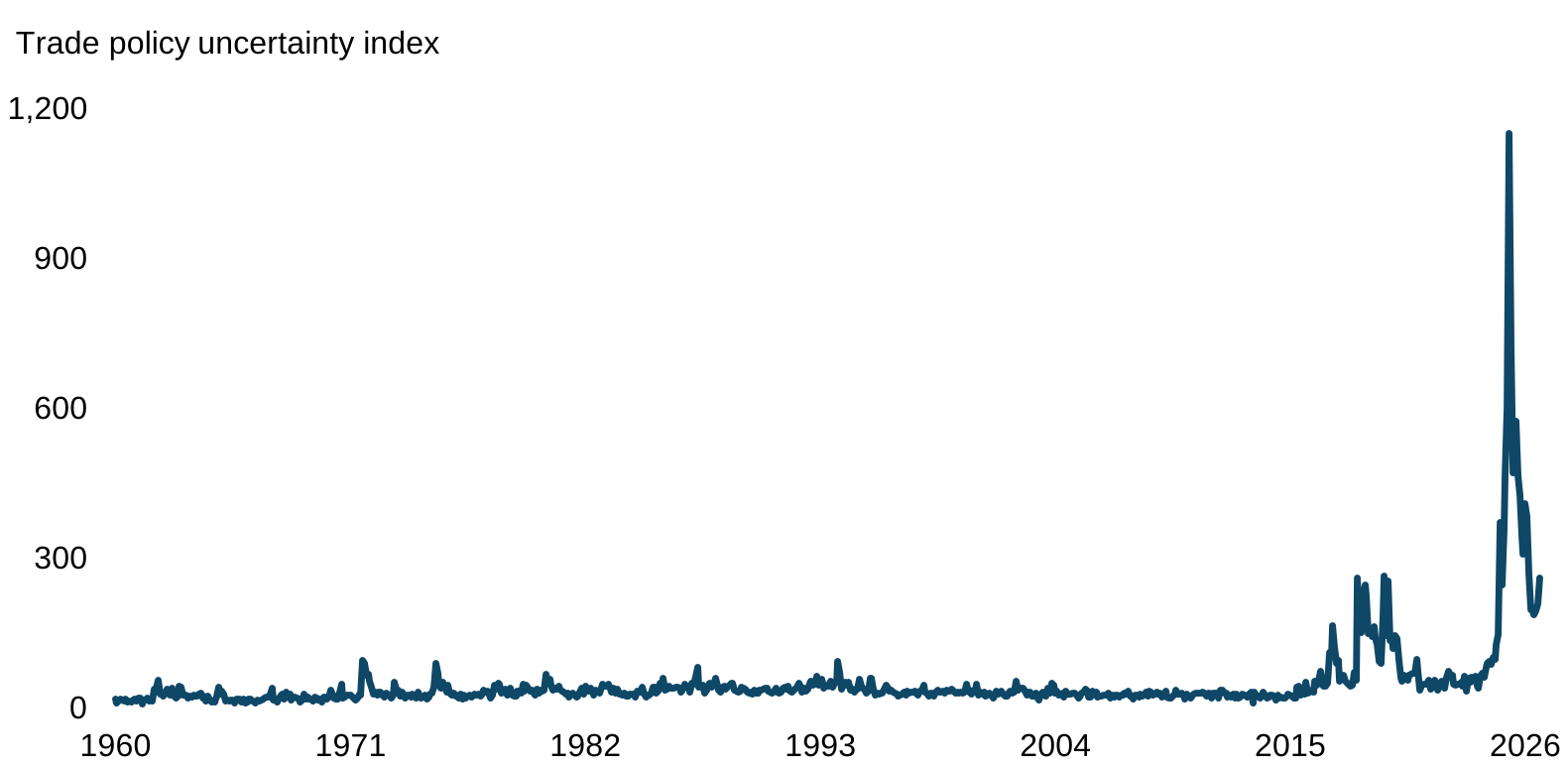
Canada is not immune to this geopolitical realignment, but we are moving decisively to seize the opportunities it creates. We have what the world wants and the foundations to build more for ourselves: clean and conventional energy, critical minerals and fertiliser, a world-class agricultural sector, advanced manufacturing, leadership in AI and quantum, a skilled and educated workforce, sound institutions, and a stable financial system.
Canada's fiscal responsibility has kept Canada strong and created the room to invest more in the workers, industries, and infrastructure that will drive future growth. These advantages give Canada an opportunity not only to navigate a changing world, but also to help shape it. By building more at home, strengthening our economic resilience, and expanding our partnerships abroad, Canada is turning global uncertainty into long-term national opportunity.
Canada has strong fundamentals

Tax competitiveness for new business investment
#1
in the G7

Foreign direct investment inflows per capita
#1
in the G7

Share of working-age adults with a college or university education
#1
in the OCED

AI talent growth
#1
in the G7
Canada is a resource powerhouse

Potash production
#1
worldwide

Uranium production
#2
worldwide

Hydroelectricity production
#3
worldwide

Oil production
#4
worldwide
Canada is building on economic momentum and fiscal strength
Canada is entering this period of transformation from a position of economic resilience and fiscal strength.
Early progress is visible across the economy
Stronger
A more dynamic, productive economy
+214,000
private employment
since last year
6.5%
unemployment rate
near its lowest in two years
+9%
business investment
2026 Q2, annualised, and highest pace of growth in two years
More independent
A more diversified and resilient economy
+56%
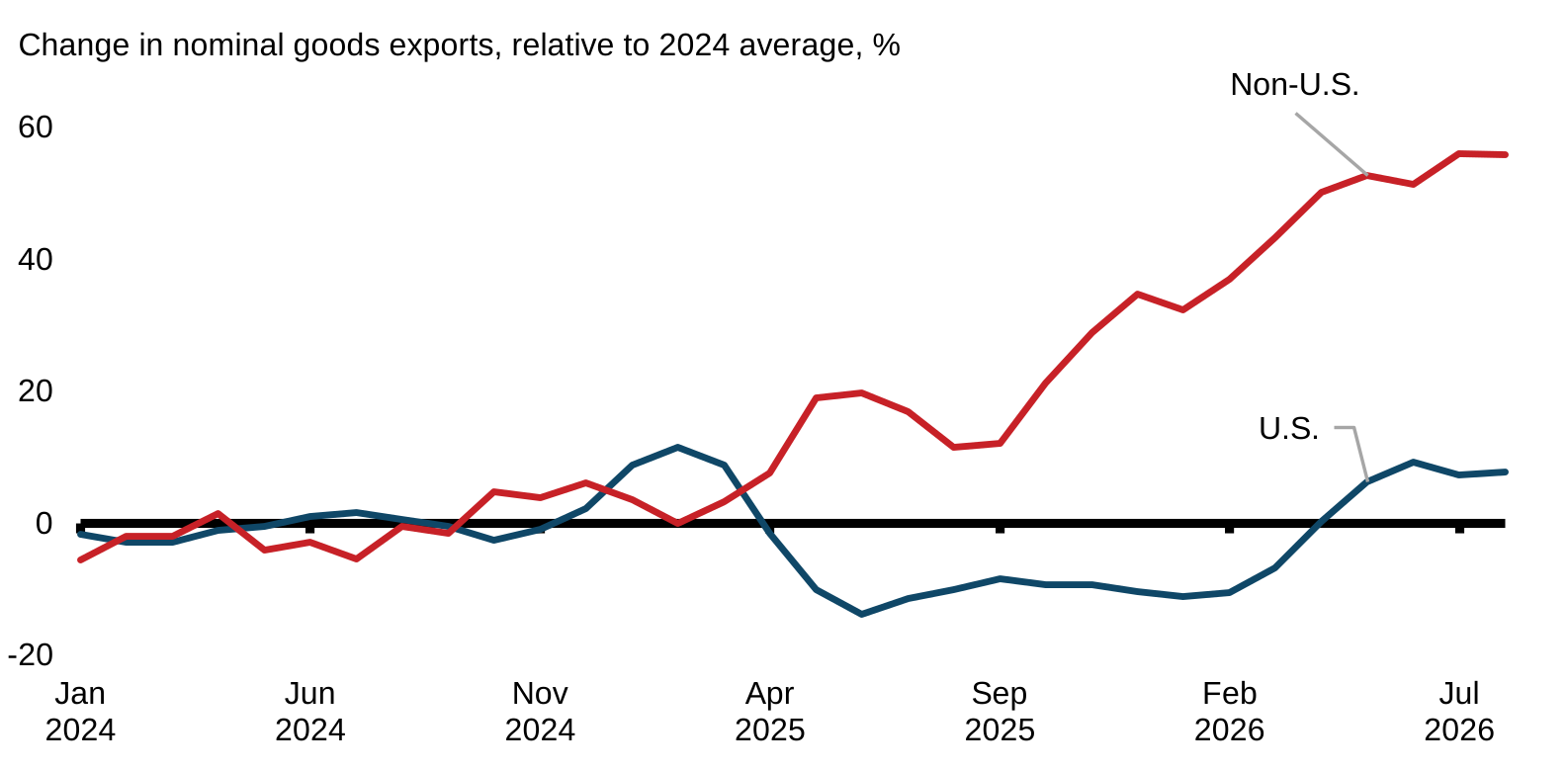
goods exports to non-U.S. markets
August 2026 versus the 2024 average, nominal
On track to secure preferential access to
3 billion
consumers
More affordable
A more affordable, secure future for Canadians
$2,000
annual savings for newly rented housing units from lower market rents
+1%
real disposable income per capita
over the past year
-25%
in homeownership costs
decline since peak
- Canada's economy grew by 3.3% annualised in the second quarter of 2026 driven by higher exports, household spending, and business investment. Recent data suggest the economy remained relatively resilient in the third quarter as well.
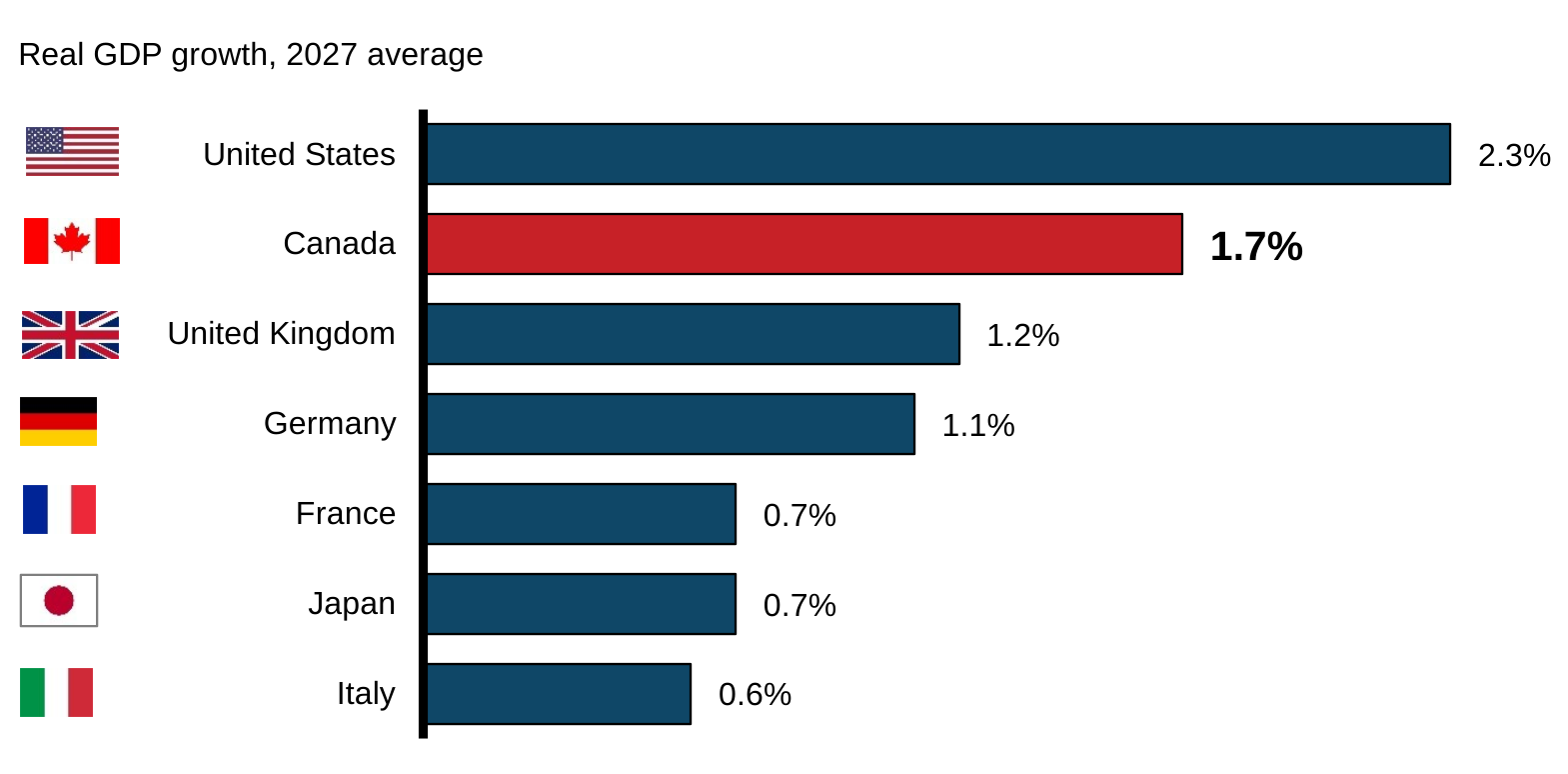
- According to the International Monetary Fund, Canada is projected to grow at the second-fastest pace in the G7 in 2027.
- Canada has added 214,000 private sector and self-employed workers over the past year, while the unemployment rate has fallen to 6.5%—near its lowest level in two years.
- Business capital investment rose 9% annualised in the second quarter, including greater investment in engineering structures, machinery, and equipment.
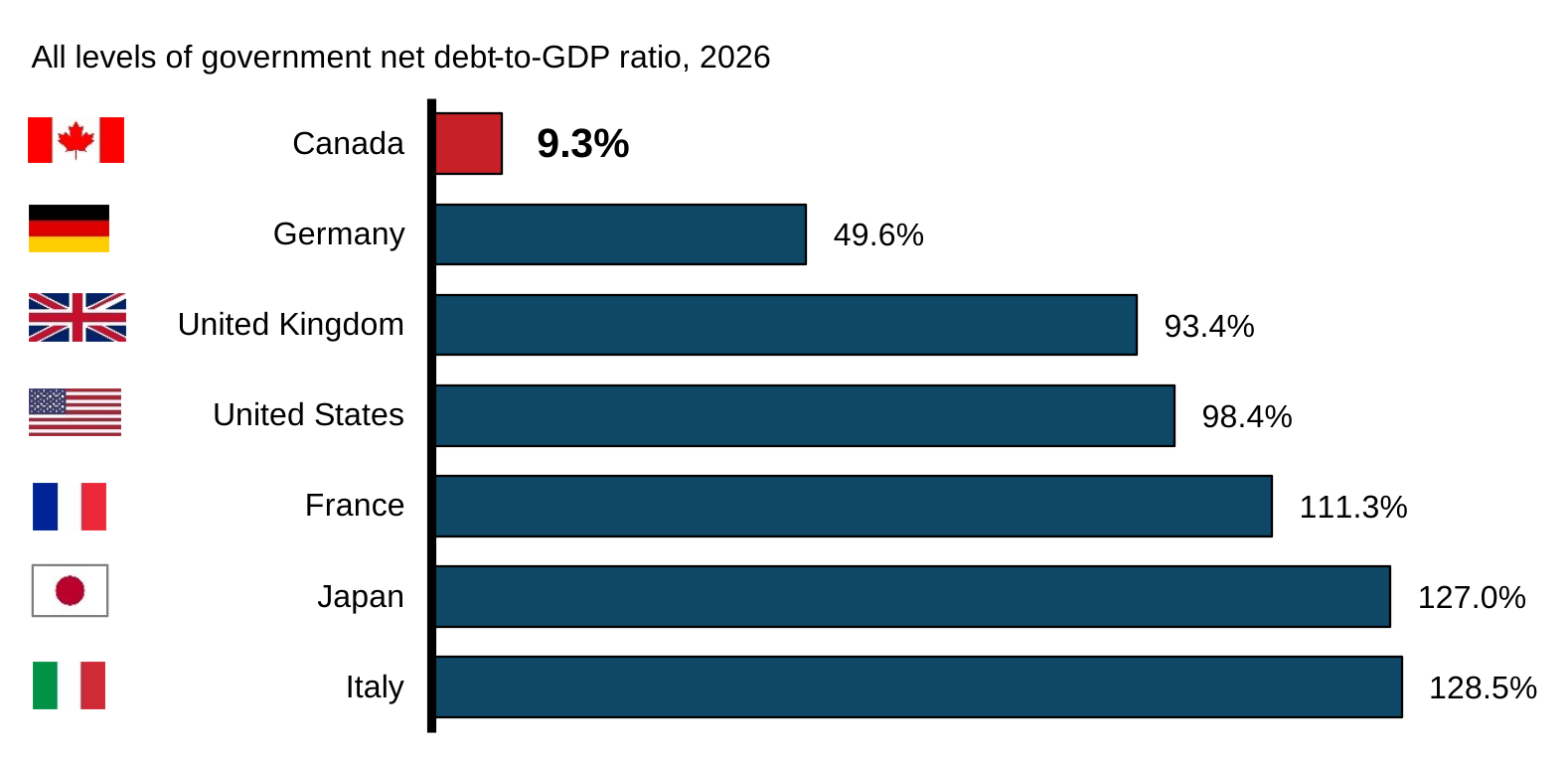
- Canada continues to have the lowest net debt-to-GDP ratio in the G7 and one of the smallest deficit-to-GDP ratios.
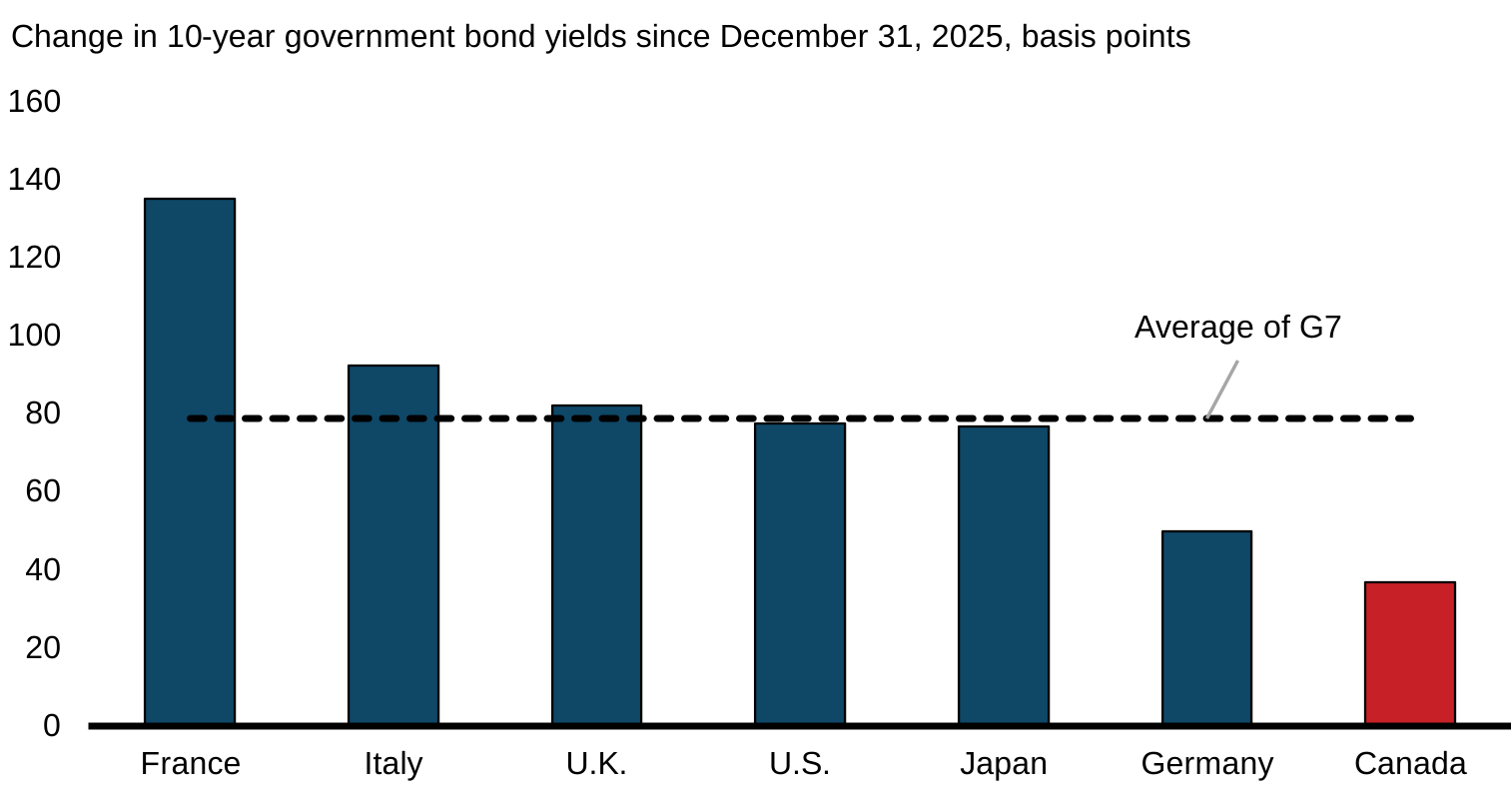
- Canada and Germany are the only G7 economies with AAA ratings from multiple major agencies. Canada also continues to borrow at relatively low rates compared to most G7 peers.
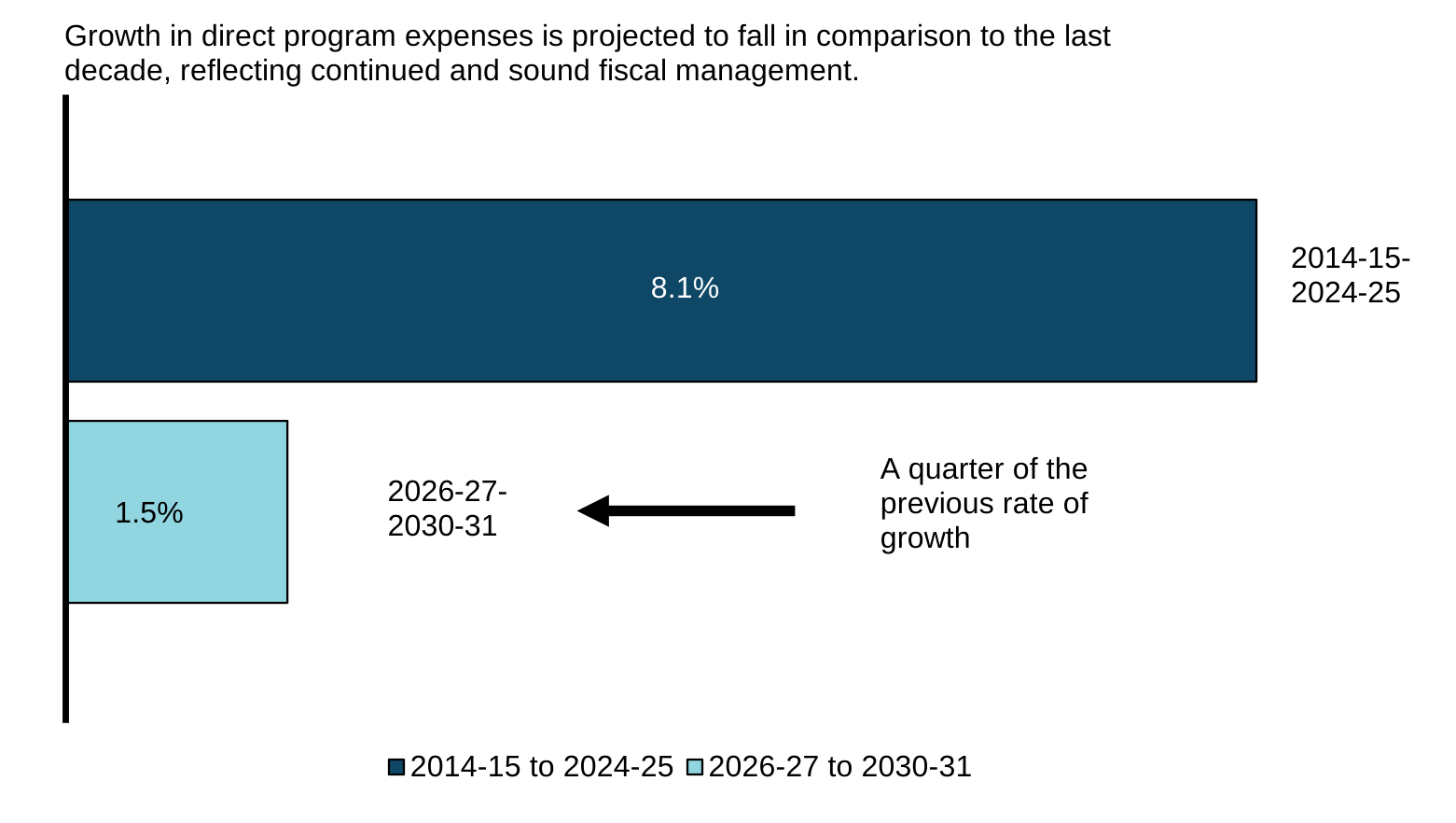
By spending less on day-to-day operations and managing public finances responsibly, we can invest more in Canadian workers and industries while making generational investments in the infrastructure, defence, housing, innovation, and productive capacity needed to expand our economy.
Canada has the lowest net debt-to-GDP ratio in the G7, giving us the fiscal capacity to invest
Canada is projected to grow at the second-fastest pace in the G7 in 2027
Canada maintains a strong fiscal position, with one of the lowest deficit-to-GDP ratios in the G7
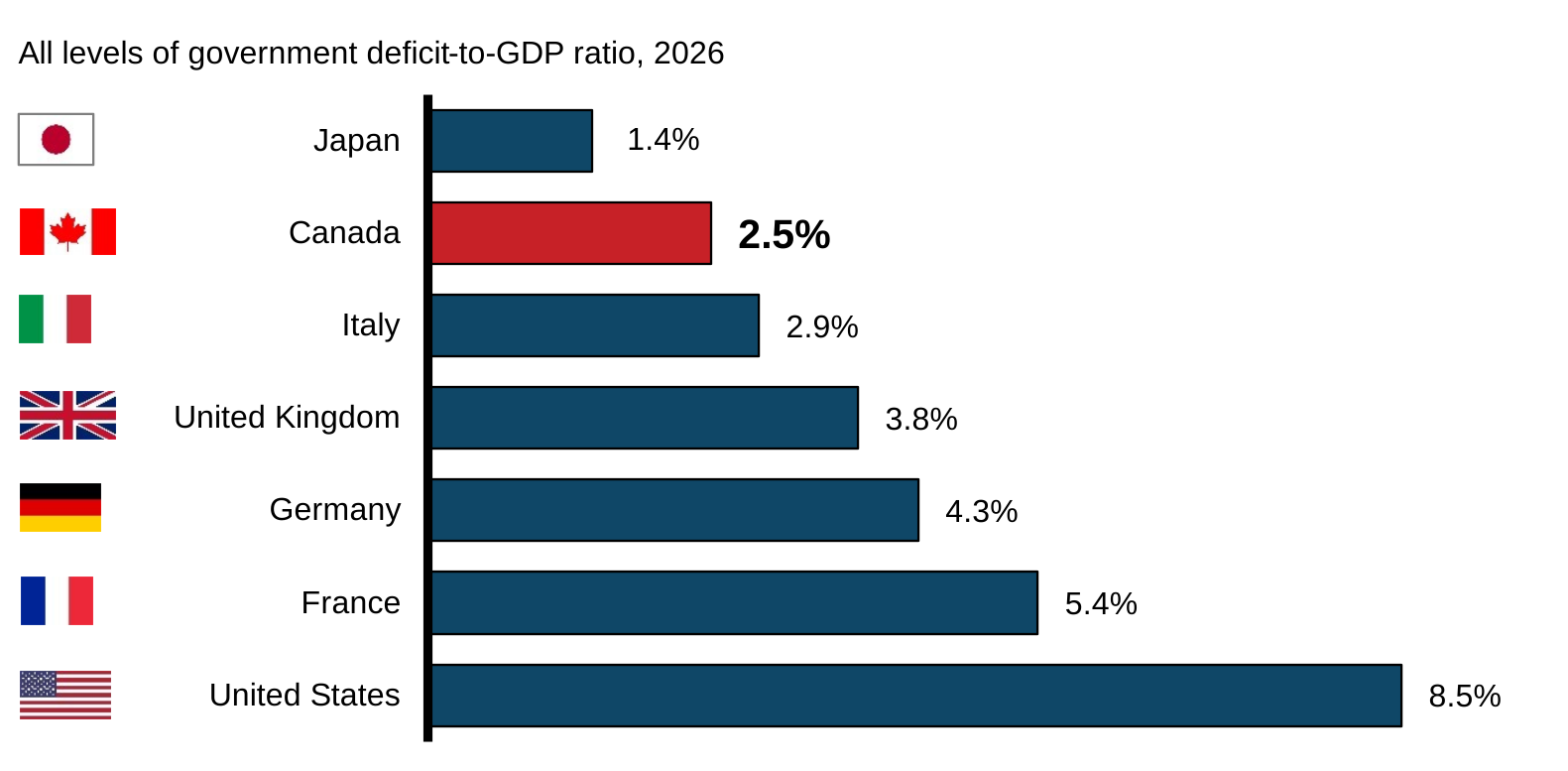
Canada's strong fiscal position is what gives us the room to invest for growth, in our people and in our sovereignty. We have the lowest net debt-to-GDP and one of the lowest deficits-to-GDP. As global pressures on borrowing persist, Canada is in a highly favourable position to make responsible, deliberate choices while preserving our fiscal advantage for the long term.
Canada's long-term government bond yield has seen the smallest increase in the G7, reflecting solid fundamentals
At the same time, Canada's new government recognises that Canadians expect efficient and effective services. By spending less on government operations, Canada can dedicate more resources in Budget 2026 to enhancing growth, making life more affordable, and protecting our culture and way of life.
Putting direct program expenses on a responsible and sustainable track
Canada is using its fiscal strength wisely. Through strategic, targeted investments and broad-based tax policy changes, Canada remains among the leading advanced economies for tax competitiveness. Budget 2026 advances flagship tax policy changes, including the Productivity Mega Deduction and the Canada Growth Incentive, which will further strengthen our tax competitiveness and create the conditions to catalyse an investment supercycle.
Canada ranks first in the G7 for overall tax competitiveness

Canada's deep and diversified public capital markets support capital raising across key sectors, from energy and natural resources to financial services, technology, industrials, and real estate. The Toronto Stock Exchange alone has more than 2,000 listed issuers, providing Canadian businesses with the access to the capital they need to finance investment and growth.
With the Toronto Stock Exchange, Canada has the 3rd largest stock market in the G7, larger than leading European markets
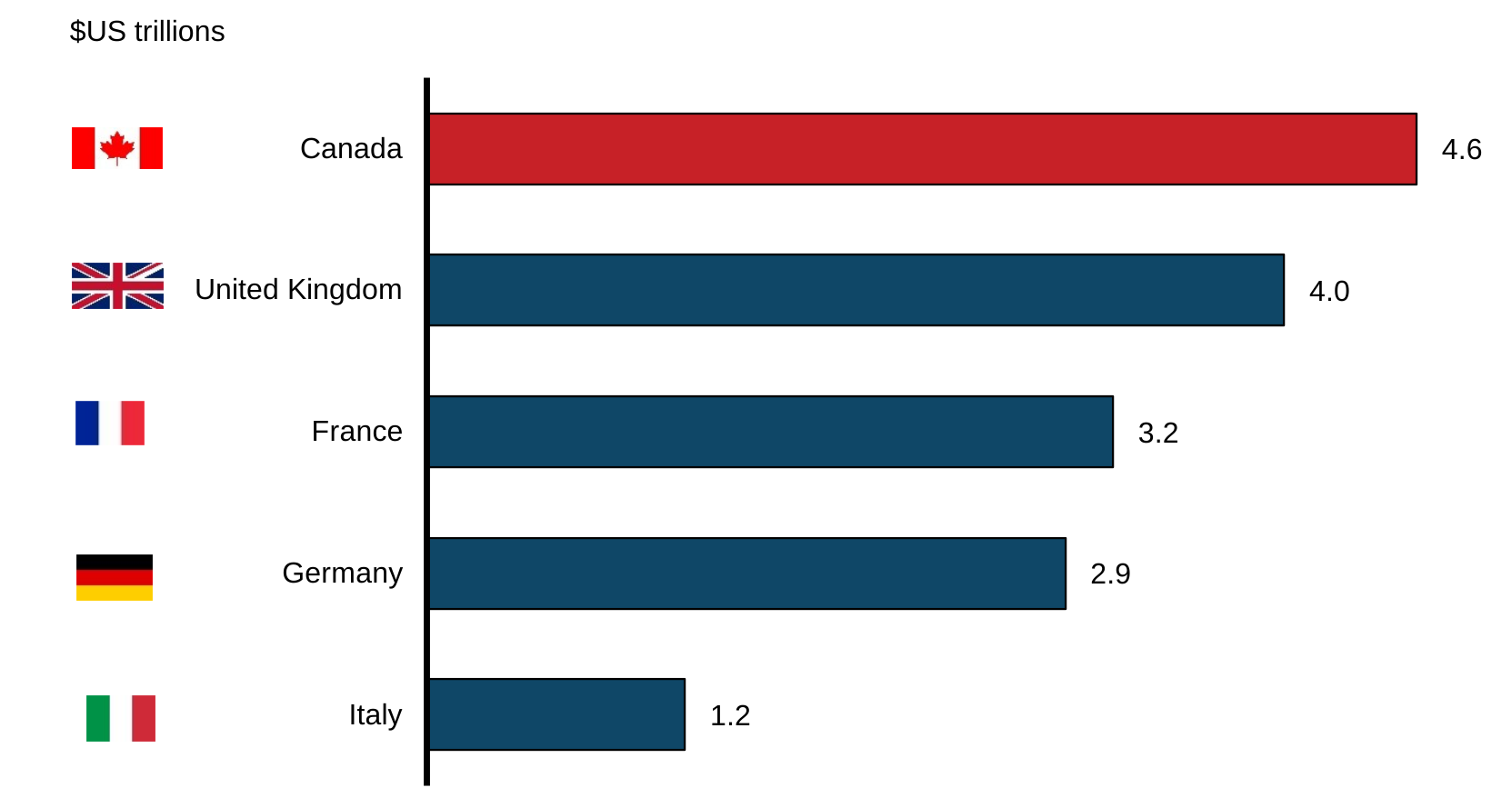
As of September 2026, Canadian mining companies are the world's most valuable, with $488 billion in combined market value. We are building that value through strategic investments, regulatory reform, new tax incentives for business investment, and cooperation with our allies to form stronger, more secure mineral supply chains.
Canada is a global mining powerhouse, with the world's most valuable combined market capitalisation

The strength to build. The discipline to deliver.
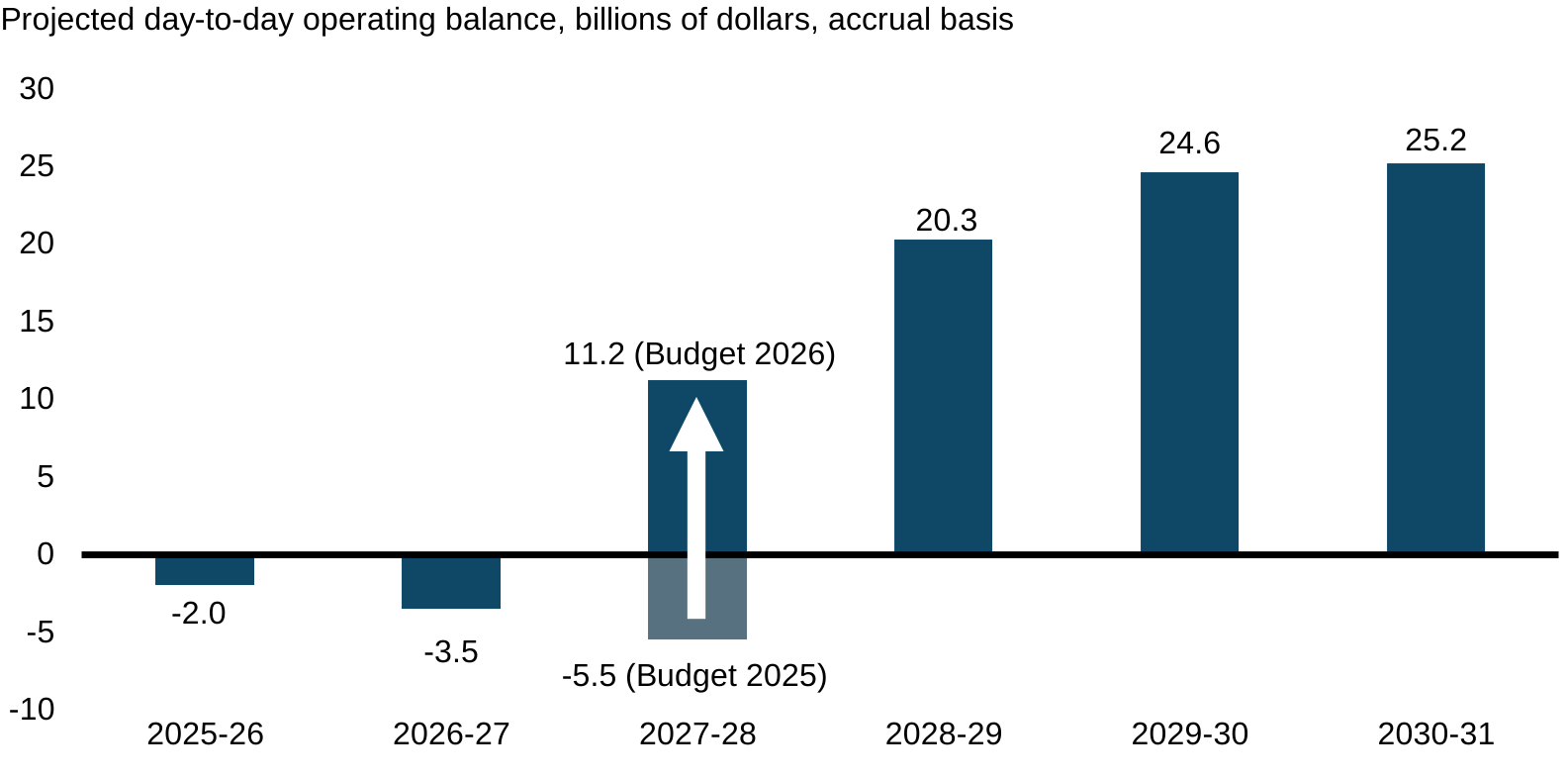
Canada's strong fiscal position gives us the capacity to invest in the future while maintaining the stability and discipline that Canadians expect. Budget 2026 keeps us on track to meet both fiscal anchors: balancing day-to-day operating spending with revenues by 2027-28—a year ahead of schedule—and keeping the deficit-to-GDP ratio on a declining path, while charting a plan to invest for growth. The public service is vital to delivering results but for too long it grew at an unsustainable pace, outstripping growth in the population. We took decisive action to return the public service to a sustainable level and refocus the priority on delivering for Canadians.
Operating spending balanced by revenues a full year ahead of schedule
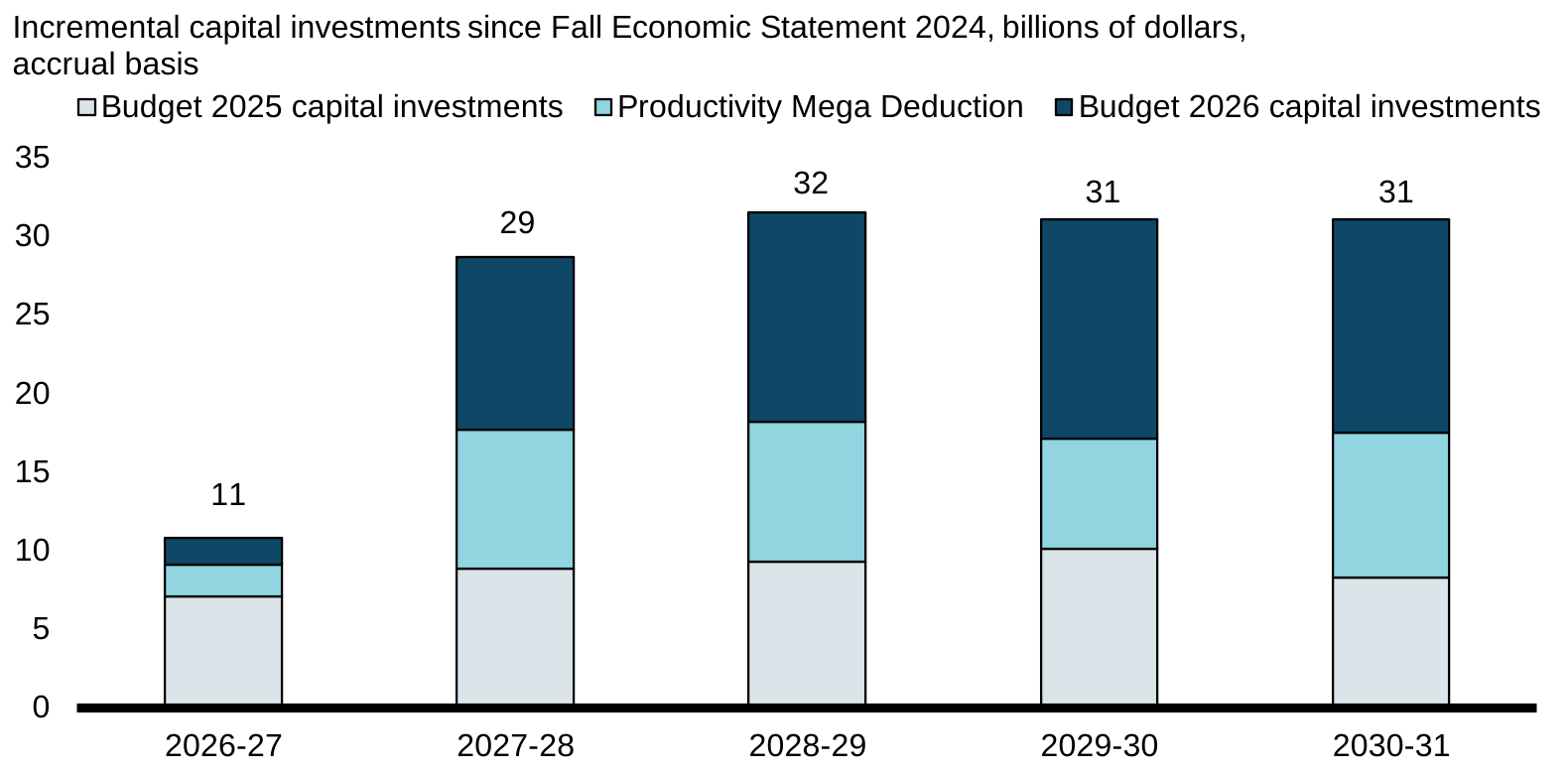
Budget 2026 accelerates capital investment
2. The right plan
We have a plan, and it's working
We have a plan to build a stronger, more affordable, and more independent economy that turns global uncertainty into national opportunity.
Over the past year, we have put in place a series of ambitious strategies spanning electricity, defence, critical minerals, food security, AI, and nature. Together, they are helping Canada seize major opportunities while strengthening our resilience in a more uncertain world.
Each strategy responds to an opportunity for Canada, and they all move the country in the same direction: building at scale and speed at home, saving families money, protecting what matters, creating better careers, and diversifying our partnerships.
The early results are clear. Investment is growing. Major projects are advancing. New trade and investment agreements are opening markets abroad. More Canadians are finding rewarding, well-paying careers in the industries that will drive growth in the decades ahead. That is how we make ourselves masters of our destiny.
Energy security. Food security. Economic security. National security. All inextricably interlinked.
We are investing over $140 billion to strengthen the foundations for a secure and resilient Canada.
Investing over $140B in strategies to build Canada Strong and protect what matters most
National Electricity Strategy
Over $50B*
Supporting the electric utilities sector that employs 108,000 Canadians
Powering Canada Strong by:
- Doubling Canada's electricity supply by 2050.
- Reducing emissions and accelerating electrification and competitiveness.
Between 2028 and 2050, an additional 60,000 jobs could be added to the sector.

Text version
For average Canadians costs go down, with electrcity taking up a bigger share.
| Energy wallet now | Energy wallet in 2050 | |
|---|---|---|
| Fuel for vehicle | 52% | 10% |
| Fuel for water/space heating | 30% | 0% |
| Electricity | 18% | 90% |
Conceptual depiction of changes to the "energy wallet" of a typical Canadian household, adapted from 2024 Canada Electricity Advisory Council: Final report.
Nuclear Strategy
$6.5B
Doubling the size of Canada's nuclear workforce
90,000 to 180,000 jobs
Developing Canada's nuclear advantage by:
- Accelerating nation-building projects, strengthening strategic value chains, and expanding high-value innovation.
- Positioning nuclear as a cornerstone of Canada's clean energy future.
- Reinvesting in Canada's nuclear R&D capacity and regulatory readiness.
- Providing strategic financing for domestic and export projects.
The nuclear sector supports 90,000 direct and indirect jobs, which the Strategy aims to double.
Critical Minerals Strategy
$2.3B*
Supporting a sector that employs 110,000 Canadians
This new funding builds on Canada's $5 billion Critical Minerals Strategy.
Becoming a critical minerals powerhouse by:
- Promoting domestic production and processing of critical minerals and safeguarding critical minerals value chains.
- Supporting the critical minerals sector, which directly and indirectly contributed $33 billion to Canada's GDP and 110,000 jobs in 2024.
Trade Diversification and Infrastructure Strategies
$6.6B
2.2 million jobs in Canada's export sectors
Diversifying Canada's export sectors, which directly support 2.2 million jobs, by:
- Doubling non-U.S. exports by the end of 2035.
- Expanding and deepening trade ties with different countries.
Investments in trade-enabling infrastructure are expected to increase GDP by up to $21 billion over time and create an average of 4,800 jobs per year during construction.
Forest Sector Transformation Strategy
$6.5B*
Supporting a sector that employs 200,000 Canadians
This new funding builds on $2.9B in support announced since August 2025.
Strengthen the competitiveness of the forest sector by:
- Increasing fibre supply and reducing costs through innovative forest management and technology adoption.
- Modernising forest product facilities.
- Supporting the production of higher-value products.
- Expanding market opportunities and attracting investment.
Automotive Strategy
$9B
Supporting 125,000+ jobs
Transforming Canada's automotive industry, which directly employs more than 125,000 workers, by:
- Helping it adapt, grow, and diversify to new markets, including by promoting electric vehicle (EV) production.
- Supporting consumer adoption through EV incentives and infrastructure development.
- Supporting the installation of EV chargers in areas where the infrastructure is needed most.
Building the Homes Canada Needs
$44.7B*
Supporting 42,000 jobs through the Build Communities Strong Fund
Building a housing system that works for Canadians by:
- Putting Canada on a path to end homelessness.
- Boosting capital in Build Canada Homes to supercharge housing construction and close the affordable housing supply gap.
- Improving the efficiency of the homebuilding sector, including through support to firms, modernising housing data, and establishing common standards for modern construction methods.
Additionally, we are investing in housing-enabling infrastructure through the Build Communities Strong Fund, which is expected to support 42,000 jobs per year on average over the next 10 years.
National Food Security Strategy
$3.2B
Strengthening Canadian food security by:
- Building a more resilient and affordable food system for all Canadians.
- Creating markets for more independent grocery stores.
- Increasing the annual GDP growth of the
food processing industry from
1.6% to 2.75%
from 2027 to 2035.
Nature Strategy
$3.7B
Delivering on Canada's commitment to conserve 30% of lands and waters by 2030 by:
- Working with partners to conserve terrestrial and marine areas, such as marine protected areas and national parks.
- Protecting and recovering species at risk across Canada.
- Protecting, conserving, and restoring wild Pacific salmon in British Columbia and the Yukon.
Canada is also developing a national ocean strategy to protect our oceans, secure our waters, and sustainably build our ocean economy.
Defence Industrial Strategy
$7.7B
More than doubling the size of Canada's defence sector workforce
38,000 to 89,000 jobs
Transforming Canada's defence industry by:
- Prioritising Canadian suppliers and materials.
- Investing in Canadian innovation and commercialisation.
- Providing predictable demand to supply chains across the country.
Increasing the share of defence acquisitions awarded to Canadian firms to 70%.
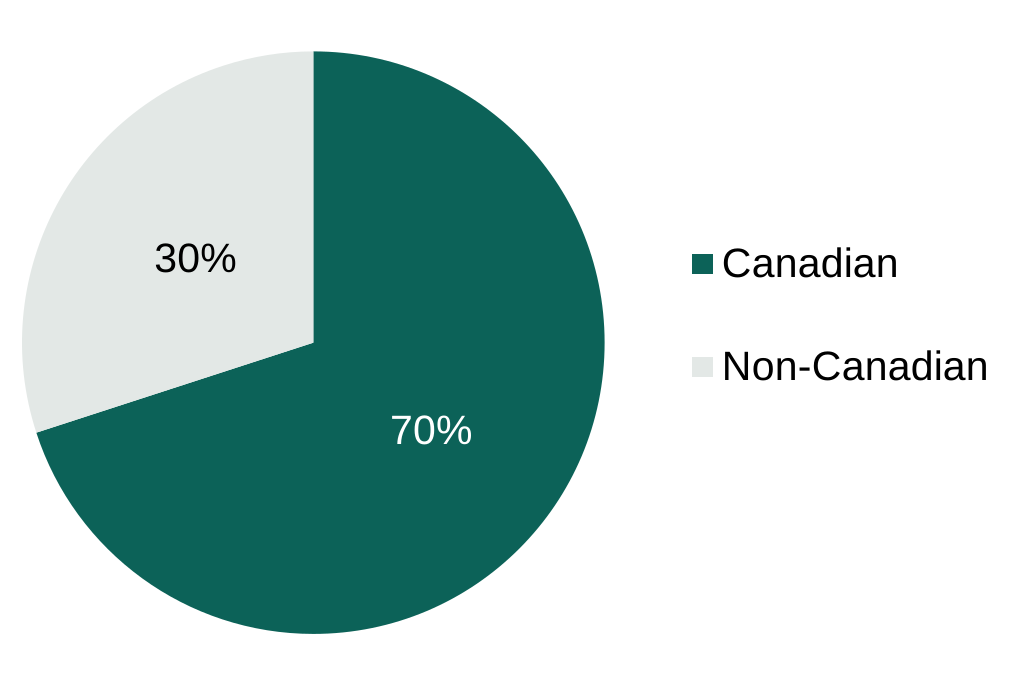
Text version
| Canadian | Non-Canadian |
|---|---|
| 70% | 30% |
National Anti-Fraud Strategy
Introducing a Multi-Sector Anti-Fraud Framework by:
- Establishing fraud-focused protections across the financial and telecommunications sectors and digital platforms.
- Requiring organisations to prevent, detect, disrupt, and respond to fraud.
The government is consulting on the structure of the Framework, including scope and extent of obligations.
AI Strategy and investments in quantum
$2.7B
Creating 90,000 work placements in AI
- Strengthening Canadian AI sovereignty in computing, data, talent, and infrastructure.
- Unlocking an additional $200 billion in economic activity and providing up to 90,000 AI-related jobs and work placement opportunities for young Canadians over the next five years.
- Investing in strategic projects, such as at Xanadu Quantum Technologies and Cohere, to build Canada's competitiveness in quantum and AI.
Note: Funding amounts are presented on a cash basis.
Building our strength at home
Canada's first market must be Canada itself. Yet internal barriers still make it harder for workers, businesses, goods, services, and capital to move across provincial and territorial lines—limiting competition, productivity, and the ability of Canadian firms to scale.
We are changing that. We have removed federal barriers to internal trade, while provinces and territories are advancing agreements on mutual recognition, labour mobility, and direct-to-consumer alcohol sales. Ontario's commitment to join Canada's national securities regulatory passport system is another important step toward a more integrated capital market. Together, these actions are helping turn 13 fragmented markets into one strong Canadian economy.
Creating One Canadian Economy

Eliminating internal trade barriers could increase Canada's GDP by up to 7%—or about $210 billion over the long term—according to the International Monetary Fund. A unified market gives Canadian businesses the scale and capital to grow, helps workers build careers anywhere in the country, and strengthens our ability to compete globally.
Through the Buy Canadian Policy and joint procurement, we are leveraging approximately $37 billion in annual federal procurement to support Canadian suppliers, strengthen domestic supply chains, and help Canadian businesses grow and compete. As of October 2, 2026, 40 contracts have been awarded under the policy, with an estimated procurement value of $1.65 billion. By making Canada its own best customer, we are creating more opportunities for Canadian businesses and workers while building the domestic capacity needed to compete and win abroad.
Investing in workers and skills
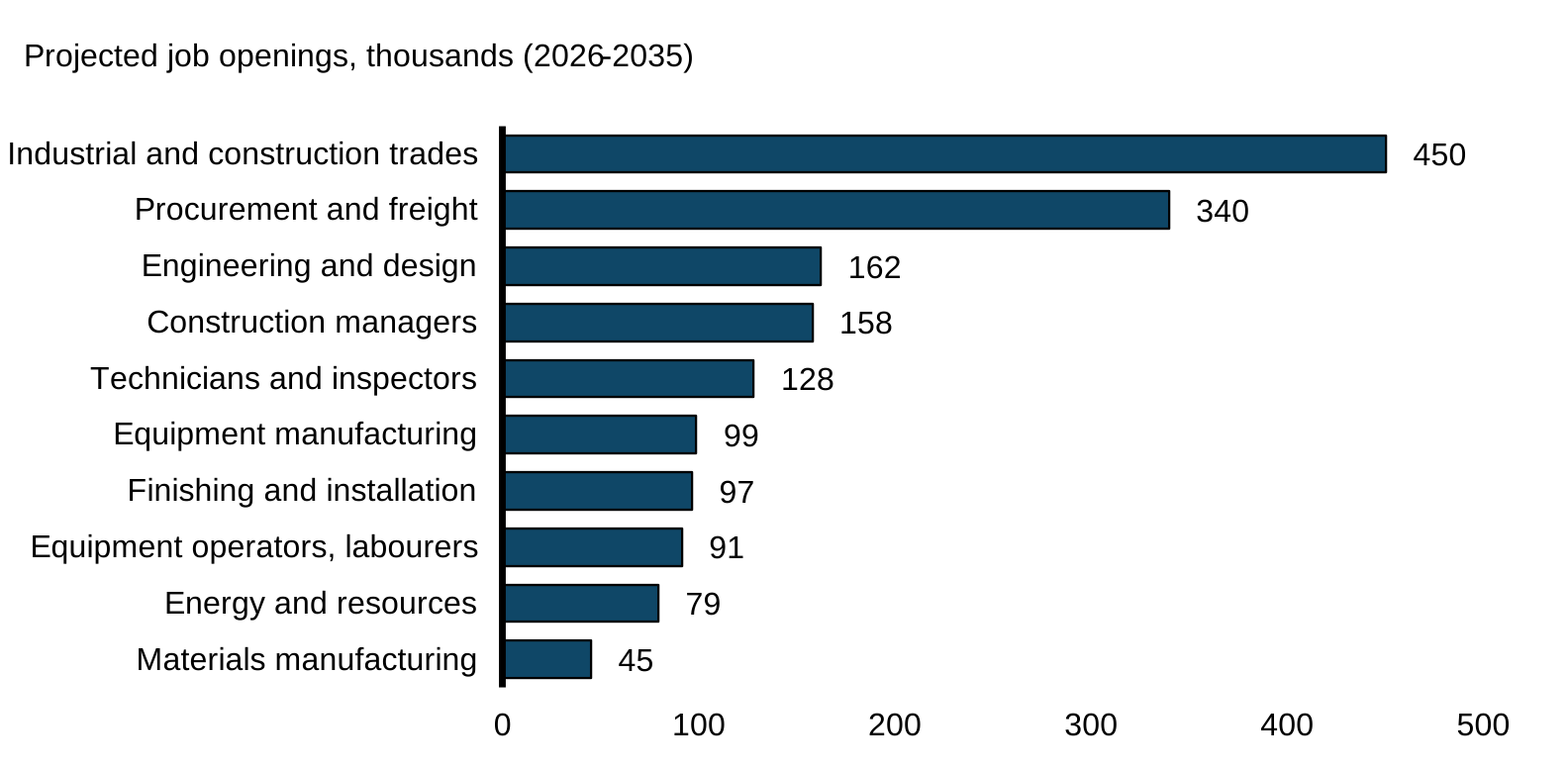
Canada needs skilled workers to build the homes, infrastructure, and energy projects that will drive growth. Team Canada Strong will recruit, train, and hire up to 100,000 Red Seal workers, while six new Workforce Alliances will bring industry and workers together to address skills needs.
We have also introduced $3.5 billion in rapid-response supports for workers and employers affected by trade disruptions.
Young Canadians are also gaining opportunities to work and build careers, with 175,000 work and skills development opportunities in 2026-27 through Canada Summer Jobs, the horizontal Youth Employment and Skills Strategy, and the Student Work Placement Program.
Budget 2026 will build on this work through a Partnerships for Indigenous Workforce Readiness Fund to support Indigenous employment and skills development.
Together, these measures help ensure that all Canadians have a chance to acquire new skills, find rewarding careers, and help keep our economy strong and growing.
Canada will need over a million skilled workers to build the projects of the future
Diversifying our partnerships abroad
When businesses invest in Canada, they have immediate access to a diverse and resilient trade network, with preferential access to global markets that continues to grow and expand. Around the world, Canada is trusted. We are leveraging this to build a more diversified and resilient trade network with reliable partners.
Canada is the only G7 country with free trade agreements with every other G7 member. Through 15 agreements in force covering 51 countries, Canadian businesses already have preferential access to 1.5 billion consumers and economies representing roughly two thirds of global GDP. We are now working to double that reach to 3 billion consumers through new trade and economic agreements currently under negotiation.
Canada's trade network will soon reach 3 billion consumers and cover markets representing nearly three quarters of global GDP

Exports to non-U.S. markets are up more than 50% since 2024
3. Canada's Investment Supercycle has already started
Canada is entering a new era of investment. Public investment, private capital, major projects, and new market opportunities are coming together to expand what Canada can build and produce for decades to come.
This is at the heart of Canada's Investment Supercycle: a continuously evolving cycle in which each investment strengthens the conditions for the next. A competitive tax system improves returns and attracts capital. New infrastructure opens markets. A more competitive and clean economy builds predictable conditions for investors. Energy projects support new industries. And major projects create demand for Canadian workers, suppliers, and communities.
Long-term investment supercycle

Canada has the resources, talent, energy, stability, and market access to compete at scale—and to ensure that the benefits stay here, in Canadian communities. Together, these advantages can turn investment into higher productivity, better careers, rising incomes, and a more affordable life for Canadians.
Our focus now is to turn nearly $500 billion in investment commitments into projects, jobs, and growth. That means more homes, modernised infrastructure, twice the electricity capacity, new critical mineral projects, defence investments that build new industries, and deeper connections to global markets. It also means helping businesses of all sizes invest in technology, automation, robotics, and AI to boost productivity and better compete globally.
Canada ranks 2nd out of 25 countries in foreign direct investment attractiveness
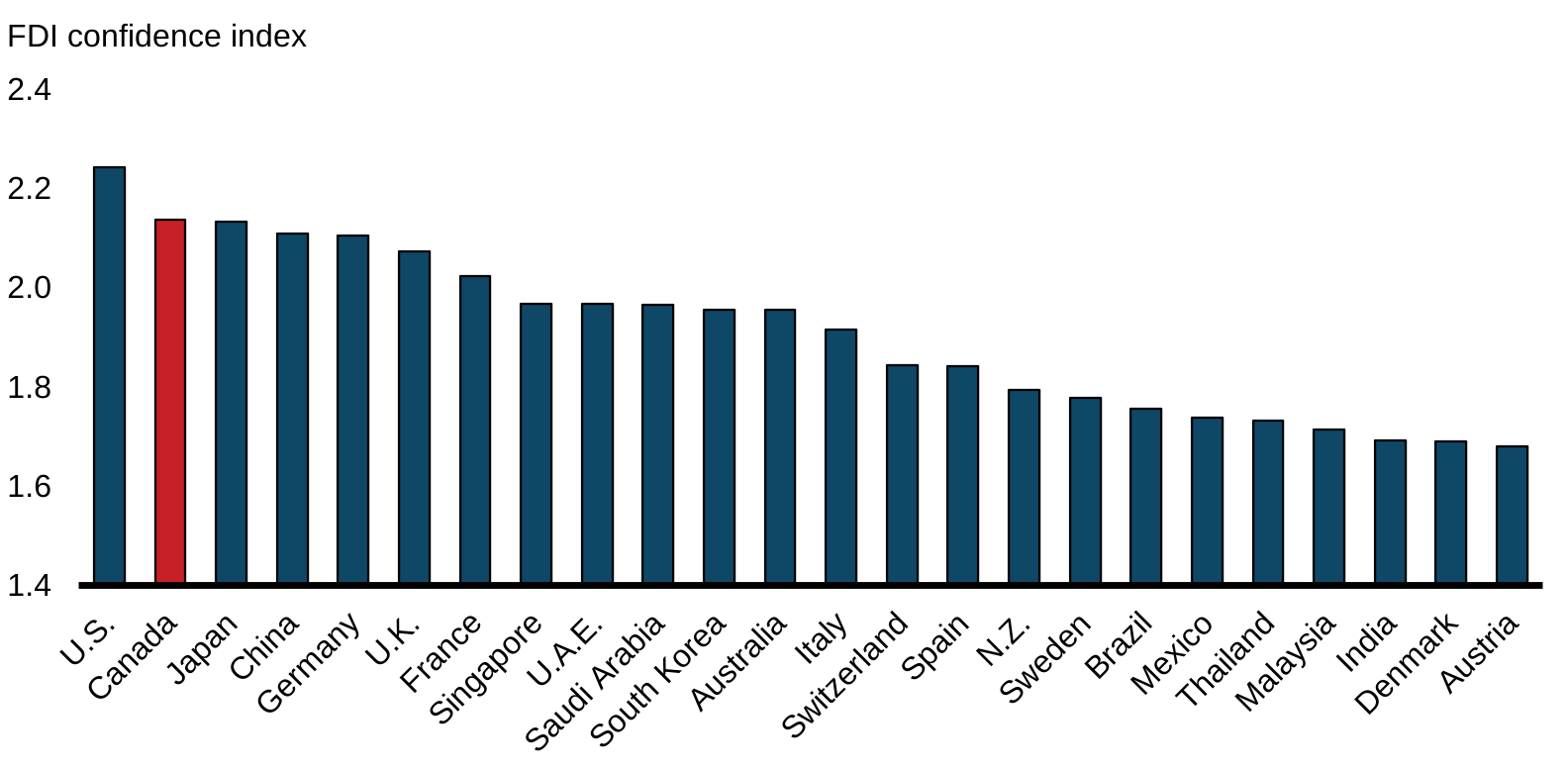
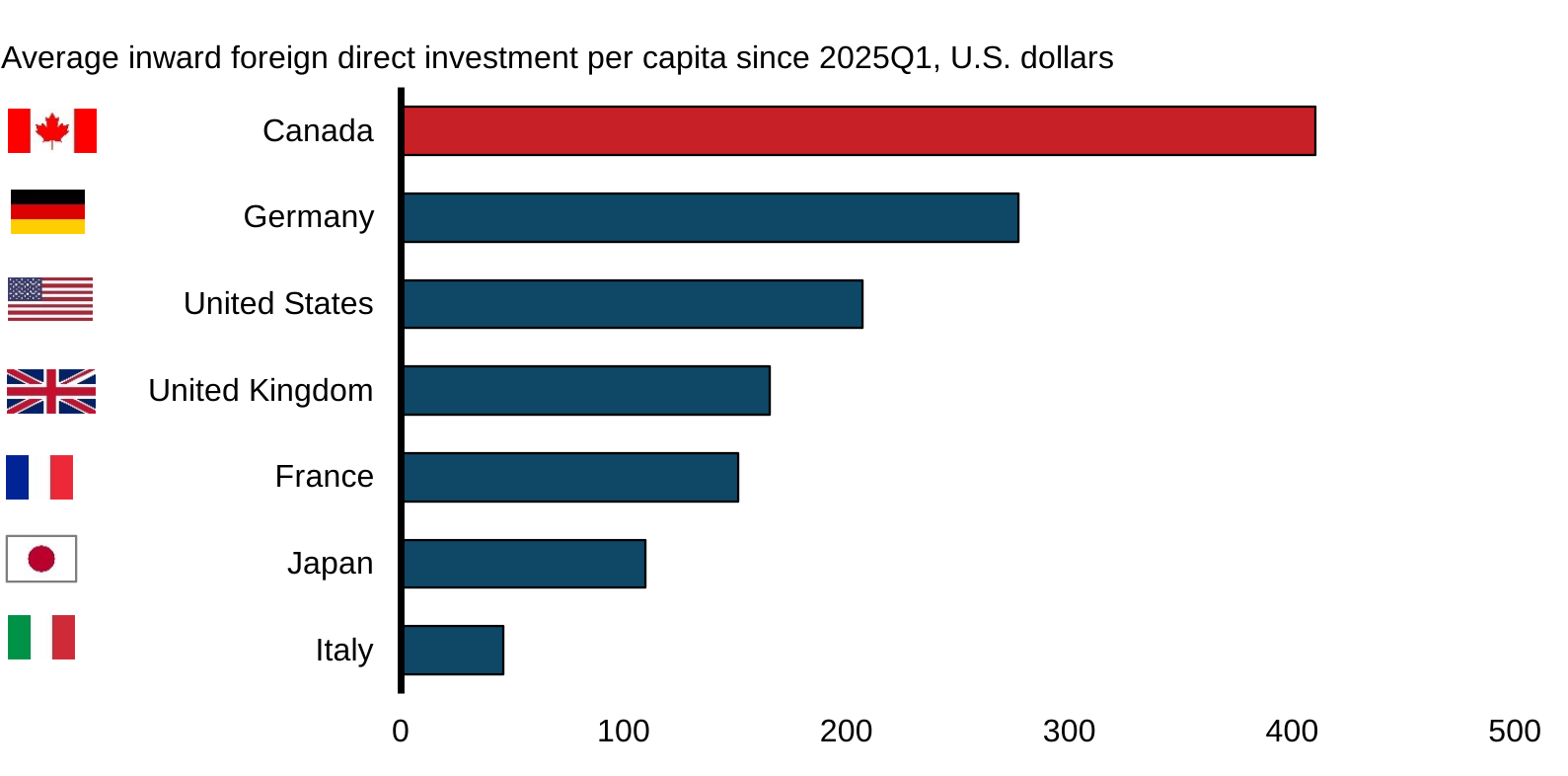
Foreign direct investment in Canada is at its highest level in nearly two decades. Canada attracted $98 billion in foreign investment in 2025 and has led the G7 in direct investment inflows per capita since early 2025, and has been ranked as the most attractive country in the world for infrastructure investment.
Investors are increasingly choosing Canada because it has what the world needs: resources, talent, market access, and policy certainty, particularly in Canada's key sectors. A competitive tax system, investment tax credits, faster project pathways, expanding market access, fiscal discipline, and stable, predictable institutions are helping attract the long-term capital needed to build the industries of the future.
Investors are increasingly choosing Canada, driving the highest inward FDI per capita in the G7
Canada Investment Summit
Canada hosted its first-ever investment summit in Toronto in September 2026, bringing together approximately 200 of the world's leading investors, along with federal ministers, senior officials, provincial representatives, and Indigenous leaders, to showcase investment opportunities across energy and critical minerals, AI, defence, and infrastructure. The Summit was a landmark event confirming Canada's position as a destination of choice for global capital and long-term investment.
It helped secure nearly $500 billion in new investment commitments and financing for businesses in Canada. Participants from nearly 30 countries, representing more than $100 trillion in assets under management, announced major commitments across strategic sectors, including infrastructure, energy, digital technologies, critical minerals, and advanced manufacturing. These commitments will help advance nation-building projects, strengthen Canada's competitiveness, and mobilise private capital at an unprecedented scale.
The Summit also featured major announcements that underscore growing investor confidence in Canada as a destination for large-scale investment. These projects span emerging technologies, energy, and strategic infrastructure, and will support economic growth, strengthen Canada's competitive advantages, and create high-quality jobs across the country.
Turning commitments into investments
Nearly $500B in announced commitments and new investment incentives

The Productivity Mega Deduction: kickstarting Canada's Investment Supercycle
The new Productivity Mega Deduction will make it significantly less expensive for businesses to invest, expand, and become more productive in Canada. Three takeaways:
- Businesses of all sizes can now deduct the full cost of a new investment immediately. Under the Productivity Mega Deduction, eligible investments acquired on or after September 15, 2026, can be deducted right away. This lowers the upfront cost of investing and gives businesses of every size a stronger incentive to purchase equipment, adopt technology, expand operations, and create jobs.
- It covers far more of the investments businesses make every day. About two thirds of capital assets will qualify for immediate expensing, compared with approximately 15% previously. That means businesses of every size can benefit—from a local business purchasing new kitchen equipment, tools, office technology, or farm machinery to a growing company investing in manufacturing and mining equipment, pipelines, construction vehicles, software, research and development, fibre-optic cables, or rail track. Limited exclusions apply for certain assets that are long-lived, subject to regulated rates, or have a significant personal use component. The Canadian approach to immediate expensing is competitive for investors compared with the United States, more than that of other G7 countries.
- The measure is permanent. Businesses making major investments need to plan years ahead. Permanent immediate expensing gives them the long-term certainty needed to make those decisions and mobilise capital.
Over a 10-year horizon, the Productivity Mega Deduction could increase Canada's productive capacity, raising GDP by approximately $22 billion annually, with long-term job creation reaching up to an estimated 80,000 jobs after 10 years.
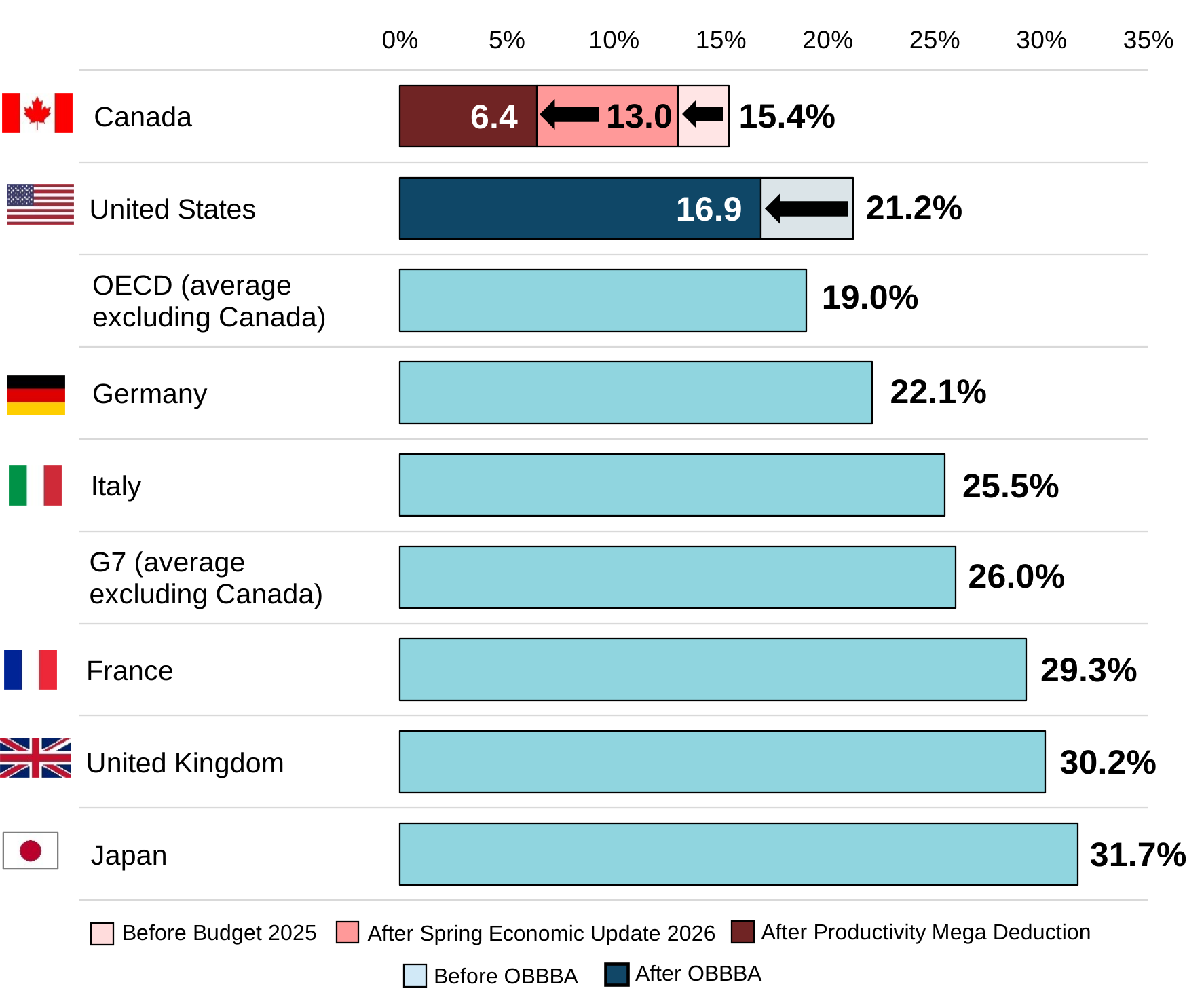
The tax burden on a new investment will fall from 13% to 6.4%: less than half the U.S. rate, about one third of the OECD average, and about one quarter of the G7 average. Put simply, a company will pay approximately 60% less tax on the return from a new investment made in Canada than on the same investment made in the United States.
Estimated long-term economic impact
$22 billion
annual boost to economic activity
80,000
estimated long-term jobs created within 10 years
Canada has the lowest tax burden on new business investment in the G7
Estimated marginal effective tax rate (METR) on new investment under the Productivity Mega Deduction.
Marginal effective tax rates (METRs) on new business investment, 2026 estimates
"Canada, since […] March 2025, has outperformed everyone in America, the Eurozone, and anywhere else in the world. This is one of the greatest moments for overseas investment in Canada that we've seen in a century."
Matt Winkler,
Editor-in-Chief Emeritus, Bloomberg News
Helping businesses of all sizes invest and grow
Small- and medium-sized businesses are the backbone of Canada's economy, making up over 98% of Canadian businesses and creating jobs in communities across the country. To help businesses invest, grow, and succeed in Canada, Budget 2026 introduces the following measures:
- Canada Growth Incentive to help high-potential businesses attract investment and grow in Canada, consisting of two measures: introducing a new tax exemption on up to $15 million in capital gains earned from successful eligible investments for Canadian builders and enhancing the small business rollover to allow increased deferral of taxes on capital gains when proceeds are reinvested in another Canadian small business. By allowing builders to keep more of the benefits when a business succeeds, these measures will help level the playing field with the United States, encourage more capital to flow to Canadian businesses, and enable successful entrepreneurs to reinvest their proceeds into Canada.
- SR&ED Program commercialisation expansion to help more Canadian businesses develop new products and technologies and bring them to market. This $930 million investment will help turn more Canadian ideas into growing companies, new high-paying careers, and made-in-Canada innovation.
- NRC IRAP Clean Technology Renewal to help Canadian clean technology SMEs develop, demonstrate, and bring new technologies to market.
- Federal Intellectual Property Review to help Canadian innovators protect, commercialise, and retain more intellectual property here in Canada, including stronger research commercialisation and safeguards against abusive patent practices.
In addition, we are launching the most ambitious effort in decades to simplify the tax system. A substantial first package of reforms is included in Budget 2026. This initiative would reduce compliance costs and administrative burden for businesses and individuals by:
- simplifying tax rules
- streamlining reporting requirements
- modernising tax administration
This will help Canadians and businesses spend less time on tax paperwork and more time investing, hiring, innovating, and growing.
Together, these measures will help Canadian companies scale, compete, and reinvest success into the next generation of Canadian businesses.
Driving investment, productivity, and affordability through competition
Helping businesses of all sizes invest and grow means creating the conditions for them to compete and succeed. Stronger competition gives businesses more opportunities to enter markets and expand, while encouraging investment, innovation, and productivity growth across the economy. More competition also means more choice, better services, and lower prices for Canadians and businesses.
To advance these goals, the government is taking a new, systematic approach through the Whole-of-Government Competition Plan. Key actions include:
- Advancing competition in key sectors, including through the Telecommunications Competition Roadmap and financial sector reforms.
- Strengthening competition enforcement.
- Making it easier for consumers to switch providers, including by expanding data portability rights.
- Working with provinces and territories to tackle anti-competitive property controls in the retail grocery sector and restrictions on worker mobility.
- Applying a competition lens across federal regulations, policies, and business supports.
Together, these actions will give new businesses more room to enter and grow, incent other businesses to invest and innovate, and drive productivity and growth while helping deliver lower prices, better services, and more choice for Canadians.
Government as a driver of competition
Competition by default: Embed competition in government decisions and strengthen the institutions that enforce it
Removing barriers to growth
Make it easier for firms to enter, compete, and grow by cutting red tape, opening key sectors to new competitors and investment, and supporting labour mobility
Budget 2026 actions include:
- Support entry and growth of challenger banks and credit unions
- Engage provinces and territories on a nationwide ban on non-compete clauses
Empowering consumers
Help Canadians get the best value by making prices clearer, switching easier, and consumer protections stronger
Budget 2026 actions include:
- Engage provinces and territories on retail grocery property controls
- Increase deposit insurance coverage
- Help Canadians understand the bank fees they pay each year
- Assist Canadians in getting an affordable mortgage
Supporting innovation
Give new ideas room to grow by modernising market rules and opening access to data, spectrum, and infrastructure
Budget 2026 actions include:
- Launch the next phase of Canada's payments modernisation
- Expand data portability beyond banking
Powering Canada Strong
The world is changing rapidly. The United States is upending global trade, wars are ongoing in Europe and the Middle East, AI is scaling at speed, and climate change is intensifying. In this changing world, electricity is fundamental to Canada's energy security, affordability, and competitiveness.
The economy of the 21st century will increasingly run on electricity, so countries that can provide abundant, reliable, and affordable power will be best positioned to attract investment, drive innovation, improve productivity, and sustain economic growth. Canada starts from a position of strength, with a nearly 80% clean grid and some of the lowest electricity costs in the G7. As our economy and our industries become more energy-intensive, the demand in Canada is expected to double by 2050. This shift is already underway in transportation, with Budget 2026 expanding charging infrastructure to support the accelerating shift toward electric vehicles. This is a unique opportunity to build a more sustainable, affordable, and prosperous future—and to become masters of our destiny.
At the centre of this effort is Canada's new National Electricity Strategy, which through greater affordable, reliable, and clean electricity will:
- Build a cleaner economy by working with provinces, territories, utilities, and Indigenous partners to double Canada's electricity system by 2050 and provide the clean, reliable power needed to support economic growth and electrification.
- Make energy more affordable by investing in the electricity infrastructure needed to expand supply and meet growing demand.
- Connect Canada through electricity by building and expanding transmission lines that link regional grids east to west, making us our own best customer for power.
- Create good careers and build the workforce Canada needs by training, attracting, and hiring the skilled workers who will build and maintain the grid of the future.
- Build Canadian by using Canadian materials, suppliers, and technologies wherever possible to strengthen domestic supply chains. For example, the Strategic Response Fund has helped support domestic manufacturing of electricity grid components and battery materials production.
Budget 2026 is investing over $50 billion to power Canada Strong.
Central to Canada's mission of becoming a global energy superpower is supplying and controlling our own energy. As our economy and industries become more energy intensive, electricity demand is expected to double by 2050. Building more energy projects will not only help us meet this demand—it will also boost our energy sovereignty, give Canadian industries a competitive advantage, and attract investment that supports long-term economic growth.
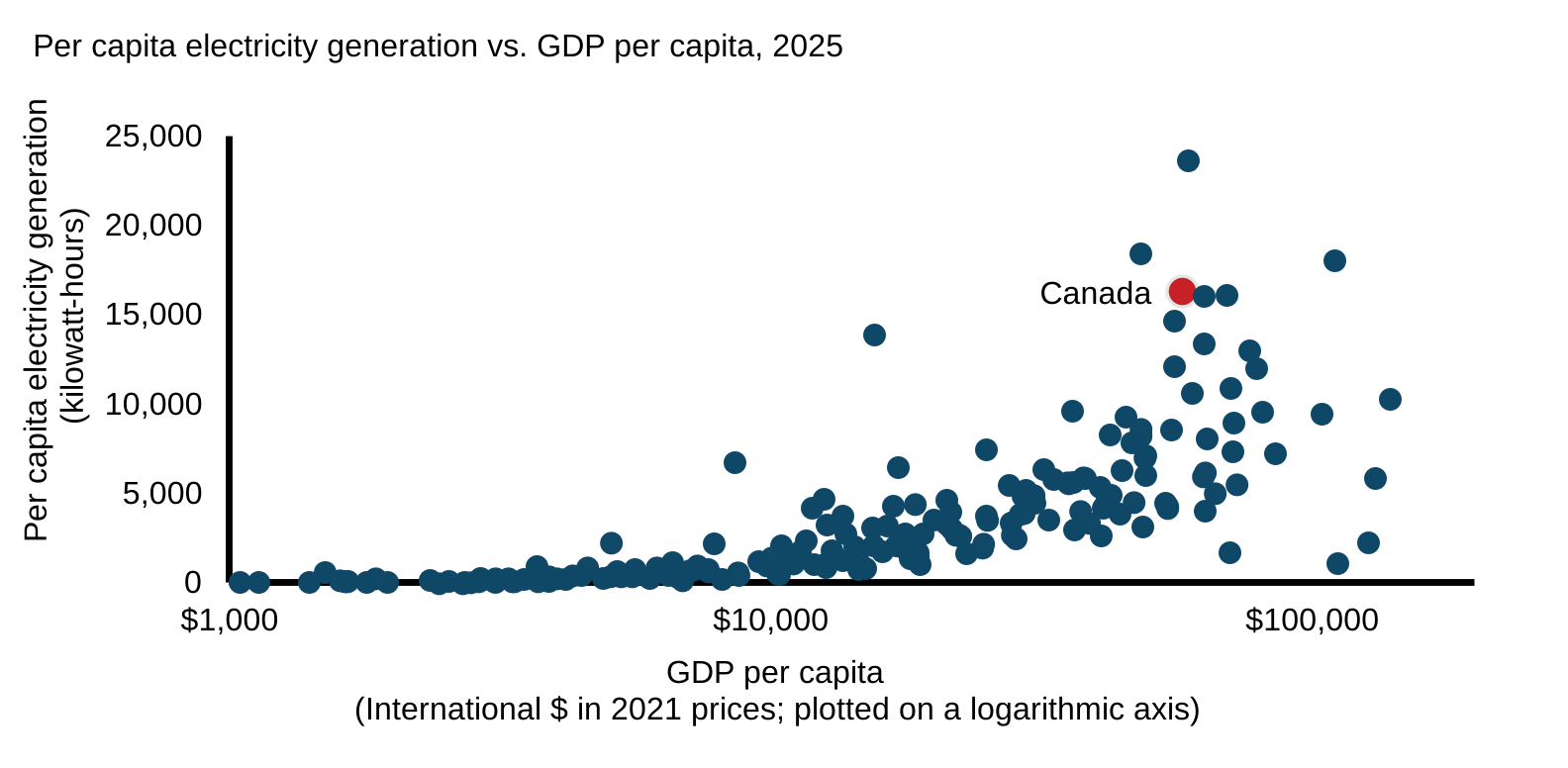
Canada leads the G7 in electricity generation relative to GDP in 2025
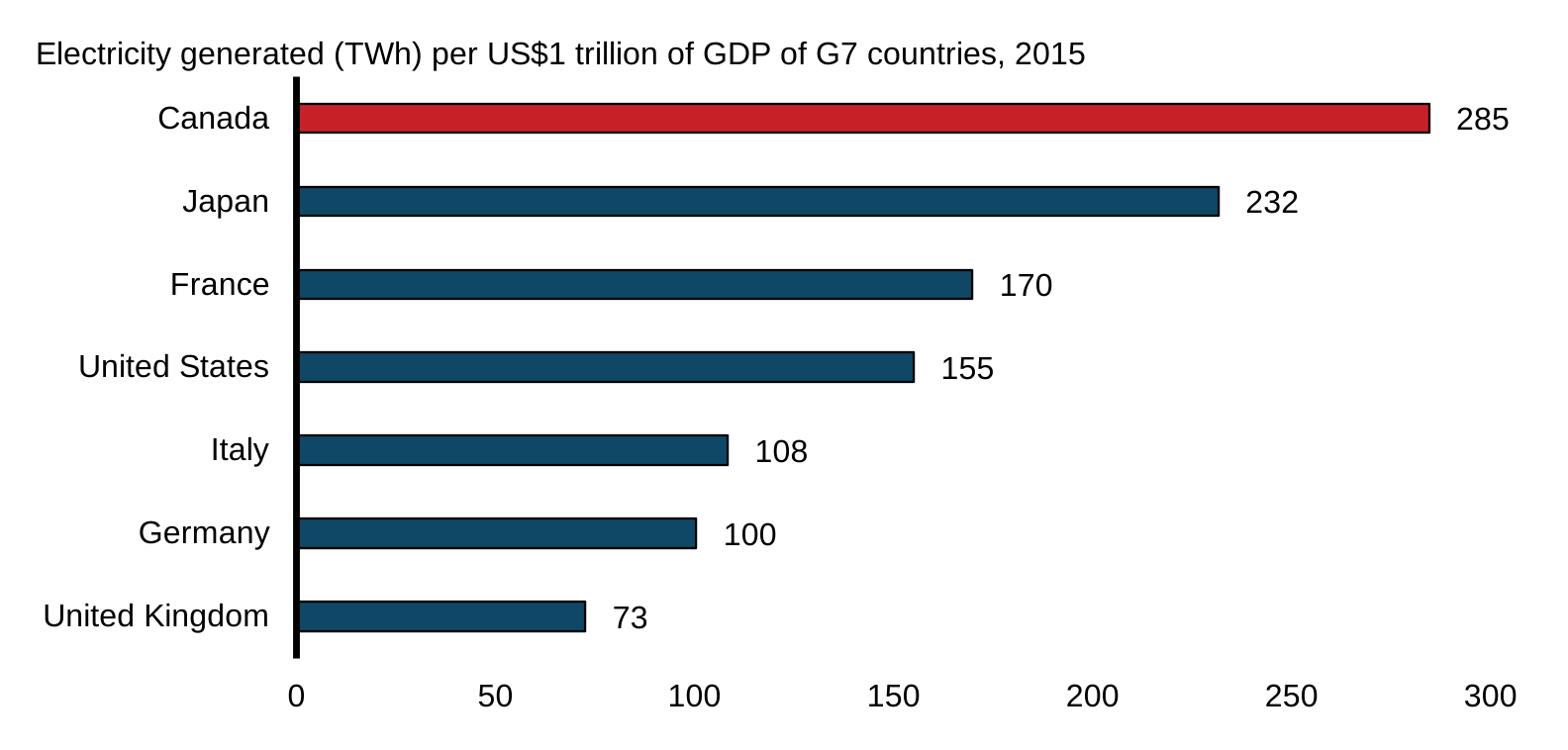
Abundant electricity is a defining feature of a prosperous economy
Moving major projects forward faster
New investment opportunities
Contrecoeur Container Terminal Project, QC
North Coast Transmission Line, BC
Red Chris Mine Expansion, BC
Iqaluit Nukkiksautiit Hydro Project, NU
LNG Canada Phase 2, BC
Darlington New Nuclear Project, ON
Canada has a once-in-a-generation opportunity to become a global energy superpower, transform our economy, diversify our trade, and strengthen our strategic autonomy. The best way to seize that opportunity is to build together, as one country, with the confidence and ambition that have defined Canada at its best.
Canada has built big before—from the Canadian Pacific Railway and the St. Lawrence Seaway to the Trans-Canada Highway and the oil sands. These projects connected our country, transformed our economy, and showed that Canada is stronger and more prosperous when we act with shared purpose. Once again, Canadian ambition is catching up to our potential. We are removing barriers, strengthening our domestic market, and creating the conditions to build, with Indigenous partners, nation-shaping projects across provincial and territorial boundaries.
The Major Projects Office (MPO) is turning that ambition into action. By bringing governments, Indigenous partners, proponents, and regulators together early, it is helping major projects move forward with greater speed, certainty, and coordination, while upholding Canada's high health, safety, and environmental standards. Twenty-eight nation-building initiatives have already been referred to the MPO, including ports, mines, energy projects, and trade corridors in every region of the country. Together, they can contribute to unlocking nearly $500 billion in new investment opportunities, creating lasting prosperity, and building a more resilient Canada.
One project. One decision. One year.
High standards do not require slow decisions. Faster, more predictable reviews will give investors certainty and get Canada building.
Canada is accelerating the projects that will power growth

18
projects

about
$200B
in new investment

200,000
jobs

10
transformative strategies

Catalyzing over
$500B
in future private sector investment

British Columbia
- Roberts Bank Terminal 2
- Port of Vancouver Gateway Strategy
- North Coast Transmission Line
- LNG Canada Phase 2
- Ksi Lisims LNG
- Red Chris Mine Expansion
Yukon
- Northwest Critical Conservation Corridor
Northwest Territories
- Mackenzie Valley Highway
- Arctic Economic and Security Corridor
- Taltson Hydro Expansion
Alberta
- Alberta High-Speed Rail
- Pacific Link Pipeline
- Pathways Plus
Nunavut
- Grays Bay Road and Port
- Iqaluit Nukkiksautiit Hydro Project
Saskatchewan
- McIlvenna Bay Project
Manitoba
- Port of Churchill Plus
Ontario
- Deep Geological Repository
- Canada Nickel's Crawford Project
- Darlington New Nuclear Project
Québec
- Contrecoeur Container Terminal Project
- Alto High-Speed Rail, Ontario-Québec Corridor
- Nouveau Monde Graphite's Matawinie Mine
Newfoundland and Labrador
- Labrador Trough Clean Power, Critical Minerals and Infrastructure Corridor
New Brunswick
- Northcliff Resources' Sisson Mine
Atlantic Canada
- Atlantic Energy Strategy
National
- Transmission InterConnect Investment Strategy
- Critical Minerals Strategy
The Canada Strong Fund: creating wealth for future generations
As we build big, we are ensuring Canadians can share in our collective prosperity and invest in Canada's future. The Canada Strong Fund, Canada's first national sovereign-wealth fund, will invest $25 billion in nation-building projects and high-growth Canadian companies—turning Canadian ambition into long-term prosperity and ensuring Canadians share in the value we create together.
The Fund will invest exclusively in Canada, alongside and on the same commercial terms as private partners. It will take minority ownership positions and operate independently from government. This approach will attract more private investment while ensuring that Canadians benefit when public support helps a project or company succeed.
Canadians will also be able to invest directly in the Fund through Canada Strong Notes. Available through participating financial institutions, the Notes will enable Canadians to easily purchase, hold, and redeem their investment while participating in the Fund's long-term success. In addition to the benefits generated through the Fund's public ownership structure, Canada Strong Notes will provide investors with protection of their initial investment while offering a coupon payment and the chance to share in returns.
Giving Canadians a stake in what we build

4. Helping Canadians get ahead
Canadians are working hard, but high living costs leave too many with too little to make ends meet after groceries, housing, and everyday bills. We are taking targeted action to give them a boost today and a bridge to tomorrow.
The boost includes the 2027 Canada Groceries and Essentials Benefit Supplement: a one-time payment in early 2027 to over 12 million low- and modest-income Canadians, equivalent to a 50% increase in their 2026-27 benefit.
Addressing the cost of housing, food, and energy
Housing
Lower asking rents
$2,000
in annual savings on rent
Average asking rents have dropped significantly since 2024, with some of the largest declines in Toronto and Vancouver.
Supporting housing affordability
By tackling homelessness, expanding affordable housing, and removing structural barriers to building more homes, faster and at lower costs.
By supporting first-time home buyers by saving them up to $50,000 through the removal or reduction of the Goods and Services Tax on new homes.
Food
Support for families
$2,570
to help with food, grocery costs
Over 12 million Canadians are receiving hundreds of dollars through the Canada Groceries and Essentials Benefit.
Lowering everyday costs
By investing $3.2 billion through the National Food Security Strategy, supporting greater competition across food production, processing, and supply chains to help deliver more affordable prices.
By capping non-sufficient funds fees at $10 and adding up to 50% more debit transactions to low- and no-cost bank accounts costing no more than $4 per month.
Energy
Energy savings
$1,400
in annual savings on energy bills
To support 1 million home retrofits to lower energy costs for Canadians and reduce emissions.
Reducing fuel costs
By removing the consumer carbon price, reduced gasoline prices by about 18 cents per litre across most provinces and territories compared to 2024-25.
By temporarily suspending the federal fuel excise tax, reducing Canadians' bills at the pump by up to 10 cents per litre on gasoline and up to 4 cents on diesel.
Note: Annual savings on rent, based on the decline in average asking rents from their peak in May 2024. Support for families based on illustrative annual support for a family of four through the Canada Groceries and Essentials Benefit.
Making benefits easier to access
Through expanded outreach to vulnerable Canadians, Budget 2026 announces the next step in Automatic Federal Benefits, to help an estimated 150,000 additional individuals receive the benefits they are entitled to.
A more affordable life for Canadians
Key national affordability benefits
Canada Child Benefit1
6M
(Number of beneficiaries)
$15,040
(Maximum benefit)
Number of beneficiaries
Maximum benefit
National School Food Program1
400K
$800
Canada Disability Benefit2
515K
$2,450
Canada Groceries and Essentials Benefit including the 2027 Supplement1
>12M
$2,570
Nutrition North Canada Retail Subsidy3
>100K
$12,000
Affordable early learning and child care
900K
50% fee reduction
or more
Build Canada Workers Benefit (2027)1
3.1M
$3,143
Canadian Dental Care Plan1
5M
$2,653
Old Age Security Program4
7.7M
$23,341
Canada Student Loans and Grants5
780K
$14,400
Temporary suspension of federal fuel excise tax6
>25M
$5.75 on
a 50L tank
of gasoline
1 Illustrative dollar amounts are for a family of four, with children up to age 12. Benefits are maximum amounts available other than for the Canadian Dental Care Plan (CDCP) and the National School Food Program (NSFP). CDCP is based on a typical dental service mix for a household with an adjusted family net income below $70K. NSFP is based on average savings for a family with two children.
2 Maximum amount for one adult aged 18 to 64 holding a valid Disability Tax Credit certificate.
3 This is an approximation of the average annual retail subsidy for a family of four. This amount will vary by region and by the size and content of the food basket.
4 Combined maximum for the Old Age Security pension and the Guaranteed Income Supplement for a single senior aged 75 and older (amounts for the 2026 calendar year).
5 This reflects the current maximum student aid per academic year for a full-time student in financial need. Students with dependants or a disability are eligible for additional assistance. Number of beneficiaries corresponds only to participating provinces and territories. Québec, Northwest Territories, and Nunavut receive alternative payments from the federal government to provide comparable supports in their jurisdictions.
6 Assumes full pass-through of excise tax relief to consumers from April 20, 2026, to January 31, 2027 (inclusive). Calculation includes HST at 15% applied to fuel excise tax savings. Starting February 1, 2027, the rate will be at 50% relief until March 31, 2027 (inclusive).
Making life more affordable for Canadians
Budget 2026 builds on major existing federal benefits and supports.
Key national affordability benefits
2026-27 baseline funding
1 Represents Canada Groceries and Essentials Benefit including top-up and temporary increase announced in January 2026. Does not include 2027 Canada Groceries and Essentials Benefit Supplement.
2 Represents estimated annual cash disbursements.
3 Does not include excess advance payments.
4 Total support for dental benefits, 2026-27.
$2 billion investment, retrofitting 1 million homes to save Canadians $1 billion per year
Heating is one of the biggest bills Canadians have to pay in the winter months. Over seven million households in Canada still heat their homes with oil, propane, diesel, electric baseboards, or outdated furnaces. These fuel sources are much more polluting, much less efficient, and can leave households paying more than necessary to keep their homes comfortable.
We are laser-focused on giving you options to lower your costs. When it comes to home heating, the best option for many Canadians is a heat pump. Heat pumps are more efficient, safer, and cleaner than oil and electric furnaces. In the summer, the same heat pump runs in reverse to cool your home. Families get a furnace and an air conditioner in one, for a fraction of the energy and far less pollution.
Through the National Electricity Strategy, we are helping build the clean, reliable, and affordable electricity system Canada needs. Building on this, the National Heat Pump Rebate, announced on October 8, will help up to 820,000 households install a heat pump. This $2 billion investment will help save Canadian families more than $1 billion every year on their energy bills and reduce Canada's emissions by over 25 megatonnes, once fully implemented alongside additional measures that will support energy retrofits in a further 280,000 rental and multi-unit residential buildings. This is how Canada's electricity advantage can help Canadian families keep their homes warm, with clean, reliable, and affordable power.

Building the homes Canadians need
A safe and affordable home is the foundation for a good life. It gives people the stability to build a career, raise a family, and participate fully in their community. Canada needs a housing system that works across the full housing continuum, from shelter and supportive housing, to community and affordable housing, to market rental housing and homeownership. This means helping people experiencing homelessness move into stable housing, expanding the supply of non-market housing for those who need it, and building a housing market that works for all Canadians.
Federal action is on track to deliver results. Rental construction is being supported through the Apartment Construction Loan Program, mortgage insurance, and the GST rebate for purpose-built rental housing. Municipalities are streamlining approvals and planning for growth through the Housing Accelerator Fund, while Build Communities Strong Fund agreements are helping reduce development charges and barriers to new construction. Build Canada Homes is also creating a new federal capacity to build affordable housing at scale.
Putting Canada on a path to end homelessness means helping people find permanent housing and ensuring they can access the services they need to stay housed, including medical care, counselling, and mental health and substance use treatment.
Budget 2026 proposes to provide nearly $45 billion on a cash basis as a next step in a housing strategy that acts across the housing continuum, anchored by three pillars:
Pillar 1
Putting Canada on a path to end homelessness within 10 years.
Pillar 2
Expanding the construction of affordable and non-market housing.
Pillar 3
Building a housing market that works for all.
This strategy is founded on a renewed partnership. The federal government will put capital, land, financing, and development capacity on the table through Build Canada Homes, while provinces and territories will be expected to support services and operations, work with municipalities to remove barriers to housing, and help deliver results for Canadians.
Supporting Canadians across the housing continuum
Help people find and keep stable housing
- Homelessness supports and services
- Supportive and transitional housing
- Housing benefits for low-income renters
- Connect housing with health and social supports
Build and preserve more affordable homes
- Build Canada Homes
- Community and affordable housing
- Develop federal land for housing
- Partnerships with provinces and territories
Make it easier to build and buy homes
- Existing government programming (Apartment Construction Loan Program), mortgage loan insurance, GST rebate on purpose-built rental
- Lower development and construction costs
- Housing enabling infrastructure
- Support first-time homebuyers
- Modernising housing data
- Reduce barriers to homebuilding, including fees, taxes, zoning and permitting
- Streamline approvals through harmonised building codes, e-permitting and AI
- Support modern construction methods
- Support Indigenous housing
5. Canada strong and united
Culture is foundational to a strong, proud, and sovereign Canada. In an increasingly fragmented world, investing in what connects Canadians allows us to share our stories, share our spaces, and share our experiences. Our two official languages of French and English, our Indigenous heritage, our vibrant hockey culture, and our parks, lakes, and cold winters are integral parts of being Canadian. When we are connected to one another, physically and culturally, we are masters of our destiny.
As Canada approaches its 160th anniversary, we are investing in the cultural institutions and the transportation networks that connect Canadians to one another. We are linking rural and remote communities, ensuring neighbours have places to gather, and supporting our talented artists, authors, and entrepreneurs as they showcase Canada to the world.
Canadian culture and stories
The Canada Strong Pass has already made it easier and more affordable for Canadians to explore the country and enjoy its cultural, historical, and natural treasures. First introduced in summer 2025, the Pass offered free admission to Parks Canada sites and participating museums and galleries, as well as savings on VIA Rail travel.
Canadians immediately took advantage; visits to Parks Canada sites increased by 13%, national museum attendance grew by an average of 15%, and VIA Rail ridership rose by 6.5%. The Pass supports families, communities, and the institutions that preserve Canada's natural and cultural heritage.
Building on that success, we are renewing the Canada Strong Pass for summer 2027 and making it permanently free for young Canadians under 25 to visit our national museums year-round.
At the same time, we are strengthening Canadian film, media, and journalism; CBC/Radio-Canada; and our national cultural institutions. Canada will also host the 2028 Francophonie Summit, an important opportunity to champion the French language and deepen the cultural and economic ties that connect us to the wider Francophone world.
Protecting and celebrating what makes us Canadian
Budget 2026 proposes to invest $4 billion to protect and celebrate what makes us Canadian. Budget 2026 also announces the government's intention to establish a new Canada Creative Credit to support artists as they foster creativity, artistic production, and cultural entrepreneurship in Canada.
Protecting Canada's natural beauty
Canada's identity is also rooted in our forests, parks, coastlines, and waterways. From helping rebuild Jasper National Park after a devastating wildfire to maintaining national parks and historic sites across the country, we are protecting the places Canadians cherish and ensuring they remain accessible and in good condition for all to enjoy.
Protecting Canada's natural heritage
Canada is protecting and restoring the natural places Canadians value. Through the Nature Strategy, we are working with Indigenous Peoples, provinces, territories, and conservation partners to conserve 30% of Canada's lands and waters by 2030, recover species at risk, and restore wild Pacific salmon in British Columbia and the Yukon. We are also investing in parks, trails, visitor facilities, and historic sites across the country so Canadians can continue to visit, explore, and enjoy them.
Safeguarding our oceans
Canada is an ocean nation, and our oceans require focused action. As home to the longest coastline in the world, Canada depends on healthy oceans to support coastal communities, Indigenous cultures, trade, food security, and local economies. As shipping and economic activity increase, we will strengthen ocean science and ecosystem protection, improve Canada's ability to prevent, detect, and respond to marine incidents, and strengthen marine conservation.
Reconciliation through partnership and ownership
Building Canada Strong means building together, in full partnership with Indigenous Peoples. We are advancing reconciliation by supporting self-determination; investing in clean water, housing, infrastructure, and core Indigenous services; and expanding opportunities for Indigenous-led economic growth.
Clean drinking water, safe housing, and dependable infrastructure are essential to a good quality of life. Between April 2025 and September 30, 2026, 11 long-term drinking water advisories have been lifted, and 44 short-term advisories have been lifted before becoming long-term. More than 1,000 housing and infrastructure projects in First Nations communities on reserve have also been completed since spring 2025, including roads, bridges, schools, health facilities, and energy systems.
Long-term, predictable funding for housing and infrastructure is essential to improving services, creating economic opportunities, and advancing Indigenous self-determination in Indigenous communities. Budget 2026 is making a historic investment of $32 billion over 10 years to provide long-term funding certainty, accelerate shovel-ready housing projects, and transform how Canada invests in First Nations housing and infrastructure, helping communities build faster, better, and stronger.
First Nations housing and infrastructure investments
More than $32B over 10 years
First Nations infrastructure
$18.7B
Over 10 years
First Nations On-Reserve Infrastructure Program
$18.5B over 10 years
Atlantic First Nations Water Authority
$227.7M over 10 years
First Nations housing
$12.7B
Over 10 years
Stabilise core housing funding
$11B over 10 years
Accelerate shovel-ready projects
$1.7B over 5 years
Transformation initiatives
$657.5M
Over 10 years
Yänonhchia’ Revolving Housing Finance Fund
$150M over 5 years
Surely Bonding Pilot
$7.5M over 5 years
Monetisation Pilot
$500M over 10 years
Budget 2026 also strengthens services for Indigenous children, families, and youth by renewing and stabilising funding for flagship initiatives that support Indigenous communities, including:
- the First Nations Elementary and Secondary Education Program on reserve
- the Non-Insured Health Benefits Program
- the Emergency Management Assistance Program
- the First Nations and Inuit Policing Program
- funding for Jordan's Principle and Pirutsiagutiit (Inuit Child First Initiative)
Through Indigenous loan guarantees and new opportunities for equity ownership, including Canada's offer to sell a 15% stake in Trans Mountain Corporation to 128 Indigenous groups in Alberta and British Columbia, more Indigenous communities are becoming partners and owners in the projects shaping Canada's future. This work was continued at the landmark First Nations-First Ministers Meeting in October 2026, with positive, forward-looking discussions on new ways for Indigenous communities to be partners in building Canada Strong. That means lasting revenues for communities, new opportunities for local workers and businesses, and greater economic self-determination for generations to come.
The $10 billion Indigenous Loan Guarantee Program supports making that possible by giving Indigenous communities access to more affordable financing to invest in major projects. With three loan guarantees already issued, Budget 2026 announces the Tla'amin Nation Tree Farm project in British Columbia:
- Tla'amin Nation Tree Farm: Supporting Tla'amin Nation in acquiring 100% ownership of Western Forest Products' Stillwater Forest Operation, a major forestry asset within its traditional territory, providing stable revenues and creating local economic opportunities.
The fifth loan guarantee, for an oil and gas project, is currently under negotiation, giving multiple communities a direct stake in major energy infrastructure and the opportunity to build long-term revenue and wealth.
Endbridge Westcoast Pipeline
38
First Nations
$400M
loan guarantee
Hydro One Chatham-to-Lakeshore Transmission Line
2
First Nations
$16.8M
loan guarantee
Darlington New Nuclear Project
7
Williams Treaties First Nations
$715M
federal-provincial loan guarantee
Tla'amins Nation Tree Farm
Tla'amins Nations
$64M
loan guarantee
$1.2B in loan guarantees supporting Indigenous ownership.
Protecting Canadians and our strategic autonomy
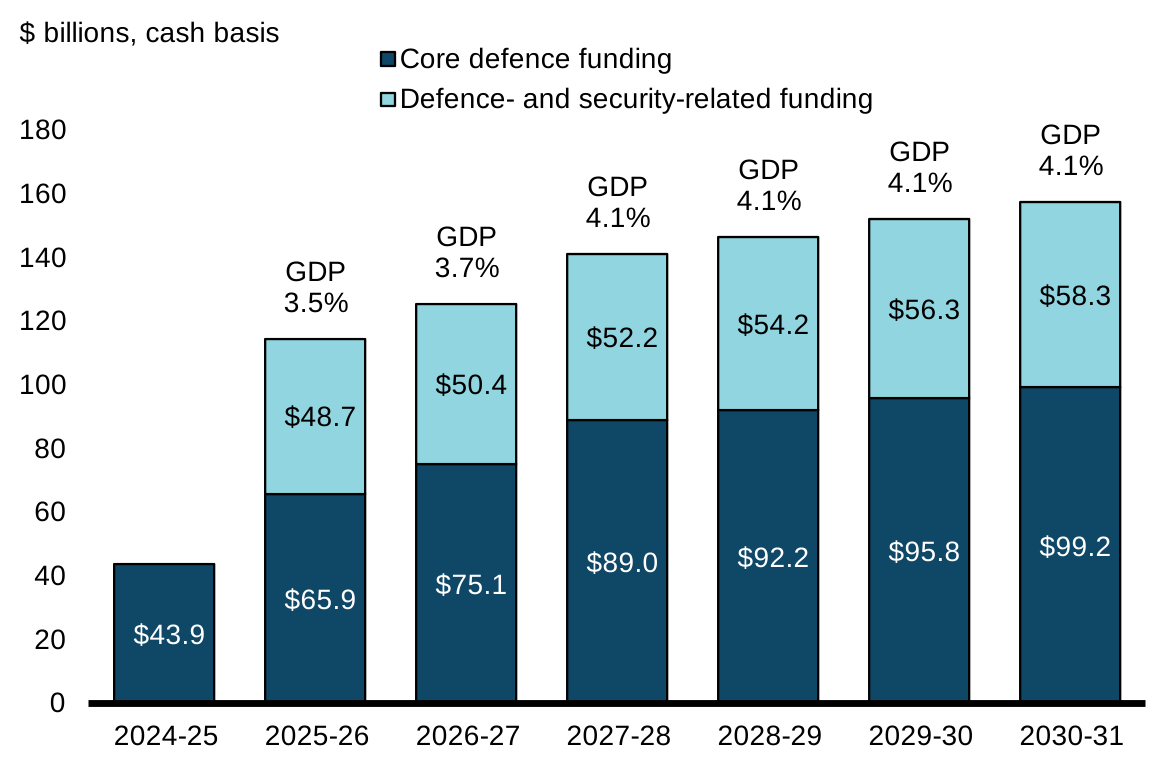
In a more dangerous world, Canada is strengthening its ability to defend its people, territory, and sovereignty. Canada has already reached NATO's target of spending 2% of GDP on defence, with a funded plan to meet its commitment of spending 4% by 2030. This commitment puts Canada on a clear path toward the new NATO Defence Investment Pledge of spending 5% of GDP on defence and security by 2035. These investments will strengthen Canada's military and Coast Guard while creating skilled jobs, supporting Canadian suppliers, and building more of what we need here at home.
We are working with allies to establish the Defence, Security and Resilience Bank (DSRB), a new international financial institution that will unlock financing to expand defence industrial capacity, support procurement, and turn defence spending into the equipment and capabilities Canada and allies need. Canada and international partners will gather in Luxembourg on November 30, 2026, to sign the Articles of Agreement establishing the DSRB, a key milestone toward the operationalisation of the DSRB in 2027. The Bank will be headquartered in Canada with a European Hub in Luxembourg, reflecting the collaborative, international partnership at the heart of this initiative.
Budget 2026 is also honouring our women and men who served by acquiring and maintaining the National Field of Honour in Pointe-Claire, Québec, the final resting place for more than 20,000 veterans and family members.
Advancing toward the NATO Defence Investment Pledge
Building a stronger, more secure Canada
Strengthening Canada’s marine security and navigation from coast to coast to coast by building program icebreakers in Lévis, Québec.

Advancing discussions to acquire six airborne early warning aircrafts, supporting aerospace jobs in Ontario, Québec, and across Canada.

Expanding the Defence Drone Initiative to accelerate the acquisition and deployment of uncrewed and counter-uncrewed capabilities.

Growing Canada’s defence industry across the country through the Defence Industrial Strategy.

Moving forward with up to 12 new submarines to protect Canada’s three coasts and operate in the Arctic.

Building safer communities
Security also means protecting Canadians from threats in their communities and online, which we are doing through a range of measures:
- Establishing a new Financial Crimes Agency to investigate serious financial crime, with operations beginning in fall 2027.
- Protecting Canadians by addressing some of the most common forms of cash-based money laundering, preventing the criminal abuse of money services businesses, and cracking down on cryptocurrency ATMs, through Bill S-8, the Combatting Financial Crimes and Drug Trafficking Act.
- Bringing banks, telecommunications companies, digital platforms, and government together to better prevent, detect, and disrupt fraud through the National Anti-Fraud Strategy.
- Strengthening oversight and enforcement against digital harms and privacy violations by committing to establish a new arm's-length Digital Safety and Data Protection Commission of Canada responsible for two new acts:
- Bill C-34, the Safe Social Media Act, would make online services safer by requiring social media and AI chatbot services to better protect users, especially children; adopt age-appropriate safeguards; and be more transparent about how they operate.
- Bill C-36, the Protecting Privacy and Consumer Data Act, would strengthen privacy protections, particularly for children, and transparency around the use of personal information in automated systems.
- Renewing bilateral agreements with provinces and territories to end gender-based violence to enhance prevention efforts and support survivors.
- Enabling communities to identify and address risks of radicalisation early with enhanced funding for the Canada Centre for Community Engagement and Prevention of Violence.
- Advancing Canada's Black Justice Strategy to reduce over-representation and repeat offending, with culturally responsive prevention, victim support, court navigation, and rehabilitation services.
This is the Canada we are building: secure in its sovereignty, confident in its identity, and united in its future.
A stronger Canada. Built by Canadians, for Canadians.
Page details
- Date modified: